University of Alaska

UAF projects grim fiscal landscape in 2017

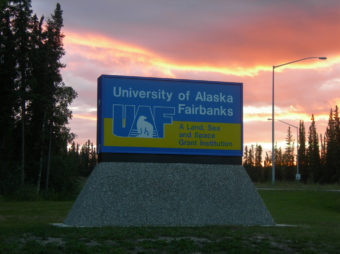
UAF is one of a few Land, Sea and Space Grant universities in the U.S. (Photo by Jimmy Emerson)
(Creative Commons photo by Jimmy Emerson)

University of Alaska Fairbanks administrators say rising costs and cuts in state dollars have produced a $42 million gap. Officials rolled out statistics Friday outlining expected funding shortfalls.

Interim UAF Chancellor Mike Powers and other administrators project a troubled fiscal landscape for the school in 2017.

Forty percent of the university’s budget is tied to state dollars, which are growing scarcer as lawmakers grapple with low oil prices and deficits.

Vice Chancellor Kari Burrell outlined the history of UAF funding and the situation on Monday.

“The pull backs we’ve had centrally was for $29 million over the last three years, but we’ve also asked units to absorb $13 million,” Burrell said. “So, the total gap that we have filled over the last three years has been $42 million.”

Burrell talked about vertical and horizontal cuts. Horizontal cuts distribute pain across most programs and has been the prevailing strategy for meeting deficits. Now, however, UA President Jim Johnsen has asked chancellors to look at vertical cuts, a strategy that could lead to programs with low student numbers to be eliminated or combined with another disciplines.

Chancellor Powers said most likely both strategies will be employed.

“Emphasize the vertical as opposed to the horizontal, but it will be a part of both,” he said. “Everybody will be touched in some way, there’s no question.”

Powers underscored the projections for the future were preliminary.

He says university officials will wait to see what Gov. Bill Walker proposes in his budget due out this month, then see what lawmakers come up with when they meet next year.

Fish economist Gunnar Knapp retiring as head of ISER

Gunnar-Knapp-at-360
UAA Institute for Social and Economic Research director Gunnar Knapp on Forum@360 in January 2015.

Alaska budget expert and fisheries economist Gunnar Knapp is retiring as director of the Institute of Social and Economic Research at the University of Alaska Anchorage.

In a letter posted online last week, Knapp said he’ll retire from the top position in June 2016, but he’ll continue to work part-time for the think tank, to continue his research and public outreach about the state’s budget deficit.

“I can’t imagine a more interesting and rewarding career than studying and teaching about Alaska’s resources, economy and society,” wrote Knapp.

Knapp has been with ISER for 35 years and led the Institute for the past three. He’s considered one of the keenest observers of Alaska’s commercial fishing industry.

Knapp calls his retirement a “long-planned decision” he made in order to spend more time with his family and enjoying the outdoors. He also plans to “finally finish” his book on the economics of fish.

Using language as a portal to the depths of cultural heritage

What do a person, a dog, a shaman effigy and a crucifix have in common?

To a traditional Dena’ina speaker, all four are in a linguistic classification that categorizes them as sharing a similar essence.

“In Dena’ina thought, what’s common is they are all animate, they are all alive, they all have a soul,” says anthropology professor Alan Boaraas.

The idea doesn’t quite translate to English. It’s a facet of culture embedded in language, as subconscious as the grammatical structure a baby learns as they absorb the dialogue around them,” Boraas says.

“What is it that’s embedded in the grammar of a language, Dena’ina in this case, that conveys a message, a point of view, a feeling, that is difficult put into English? And often is lost, as they say, in translation.”

The problem of “lost in translation” is much more significant than just ordering something you didn’t quite expect in a foreign restaurant.

“The relationship between language and how you organize the world is subconscious as you learn language, and would become what we sometimes call human nature, which is why one culture’s human nature is not another culture’s human nature, because the language is different. You can argue all you want what human language is, but it really has to do with how you understand the grammar of the language as a filter for the world.”

Dena'ina elder Peter Kalifornsky and anthropologist Dr. Alan Boaraas. (Photo courtesy of the University of Alaska Anchorage)
Dena’ina elder Peter Kalifornsky and anthropologist Dr. Alan Boaraas. (Courtesy of the University of Alaska Anchorage)

So for a Native Athabascan of the Cook Inlet region, Dena’ina isn’t just the language of their people, it is a portal to the full depths of their cultural heritage.

And that portal has almost been lost.

According to anthropologists, Dena’ina has been one of the world’s most endangered languages, with just a handful of speakers left by the 1970s. But Boraas and linguist James Kari started working with a few of the remaining fluent elders to preserve the language, making recordings of the speakers, translating stories and turning the oral tradition into a written language.

All that knowledge has coalesced into a curriculum for language classes, such as a beginning Dena’ina class taught this fall at the Kenai Peninsula College. Another class on grammar will be offered this spring.

Short plays on climate change to be read at Mendenhall Glacier

Six short plays on climate change will be read at the Mendenhall Glacier pavilion. (Photo by Lisa Phu/KTOO)
Six short plays on climate change will be read at the Mendenhall Glacier pavilion Dec. 3. (Photo by Lisa Phu/KTOO)

As world leaders discuss climate change in Paris this week, Juneau residents get a chance Thursday night to explore what climate change means on a local level.

In “A Pain in the Crevasse,” performers such as Juneau playwright Frank Katasse and assemblymember Maria Gladziszewski will read six short plays on climate change at the Mendenhall Glacier pavilion.

(Image courtesy Perseverance Theatre)

The free event is being organized by Perseverance Theatre and University of Alaska Southeast.

Perseverance Theatre’s Shona Osterhout said the plays will provide an interesting angle on a serious issue.

“These are all plays that have been written all over the world, but you can really take it in and have your own thoughts about it,” Osterhout said. “I think art is really great to talk about issues like these.”

The theater event is one of many taking place around the world through the initiative Climate Change Theatre Action. Short plays on climate change are being performed in cities throughout the U.S. and in more than 20 countries.

One of Thursday night’s plays is called, “An Average Guy Thinking Thoughts on Global Warming.”

“You get an average guy who doesn’t know a lot and he’s being honest and he’s showing himself to the audience for what he is and it’s hilarious and at the same time, it’s very poignant and you take something away after you read it,” said UAS student Bryan Crowder.

Following the six short play readings, the audience is invited to the Mendenhall Glacier Visitor Center for a panel discussion with glaciologists and local climate change experts. Panelists include UAS professors Eran Hood and Cathy Connor, UAS assistant professor Glenn Wright and Mendenhall Glacier Visitor Center Director John Neary.

“A Pain in the Crevasse” begins at 7 p.m. Thursday.

UA execs abruptly resign after meeting with new pres

Two top University of Alaska executives have resigned. The heads of statewide finance and human resources have stepped down following meetings with UA’s new president. The resignations come even as the school faces big funding hurdles.

Jim Johnsen, UA President candidate
Jim Johnsen at a meet and greet in July. (Photo by Jeremy Hsieh/KTOO)

Monday, University of Alaska President Jim Johnsen sent word to UA staff that he had accepted the resignations of Chief Finance Officer Ashok Roy and Chief Human Resources Officer Erik Seastedt.  Johnsen said both men consulted with him before resigning. Johnsen took over as the school’s president in September. UA Spokeswoman Robbie Graham said shake-ups are not uncommon in organizations with a new boss.

“When a new leader comes in, or a new CEO, or a new president, it’s inevitable there’s going to be change. Change is normal, it’s part of the process,” Graham said.

Johnsen takes up the reins at a time when the state is in deficit mode and the school has seen three years of budget cuts by lawmakers. He has vowed to run a more efficient operation, even as the Board of Regents agreed to a roughly $1 billion operating budget.

Robbie Graham denied the loss of the two top executives would hamper Johnsen’s ability to sell UA’s budget in Juneau.

“President Johnsen clearly understands the university’s needs, the budget considerations and all ideas for how to streamline these positions in both functional areas,” Graham said.

Ashok Roy joined the University in 2012, while Seastedt started in 2013. Both positions are currently being staffed by deputy officers until the positions are filled permanently.

UAF comes clean about disciplinary failures in sex abuse, rape cases

UAF is one of a few Land, Sea and Space Grant universities in the U.S. (Photo by Jimmy Emerson)
(Creative Commons photo by Jimmy Emerson)

The University of Alaska Fairbanks violated its own policy regarding sexual misconduct cases between 2011 and 2014. University students responsible for rape and other sex crimes were not expelled or suspended during that time.

It’s unclear how far back the improper punishment goes, but UAF said it is committed to turning that culture around.

The University of Alaska Fairbanks has found five instances of sexual misconduct when proper student disciplinary actions did not take place. Three of those cases involved rape.

Mae Marsh is Title IX coordinator at UAF. Her office handles sexual misconduct complaints. She said not properly punishing sexual assault offenders in the past sent the wrong message to students.

“Our silence was acceptance in some ways, but now we’re going back and we’re correcting that and that’s why we’re going public with it because we’re breaking the silence. You’re not alone anymore. This is it. We’ve got a new standard on how things are going to be on our campus,” Marsh said.

Marsh joined UAF in 2012. UAF hired two investigators to look into sexual assault complaints in 2014. Prior to that, complaints were investigated by Residence Life staff, since most complaints took place in the dormitories. Formal sanctioning was the responsibility of the dean of students.

“It’s not just that one person failed to do something. It was an entire system,” Marsh said.

UAF took other measures against the students found responsible of sexual misconduct between 2011 and 2014, like not allowing them in dorms or on campus. All five cases also went through the criminal process with Fairbanks police and the district attorney.

For the victims, Marsh said UAF provided counseling, medical assistance and academic help.

In 2011, the U.S. Department of Education put all colleges and universities on alert that sex discrimination, including sexual violence and sexual harassment, is prohibited by Title IX laws. The University of Alaska system is in the middle of an audit by Department of Education for possible Title IX violations.

It’s taken a few years, but Marsh said UAF has set up a structure to handle and track sexual assault complaints.

“We have updated our policies, we’ve appointed coordinators, we’ve trained our professionals. We are in the process of installing a centralized tracking system. We had a huge awareness campaign that came out. We’ve trained all our employees. We’re implementing the climate surveys,” Marsh said.

Marsh hopes these things have helped students feel more comfortable reporting sexual misconduct.

In 2012, UAF had four reports of sexual misconduct. Last school year, there were 44. Those numbers are still low compared to national averages which show one in five females experience sexual assault while in college.

Of those 44 reports last school year, four involved rape. One case has been investigated and the perpetrator is awaiting school sanctioning. The other three cases involve one alleged perpetrator and are still being investigated. The two men in these cases have been arrested.

Marsh says UAF is in the process of rectifying the old cases. She says UAF will be retroactively sanctioning the students found responsible for sexual misconduct with suspension or expulsions. They won’t be able to re-enroll at UAF.

At 7 p.m. Tuesday, UAF is showing a documentary on college sexual assault, “The Hunting Ground.” At 6 p.m. Wednesday the university is holding a town hall on how to move forward.
Site notifications
Update notification options
Subscribe to notifications