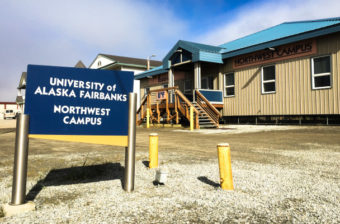
University of Alaska

Subcommittee looks for $35 million cut to University of Alaska

The House Finance University of Alaska Subcommittee recommends cutting $35 million from the university’s budget for the upcoming year.

Combined with Gov. Bill Walker’s proposed $15 million cut, the university would lose one in seven dollars in state funding.

The subcommittee also voted to support consolidating the university’s three campus administrations by the end of the year.

The Board of Regents has nominated Jim Johnsen for UA president. (Photo courtesy of University of Alaska)
University of Alaska President James Johnsen (Photo courtesy of University of Alaska)

University President James Johnsen has proposed cutting administrative costs and streamlining programs, but the subcommittee’s cuts go much further.

“I don’t have a problem reducing administrative costs and generating – getting those revenues over into our academic programs,” Johnsen said

But to combine the accreditations of all three campus this — formally merging them into one institution — in 10 months would be impossible, he said.

“That’s a big deal. That’s not going to happen in 2016,” he said. “But to reduce administrative costs across the system, we can definitely do that.”

The subcommittee voted for the cuts five-to-two Wednesday. Supporters of the cut noted that including federal and other funds, the university’s budget is $875 million.

Johnsen said he’s glad the cuts didn’t go even deeper. Subcommittee Chairwoman Tammie Wilson, a North Pole Republican, had initially wanted a $47 million cut but scaled it back after hearing from university leaders.

Johnsen said he’ll fight for more money before the Legislature completes the budget.

“I appreciate the move the committee made” to restore $12 million, he said, adding that subcommittee members said the recommendations are the beginning of the budget process.

“I’m still disappointed, however, in the outcome of this proceeding,” he said. “But knowing there’s a process to move forward with, we’ll continue to press it.”

The House Finance Committee will vote on the recommendations before the full House votes. The university regents ultimately decide how the budget will be spent.

University of Alaska regents hear pushback on restructuring plan

Last week, the University of Alaska Board of Regents released a plan to reorganize the UA system into three focused campuses and heard reaction from the public.

In light of state budget cuts, the draft Strategic Pathways plan released Tuesday is meant to cut costs by focusing each of the three main UA campuses into certain disciplines.

The proposal defines the University of Alaska Anchorage as the “metropolitan university,” responsible for health, policy and social sciences. The University of Alaska Fairbanks would be the “research university” for science, engineering and rural development. The University of Alaska Southeast is labeled the “liberal arts and sciences” university, focused on fisheries, mining, and interdisciplinary environmental studies. The plan also retains a few core programs, namely education and management, across all campuses.

While the draft plan offers few details about which non-core degree programs would be eliminated, more than a dozen people expressed concerns in Fairbanks on Thursday that their area of interest could be impacted.

“I believe the presence of a robust music theater and fine arts curriculum at the University of Alaska Fairbanks has been a foundation upon which the arts community in Fairbanks has been built,” Jack Wilbur of Fairbanks told the Board. “And I’m concerned that the Strategic Pathways concept as presented might undermine that foundation.”

Others were concerned that narrowing UAF to an engineering school would harm other research areas.

“UAF is not an ivory tower,” said Douglas Cost, a doctoral student with the International Arctic Research Center. “It is a location of real-world problem solving by faculty, adjuncts and graduate students in their research and teaching. In order to help Alaskans deliberate, debate and shape the next 25 years, the importance of interdisciplinary collaboration and outreach must be supported.”

The Strategic Pathways draft doesn’t give estimates of cost savings. But it does contain some specific and ambitious goals for student achievement, including increasing the proportion of Alaskans hired into Alaska teaching positions from 30 percent to 90 percent. The plan also seeks to increase the percentage of graduates in STEM fields from about 4 percent to 6 percent, as well as boost the number of graduates in health occupations.

The plan imagines three phases of restructuring, beginning this spring and finishing around 2019.

In a letter sent to UA faculty and staff Tuesday, President Jim Johnsen said the Board of Regents wouldn’t make any final decisions in their meetings for the week.

Fairbanks senator wants to legalize concealed guns on campus

guns on campus
(Creative Commons photo by Nathan Cowlishaw)

A Fairbanks state senator wants to remove restrictions for carrying concealed firearms on college campuses, which the University of Alaska opposes.

Republican Sen. Pete Kelly told the Senate Education Committee on Wednesday that his Senate Bill 174 would remove a Constitutional wet-blanket that UA policy puts on students, faculty and staff to bear concealed firearms on campus. Kelly reeled off a series of past shootings on campuses and suggested they might have ended without as much death if students and faculty were carrying.

Sen. Pete Kelly
Sen. Pete Kelly in March  2014. (Photo by Skip Gray/360 North)

“Bad guys with guns are stopped by good guys with guns,” Kelly said. “And if the university has made it so all the good guys can’t have guns, they are then at mercy of bad guys with the gun.”

In response to committee members’ questions, Kelly wasn’t able to name any situations on UA campuses where having a concealed firearm would have helped. He conceded state law bars concealed handguns from legislative chambers. But he offered that situation could be remedied with future legislation.

The education committee also heard from UA President Jim Johnsen, who outlined five broad objections to the bill. Johnsen likened the university to courts, the legislature and K-12 schools, where concealed firearms are barred.

“Such places have been recognized by the Alaska Legislature as sensitive places in which regulation of firearms is presumptively lawful,” said Johnsen.

Sen. Kelly told the committee he thought the university had some good points and was willing to amend the bill to accommodate them. The hearing was limited to an hour, so public testimony was truncated. More testimony was expected in committee Thursday.

UA Regents endorse plan to streamline university system

University of Alaska Anchorage sign
(Photo by Jimmy Emerson)

The University of Alaska Board of Regents has endorsed UA President Jim Johnsen’s plan to restructure the university system, as it faces continuing declines in state funding.

UA President Jim Johnsen presented the framework for the plan at a 2-day work session last week. He says it will streamline and increase efficiency across the university system.

“Focusing each one of our major campuses, our universities, UAS in Southeast, UAA in Anchorage and UAF in Fairbanks, focusing them on where they’re strong already; where they already have a competitive niche; where there’s a great deal of excellence; where there’s faculty capacity; and focusing each one of them somewhat differently to hit our state’s high priority needs,” Johnsen said.

Though the details are not set in stone, a press release suggests UAF could focus on technology, engineering and mathematics; UAA on nursing and economic and policy sciences; and UAS could take the lead in mining and marine programs.

The University of Alaska offers 478 degree and certificate programs. And Johnsen says the idea with the plan is to reduce the redundancies between campuses. But, he says some of those redundancies will need to remain in place.

“There would be more specialization, and that way we can have strength and excellence in a more diverse set of fields, actually, while at the same time making as common as possible things like our general education requirements, and email systems, and support systems and things like that,” he said.

Having things like a common set of general education requirements at each campus will make it easier for students to transfer between programs and campuses within the UA system.

The Board of Regents unanimously approved the President’s framework plan. But, Regent Chair Jo Heckman says there’s still a lot of work to be done.

“It’s gonna be awhile before we see an actual implementation, because the devil is in the details, and a lot of details have to be worked out,” Heckman said.

There are no estimates yet on exactly how much this plan could save the university. And full implementation is still years away.

The Board of Regents will take up discussion on the plan again at their meeting in Fairbanks on Feb. 18-19.

UAF engineering chases sparse funding, looks to private sector

Rendering of what the completed UAF Engineering building will look like. (Courtesy UAF)
Rendering of what the completed UAF Engineering building will look like. (Courtesy of UAF)

Conoco-Phillips is donating a half-million dollars to help complete an engineering building at the University of Alaska Fairbanks. It is the second large donation by industry directed to the project. But it’s questionable whether the building will see students anytime soon, given Alaska’s fiscal climate.

With Conoco-Phillips’ $500,000 donation, UAF’s engineering building has attracted $1 million in private gifts. It’s still just a fraction of the funding needed to finish the $122 million project.

UAF spokeswoman Marmian Grimes estimates it will take tens of millions of more dollars to open doors to students.

“$34.8 million in the capital budget. And then with the Conoco-Phillips gift, then another $5.5 million to finish the fourth floor.”

The fourth floor will be home to a new alternative energy lab and its where Conoco directed its donation. However, it’s the ‘capital’ portion of the equation that’s tricky, given the state’ current fiscal landscape.

John Davies serves on the Board of Regents and is a former state legislator. He says the Board of Regents has made completing the engineering building its top legislative request. And while he acknowledges a capital appropriation looks doubtful, he holds out hope for a general obligation bond.

“I think the legislature in this environment certainly has the capacity to do that. And certainly one of the highest priorities on that list would be finishing the engineering building at UAF,” Bonds says.

Davies says there is a large unmet demand for engineers in Alaska. He hopes the governor and lawmakers take a page from Conoco’s book and invest in the building’s completion.

Models show permafrost melting faster than thought

Vladimir Romanovsky
Vladimir Romanovsky in front of huge ice wedges in permafrost on an Arctic riverbank. (Photo courtesy Sergey Davydov)

For years researchers studying permafrost in the Arctic have seen a warming trend. Now scientists at the University of Alaska Fairbanks say it is happening even faster than expected.

Vladimir Romanovsky heads up the Permafrost Laboratory at the University of Alaska Fairbanks’ Geophysical Institute. Based on three decades of study he says the trend is more dramatic than previously thought.

“Even on the North Slope the summer thaw is increasing. We’re getting pretty close to that threshold of beginning of thawed permafrost.”

Romanovsky and his team, drew data from several models, as well as their own on-the-ground observations. They entered them into a special permafrost model. From that they developed two scenarios. One projects the consequences of modest reductions in global CO2 emissions. In that scenario, the resulting thaw is largely confined to the North Slope’s Brook’s Range.

The second scenario assumes today’s CO2 emission rates continue. In that case, more than half of the permafrost on the North Slope and Coastal Plain would be thawed by next century. Romanovsky says as ice-rich soils melt, the thawing will be dramatic to ecosystems and infrastructure.

“At one place you can have, like, half-meter settlement and another, just a few meters from that, almost none. And that’s the most dangerous for infrastructure because the surfaces become very uneven.”

Romanovsky’s findings were reported last week at the fall meeting of the American Geophysical Union.

Site notifications
Update notification options
Subscribe to notifications