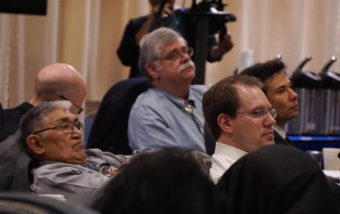
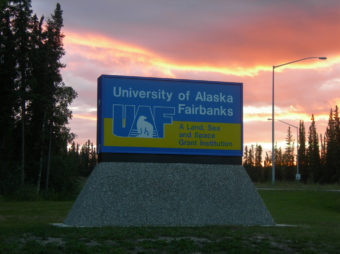
The Senate passed a bill Thursday to allow people to carry concealed firearms on University of Alaska campuses.
Sen. Pete Kelly, R-Fairbanks, debating the merits of his Senate Bill 174. The bill would deny the University of Alaska the authority to regulate the possession of guns and knives on campuses. (Photo by Skip Gray/360 North)
Bill sponsor Fairbanks Republican Sen. Pete Kelly says students would be safer if there were more guns on campus.
Kelly quoted professors from other countries who opposed the measure, Senate Bill 174.
“‘Well, if I’d have known this would be the case, I never would have taken this job,'” Kelly recalled them saying. “Or, ‘If this bill is enacted, I’m considering quitting.’ Now, almost everyone that heard that — good ol’ fashioned Americans — the same thought was going through our, their mind, because I talked to them later, and repeat after me: ‘Don’t let the screen door hit you in the …’ You know the rest of the phrase.”
University leaders asked legislators to amend the bill so the university maintained more of its ability to regulate guns. While Kelly agreed to some amendments, he opposed others.
Anchorage Democratic Sen. Berta Gardner opposed the bill. She noted that the late U.S. Supreme Court Justice Antonin Scalia recognized that firearm restrictions in schools and government buildings were legitimate.
“The University of Alaska is a government building. It’s also a school. The Alaska State Capitol is a government building. We ban weapons in this building,” she said. “Why do we think it’s incumbent upon us to not allow or trust the Board of Regents to regulate their buildings in the same way we regulate our own?”
The vote was 13-5. Majority caucus Senators Click Bishop of Fairbanks, Lyman Hoffman of Bethel, and Gary Stevens of Kodiak joined Juneau Democratic Sen. Dennis Egan and Gardner in opposing the bill.
The House Education Committee will hear the bill next.
The University of Alaska Anchorage’s women’s basketball team is playing in the program’s first-ever NCAA Division II national championship game on Monday, where the Seawolves will face off against Lubbock Christian in Indianapolis.
Coach Ryan McCarthy took the reins of the UAA women’s basketball program in 2012, and the team has seen consistent improvement every season since.
But, McCarthy said this is the first year he and his team talked about winning a national championship from day one.
“Maybe that’s me being young and naive, I never thought, ‘Man I really think we’re the best team in the country,’” he said. “But this year, I really believed it, and I think more importantly, the girls that were playing believed it, and I think they believe that right now.”
The Seawolves have 38 wins – an NCAA Division II record – and 2 losses this season.
Despite the record, McCarthy said all the pressure is on their opponent — undefeated Lubbock Christian.
“They’re the team that’s undefeated. Everyone says they’re number one in the nation and so if they lose, people are gonna ask them what happened. If we lose, no one is gonna ask us that question, because they’re the number one team — it would be an upset if we win,” McCarthy said. “So, we weren’t even number one in our own region. I’m excited, I think we get to be loose, and come in there and play our game.”
The players agree with that sentiment.
Junior forward Alysha Devine, a Wasilla High School graduate, said after 40 games, the jitters are gone and it comes down to preparation.
“Coach told us, you know, ‘You’re not nervous if you’re prepared.’ And I really think that we are prepared and we are preparing within the next few days, too, it’ll just keep getting us more confidence and we’re in a great place right now, and I’m really looking forward to it,” she said. “And I’m sure the nerves will get there before the game, but all the preparation will pay off.”
And with 11 days between games, which is unusual in a collegiate basketball season, the Seawolves have plenty of time to rest and prepare.
Senior guard Jenna Buchanan, a Galena High School grad, said it hasn’t quite sunk yet in that she and her teammates will be playing in the biggest game of their career in less than a week.
“You know, I think it’s exciting. I haven’t really given much thought how big a stage it is, really. I think I’ll do that once we get there. But, I’m just excited to play,” she said. “I was counting the sleeps till our game last night, and so I’m just ready to go.”
And, with only a few sleeps left to go before the big game, Coach McCarthy said the countdown has begun – not just for the season, but for the college careers of Jenna Buchanan and the team’s other seniors.
“After this, it’s done, it’s over, that’s the way America works,” he said. “No more playing college basketball, but what a great way to end it on the grandest stage of them all.”
The UAA women’s basketball team will play against Lubbock Christian for the NCAA Division II National Championship in Indianapolis at 11 a.m. Alaska time on Monday.
The game will be aired live on the CBS Sports Network – which is only available in Alaska on an expanded Dish Network package or Direct TV.
Members of a University of Alaska Fairbanks mountaineering class are recovering after being hit by an avalanche in the eastern Alaska Range. The incident has raised questions about the university taking students into the mountains.
The McCallum Peak climbing trip was the culmination of an 11-week mountaineering course. UAF spokeswoman Marian Grimes said the group, which included nine students and four instructors, was climbing up the Canwell Glacier off the Richardson Highway Saturday when the slide triggered.
USGS’s Peter Haeussler prepares to measure the offset of a crevasse on the Canwell Glacier in November 2002, following a magnitude 7.9 earthquake that struck near Denali National Park. (Public domain photo by U.S. Geological Survey)
”Some people were partially buried in the snow,” Grimes said. “Some were on top of the snow. There were two people who had their faces covered. The climbers who were free of the snow assissted them very quickly, uncovered their faces within the first about 20 or 30 seconds.”
Grimes said no one was seriously injured, but the climb was abandoned and the group returned to Fairbanks. UAF Director of Recreation, Adventure and Wellness programs Mark Oldmixon said snow conditions appeared to be initially OK to the instructors.
”They didn’t find any red flags: natural avalanches or shooting cracks,” said Oldmixon.
An Alaska Alpine Club trip to the same area was canceled. Volunteer leader Kellie O’Brien said she didn’t feel comfortable with conditions, given recent weather.
”Reviewing history of the weather in Alaska and knowing that we’ve had strange snow, and that it’s been inconsolidated,” O’Brien said. “And then to have the temperature so warm followed up by that fresh snow fall that passed through, I just have this sixth sense that it just was not stable conditions.”
O’Brien referred to a forecast posted earlier in the week to the Eastern Alaska Range Avalanche Center website, warning of instability. Oldmixon, who’s actively involved in the online center, maintains the forecast was stale.
”It shouldn’t be something we necessarily use as a go-no go five days later,” said Oldmixon. “So we felt comfortable still sending the trip.”
Alaska Avalanche Information Center education coordinator Sarah Carter was in the area teaching course the prior weekend, and some of her students posted the forecast. Carter agreed conditions shift quickly, and are localized, but cautions that the eastern Alaska Range snowpack has become generally less stable in recent years due to warmer weather.
”With the warmer systems moving through, there are multiple layers of stronger snow with facets between those layers.” Carter said.
Carter noted basic techniques, like only exposing one group member at a time to a slope to reduce risk, but she insisted on not laying blame relative to the UAF avalanche incident.
“There is an element of luck in the mountains,” said Carter.
UAF’s Oldmixon said his initial takeaway from the weekend accident is that the class fell victim to rapidly changing conditions, common in the mountains.
“My initial instinct is we didn’t do anything wrong,” Oldmixon said. “These accidents will occur and in this one there could have been 13 deaths.”
Jeff Benowitz is an experienced local alpinist and longtime UAF climbing gym instructor.
“The University of Alaska should not be in the mountain guide business,” said Benowitz. “We should offer mountaineering skill classes and we can do that on campus, and we do it very well.
The university’s Oldmixon said the avalanche incident will undergo thorough review and could result in program changes, but the initial priority is helping those involved recover from the slide.
Senators introduced four new bills Monday that would require local governments and schools to pay more for pensions, end two college scholarship programs, and cut the amount that municipalities receive in state funding.
Towns and schools are concerned about the effect on taxes and services.
The first measure, Senate Bill 207, would shift much of the costs of teacher pensions from the state onto local school districts.
Sen. Pete Kelly, R-Fairbanks, during a Senate Finance Committee meeting. Sen. Anna MacKinnon, R-Eagle River, looks on. (Photo by Skip Gray/360 North)
Fairbanks Republican Sen. Pete Kelly, who supports the change, said he wants to ease the impact on districts.
“Obviously, the state is in pretty difficult times,” Kelly said. “There are some things we simply can’t do anymore. And it’s important, though, that as we recognize those things the state can’t afford to do anymore, that we mitigate the impact on communities and provide as many shock absorbers as we can.”
Association of Alaska Schools Boards Executive Director Norm Wooten said districts fear the effect of the higher costs.
“My members are very concerned,” Wooten said. “There’s some short-term and some long-term uncomfortableness about this. The short term is that districts have already issued teacher contracts. They’re putting the final touches on their budgets and they still don’t know not only what they’re not going to get, but what they’re going to lose.”
In the long term, Wooten said districts could cut programs and lay off staff.
The increased costs would be offset in at least the first year by the second measure, Senate Bill 208. This would phase out two college funding programs: Alaska Performance Scholarships for students with high grades and test scores and Alaska Education Grants for students with financial need.
These programs would be wound down by 2022. A portion of the fund that paid for these programs would be used to lower school districts’ pension contributions.
The third piece of legislation, Senate Bill 209, would also increase local pension contributions. Municipal and other government bodies that contribute to the Public Employees’ Retirement System would have to pay more. They currently pay the equivalent of 22 percent of salaries, but would have to pay 4.5 percent more by 2018.
Anchorage Mayor Ethan Berkowitz, a former legislator, said the bill was poorly thought out and didn’t include municipal perspectives.
“When they say that everything’s been put on the table, that doesn’t mean you’re carving up the municipalities and treating them like cash cows, and that’s what they’re trying to do right now. That’s not acceptable,” Berkowitz said, adding: “This has not been a process that has included municipal governments. It’s not been a process that’s included taxpayers. It has been a group of legislators operating in a closed room, without adequate input, just trying to solve a math problem.”
The fourth bill, Senate Bill 210, would cut the total amount the state pays to communities as revenue sharing in half. But it would increase the minimum payments to help protect rural communities.
Sen. Lyman Hoffman, D-Bethel, during a Senate Finance Committee meeting. (Photo by Skip Gray/360 North)
Bethel Senator Lyman Hoffman, a Democrat who caucuses with the majority, said the state can’t afford to continue the program in its present form.
“Assisting those communities – primarily smaller communities throughout the state of Alaska that rely heavily upon the program, that may have 80, 90, 95 percent of their revenues to continue to keep their doors open,” is important, he said. “Whereas larger communities, they may only — this program may be less than 5 percent of their revenue and can … probably make better adjustments.”
Alaska Municipal League Executive Director Kathie Wasserman said the cost of all these changes could be large.
“All I know is that it’s going to be a huge impact,” Wasserman said. “You can’t hand a state bill over to the municipalities, lower the amount of money that they get, and then hand them an extra bill, and not have a huge impact.”
Eagle River Republican Sen. Anna MacKinnon said the bills were a necessary step to help close a state deficit of more than $4 billion. The four bills could provide $100 million, although the fiscal analysis must be completed.
“This suite of bills is attempting to address … a huge hole in Alaska’s budget, and it is a suite of bills that work together,” she said. “There is criticism to be had for any of the bills individually. But our goal is taken as a whole, that these bills will provide an opportunity for communities to understand the magnitude of the problem that the state is facing.”
MacKinnon and Kelly co-chair the Senate Finance Committee. The committee plans to announce opportunities for public testimony on the four bills.
In the past few years, the issue of sexual assault has been a major focus for universities around the nation. The University of Alaska Fairbanks is no exception.
University officials recently visited UAF’s Northwest Campus in Nome to discuss the issue, but campus dynamics and the communitywide struggle with sexual assault and domestic violence made it hard to draw connections between efforts in Fairbanks and actions in Nome.
To spark discussion on the issue of sexual assault, UAF’s Northwest Campus recently screened the documentary “The Hunting Ground.” The film opens with a rolling orchestral soundtrack that calls to mind university quads and collegiate culture.
In the opening sequence, home videos show students react to hearing they’ve been accepted to their top choice schools. Most of the students are young women and most schools are big-name universities like Notre Dame or Harvard.
It’s inspiring, but not at all familiar. In Nome, university culture couldn’t be more different. UAF’s Northwest Campus is a community college that mainly serves nontraditional students. It offers mostly one-credit courses like kuspuk sewing and caribou hide tanning. And those courses aren’t just offered in Nome.
“We have a sled-building class in Shaktoolik.” explained Bob Metcalf, the Director of UAF’s Northwest Campus.
Metcalf says every campus employee is trained in Title IX, a federal law that guarantees gender equity in all federally funded schools. Sexual assault is considered a form of discrimination since it creates a hostile environment for the victim and prevents him or her from benefiting from the school’s education program.
UAF’s interim Chancellor Mike Powers made the trip from Fairbanks to screen the film. After the closing credits, he opened the room up for public discussion.
“What we can do to help support the community, the Northwest Campus, on prevention?” Powers asked. He asked the room for suggestions on what UAF should be aware of regarding sexual assault.
But the room remained silent. The issue of sexual assault is huge in Alaska.
Thirty-seven percent of women in Alaska have been sexually assaulted in their lifetime. That’s according to the Alaska Victimization Survey conducted by UAA’s Justice Center. In the Nome census area, from Shishmaref over to Savoonga and down to Stebbins, 31 percent of women are victims of sexual assault.
Mae Marsh, UAF’s Title IX Coordinator, said the University can encourage a stronger stance against sexual assault.
“If the university can’t do something to change this mindset, who can?” Marsh asked.
“If you come to the university and there’s a standard that says ‘This is not acceptable behavior, and if you demonstrate this type of behavior, you will be expelled from our community, or you will be suspended,’ it sets a new standard,” Marsh said.
But the push for the University to lead the way doesn’t quite translate at UAF’s Northwest Campus in Nome. The campus’s transient and nontraditional student body makes sweeping changes harder to carry out.
Instead, Bob Metcalf said the campus is following in the footsteps of the community.
“They’re ahead of the campus with Green Dot, and equity and social justice. We see our role as supporting [the community],” said Metcalf.
Green Dot is just one of the ways the community is confronting sexual assault. The statewide initiative encourages people to speak out against violence. It’s already been introduced at Nome Public Schools. Local parent Dana Handeland has two children in college. She says talking about sexual assault before students leave for college is a good thing.
“Most children grow up with all the children they go to school with,” Handeland explained. “They’re almost siblings by the time they graduate.”
Despite having both children out of the house, Handeland was at the screening of “The Hunting Ground,” to educate herself. She said for children who grow up in bush communities, the transition to college can be traumatic.
“Rural communities need to start this much sooner than just, ‘OK, let’s make sure you watch this as orientation in college,’ ” Handeland urged. “They’re already bombarded with ‘How am I going to find my class,’ [and] ‘where’s this building?’”
UAF’s interim Chancellor Mike Powers and Title IX Coordinator Mae Marsh offered updates and answered questions for locals in the audience like Handeland. But there was a clear disconnect.
The differences between battles being fought on campus in Fairbanks and throughout the community in Nome highlighted their different priorities. Without an action plan in place, UAF officials boarded a plane out of Nome that same evening, leaving the community to continue its uphill battle against sexual assault.
Kay Field Parker demonstrates Ravenstail techniques at the opening reception for her art show, “Traditional and Contemporary Ravenstail Weavings,” at the Kenai Visitors and Cultural Center in January. (Photo by Jenny Neyman/KDLL)
Kay Field Parker has been a lifelong crafter, but when she took a class in spruce root basketry at the University of Alaska Southeast in 1987, she found it increasingly difficult — and not nearly as intriguing as the weaving class she kept seeing.
“My class was going along and I started noticing the class across the hall was a Ravenstail class. And as the weeks went by, my basket got uglier and their weaving got more beautiful and I was hooked.”
Ravenstail is the precursor to the Chilkat weaving tradition that creates the button blanket robes bearing the clan symbols of the Tlingit, Haida and other Northwest Coast populations. Chilkat is known for being one of the most complex weaving traditions in the world, unique in its ability to create circular forms. Within that style are echoes of the even older tradition, from the mid-1700s and earlier displaying even more complexity.
Echoes were about all that was left. That is until the 1980s when fiber artist Cheryl Samuel started researching Chilkat robes. The more she studied, the more she uncovered references to the earlier weaving practice from which Chilkat developed. It was more geometric, with strong, linear patterns, whereas Chilkat designs are curvilinear and totemic. Known until then as the Northern
Geometric weaving style, Samuel coined the term Ravenstail and set about studying all the examples she could find.
Since then, Ravenstail has experienced a resurgence, particularly in Alaska. Parker, who lives in Juneau, is one of the most noted practitioners in the state, and a display of her work is the spring art exhibit at the Kenai Visitors and Cultural Center.
She gave a presentation to open the show last month, complete with a weaving demonstration.
Ravenstail is a laboriously slow process. An apron can take Parker six months to complete — even now, with her 20 years of experience and the convenience of modern materials.
Ravenstail involves several intricate and complex weaving techniques, which Parker displayed for an eager crowd of local fiber artists. (Photo by Jenny Neyman/KDLL)
The original Ravenstail weavers used the undercoat of mountain goat hair, which is softer than even the best merino yarn used today, but required pulling away layers of guard hair to get at the fiber underneath. The weavers made a two-ply, very fine, tightly twisted yarn that didn’t compact when woven.
“The materials were all spun on their thigh. As a roving, as you move it down your leg you’re twisting the individual strands, as you move it back up you’re plying it together. And with that motion, you create about an inch of material,” Parker said.
Along with the natural color, the yarn was also dyed black or yellow. Yellow came from a moss that grows on spruce trees, but not on the coast where the weavers lived. It was a trade item from east of the mountains. Black was dyed with the inner bark of hemlock trees, but could only be collected in the spring. Best not to run out of yarn mid-project.
Ravenstail is a twining method, where the horizontal weft yarn spirals around the vertical warps and other wefts. In regular weaving, the wefts are plaited under and over the warps. In Chilkat, the designs are done in small weaving areas that are tied together into a complete piece. Ravenstail robes are worked in horizontal rows progressing from top to bottom, with borders added last and finished with various embellishments, like abalone or deer hooves.
“Ravenstail has a lot of different techniques to it,” Parker said. “There are actually seven different techniques that they use in this style of weaving. Whereas with the Chilkat, there are only three techniques that are used. So this was very highly developed.”
Several members of the local fiber arts guild attended Parker’s demonstration, eager to see the patterns develop for themselves.
Lee Coray-Ludden, of Clam Gulch, visited the show with her daughter, Sarah Goodwin, of Sterling, and could barely contain herself at just looking.
“I said, ‘Oh my God! I just want to touch it.’ She’s policing me, ‘Don’t touch it, Mom. See the sign? Don’t touch it.’ But because I work with fiber I want to touch it,” Coray-Ludden said. “That’s the beauty of fiber arts. You’ve got the abalone, you’ve got the metal, you’ve got the hooves, you’ve got the different fibers in here, and fur, all coming together to make this exquisite beauty.”
She was awed by the intricacy as well as the artistry, and the thought that it came from people over 200 years ago.
“When a culture gets to this level of art form, that’s a very sophisticated culture, and that’s what the people of Southeast have,” Coray-Ludden said. “Yet, when the Russians came in and the Americans came in, we didn’t acknowledge that. And, so, to see this, I think, is wonderful.”
Parker’s Ravenstail creations are on display at the Kenai Visitors and Cultural Center through May.
Close
Update notification options
Subscribe to notifications
Subscribe
Get notifications about news related to the topics you care about. You can unsubscribe anytime.