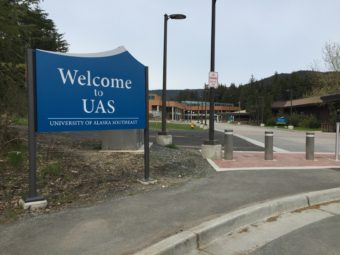
University of Alaska Southeast Monday, August 19, 2013 (Photo by Heather Bryant/KTOO)
After a Wednesday morning announcement by Gov. Bill Walker, the University of Alaska finally knows exactly how much money it will have for the upcoming fiscal year.
During the legislative session, university officials assumed lawmakers would give them between $300 million and $325 million.
“To that end, we prepared for $300 million. When the legislature completed its work and the budgets were finalized, our budget ended up being at $335 million,” Roberta Graham said. Walker’s $10 million veto brings their final number to $325 million — the most the university originally expected.
Graham is the university’s associate vice president for public affairs.
“While we were hopeful that ($335 million) would be the number, and we then looked at how we would take that $335 million and invest in strategic priorities for the university, we also were mindful that the governor’s action may change that,” Graham said.
She said the university’s strategic priorities include maintenance, research, enrollment, compliance issues and fundraising.
Graham added that the university will take most of the governor’s cut from funds dedicated to its strategic priorities and the rest will be absorbed by cutting about eight staff positions in the university system.
Legislators from both parties criticized Walker’s actions.
Fairbanks Republican Rep. Steve Thompson said delaying road construction work will cost a lot of jobs.
Anchorage Democratic Sen. Bill Wielechowski said he’d like to see the legislature override the PFD decision. Three-quarters of the 60 legislators must agree to successfully override any of the vetoes.
“The real losers today are working Alaskans, who are really going to suffer,” Wielechowski said. “A family of four is going to lose over $4,000 from this action. And I think there are better ways to do it. I’m surprised the governor took this action and I’m going to encourage fellow legislators to override this veto. ”
Nikiski Republican House Speaker Mike Chenault said it’s not clear whether there will be enough votes for override Walker’s vetoes in the special legislative session beginning July 11.
“It might have been nicer if early on, at the beginning of session, he would have came in with a smaller budget than what they originally proposed, so, you know, we’ll look at it, determine what’s the right thing to do and try to accomplish that,” Chenault said.
Rachel Waldholz of Alaska’s Energy Desk contributed to this report.
Original story | 1:39 p.m.
Gov. Bill Walker announces line-item budget vetoes at the Atwood Building in Anchorage on Wednesday. Lt. Gov. Byron Mallott is also pictured. (Photo by Rachel Waldholz/Alaska’s Energy Desk)
Gov. Bill Walker cut Permanent Fund dividends Wednesday to $1,000 per person, about half the projected amount. The cut was one of a series of reductions that Walker made to lower the state’s budget by $1.5 billion.
Walker said he made the changes to reduce the amount of savings the state must spend to cover the budget. And he said he cut dividends to preserve PFDs into the future. The state is on track to exhaust its savings in four years without cuts.
He said he’ll take the blame for reducing dividends. He expressed hope that this will make it easier for lawmakers to approve his long-term fiscal plan for state government.
“What I’ve tried to do is take away from them the risk that they may suffer … at the polls, so that’s off the table,” Walker said. “And any excuses now – it’s just pure politics.”
Walker vetoed $1.29 billion from the budget. The cuts include a $58 million reduction to schools, including shifting $30 million in bond reimbursement to local schools. The state will delay $430 million in oil and gas tax credits into future years. The University of Alaska will see a $10 million cut.
In addition to the vetoes, Walker delayed $250 million in road and bridge repairs. And he shut down two megaprojects: the Knik Arm bridge and the Susitna-Watana dam.
Walker said the state can’t balance its budget only through cuts.
“We’re not cutting our way into prosperity,” he said. “We’re using the only tools we have available to us to do all we can to reduce the deficit.”
Walker signed the operating, mental health and capital budgets for the fiscal year that starts Friday. He also signed a bill that will restructure oil and gas tax credits, but not by as much as he wanted.
The 2015 Governor’s Picnic held at the University of Alaska Southeast. (Photo by Jeremy Hsieh/KTOO)
A $6 million cut has made the University of Alaska Southeast reconsider what is really important. UAS is giving up its masters of business administration degree program and some staff positions, but it’s offering a new fisheries and Northwest Coast Arts program.
The University of Alaska Southeast’s budget cut is the result of a near $20 million statewide squeeze on the entire university system. UAS Chancellor Rick Caulfield said the $6 million hit to UAS’ wallet comes with a combination of reduced spending, an increase in costs and re-prioritization at the top.
Officials said they’ve eliminated about 23 positions mostly through attrition. Four people were laid off and three faculty contracts weren’t renewed.
“We’ve worked hard to minimize the impact on our instructional mission and on the student support services so that students will see less of an impact, and if we find savings in any area it will be more in the administrative realm,” Caulfield said.
UAS is also getting rid of at least one degree program. Caulfield said they won’t offer a master’s degree in business administration next school year.
“We did that because our sister institutions to the north at UAA and UAF also offer a master’s in business administration,” Caulfield explained. “We’re having to focus instead on programs where we have the greatest demand and certainly that meet the needs of employers and our communities here in Southeast Alaska.”
Those programs include teacher education, environmental sciences and marine biology.
“We’re also trying to develop our career and technical education programs — especially in mine training, but also in construction technology and diesel technology,” Caulfield said.
Caulfield said UAS is launching a new bachelor’s of science degree program in fisheries with UAF.
UAS also plans to reorganize its art program to focus on Northwest Coast Arts.
“We have great opportunities in Juneau and Sitka and Ketchikan to partner with other organizations that are interested in the economic development of the arts and supporting artists,” Caulfield said.
UAS hired a new faculty member to help expand the art program, he said.
Caulfield added that he wouldn’t be surprised if budget cuts and a reduction in offerings persuade some prospective students to go to school somewhere else. But, he believes affordability and quality will outweigh future students’ worries over studying in Southeast.
Correction: A previous version of this story misstated that UAS is adding a new marine biology degree program. It already has a marine biology degree program and is adding a fisheries degree program.
The HAARP facility near Gakona, Alaska. (Wikimedia Commons)
UAF took ownership of the High Frequency Active Auroral Research Program facility in Gakona from the Air Force last summer, and there’s optimism that the station, once destined for scrap, has a future.
The University of Alaska Fairbanks Geophysical Institute is tasked with revitalizing HAARP as a tool for conducting experiments in the earth’s ionosphere. Though the Air Force has completed its HAARP mission, institute director Robert McCoy stresses that the 25-year-old facility on the Tok Off remains the best of 4 ionospheric research stations in the world.
”It was started in ’89, but the final push was only a few years ago so it’s actually fairly new,” McCoy said. “And by a factor of ten it’s more powerful than the other ones around the world. It’s far more flexible than the other ones, so we just gotta get the word out.”
HAARP’s high power radio transmitter and antennas are used to stimulate the ionosphere for communications research and other work. McCoy said that could include testing over-the-horizon radar.
”What HAARP is a big HAM radio,” McCoy said. “And over-the-horizon radios, that’s what they are. Basically big HF (High Frequency) transmitters. So HAARP is flexible enough where the beam can be steered and it can be used in that mode. So we don’t want to use it as an over-the-horizon radar, but we’re talking to NORAD and NORTHCOM about an over-the-horizon test bed. And the problem is up here in the Arctic, the Aurora causes such problems. But HAARP has enough power to overcome the aurora.”
McCoy said that just one of the research possibilities federal agencies have expressed interest in conducting at the HAARP facility.
“The Department of Energy, the Naval Research Lab, DARPA,” McCoy listed. “The National Science Foundation has also come to us and wants to work with us.”
McCoy said the university is still awaiting permits and acquisition of the land the facility sits on in anticipation of demonstrating HAARP’s potential for customers next February. He said UAF has focused on making the $300 million former Navy and Air Force research facility more efficient by combining operations with the university run Poker Flat Rocket Range outside Fairbanks.
”We have a team at Poker costs way down,” McCoy said. “So now we have a smaller team at HAARP. We’ve combined them. As far as the science team, there used to be five people back in DC who would come out to run experiments. Our faculty on the seventh floor of the LV building of space physics, they can now run those experiments. So they’re doing research and they only have to be called on for a short time. So we’ve got those costs way down.”
McCoy said with other measures, like better insulating HAARP buildings, UAF hopes to cut yearly operating costs from $7 million, down to $2 million. The University of Alaska has given the GI 3 years to repay a $2 million start-up loan.
The University of Alaska Board of Regents meets in Anchorage June 3, 2016. (Photo by Josh Edge/APRN)
The University of Alaska Board of Regents has adopted the system’s $909.8 million operating budget for the upcoming fiscal year.
Just under $335 million of that comes from the state.
That means the university system faces a $40 million budget shortfall, rather than the $75 million discussed previously.
“That’s a big difference,” UA President Jim Johnsen said. “So that enables us really to continue investing in some programs. We’re still gonna have to reduce programs; we’re gonna have to reduce people, unfortunately.”
“But this enables us to have a glide path to the future, where we can be much more careful about the reductions we make and it allows us to invest strategically in really high value areas, areas that meet the state’s higher education needs.”
It’s not immediately clear how many jobs will be impacted, but it’s expected to be fewer than the 700-plus positions anticipated under the larger cut.
The board approved the operating budget by a vote of 10-1, with Regent Kenneth Fisher tallying the “no” vote.
The state’s capital appropriation for the university only includes $19 million dollars reallocated from the Municipality of Anchorage for the controversial U-Med Road.
Since the University did not receive funding for the partially-built engineering building on the Fairbanks campus, the board of regents at a future meeting will explore the development of a $40 million bonding package to complete construction.
Reps. Ben Nageak, D-Barrow, Kurt Olson, R-Soldotna, Lance Pruitt, R-Anchorage, and Neal Foster, D-Nome, watch as a budget-related vote is tallied in the Terry Miller Gym in Juneau, May 31, 2016. (Photo by Jeremy Hsieh/KTOO)
The legislature passed a state budget that prevents layoff notices going out to state workers Wednesday. But that budget could draw $3.2 billion from the state’s piggy bank, the Constitutional Budget Reserve. It’s not clear how Gov. Bill Walker will respond to a spending plan that doesn’t address Alaska’s long-term state fiscal imbalance.
After weeks of quiet, behind-closed-doors negotiations, the legislative conference committee on the budget passed a funding plan for the fiscal year that starts July 1. That action set the stage for both the House and Senate to vote on the budget Tuesday. The vote came ahead of a Wednesday deadline, preventing thousands of layoff notices from being sent to state workers.
Conference committee chairman Sen. Pete Kelly, R-Fairbanks, said this session will provide lasting budget savings, due to overhauls of Medicaid and criminal justice. Under the proposed budget, total spending – including federal funds – would fall from $9.3 billion this year to $8.8 billion in the coming year.
“Our goal was to cut somewhere (around) $400 million, $500 million,” Kelly said. “We’re over a $400 million reduction. And as we said before, those reductions will continue into the future, because of the reform bills.”
House Minority Leader Chris Tuck, D-Anchorage, highlighted money that was restored to the budget, including funds for senior benefits, early education, the University of Alaska, and the Alaska Marine Highway.
House Minority members have supported changes to the oil and gas tax system that would cut subsidies to producers. But Tuck said the top priority was preventing layoff notices.
“Now that we got this off the table – now that we’re no longer threatening state employees – it’s time to get to work and fix Alaska’s future,” Tuck said.
Rep. Les Gara, D-Anchorage, said it wouldn’t have been appropriate to use the budget as leverage to pass oil and gas tax changes.
“You can’t leverage other peoples’ votes by saying, ‘I’m going to shut down government if you don’t give me the oil tax bill I want,’” Gara said. “Those things have to be decided on their merits.”
But the lack of progress on reaching a comprehensive fiscal plan to stabilize the state budget for future years is a concern for many residents. That’s according to Rasmuson Foundation President and CEO Diane Kaplan. Foundation surveys found Alaskans want the legislature to adopt a comprehensive plan this year.
Walker has proposed a series of new taxes and tax increases, as well as cuts to oil and gas tax credits. Kaplan says Alaskans would like to see the legislature do more than pass the budget.
“In the long-term, nothing is being done this session – other than the modest budget cuts – that puts us in a good position to have a bright economic future for any Alaskans …,” Kaplan said. “This is not a sustainable way to operate the state of Alaska – using reserves.”
The potential $3.2 billion Constitutional Budget Reserve draw would be more than 40 percent of the entire $7.75 billion fund. And it would be nearly a fifth of all savings that the state can spend, including the Permanent Fund earnings reserve.
One party that will be keeping a close eye on what the state government does in the coming weeks is the bond-rating firms. Standard and Poor’s analysts have said negative pressure on the state’s credit rating could intensify if the legislature doesn’t make structural changes.
San Francisco-based S&P analyst Gabe Petek said his firm is watching for what happens next.
“We have not viewed the state’s fiscal structure as sustainable over the longer term,” Petek said. “And so, we’ve been watching to see if the legislature could reach an agreement on some package of reforms that would put the state’s finances on a more sustainable trajectory.”
While Majority Caucus legislators have said they would bring pieces of Walker’s fiscal plan up for votes, it’s not clear whether any will pass.
Close
Update notification options
Subscribe to notifications
Subscribe
Get notifications about news related to the topics you care about. You can unsubscribe anytime.