University of Alaska

UAS names new education college dean tasked with ambitious in-state teacher hiring goals

By 2025, the University of Alaska says it wants nine out of 10 teachers hired in the state to be one of its graduates.

According to the university, two-thirds of Alaska’s teachers currently come from out of state.

Incoming Executive Dean of the Alaska College of Education (Photo courtesy of UAS)
Steve Atwater is the incoming executive dean of the Alaska College of Education. (Photo courtesy UAS)

It’s an ambitious goal, one that will require more coordination among the teacher training programs at the university’s three main campuses. To oversee that, the University of Alaska Southeast Tuesday named Steve Atwater as the executive dean of the new Alaska College of Education.

The new role will be responsible for education programs at UAS while also coordinating with existing programs at UAA and UAF.

Atwater starts July 1. The job is based in Juneau, but he’ll travel frequently to work with faculty and staff at other campuses as chair of the newly created UA Teacher Education Council. Atwater said a big part of that will involve looking at common issues for the three campuses and finding uniform solutions.

“An easy way to look at that would be the placement of interns in rural Alaska,” Atwater said. “How do we do that? How do we put student teachers into rural Alaska? Right now we have three different ways to do it, and so this will be coming up with some processes that will be standard across the system.”

The UAS School of Education will be restructured. At UAA and UAF, the education programs will be absorbed into other colleges. UAS Chancellor Rick Caulfield said class offerings and faculty will remain the same.

“So students will continue to be able to become teachers at each of the three universities in the university system, but he’ll be providing a coordination role and a leadership role across the entire state,” Caulfield said.

Caulfield made the final decision to choose Atwater based on recommendations from a search committee.

He said the university’s Board of Regents is looking to UAS to lead the system’s push for more Alaskan teachers. He said he’s excited for Atwater to take on the challenge.

“The major focus in the short run will be the restructuring, but my hope in the long run is we’re going to see far more Alaskans choosing to become teachers and we’ll see more students in our classrooms and in our online program as well,” Caulfield said.

Atwater said meeting the university’s 90 percent goal will mean working with partners across the state.

“So I look forward to working with the Legislature, other entities to try to really encourage that conversation to be broader than just the university recruiting students but to really grow the esteem of the teaching profession as a way to help direct or steer students into that,” Atwater said.

In recent years, school districts across the state have struggled with staffing shortages.

Atwater comes from the University of Alaska Fairbanks, where he’s the interim dean of the School of Education. He was a former superintendent for both the Kenai Peninsula Borough and the Lake and Peninsula school districts and got his start teaching in rural schools in Western and Southwest Alaska.

The Alaska Association of School Administrators named him 2013’s Alaska Superintendent of the Year.

University plans major, 13,000-acre timber sale in Chilkat Valley

This map shows 13,426 acres of land scattered throughout the Haines Borough that the University of Alaska owns that's in negotiations for a timber sale.
This map shows 13,426 acres of land scattered throughout the Haines Borough that the University of Alaska owns and is negotiating a timber sale of. (Courtesy of the University of Alaska)

The University of Alaska is negotiating a timber sale on more than 13,000 acres of its land in the Haines Borough. The estimated volume of the 10-year deal is far greater than any timber sale in the Haines area in recent history.

The university’s 13,426 acres are scattered throughout the borough. Most of that acreage is located across the Chilkat and Klehini Rivers or across the Chilkat Inlet from Haines.

That includes a piece of land near the Davidson Glacier and a few smaller portions close to town.

The university says it received interest in the timber on its Haines parcels, and is entering into a 10-year negotiated sale.

Christine Klein is the chief facilities and lands officer at the university. She spoke at a Facilities and Land Management Committee meeting on Tuesday.

“We have received a formal letter of interest from an international buyer for our holdings in the area for really the long term, for a 10-year term,” said Klein.

The sale is estimated at around 100 million board-feet.

Lynn Canal Conservation’s Executive Director Elsa Sebastian calls that number “alarming.”

“A hundred million board-feet means that we’re not talking about a local sale,” Sebastian said. “We’re talking about an outsider coming in, cutting our trees and likely exporting as many as possible overseas.”

That goal trumps the size of other recent Haines-area timber sales. In 2015, the state Division of Forestry moved forward with the Baby Brown Timber Sale. At 855 acres and 20 million board-feet, it was set to be the largest sale in the Haines State Forest in 20 years. That sale was delayed after a successful appeal of the land use plan. The state is preparing to put it back out to bid.

The Board of Regents approved the development and disposal plan for the university sale at a meeting this week, authorizing it to move forward.

The university acreage includes Sitka spruce, western hemlock, cottonwood and birch. Klein said the market for cottonwood is new.

“It’s for an existing market species, as well as for a new market for cottonwood type hardwoods for furniture,” said Klein.

Sebastian said the harvest of cottonwood is concerning.

“We are somewhat concerned to hear the potential for large scale harvest of cottonwood,” Sebastian said. “Especially so near the bald eagle preserve, considering that cottonwood is important habitat used by nesting bald eagles.”

According to Klein, the details are still being negotiated. She couldn’t say who the interested buyer is or how the timber will be harvested.

Klein clarified this sale is different from one on the Chilkat Peninsula that the university put out to bid in 2017.

“This is not the area, the Chilkat 400 acres that you saw in the fall,” said Klein. “This is a separate development program.”

That sale, in Haines’ Mud Bay neighborhood, was introduced amid a local conversation about whether to limit resource extraction.

It drew concerns from throughout the community. But the university didn’t receive any bids. Ultimately, it decided to develop that land for a residential subdivision.

Klein said interest in that sale led to this negotiation. It’s expected to generate $10 million in revenue.

The university is accepting comments on the development and disposal plan for the sale through April 19. Klein said her office is also planning to schedule an information session in Haines in the next few months.

The university plans to award a timber contract by the end of July.

University of Alaska opens first all-gender restroom

FAIRBANKS — University of Alaska’s first all-gender restroom has opened at the Fairbanks campus’ engineering building.

The Fairbanks Daily News-Miner reported Monday that the restroom is open to all people regardless of gender identity. It features private, lockable stalls in an inclusive and genderless manner.

University spokeswoman Marmian Grimes said inclusive restrooms have been in the works for a while.

Jenny Campbell, director of design and construction for the University of Alaska Facility Services, said the idea came to life when the Department of Education published its 2016 “Dear Colleague” letter outlining the need for Title IX compliance in campuses across the country.

Campbell said the restroom is modeled after European restrooms, with stall walls going from floor to ceiling.

Campbell said that student input has been overwhelmingly positive.

University of Alaska president appeals for public support for more funding

UA president Jim Johnsen delivers his State of the University address at the University of Alaska Anchorage Lucy Cuddy Hall. (Photo by Wesley Early/Alaska Public Media)
UA president Jim Johnsen delivers his State of the University address at Lucy Cuddy Hall at the University of Alaska Anchorage. (Photo by Wesley Early/Alaska Public Media)

In his State of the University address Tuesday, University of Alaska President Jim Johnsen stressed the need for an increase in state funding after four years of cuts.

Addressing Commonwealth North’s monthly public affairs luncheon at the University of Alaska Anchorage, Johnsen described the challenges the university has faced since the state’s economic downturn began.

“These cuts hurt badly. But the greater impact than to us here at the university is the impact to the state and our reduced capacity to serve our large, unmet needs for higher education,” Johnsen said.

The university’s annual budget has declined by more than $60 million since 2014. The UA Board of Regents requested an increase from the state for the next fiscal year, but Gov. Bill Walker’s proposed budget would flat fund the university at $317 million.

Johnsen said meetings with state legislators this session have left him hopeful that lawmakers want to invest in public education. He said the university has worked hard to find ways to save money by consolidating programs, cutting travel and administrative costs and freezing wages.

He also encouraged anyone concerned about university funding to do what they can to help.

“In whatever way you can by getting in touch with your legislators, we’re deep in the budget process right now, and letting them know how critical it is for you as a student, how critical it is for you as business leaders, how critical it is for you as leaders of foundations, as leaders of our state, as educators, that we support this great university,” he said.

After his speech, Johnsen said he feels the Legislature recognizes that the university is a sound investment.

“We didn’t just sit back or crawl under the table and wait for oil prices to come back. We went forward and came up with very strong, proactive plans,” Johnsen said. “And I think that legislators see, ‘Wow, OK, those guys are moving forward. They want to lead. They seem to be a good investment in our people and in our future.”

State budget negotiations are ongoing. Legislative subcommittees for both the House and the Senate are considering the university budget this week.

Alaska Public Media’s Wesley Early contributed to this report. 

University supporters rally for full funding outside state Capitol

UA students and staff hold signs calling for more funding for higher education in Alaska at a rally on the state Capitol steps on Feb. 2, 2018. (Photo by Adelyn Baxter/KTOO).
UA students and staff hold signs calling for more funding for higher education in Alaska at a rally on the state Capitol steps Friday. (Photo by Adelyn Baxter/KTOO).

About 100 supporters of the University of Alaska rallied outside the state Capitol Friday to call on legislators to fully fund the state’s university system.

Gov. Bill Walker’s proposed budget for the next fiscal year flat-funds the university at $314 million, plus an additional $70 million for deferred maintenance. That’s $24 million less than the university requested.

At the rally, legislators, university faculty and students spoke about the need to fund Alaska’s public university to strengthen the state’s workforce and economy.

Rep. Adam Wool, a Fairbanks Democrat, said he supports fully funding the UA Board of Regents’ budget request of $341 million.

“And the cuts that we’ve endured, the number of people we’ve cut, the number of millions of dollars we’ve cut in the last several years is deplorable,” Wool said. “We have to stop it now. We have to reverse the trend. We have to reinvest. I’m embarrassed every time I see these numbers come out.”

Forest Haven is a Ph.D. candidate at the University of California, Irvine studying the regulation and management of subsistence food resources in Southeast Alaska. Before that, she enrolled at UAS to get an associate degree, but with her professors’ encouragement pursued a four-year cultural anthropology degree.

“But I think what often ends up happening when you cut funding is you’re increasing class size, you’re making it harder for professors and smaller universities to offer that sort of unique kind of intimate education that is available at UAS.”

UA President Jim Johnsen was at the Capitol earlier in the week presenting a budget overview to members of the House Finance Committee.

University of Alaska Southeast program trains students for mining careers

Employment opportunities mining was one of several topics discussed during last week’s Ketchikan Chamber of Commerce luncheon.

An ore sample from Niblack mine exploration. Bills before Congress would speed construction of a road linking it to the Prince of Wales Island system. (Photo courtesy Healtherdale Resources.)

The Alaska Miners Association chapter chair Graham Neale also is director of the University of Alaska Southeast’s Center for Mine Training in Juneau.

Neale said mining is an important industry.

“You look around this room, and pretty much everything that’s in this room has either come out of the ground or on top of the ground. And everything that we’re eating has come from agriculture,” he said. “Everything that’s made out of wood came from the timber industry which is obviously a huge economic driver in this region during the ‘70s and ‘80s. And everything else comes out of the ground. And so that’s why we mine. We’ve built ourselves a society around it, and we’ve come to depend on these things in our natural life.”

Casey Bain works at the Center for Mine Training coordinating programs and recruiting new students.

“My mission is to get out there and get high school seniors interested and involved in mining,” Bain said. “To know these jobs are here, and to know what kind of training opportunities they need to become a successful employee in the industry.”

Bain showed a map of Alaska illustrating where the mining workforce comes from.

“They come from all over. And these mining companies, they don’t want to have to go down to the Lower 48 to get their miners,” Bain said. “They want their miners right here in Alaska. And that’s my job. I need to put more dots on that map.”

Bain said the average annual salary in the mining industry in Alaska is $108,000.

“With these opportunities at home for these homegrown kids, I think it’s imperative that we let them know these opportunities are here.”

Bain said different types of workers are needed in the mining industry, from entry level to professional and technical.

“These camps, they’re out in the middle of the woods,” Bain said. “They need people to cook. They need people to scrape. They need people to test water. I let folks know that there’s a lot more than getting there and blowing stuff up.”

Neale and Bain were in Ketchikan, in part, to introduce the Southeast mining program to students.

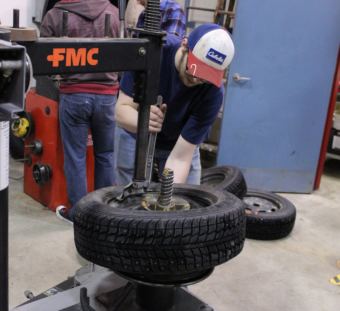
“We went to Kayhi and Revilla just before we came here,” Neale said. “We’ve had 250 students go through that class since the program’s inception. The whole point is to act as a catchall into our mine mechanics programs. We have a one-year occupational endorsement, two-year associated applied science, and from there, hopefully, into employment.”

The program began in 2011. The next introductory training session begins Jan. 29.

Site notifications
Update notification options
Subscribe to notifications