University of Alaska

Juneau’s high school auto shop program in jeopardy as district evaluates options

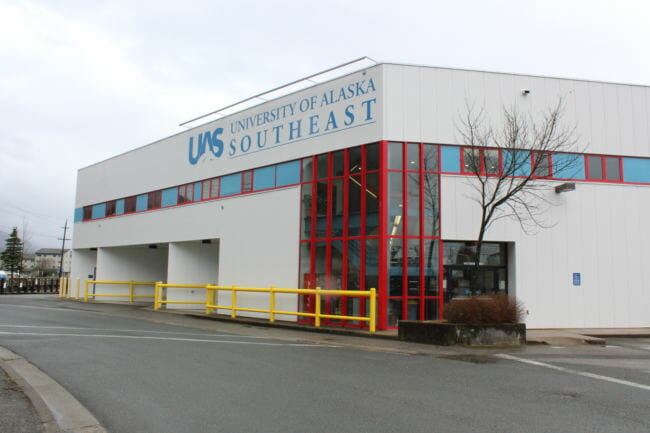
The University of Alaska Southeast's Technical Education Center. (Photo by Adelyn Baxter/KTOO)
The University of Alaska Southeast’s Technical Education Center. (Photo by Adelyn Baxter/KTOO)

A long-running partnership between the University of Alaska Southeast and Juneau-Douglas High School may come to an end.

The university allowed the high school to use its automotive facility across Egan Drive for more than 30 years.

Budget constraints mean the school district can no longer afford rent.

The high school’s automotive program runs largely out of the university’s Technical Education Center across the street from the high school.

High school students learn a variety of skills through the program from how to change oil to transmission swaps.

“For us right now, it’s an economic situation where we’re paying $40,000 to hold basically three classes over there, with an up-to-$3 million cut,” said David Means, district director of administrative services. “It’s something we just felt like we couldn’t afford.”

During the budgeting process this spring, the school board made a lot of tough decisions.

One budget item they decided to cut was the $40,000 the district pays annually to rent space in the auto shop from the university.

The district hoped it could negotiate rent with the university. But that hasn’t been the case.
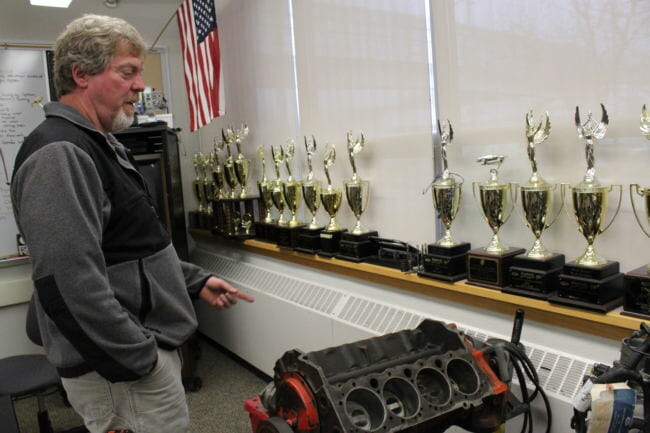
Juneau-Douglas High School automotive instructor Steve Squires points out some of the awards students have won over the years for technical knowledge. (Photo by Adelyn Baxter/KTOO)

“I’ve known the school district has been under budgetary crisis, everybody knows that, for the last few years. But it didn’t really dawn on me that the automotive program wasn’t going to make the cut until just a few weeks ago,” said Steve Squires, who has taught the small engine and automotive programs for 19 years.

Squires said he would still be able to teach small engine and introduction to automotive classes in the building.

But losing the auto shop would put an end to the hands-on instruction students receive in the more advanced courses.

“What’s really unfortunate is I think a lot of the (career and technical education) programs are finally starting to turn around and people are starting to understand that college isn’t the only way to make a good living and a good career,” he said.

Squires teaches about 80 students a year and said while he has kids who just want to learn the basics, a number of them go on to automotive or engineering careers.

They’ve won national awards and scholarships using what they learned in the shop.

Some former students now work in repair shops and auto part stores in town.

National trade schools recruit a handful of students each year.

One graduate now works for Tesla.

“They have a facility they have to pay for heating and the maintenance of the equipment and things like that, but they’re really not very negotiable to any kind of reduction in fee when the school district’s going through such a hard budgetary process,” Squires said.

UAS Chancellor Rick Caulfield said the university had a professional broker look at the facility in 2016 to evaluate the rent. The broker determined $40,000 was a fair price.

“We’re all facing budget challenges and at the university we’ve made a number of cuts and I know the school district is facing some of the same challenges,” Caulfield said. “We’re interested in continuing our partnership with the school district, but in the end they have to decide whether that’s a program they want to continue or not in light of their other budget priorities.”

Senior Dylan Rice adjusts a tire during an automotive class in the UAS Technical Education Center. (Photo by Adelyn Baxter/KTOO)
Dylan Rice, a senior, adjusts a tire during an automotive class in the UAS Technical Education Center. (Photo by Adelyn Baxter/KTOO)

The university is open to looking for ways to lower rent, Caulfield said. They offered to cut it in half by reducing the amount of space the high school class takes up in the auto shop. The district did not think that would work.

JD senior Dylan Rice has been in the class for two years and is waiting to hear back from automotive schools.

“When you take away the hands-on part of the learning, it’s just book work,” Rice said. “I think that you can’t apply what you know from the book if you’re not using your hands.”

The topic is likely to come up at Wednesday’s special Assembly meeting on the city’s operating budget. The district may ask the city to help cover the cost of rent.

Correction: An earlier version of this story misstated the location of the university’s Technical Education Center. It’s across Egan Drive from the high school, not Glacier Highway. 

Baseline report begins Haines economic development planning

Tourists walk on the cruise ship dock towards Haines’ Fort Seward. (Photo by Emily Files/KHNS)

Self-employment is rising in Haines, and personal income growth locally is slightly ahead of the state as a whole, according to an 80-page report on local economic data.

It’s the start of a five-year economic development plan for the community.

The newly formed Haines Economic Development Corporation is working with the consulting firm McDowell Group to better understand the local economy.

The first step in that process: a baseline economic report, a foundation looking at where the economy stands now and where it’s headed, to help create a five-year economic development plan.

McDowell Group managing principal Jim Calvin spoke this week at a community meeting in Haines.

“You can get a pretty good picture of the condition of the economy, the forces that are at work in the economy, the trajectory of the economy. That’s what we’re trying to do,” Calvin said. “We just want to understand where we are today and how we got here as a community so we can better understand where we’re likely to be in five years or ten years in the absence of any really proactive economic development effort.”

The report is lengthy, but a working draft, while more data is collected and community members are surveyed. But, here are some of the important conclusions, so far:

  • From 2007 to 2016, personal income growth in Haines was slightly ahead of the state in general.
  • In Haines, it increased by 9 percent over the past five years. That’s compared to a growth of 3 percent in Alaska.
  • Most of that growth has come from non-employment related income.
  • Self-employment is rising in Haines. It increased 10 percent from 2012-2016.
  • About a third of residents who filed income taxes reported income from small businesses.
  • Haines has a very seasonal economy. The number of winter jobs just about doubles by mid-summer.

According to Calvin, population can be a good indicator of economic health.

“Some of the real take home points about Haines population is it’s just sort of steady as she goes,” Calvin said.

The report also looks to the future, at things that could potentially alter the economy, such as cruise ship traffic.

“We project that between 2017 and 2019 there’s going to be a 33 percent growth in cruise related visitation to the community,” Calvin said.

And, resource-related developments, such as a potential hard rock mine in the Chilkat Valley.

The Canadian company Constantine Metal Resources is conducting mineral exploration known as the Palmer Project in the Upper Valley.

The McDowell report said the project employed 64 workers in 2017, half of which are based in Haines.

Constantine reportedly spent $3.3 million in goods and services in Haines from 2013-2017.

McDowell also looks at a 10-year negotiated timber sale, recently announced by the University of Alaska.

The university estimates the sale to generate 150-million board feet and $10 million in revenue.

It’s unclear at this point how the local economy will be impacted.

According to the McDowell report, the university estimates 55-60 local jobs will be created over those 10 years.

Both projects are points of contention within the community.

Commercial fishing, the visitor industry and the arts also play big roles in the current economy of Haines.

As data continues to be generated, the Haines Economic Development Corporation also is surveying the community, and incorporating the results of that survey into the five-year plan.

The survey is open until the end of April.

The HEDC got its footing last year, after receiving $95,000 in borough funding.

The development corporation is paying McDowell $49,500 for the economic assessment and development plan.

Haines Borough sends comment letter on 13,000-acre timber sale

The Haines Borough is asking for more information about a major timber sale in the Chilkat Valley, recently announced by the University of Alaska.

At a regular meeting Tuesday, the Assembly voted to send a letter to the university prior to a community meeting at the end of April.

The letter drafted by Borough Manager Debra Schnabel reads, “We are challenged to appreciate the enormity of this development and the impact it would have on our community.”

It requests more information specific to the development plan.

“The main thing that I would want to say is we’d like to be stakeholders,” Schnabel said. “There’s the state, there’s the university, there’s Mental Health, and there’s the borough. Why can’t we be part of a four-legged stool instead of a three-legged stool?”

Schnabel writes, “We appreciate that the proposed timber harvest would change the nature of this community forever. For this reason it is right to recognize the Borough as a stakeholder and that the University, Mental Health, DNR, and the Borough engage in frank and sincere discussion toward a win-win outcome.”

In March, the university announced it is negotiating a timber sale on 13,000 acres of its land in the Haines Borough. The 10-year deal is estimated to produce 150 million board feet.

Many residents spoke up, both for and against it, at an Assembly meeting earlier this month.

And, more came forward at Tuesday’s meeting.

“I’m here to comment tonight to ask you to please cooperate with the timber sale – the proposed timber sale,” Paul Nelson said. “I believe that this is a very valuable renewable resource. And if we work with the people that have a market for this timber and are promoting it, it can be a resource for generations to come.”

Haines Chamber of Commerce executive director Tracey Harmon said, “The chamber urges the Haines Borough, and the Haines Borough Assembly, to work with the University of Alaska to allow their proposed timber harvest to go through in the borough.”

Jo Goerner asked the Assembly to encourage “responsible” resource extraction.

“There’s any number of issues that clear-cutting can really affect,” Goerner said. “I would just encourage the Assembly, as you are working with the university to do this sale, that you remind them that responsible extraction is far better than this kind of, let’s just gobble it up and send it off into 10 years’ worth of money and after that we’re left with the scars.”

The letter also says, “We want to encourage a partnership that builds community by providing set-aside sales for local entrepreneurs and incentives and investment for local processing of wood product.”

Mud Bay Lumber Company co-owner Sylvia Heinz spoke to that.

“I think that you as an Assembly and you as individuals would benefit by advocating for the local timber industry,” Heinz said. “Because it is economically sustainable, socially sustainable and environmentally sustainable.”

The Assembly voted 5-1 to send the letter. Brenda Josephson was opposed.

She pushed back on some of the details of the letter and spoke about the opportunities the sale could provide.

“A sale of this side that they’re talking about may be what an investor needs to put a chip mill with a long term potential to stabilize the timber industry of Haines,” Josephson said. “This is huge opportunity for Haines. Job training for local youth and forest industry is going to be an awesome benefit.”

An open house with the Department of Forestry and representatives from the University of Alaska is scheduled for April 26 in Haines.

Alaska Senate set to debate state budget on Thursday

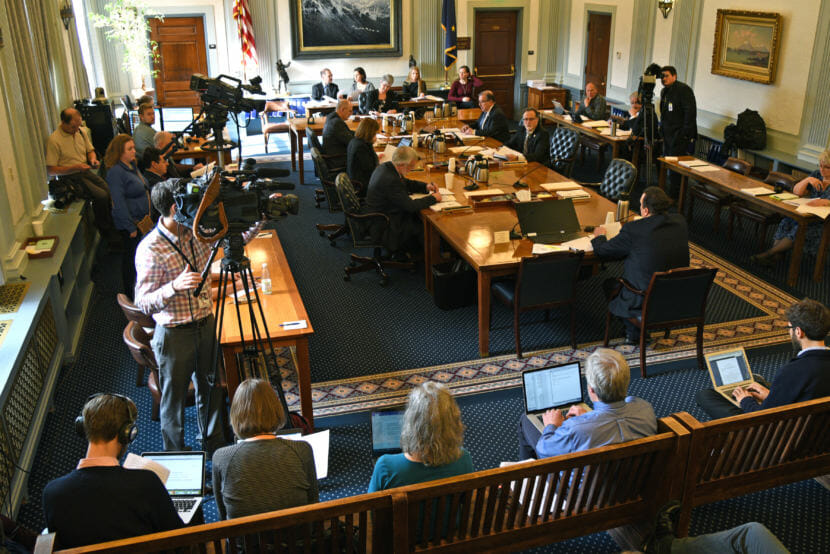
The Senate Finance Committee works on passing state operating budget bills April 5, 2018, in the Alaska State Capitol with several TV cameras and a row or journalists present. (Photo by Skip Gray/360 North)
The Senate Finance Committee works on the state operating budget bill last week. The committee passed the bill on to the Senate on Tuesday. (Photo by Skip Gray/360 North)

The full state Senate is scheduled to debate amendments to the state’s operating budget Thursday.

The Senate Finance Committee passed the budget, House Bill 286, on Tuesday. The committee substituted its own version of the budget bill for the one the House passed.

The Senate bill would provide $4.2 billion to fund the portion of the budget that the Legislature focuses on each year. It has $1 billion for Alaska Permanent Fund dividends, which would provide a $1,600 dividend.

The biggest difference from the House budget is that the Senate bill does not include $1.28 billion for school funding. The Senate would provide that money in separate legislation, House Bill 287.

Committee Co-Chairman Lyman Hoffman, a Bethel Democrat, said the school funding bill is intended to reduce the risk of widespread layoff notices.

“Hopefully, we can come to an understanding with the other body, so that early funding can happen,” Hoffman said. “I’m optimistic that pink slips will not go out.”

The Senate budget includes less money than the House for Medicaid and would cut $13.5 million of the $19 million increase that the House budgeted for the University of Alaska. And it would pay out more for oil and gas tax credits.

The Senate could vote on the budget as soon as tomorrow. Once the Senate passes it, the House would have to vote on whether to accept the Senate’s version. If it doesn’t, the two chambers will work out the differences through a conference committee.

The scheduled 90-day end of the session is Sunday, although it’s not likely lawmakers will be done. Voters passed an initiative in 2006 that set the session length at 90 days in state law.

But the Legislature can go past that date. The state constitution sets the session length at 121 days.

University of Alaska extends comment period for proposed timber sale near Haines, Klukwan

University of Alaska announced Monday that it is extending the deadline for comment on a controversial timber sale near Haines and Klukwan by 10 more days, until May 7.

The extension for comment on the proposed 13,000-acre timber sale on university lands comes after a well-attended special Assembly meeting April 3, which resulted in requests for more time from the borough and Klukwan Tribal Council.

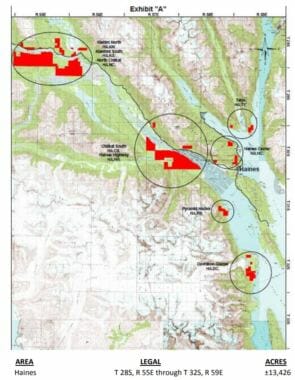
This map shows 13,426 acres of land scattered throughout the Haines Borough that the University of Alaska owns and is negotiating a timber sale of.
This map shows 13,426 acres of land scattered throughout the Haines Borough that the University of Alaska owns and is negotiating a timber sale of. (Courtesy of the University of Alaska)

Haines Borough Assembly Chambers were packed Tuesday evening for the special meeting to gather input on the largest proposed timber sale in the area in recent history.

Many residents expressed concerns about a rushed timeline for the project.

“The beauty of the Chilkat Valley is why I live here and what brings tourists here,” Haines resident Thom Ely said.

Ely was one of several residents that said clear-cutting and industrial scale logging would harm tourism.

“I have had a tourism business for 30 years,” Ely said. “We run tours on the Haines Highway and one of these areas is right along the highway up in the upper Valley there.”

The Borough should look into a land exchange with the university, Ely said, or a buyout of the timber rights.

Resident Haines Tormey said logging could bring much-needed jobs to the region and also be a part of the tourism economy.

“In Ketchikan, one of the main tourist attractions is the lumberjack show. Tourists don’t flee from timber and clearcutting, they’re interested in it,” Tormey said. “It is what makes Alaska, Alaska. We mine, we fish and we log.”

Tony Strong, a Tlingit man from Klukwan, said his community is very concerned that the proposed timber sale would worsen the situation of Chilkat River king and sockeye salmon, traditional foods for his people, and damage the overall ecology of the area.

“How often do we have to lose everything we have for a little bit of money, for a little bit of job for a few people? We cannot continue to do that,” Strong said. “I think we have to ask, figure out some way to make sure that we don’t lose all those resources—not just the timber but the value that comes with that, the inherent ecology.”

Klukwan Tribal Council President Kimberly Strong sent a note that was read aloud at the meeting, informing the borough that Klukwan also was requesting an extension of the comment period.

Strong wrote that Klukwan objects to the sale due to lack of information.

Logging began in the Haines area in the late 1800s and grew in the 1900s with mills operating along the waterfront into the mid-20th century.

While the last large mill closed here in the early ’80s, small-scale lumber operations continue to this day.

The local economy now relies mostly on tourism and fishing.

The University of Alaska is a land-grant university, which means the federal government gave the state land to benefit the university

The acreage was originally selected by the state in 1954, prior to statehood and the Alaska Native Claims Settlement Act and was eventually deeded to the University of Alaska in the 1980s.

The university announced March 28 it was entering into a negotiated timber sale on 13,400 acres of that land scattered throughout the borough.

The 10-year deal is estimated to produce 150 million board feet.

It comes on the heels of the university’s attempted 400-acre timber sale on the Chilkat Peninsula. No bids were received on that controversial proposal.

The university said it will develop that land for a residential subdivision.

The most common refrain at Tuesday’s meeting was that Haines residents need more information about the university’s plans. Some felt the University was fast-tracking the project.

University of Alaska President Jim Johnsen recently said the university system cannot withstand continued budget cuts.

The university’s annual budget has declined by more than $60 million since 2014.

Kathleen Menke said at Tuesday’s meeting that she was alarmed by the lack of process.

“For the university to say that they are coming here on the 26th after the deadline for public comment is just not adequate public process,” Menke said.

The university had set the date of April 19, for public comment to be received and has now extended it until after a April 26 meeting with the Alaska Department of Forestry with representatives of the university and the public in Haines.

University officials said they recognize that extending the deadline for comments until after the scheduled open house meeting will allow more opportunity for the public to make informed comments on the project.

Many at Tuesday’s meeting said they worry about the University’s plan to award a contract so quickly, including John Norton.

“I’m not against the idea of logging, but what raised some level of concern for me was that idea, when I read that they were going to award the contract for this cut in July,” Norton said.

The university plans to award a contract for the timber sale by the end of July.

UA President Johnsen shares outlook for university budget

University of Alaska President Jim Johnsen talks about the spread of the university's campuses @360 in Juneau on on April 3, 2018.
University of Alaska President Jim Johnsen talks about the spread of the university’s campuses @360 in Juneau on Tuesday. (Photo by Rashah McChesney/Alaska’s Energy Desk)

University of Alaska President Jim Johnsen has spent the last few months advocating for more funding for the university, arguing that it cannot withstand continued budget cuts.

The Alaska House of Representatives passed its version of the state operating budget Monday by a narrow margin. It includes $19 million more for the university’s operating budget than Gov. Bill Walker proposed.

Johnsen, appearing on Forum@360,  said he was grateful the House decided to increase UA’s budget and is hopeful the Senate will follow suit.

“I can’t control that process, certainly,” Johnsen said. “But what I can do is continue every single day advocating for the interests of the university but always setting those in the context of the interest of the state.”

The university’s annual budget has declined by more than $60 million since 2014, forcing cutbacks that have affected class offerings, staffing and campus enrollment.

In 2016, Johnsen put forward Strategic Pathways, his plan to cut costs and consolidate administration while making the university function better. UA faculty and staff last year criticized Strategic Pathways, and Johnsen. The plan is in its final phase and being implemented across UA campuses.

“I think that the tough decisions the regents have made, the university has made, has gone a long way in persuading legislators that now is the time to stop the cuts and to actually start investing back into higher education for the state,” Johnsen said.

Part of that reinvestment effort includes the new, consolidated Alaska College of Education based in Juneau. Last week, the University of Alaska Southeast announced that Steve Atwater will lead the school as the new executive dean. The university has set a goal to produce 90 percent of the K-12 teachers hired in the state by 2025.

“There’s no more important job in Alaska, in my view, than teachers,” Johnsen said. “And we’re importing 70 percent each year, 70 percent of the new teachers hired in the state. And they churn at a very high rate.”

Johnsen said the university plans more scholarships and outreach to recruit prospective teachers for Alaska classrooms.

The Teach for Alaska Presidential Scholarship provides up to $12,000 to Alaskans pursuing a teaching degree at any UA campus.

Site notifications
Update notification options
Subscribe to notifications