Climate Change

Arctic Native leaders: Paris climate agreement didn’t address indigenous rights

Reggie Joule says the plan to reduce global greenhouse gas emissions that emerged from the Paris climate talks last week didn’t include some very important provisions.

“We were definitely trying to get in the binding part of the agreement the recognition of the rights of indigenous people,” said Joule, mayor of Alaska’s Northwest Arctic Borough. He said it was disappointing that it didn’t make it in.

Joule sat in on the climate talks as an observer with the Inuit Circumpolar Conference, or ICC, which represents Native peoples of northern Alaska, Canada, Greenland and northeast Russia.

The ICC and Saami Council, which represents indigenous peoples of northern Scandinavia and Russia, were among many indigenous rights groups and thousands of other delegates whose main objective was a broad agreement to slow global climate change.

“The rights of indigenous peoples wasn’t one of the major issues of a lot of the countries,” he said.

That’s unfair because the Arctic is suffering rising temperatures and other climate change impacts much faster than the rest of the planet, says Jim Gamble, executive director of the Aleut International Association. The organization represents Natives in the Aleutian Islands and far eastern Russia.

“Any agreement that doesn’t take into account that people live in the Arctic and indigenous people are really on the front lines of this change — that’s a missed opportunity,” Gamble said.

Indigenous people didn’t cause climate change, says Evon Peter, a Gwich’in Athabaskan and University of Alaska-Fairbanks vice chancellor.

“Other observers say it’s ironic that the climate agreement gives indigenous peoples such a small voice,” Peter said, “and yet it assigns a huge role to the mainly wilderness areas in which they live, which would serve as ‘carbon sinks’ to absorb and offset emissions from developed and developing countries.”

Joule says he hopes indigenous peoples will be given greater accord in the next global climate change conference to be held three years from now.

Models show permafrost melting faster than thought

Vladimir Romanovsky
Vladimir Romanovsky in front of huge ice wedges in permafrost on an Arctic riverbank. (Photo courtesy Sergey Davydov)

For years researchers studying permafrost in the Arctic have seen a warming trend. Now scientists at the University of Alaska Fairbanks say it is happening even faster than expected.

Vladimir Romanovsky heads up the Permafrost Laboratory at the University of Alaska Fairbanks’ Geophysical Institute. Based on three decades of study he says the trend is more dramatic than previously thought.

“Even on the North Slope the summer thaw is increasing. We’re getting pretty close to that threshold of beginning of thawed permafrost.”

Romanovsky and his team, drew data from several models, as well as their own on-the-ground observations. They entered them into a special permafrost model. From that they developed two scenarios. One projects the consequences of modest reductions in global CO2 emissions. In that scenario, the resulting thaw is largely confined to the North Slope’s Brook’s Range.

The second scenario assumes today’s CO2 emission rates continue. In that case, more than half of the permafrost on the North Slope and Coastal Plain would be thawed by next century. Romanovsky says as ice-rich soils melt, the thawing will be dramatic to ecosystems and infrastructure.

“At one place you can have, like, half-meter settlement and another, just a few meters from that, almost none. And that’s the most dangerous for infrastructure because the surfaces become very uneven.”

Romanovsky’s findings were reported last week at the fall meeting of the American Geophysical Union.

Documentary on climate change in Kivalina and Newtok premieres this weekend


A new documentary focusing on the effects of climate change in Kivalina and Newtok will premiere this weekend on Al Jazeera America. The 30-minute TV program is titled “When the Water Took the Land.”

Libby Casey is a correspondent for Al Jazeera America, which produced the show for its documentary series, “Fault Lines.” Between President Obama’s fall visit to Alaska and the recent climate talks in Paris, she said there’s a large-scale spotlight on finding ways to fight climate change.

For this documentary, though, Casey said the goal is to highlight people who deal with coastal erosion and rising temperatures in their daily lives.

“When you go to villages like Kivalina and Shishmaref and Newtok, you experience it firsthand,” she said. “So we wanted to go and talk to the people for whom this isn’t theoretical. It’s not a debate in Congress. It’s their real lives.”

The filmmakers landed in Kivalina in early October and filmed there for a few weeks, interviewing everyone from elders and whaling captains to tribal leaders and city officials. Even early on, Casey said it was clear the community had spoken on the subject before.

“A lot of journalists come up and parachute in,” she said. “The community is really patient, and they tell their story over and over again to people like me — to reporters. They tell it to state officials. They tell it to federal officials. One woman we talked to — Lucy Adams, a well-known elder — said, ‘Sometimes I just feel like I should stop talking. We talk and we talk, but what good does it do? Nothing’s changing.’”

Casey said she heard similar frustrations in Newtok, even though the community is a step ahead of Kivalina, having already decided on a site for relocation. Both villages will need major funding — and more federal help — before they can move.

In the meantime, Casey said their lands are being swallowed up by the sea — something she hopes the documentary can convey, with urgency, to viewers around the world. She said Al Jazeera will broadcast the show in the U.S. and internationally, giving residents in Kivalina and Newtok a chance to communicate with a wider audience.

“We were privileged to have people sharing their stories in their own words,” she said. “We really wanted the Yupik community and the Iñupiaq community to be able to share their stories in an honest and raw way.”

The documentary will premiere Dec. 20 at 9 p.m. and then air again Dec. 22 at 6 p.m. Viewers in Alaska can watch on Al Jazeera America, available on DISH and DirecTV.

NOAA report outlines impacts of warming Arctic

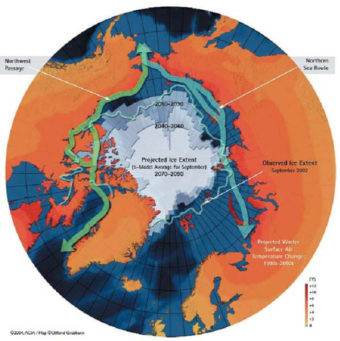
The National Oceanic and Atmospheric Administration on Tuesday released its annual Arctic Report Card, covering everything from rising temperatures on land and sea to sea ice declines and its impact on Arctic ecosystems and the rest of the world.

Since the beginning of the 20th century, the report finds surface air temperatures in the Arctic have increased by 5.2 degrees Fahrenheit.

Jackie Richter-Menge is with the Army Corps of Engineer’s Cold Regions Research and Engineering lab. She says half of that warming has happened in the last three decades.

“Between October 2014 and September 2015, the Arctic-wide annual average surface air temperature over the region was 1.3 degrees centigrade – or 2.3 degrees Fahrenheit – above the 1981-2010 baseline average,” Richter-Menge said.

That’s the highest annual average temperature in the observational record since it began in 1900.

Generally, Richter-Menge says air temperatures in all seasons were above average in the Arctic this year, with some reaching 5.4 degrees Fahrenheit above the baseline.

She says it was also an interesting year for sea ice, and the changes correlate strongly to the increasing air temperatures.

“In February 2015, the lowest-ever maximum ice extent in the satellite record – which begins in 1979 – occurred on the 25th of February,” Richter-Menge said. “This was 15 days earlier than average.”

And that record-low maximum was capped off with the 4th-lowest sea ice minimum on record in September 2015.

Along with declining sea ice, Richter-Menge says the composition of the sea ice has changed dramatically over the last few decades.

“In February and March, the oldest ice – defined as being greater than 4-years-old – made up 3 percent of the ice cover, while new first-year ice made up 70 percent of the ice pack,” Richter-Menge said. “Thirty years ago, in 1985, the composition of the ice cover was much different. Twenty percent of the ice pack was over 4-years-old and only 35 percent was classified as first-year ice.”

She says these observations confirm a trend toward a thinner, more vulnerable ice pack.

The ice pack isn’t the only thing made vulnerable by a warming climate. According to Kit Kovacs, with the Norwegian Polar Institute, marine mammals are greatly impacted – particularly walrus populations, which are hauling out on land rather than sea ice as they follow the retreating sea ice edge.

“This new haulout behavior is raising concerns about the well-being of females and their young that must now make a 180 km — that is 110 miles — feeding trips each direction from coastal haul-outs to areas of high prey abundance, rather than simply utilizing nearby ice edges as they did in the past,” she said.

Kovacs says fish populations are also changing in places like the Barents Sea – north of Scandinavia – where rising ocean temperatures are attracting fish species normally found in warmer waters, displacing cold-water, Arctic species.

Impacts are not limited to marine habitats. Martin Jeffries, an adviser for the U.S. Office of Naval Research, says the warming Arctic is resulting in lower snow pack coverage in May and June, and increasing water discharges from Arctic rivers.

“In 2014, the year for which we have the most-recent complete record, the combined discharge of the eight largest Arctic rivers was 10 percent greater than the average of 1980-1989,” Jeffries said.

The report says the changes recorded over the last few decades are clearly evident. And combined with projections of continued warming temperatures, we can expect to see further change throughout the Arctic in the future.

For Alaskans in Paris, climate talks hit home

Esau Sinnok, 18, of Shishmaref, with Interior Secretary Sally Jewell and others at the COP21 climate meeting in Paris. (Photo courtesy Arctic Youth Ambassadors)

On Saturday, representatives from around the world released a climate change agreement in Paris, the result of years of negotiations – and a final two weeks of intense talks.

Among the thousands of people who gathered in Paris over those two weeks to weigh in on the effort were several Alaskans.

Esau Sinnok is 18, he’s from Shishmaref, and during his time in Paris, he’s been interviewed by — it feels like — just about every major news outlet in the world.

“…from National Geographic… from CNN… and tomorrow I’ll be in an interview from Al Jazeera…” he said.

Sinnok is one of several Alaskans in Paris, where they were greeted as messengers from the front lines of climate change — though there’s also another predictable reaction.

“This old lady, French lady, asked where I was from, and I said, ‘I’m from Alaska,’ and her eyes just bulged out of her head,” Sinnok said, laughing.

It was a three-day trip from Shishmaref to Anchorage to Minneapolis, and finally to Paris. Sinnok went as a Youth Ambassador for the Arctic Council, and as a representative for the Sierra Club and the Indigenous Environmental Network.

He went to tell world leaders his stories from home: how his barrier island is losing ground to the sea; how ice forms later in the year, making hunting unpredictable; and, how for the first time in memory, he said, they’ve had rain in the winter.

He hoped to add urgency to the talks.

“I know that they’re doing their best in those meetings, but I feel like what they’re talking about won’t be in play for the next few decades,” he said. “And we need something done right now, because in 20, 25 years, Shishmaref will be under water.”

Esau Sinnok at home in Shishmaref. (Photo courtesy Arctic Youth Ambassadors)

Maija Katak Lukin is no stranger to press coverage, either. The Kotzebue city council member was mayor when President Obama visited this fall, bringing with him a global spotlight.

Lukin was invited to Paris by the State Department, and spoke on a panel with Interior Secretary Sally Jewell about what’s happening in the region around Kotzebue.

“I said, you know, we don’t call it a climate change adaptation plan, we call it a survival plan,” she said.

Lukin said she appreciated being able to tell her story, and it was fascinating to hear how communities from the Marshall Islands to Scandinavia are coping with a warming climate.

But every once in a while, she said, someone would ask — well, why do you live there? Why not just move?

“You know, it’s kind of difficult to stay diplomatic when somebody asks you, ‘Why is your life important?’” Lukin said. “Because that’s really what they’re saying.”

Princess Daazhraii Johnson works with the environmental group REDOIL. Speaking via Skype from her hotel room in Paris, she said she doesn’t want her state to be known only as the forefront of global warming. Instead, with its far-flung communities and often challenging environment, she hopes Alaska can become a leader in a different way — as a laboratory for the kinds of alternative energy systems, collaboration and ingenuity that will be needed to cope with a warming world.

She said, “I feel like we have the opportunity right now to really be a model for what is possible.”

Nearly 200 Nations Adopt Climate Agreement At COP21 Talks In Paris

This is a developing story. Please visit NPR for the latest updates.

Watch the conference live:

In what supporters are calling a historic achievement, 196 nations attending the COP21 climate meetings outside Paris voted to adopt an agreement Saturday that covers both developed and developing countries. Their respective governments will now need to adopt the deal.

Presenting the plan aimed at curbing global warming ahead of Saturday’s vote, France’s Foreign Minister Laurent Fabius told the delegations, “You go into this room to decide a historic agreement. The world holds its breath and it counts on you.”

The agreement, which was publicly released Saturday morning (ET), sets the goal of limiting the world’s rise in average temperature to “well below 2 degrees Celsius above preindustrial levels and pursuing efforts to limit the temperature increase to 1.5 degrees Celsius.”

Reporting on details of the deal, NPR’s Christopher Joyce says, “To help developing countries switch from fossil fuels to greener sources of energy and adapt to the effects of climate change, the developed world will provide $100 billion a year.”

French President Francois Hollande, right, French Foreign Minister and president of the COP21 meetings Laurent Fabius, second right, UN climate chief Christiana Figueres, left, and UN Secretary-General Ban ki-Moon join hands after the final adoption of an agreement at the COP21 United Nations conference on climate change. Francois Mori/AP
French President Francois Hollande, right, French Foreign Minister and president of the COP21 meetings Laurent Fabius, second right, UN climate chief Christiana Figueres, left, and UN Secretary-General Ban ki-Moon join hands after the final adoption of an agreement at the COP21 United Nations conference on climate change.
Francois Mori/AP

He adds that the 1.5-degree cap was sought by island nations.

Under the agreement, the Obama administration says that for the first time, all countries will be required to report on “national inventories of emissions by source” and also to report on their mitigation efforts.

President Obama spoke on the agreement late Saturday afternoon, saying the agreement was a strong one, showing what is possible when the world stands as one.

“We met the moment,” Obama said.

https://www.youtube.com/watch?v=zFCnajf2VQk

UN Secretary-General Ban Ki-moon said: “With these elements in place, markets now have the clear signal they need to unleash the full force of human ingenuity and scale up investments that will generate low-emissions, resilient growth,” adding that “what was once unthinkable has now become unstoppable.”

You can watch a livestream of the Paris event online.

Update at 3:05 p.m. ET: Hollande Gives Al Gore A Shout-Out

“You’ve done it,” French President Francois Hollande told the delegates in the hall, setting off a new round of applause. “You have succeeded where six years ago there was failure.”

Turning philosophical during his remarks, Hollande said that for everyone in the room today, they’ll someday face questions such as “What was the meaning of our lives, what did we achieve.”

And he answered, “one thing will come up time and again: you will be able to say that on the twelfth of December you were in Paris for the agreement on the climate. And you will be able to be proud to stand before your children and your grandchildren.”

Hollande went on to acknowledge the work on climate change by former U.S. Vice President Al Gore — who’s in attendance, and who rises and bows as people in the chamber yell and applaud.

We are entering a low-carbon age, Hollande said, adding later that the climate agreement represents the “most beautiful, most peaceful revolution” in the world.

Update at 2:27 p.m. ET: A ‘Tremendous Victory,’ Kerry Says

“This a tremendous victory for all our citizens,” Secretary of State John Kerry says. “It’s a victory for all the planet, and for future generations.”

Kerry said the deal “will help the world prepare” for impacts of climate change that are either already here or are on the way, adding that it could prevent the worst environmental effects from coming to pass. He went on to say that American enterprise and businesses would play vital roles in that process.

Kerry also praised the summit’s French hosts for their work on the agreement, particularly in light of the recent terrorist attacks.

“We’ve taken a critical step forward,” Kerry says, adding that the next actions will be equally important.

Update at 1:43 p.m. ET: ‘Single Most Important Collective Action’

Conservation International Chairman and CEO Peter Seligmann says the COP21 agreement “is a transformative diplomatic victory,” but he adds, “The hard work of delivery begins now. The security of nations and humanity depends upon the reduction of emissions and the protection of nature.”

The group calls the agreement “the single most important collective action for addressing climate change ever agreed upon.”

Update at 1:30 p.m. ET: Deal Is Adopted

The hall erupts into applause after no one objects to a final adoption of the deal to combat global warming and rein in greenhouse gases.

After the excitement dies down, Fabius is reminded he must use his gavel to make the results official.

“It’s a small gavel, but I think it can do a great job,” he says as he raps it on the table.

Update at 1:18 p.m. ET: The Session Has Begun

After hours of delays, Fabius begins the evening’s proceedings in France. The event quickly turns to correcting errors in the documents, such as differences between translations of the deal (it’s in six languages).

Update at 12:50 p.m. ET: U.S. Supports Deal; Meeting Still Pending

With delays slowing the start of the meeting, we’re hearing word that U.S. climate envoy Todd Stern says the United States will agree to the deal. Stern spoke to reporters as delegates entered the main gathering hall.

The Like Minded Group of Developing Countries — China, India, Saudi Arabia, and others — has said through a spokesman that they’re “happy” with the deal, the BBC reports.

Our original post continues:

“The end is in sight. Let us now finish the job,” UN Secretary-General Ban Ki-moon told delegates at the two-week meetings. “The whole world is watching. Billions of people are relying on your wisdom.”

The document includes two essential recognitions:

  • “that climate change represents an urgent and potentially irreversible threat to human societies and the planet and thus requires the widest possible cooperation by all countries”
  • “that deep reductions in global emissions will be required in order to achieve the ultimate objective of the Convention and emphasizing the need for urgency in addressing climate change.”

The deal also calls for five-year updates on how the plan is being instituted.

For it to take effect, all 196 individual governments in the UN’s Framework Convention on Climate Change will need to adopt the final document. Working out terms of the deal required adding an extra day to the conference.

“Major hurdles included how much wealthy countries would spend to help developing countries adapt to climate change,” NPR’s Christopher Joyce reports from Paris. Chris adds, “donor countries will retain the right to monitor how that money is spent.

Urging negotiators to seize a chance to change the world, French President Francois Hollande said Saturday morning, “History is here. All the conditions are met. The decisive agreement for the planet is now.”

Copyright 2015 NPR. To see more, visit http://www.npr.org/.
Read Original Article – December 12, 20155:40 PM ET
Site notifications
Update notification options
Subscribe to notifications