Climate Change

Conservation group says Obama should be tougher on Tongass

Tongass National Forest
Part of the Tongass National Forest in April 2008. (Creative Commons photo by Xa’at)

A federal proposal to make Southeast Alaska’s logging industry sustainable while preserving old growth in the Tongass National Forest does too little, too slowly, according to one conservation group. The Oregon-based Geos Institute says the Tongass National Forest draft plan is out of step with a global agreement to reduce climate change.

President Barack Obama visited Alaska in September to see the effects of climate change firsthand. Then, a few months later, the U.S. joined about 195 nations in signing the Paris Climate Change Agreement. The president has made reducing carbon emissions a talking point during his time in office.

“But his administration puts forth a plan that’s not ambitious enough,” said Dominick DellaSala, a scientist at the Geos Institute. What he’s referring to is the draft timber plan for the Tongass, which is open for public comment until February.

In a nutshell, the federal plan outlines dramatically reducing old growth logging while ensuring a sustainable supply of young growth trees. The problem, DellaSala said, is the plan isn’t aggressive enough.

“Those acres of trees over time being cut down would be equivalent to 4 million additional cars on Alaska roads every year,” DellaSala said.

That estimate is over a hundred years. The Geos Institute has been crunching the numbers with Forest Service data. DellaSala believes the transition from old to young growth logging could be done in five years, rather than 16. That’s what the plan is proposing.

DellaSala says trees soak up carbon dioxide from the atmosphere like a sponge. Essentially, a big stick of carbon.

“Now unfortunately, when a tree does fall in a forest and if it’s done by logging, you’re going to lose about 80 percent of that stored carbon,” DellaSala said.

Eventually, when it decomposes, it goes up into the atmosphere as greenhouse gas. And with old growth trees, DellaSala says you get more carbon.

With the Paris Climate Change Agreement, leaders came up with guidelines to slow global warming. They pledged to protect forests, like the Tongass.

“So it’s absolutely critical to everyone’s future that we keep those temperatures below that 4 degree Fahrenheit tipping point that most scientists believe that all hell will break loose in terms of climate change,” DellaSala said.

Owen Graham isn’t concerned with the Paris Climate Change Agreement. He’s the executive director at the Alaska Forest Association, a timber industry group.

“You know, I don’t really give a damn about the Paris, what they did over there with climate change,” Graham said.

Graham thinks the Tongass draft plan already transitions to young growth trees too soon. Any sooner could be devastating.

“That’ll put the local sawmills out of business. And it seems kind of pointless. It’s just cutting the trees early and exporting them,” he said.

Graham said most mills in the area can’t process the less valuable product. So the trees would likely be shipped overseas or down south, resulting in the loss of hundreds of regional jobs.

“The industry that we’ve had in Southeast Alaska has never been a big industry despite what you hear from some of the environmental groups,” Graham said. “We’ve never been a big industry and we’ve never had a significant impact on anything, let alone global warming.”

Dominick DellaSala said the goal of his report isn’t to reduce jobs. It’s to find alternatives.

“I think we need to demonstrate that with a pilot study that these young trees can be processed locally. They can add jobs and they can have value to them,” DellaSala said.

Forest Service reps said they need more time to review DellaSala’s report before commenting. But DellaSala says the clock is ticking. The president is wrapping up his term.

“This is not a legacy gift to Alaskans when we still have this much old growth on the table,” DellaSala said.

How much old growth is on the table? According to the plan, more than 43,000 acres by about the year 2117. That sounds like a lot. But it’s about a quarter of a percentage point of the entire Tongass.

The Forest Service is holding an open house on Jan. 19 to discuss the draft plan on the Tongass. It starts at 5 p.m. at the Juneau Ranger District conference room. Public comment ends Feb. 22.

Alaskans fly south for Arctic symposium

The Canadian Coast Guard Ship Louis S. St-Laurent makes an approach to the Coast Guard Cutter Healy in the Arctic Ocean. (Photo by Patrick Kelley/U.S. Coast Guard)

The University of Washington School of Law is hosting policymakers from Alaska and around the country for discussions on Arctic security and politics, development, transportation and shipping, environmental protection, and climate change.

The third annual Arctic Encounter Symposium runs Friday through Saturday in Seattle.

Elected Alaska officials, academics, municipal and Native corporation representatives, and some of the Coast Guard’s top officers are expected to attend.

Bethel Rep. Bob Herron is part of a panel that will discuss development of a port system, and improving communications and mapping of the Arctic. He said they’ll also talk about reducing heating costs, developing adequate water and sewer systems for Arctic communities, and responding to the effects of climate change.

“I think that we have to remind them that maybe we are the best to be deeply involved, and not to take us for granted,” Herron said.

Lt. Gov. Byron Mallott, Anchorage Sen. Lesil McGuire and Craig Fleener, the Walker administration’s Arctic policy adviser, are some of the other Alaskans participating in panel discussions or addressing the conference.

Herron is attending again this year in his role as chair of the House Economic Development, Tourism & Arctic Policy Committee. He admits to being annoyed whenever he hears comments from nonresidents that imply that Alaska needs saving from Alaskans.

“We’re not someone’s convenient snow globe so they can look inside the snow globe and see all these little fur-clothed, subsistence people living in a zoo, in a museum, in an environment where they must protect it,” Herron said. “There’s a couple times where I’ve felt that I’ve been patted on the head and they’ve said, ‘Don’t worry. We’ll take care of you.'”

Alaska Sen. Lisa Murkowski and Washington Sen. Maria Cantwell, co-chair and ranking member of the Senate Energy and Natural Resources Committee respectively, will also attend the symposium.

Herron said it’s good that the symposium is being held in Seattle this year.

“We’ve got to bridge this Pacific Northwest, western Canada future,” Herron said. “You can’t separate Alaska from the Arctic. You can’t separate Alaska from our Canadian neighbors. And, even though we’re not directly connected to the Pacific Northwest, we still have all that history.”

Temperatures up by 50 Degrees at North Pole

On July 12, 2011, crew from the U.S. Coast Guard Cutter Healy retrieved a canister dropped by parachute from a C-130, which brought supplies for some mid-mission fixes. The ICESCAPE mission, or "Impacts of Climate on Ecosystems and Chemistry of the Arctic Pacific Environment," is a NASA shipborne investigation to study how changing conditions in the Arctic affect the ocean's chemistry and ecosystems. The bulk of the research took place in the Beaufort and Chukchi seas in summer 2010 and 2011. (photo by Kathryn Hansen/NASA)
Crew from the U.S. Coast Guard Cutter Healy retrieve a canister dropped by parachute, which brought supplies for some mid-mission fixes. (Photo by Kathryn Hansen/NASA)

The North Pole is melting. Or so say many news outlets. But Walt Meier, a research scientist for NASA and a co-author of the National Oceanic and Atmospheric Administration’s 2015 Arctic Report Card on Sea Ice, says that’s not quite accurate.

“I’ve seen stories on that, and they’re kind of misleading,” Meier said.

Meier explains that what’s actually happening is a strong low pressure over Iceland is funneling warm air up into the Arctic and toward the North Pole, resulting in air temperatures slightly above freezing.

While Meier does say that much of the media’s coverage about the melting at the North Pole is overblown, temperatures are generally much lower this time of year.

“You’re normally at -20, -30 degrees Celsius up at the North Pole at this time of year,” Meier explains, “so that’s a really anomalously warm weather system that’s moving through there.”

Although there aren’t records that show how often something like this has happened in the past, there are records that indicate a warming climate.

According to both NASA and NOAA scientists, 2014 was the warmest year since 1880, and 2015 is on track to be even warmer. While the rest of the world has warmed by an average of 1.4 degrees Fahrenheit, the Arctic has warmed by twice as much.

Despite a history of rising temperatures and an anomaly of warm air funneling up from Iceland, Meier clarifies that the North Pole hasn’t turned to slush quite yet.

“When you have temperatures like that, you would have some surface melt, but you know it’s still ice covered,” he said.

Meier says there’s probably still 6 to 8 feet of ice at the pole.

The low pressure causing the spike in temperatures at the North Pole is the same weather system that recently led to blizzards in the southwest, tornadoes in Texas and flooding in the Midwest.

The system is expected to move off the pole by next week, bringing temperatures back down to the normal -25 degrees Celsius.

After two years, is The Blob finally dead?

SST anomalies Pacific Nov.-Dec. 2015
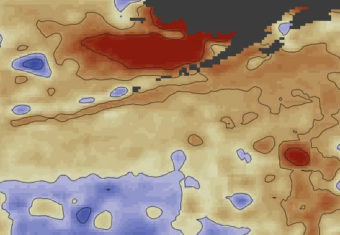
Sea surface temperature maps from early November (left) and early December (right) show declines in warm water anomalies that became known as The Blob. (Image courtesy of NOAA Fisheries/Southwest Fisheries Science Center)


Northeast Pacific sea surface temperatures suggest an unusual mass of warm water has either diminished dramatically or even started dissipating in November.

“It’s an evolving system,” says Nicholas Bond, a senior scientist at NOAA’s Joint Institute for the Study of the Atmosphere and Ocean at the University of Washington. In a monthly newsletter Bond wrote while working as the Washington State Climatologist, he coined the nickname The Blob for the area of ocean which showed increasing sea surface temperatures in October 2013.

“We can see the beginning of the end for The Blob,” Bond says. “But, by some measures, it’s still got its ugly head. It’s still rearing.”

At its peak, The Blob generated ocean surface temperatures that were 2 to 3 degrees Celsius above average. Now, temperatures are only .5 to 1.5 degrees Celsius above average.

“It has moderated to an extent. Whether it’s gone or still there is kind of a matter of taste,” Bond says. “But it is warm enough there relative to normal that it’s probably having an impact on the weather, especially in places right along the coast.”

Temperatures are still slightly above normal near shore, but temperatures have significantly cooled to near normal in some areas far offshore in the middle of the Northeast Pacific.

What does The Blob look like right now? Click here to see live maps of Eastern Pacific sea surface temperatures from NOAA’s Southwest Fisheries Science Center.


One of Bond’s colleagues claims The Blob is already dead.

“The big amplitude of warm water is gone and there’s no reason to expect it to reform at all,” says Cliff Mass, a professor of atmospheric sciences at the University of Washington.

Mass says persistent high pressure over the northeast Pacific earlier moderated winds near the ocean surface.

“Which means there’s less mixing in the upper ocean and which brings up less cold water from below,” Mass says.

But Mass says that high pressure hasn’t been as persistent lately, and more cold water is now being stirred up from below.

“It’s really changed. That’s because of El Niño,” Mass says. “The El Niño circulation works against The Blob, and that’s progressively happening now.”

Scientists believe that this winter’s El Niño, a phenomenon associated with equatorial ocean warming, could be the strongest in decades. That, Mass writes in his blog, should be good news for Pacific Northwest ski areas.

Bond believes the ocean is still retaining enough heat energy for The Blob to persist for at least several more months, and it could actually be reinforced by El Niño near shore.

Aside from affecting weather patterns and prompting changes in precipitation, the higher sea surface temperatures may also be responsible for recent sightings of unusual species in the northeast Pacific, such as sunfish and tuna. But Bond says those are anecdotal accounts of stragglers getting swept up north. He says it’s more important to consider what is happening at the base of the food chain where there may be more warm water plankton than cold water plankton.

“That’s actually a big deal because those cold water species are bigger and have more fat in them. So, more calories for the small fish, the juvenile salmon and so forth that feed on them,” Bond says. “That kind of transition that we’ve seen over the last year or so is kind of still going on and it is having impacts on the whole marine food web.”

Bond says juvenile salmon and seabirds may be doing poorly along the West Coast while tuna could benefit from the increased temperatures.

Scientists from a variety of fields will converge on Seattle next month for another conference on recent changes and impacts of The Blob. Biologists and climatologists previously met last May in San Diego.

Russian icebreaker makes record-setting Arctic voyage

This projection shows Arctic sea ice coverage will substantially decrease by 2070. (Image courtesy of the University of Arctic Council)
This projection shows Arctic sea ice coverage will substantially decrease by 2070. (Image courtesy of Arctic Council)

According to the Russian media outlet Port News, a Russian icebreaker has just completed the fastest transit of the Northern Sea Route. Along with setting the speed record, the icebreaker also completed the trip over a month after the shipping season usually ends in the Arctic. But it’s still a long way off from becoming the next great trade route.

The Northern Sea Route runs along Russia’s Arctic coast from the Barents Sea in the west to the Bering Strait in the east.

The Vaygach, a nuclear-powered icebreaker, took just seven and a half days, or one hundred and 85 hours to be exact, to complete the trip. It left from the Siberian side of the Bering Strait Dec. 17, covering over 2,200 nautical miles before reaching its destination in the White Sea on the 25th.

Statistics do show a handful of other trips taking fewer than eight days, so it’s not the speed that’s most impressive, but the time of year it took place. According to statistics from the Northern Sea Route Information Office, the last three shipping seasons wrapped up in mid-November. The Vaygach started its trip in mid-December, completing the record-breaking journey on Christmas Day.

Walt Meier, a research scientist for NASA and co-author of NOAA’s 2015 Arctic Report Card on Sea Ice says the successful transit is a sign of changing ice conditions in the Arctic.

“You know, doing it this late in the year, is pretty unusual and is an indication that the ice is pretty thin, you know they have confidence that they can get through without too much trouble,” Meier says.

That confidence was showcased at an international Arctic forum in St. Petersburg in early December, where Russia’s deputy Prime Minister Dmitry Rogozin said the Northern Sea Route could soon be operational year-round. But despite the record transit and the proclaimed potential of the route, Andreas Østhagen a senior fellow at the Arctic Institute’s, doesn’t think this is this start of an Arctic boom.

“When I read this story, though initially, I’m assuming that what they’re doing, and by ‘they’ I mean the Russian authorities, is just highlighting the capabilities they have,” Østhagen says.

Those capabilities include the largest fleet of icebreakers in the world, with more than Norway, Canada, Demark and the U.S. combined. While Russia’s unmatched fleet allows them to offer more escorts and assistance along their Arctic coastline, it hasn’t exactly attracted to more international traffic.

The number of vessels that traveled the full-length of the route dropped from more than 70 in 2013 to less than 20 in 2015. The amount cargo transported dropped even more dramatically by about 97 percent in just two years.

So what can explain all this? Østhagen says, among other factors, the recent plunge in oil prices means the shorter route is just less attractive to international traffic.

“And then you have the incidents in Ukraine in 2014 naturally hampering the operational environment, maybe not directly, but at least indirectly. The business climate for Russian collaboration in the Northern Sea Route was damaged to some extent,” Østhagen says.

Despite persisting political tensions, there is one type of traffic that has been on the rise: Destinational traffic, or intra-transits as Østhagen describes them.

“When you look at the numbers for this year, I think it’s quite obvious that what is taking place in the northern sea route is intra-transits, so transits with a destination in the Northern Sea Route itself,” Østhagen says.

Russia granted over 700 permits for vessels traveling along the route, a number that has steadily risen over the past few years. The amount of cargo is also up, nearly doubling between 2013 and 2015.

So what’s next for the Northern Sea Route? While it’s hard to predict how the political climate may shift, NASA’s Meier says the changing climate in the Arctic is leading to thinner ice.

“And as the ice is thinner, it’s more easily blown by the winds as well, so it can more easily move away from the coast,” Meier says.

With any luck the right winds, the Northern Sea Route will be back open for business in June of next year.

Take a break from the holiday hustle to explore Earth’s oceans, atmosphere

Market squid
Market squid hatch in the wet lab at the Ted Stevens Marine Research Institute this summer. (Photo by Matt Miller/KTOO)

Looking for something to do during the holiday season aside from Christmas shopping and holiday parties? Perhaps something that is educational as well as entertaining? And free?

Staff at the National Oceanic and Atmospheric Administration’s Ted Stevens Marine Research Institute are offering free tours through next week.

Outreach educator Ralph Steeves says the tour focuses on the two missions of the Point Lena facility: assessment of the North Pacific fisheries stocks and study of the climate and health of the ocean.

“So, we visit the biology labs, the chemistry labs, the genetics labs,” Steeves says. “We will go into what they call the wet lab where we have live specimens going that are going through experimentation in regards to climate and water temperature. We also talk about some very interesting technology that keeps the building warm. This is a building is one of the only ones in the federal government that relies on no fossil fuels for heat.”

The hourlong tour through the facility includes artifacts from scientists studying Alaska’s fisheries and marine mammal populations, the wet lab where many of the research experiments are conducted, the heat exchange system which uses ocean water to heat or cool the facility and the lobby aquarium. It’s a bit like the tour offered to visitors during the summer season.

Science on a Sphere
Science on a Sphere that was located at the now-demolished Alaska State Museum shows ocean currents in this view. (File photo by Matt Miller/KTOO)

“And then, we have a presentation on the Science on the Sphere which is that globe you may have seen at the (Alaska State) Museum in the past. Of course, it’s decommissioned right now while they’re building SLAM,” Steeves says. “In Juneau (we’re) very fortunate. We’re the only city in the entire world that has two of them. One of them is here at NOAA. We have a presentation on that that talks about the other things that NOAA does beside fisheries, and some current data on climate change.”

Steeves says the Science on a Sphere presentation runs about 25 minutes and the whole experience at the lab runs about an hour and a half.

Tours are offered every weekday at 1 p.m. through next week. There’ll be no tours on Christmas Day, the following Friday of next week or New Year’s Day, when the facility is closed.

Call ahead at 789-6050 if you want to reserve a spot in the daily afternoon tours that are usually limited to a dozen people 16 years and older. Tours can also be arranged by appointment.

Most importantly, Steeves says don’t forget to bring your camera.

Related videos:

NOAA’s Joe Orsi describes a large ocean sunfish that was caught in a trawl during summer 2015.

NOAA’s Gordon Garcia describes an attempt to hatch market squid during summer 2015.

Site notifications
Update notification options
Subscribe to notifications