Climate Change

Eaglecrest to suspend operations March 21

Eaglecrest 160228 Logjam low snow
Patches of bare ground dot the Logjam run at Eaglecrest Ski Area on Feb. 28. (Photo by Sarah Moore)

Eaglecrest Ski Area is heading into what may be its final two weekends of the season.

The city-owned ski area announced Friday that it will suspend its operations Monday, March 21. Previously, general manager Matt Lillard said the suspension would come after this weekend.

They only expect to open the beginner area off the Porcupine Chairlift.

If significant snow does come, officials say staff will be prepared to reopen.

What’s so critical about polar bear habitat?

Polar bear jumping on fast ice. Creative Commons photo by Arturo de Frias Marques)

A federal appeals court last week ruled the U.S. Fish and Wildlife Service was following the law when it designated a California-sized piece of the Alaskan Arctic as critical habitat for the polar bear. The ruling dismayed the state of Alaska, the oil industry and several Native groups. They’d challenged the habitat designation, saying it was too broad and would deter activity in the region. Let’s take a look at this designation and what it could mean for the industry.

The first thing to know is that this habitat is an enormous area, but 96 percent of it is off-shore, covering sea ice or sea. The 4 percent that’s on land is a band of coast that stretches from the Canadian border in the northeast to Barrow, and all the barrier islands, down to Hooper Bay in Western Alaska.

U.S. Fish and Wildlife Biologist Ted Swem says the habitat designation won’t require anyone to get any new permits. For oil companies, he says, it just adds a question for federal permits they’d have to get anyway.

“In my experience it adds paragraphs or pages to the length of a document, and that requires the project applicant and the federal agency with which we’re working to add more text, and we have to have more thought and more discussion …. But it doesn’t add weeks or months to the process.”

That’s because, Swem says, regardless of whether the habitat is designated, the polar bear is listed as a bear2threatened species. Under the Endangered Species Act, he says, any federal permit for development in this area of the Arctic already requires consultation with his agency, to evaluate its impact on the bear. And here’s the thing: even without the habitat designation, Swem says Fish and Wildlife still has to look at the impact on the habitat, because harming the habitat could harm the bear.

“Every place there’s critical habitat, there is also polar bears,” as Swem put.

The habitat designation adds a new question– what’s the impact on the bear’s habitat? — but the answer is roughly the same.

“Not just roughly, but I would say it would be the same.
Swem says. “It has been the same. In my experience, the answer is the same.”

Swem cites Point Thomson, the Exxon project on the North Slope, as an example. Exxon got the crucial wetlands permit for that in 2012 when the polar bear habitat designation was in place before the legal challenge put it on hiatus.

“And it was right on the coast and it is in critical habitat, and I would contend that it didn’t affect that development at all, to have that project within critical habitat,” Swem says.

The Corps of Engineers’ wetlands permit required Exxon to bring two drilling pads in from the coast a bit and shrink a third, to accommodate polar bears coming ashore. The Corps also required Exxon to pay compensation for filling 267 acres of wetlands, at a 3-to-1 ratio. That meant paying a conservation fund to preserve 801 acres elsewhere. Exxon won’t say how much they had to pay, but safe to say it was several million dollars.

Joshua Kindred, an environmental attorney for the Alaska Oil and Gas Association, an industry trade group, contends the habitat designation adds exponentially to that kind of cost.

“If an area of land in which say a developer want to develop is critical, then the Corps puts sort of an automatic multiplier on the value of that land, from a wetlands mitigation standpoint,” he said.

That’s not how the Corps of Engineers sees it.

“There’s no one thing that says ‘OK this is habitat for a polar bear, therefore the wetland mitigation ratio is X,” says Sheila Newman, chief of the Special Actions Branch, in the regulatory arm of the Corps of Engineers-Alaska District.

It’s not easy to explain the Corp’s evaluation methods. Newman says they examine wetland “functions” but have no standard assessment tool. They use several. Newman says they’re trying to pare down the methodologies so companies can better predict their mitigation costs.

“But, you know, we are not there yet,” she says.

But, she says, on all the assessment tools in use, it wouldn’t make a difference whether an area is a designated critical habitat or just a place where polar bears tend to be seen.

“So the critical habitat designation, in itself, does not make a difference at all,” she said.

Kindred, from the Alaska Oil and Gas Association, says the designation, if nothing else, adds uncertainty to a project. He says AOGA and the other plaintiffs haven’t decided yet whether to pursue their legal challenge further.

Warm water Blob is prime suspect in marine mortality, habitat changes

Kodiak fin whale necropsy
Scientists performed a necropsy on this fin whale, found on Whale Island in the Kodiak Archipelago in
June 2015. It was the only whale that scientists were able to access to get a sample for testing. (Photo courtesy Bree Witteveen/Alaska Sea Grant Marine Advisory Program)

Scientists are increasingly alarmed about the potential for more species die-offs and other adverse effects on marine mammals and seabirds if the suspected cause, a huge anomaly of warm water in the northeast Pacific Ocean, persists into summer. The warm seawater may be a catalyst for a variety of ongoing ecological incidents along the West Coast, including a breakdown in the marine food web.

Listen to part 1 of the broadcast version of the story:


Biologists and ecologists reported on a distressing list of affected marine species at a recent two-day workshop at the University of Washington. The conference was a follow-up to a similar gathering held last May in La Jolla, California, that primarily featured climatologists. oceanographers and marine researchers.

“I just wanted to point out that ‘14 and ‘15 have been two of the warmest years on record for temperatures in coastal Alaska,” said Russell Hopcroft of the University of Alaska Fairbanks’ School of Fisheries and Ocean Sciences, hinting at the potential environmental and economic impacts of the warm water anomaly that has lingered in the northeast Pacific Ocean for the last two years.

“This is fed back through the state and may even be responsible for increased wildfires in the past year,” Hopcroft said.

Out at sea, the warm water mass may be depriving fish, seabirds and seaweed of their normal food sources. Water temperatures down to a depth of 300 feet have ranged from 2 to 8 degrees Fahrenheit above normal.

One theory considered by marine researchers and biologists is a distinct layer of warm water on top of cold water is creating stratification of the water column in which plankton and nitrate nutrients are prevented from rising to the surface.

“Certainly the salmon returning this year — the pinks that only go out for two years, so they were out in 2014 and 2015 — were coming back about half weight,” said Richard Dewey of Ocean Networks Canada and the University of Victoria. “The herring are half weight.”

“And so, the northeast Pacific has been pretty malnourished,” Dewey said. “I think the nourishment comes from the wind mixing of nutrients up into the Gulf of Alaska.”

Copepod
A microscopic photo of Neocalanus cristatus, a large lipid-rich, sub-Arctic species of copepod. It’s a form of plankton found commonly in the Gulf of Alaska as well as off the Pacific Northwest in late-winter and spring. (Image courtesy Bill Peterson/NOAA-NMFS Newport Research Station)

Young salmon and herring usually feed on plankton, but some plankton species such as warm water copepods have fewer lipids or less fat content than cold water species.

For the first time in his over 30-year career, Bill Peterson, an oceanographer at the National Oceanic and Atmospheric Administration’s Newport Research Station in Oregon, said he saw 11 new species of warm water copepods just appear on the West Coast.

“The copepods tell us that water came from a long ways away,” Peterson said. “Where it came from, I don’t know. But it’s an issue we have to solve, I think. This water just didn’t sit there and warm up. It came from someplace different.”

As an example, an alarming spike in sea lion strandings along the California coast over the last two years may be caused, in part, by the incoming mass of warm water. Upwelling of ocean water near the coast would normally stir up cold water copepods that would be a major food source for sardines and anchovies. That upwelling was reduced dramatically or completely overwhelmed when the warm water mass moved right up to the shoreline. Sardine and anchovy populations relocated northward to find food, and sea lions may have been deprived of a major food source for themselves and their pups.

The bodies of common murres litter the beaches of Prince William Sound and many other areas around Alaska. Some of the seabirds have been found some 350 miles inland, around Fairbanks. (Photo by David Irons)

It’s possible such breakdowns in the marine food web were also the cause of the extraordinary number of whale strandings, as many as 30 were reported along Alaska’s coastline last year. There’s also the near-complete collapse of the pollock hatchling population around Kodiak Island, and this winter’s die-off of over 22,000 common murres in Alaska. Recent speculation has included starvation as a possible cause of the seabird deaths.

Scientists are also curious about whether The Blob was responsible for absence of nitrate nutrients that led to jellyfish blooms and devastation of kelp beds along the West Coast.

There was also an observed shift in the diatom population, outbreaks of paralytic shellfish poisoning, and crashes in the populations of Cassin’s auklets, Heermann’s gulls and other seabirds.

Eric Bjorkstedt, fisheries researcher at California’s Humboldt State University and the Southwest Fisheries Science Center, said they’re seeing more algae blooms which spread toxins such as demoic acid that pervade the entire food web. Bjorkstedt said one of his colleagues described it as a “wicked cauldron of nastiness.”

“That might explain why crab are so affected,” Bjorkstedt said. “This is a big deal, especially in our little neck of the woods where crab is a huge part of the economy. The fact that it’s still closed because of demoic acid is a big problem.”

Sea star wasting disease is affecting starfish populations throughout the Pacific, from Alaska to Baja California. (Photo by Kit Harma, pacificrockyintertidal.org)
Sea star wasting disease is affecting starfish populations throughout the Pacific, from Alaska to Baja California. (Photo by Kit Harma/pacificrockyintertidal.org)

Steve Fradkin, a coastal ecologist at Olympic National Park in Washington state, said they’re investigating a potential link to a disease that has infected over 22 species of sea stars all along the West Coast.

“The incidence of sea star wasting disease appears to be related to warm water temperature anomalies,” Fradkin said. “So, whenever the temperature anomaly is 1 and a half degrees or greater, we see a spike in sea star wasting disease.”

Northern fur seal pups on St. Paul Island, Alaska. (Photo courtesy of NOAA)

Some species may be able to tolerate such a dramatic temperature change for only a short period of time. For example, reports of California sea lion and Northern and Guadalupe fur seal strandings noticeably jumped in 2014, and then skyrocketed to unprecedented levels in 2015.

“Warm anomalies have persisted for more than two years, and it looks like the real killer was the second year,” said Art Miller, research oceanographer at Scripps Institute of Oceanography in La Jolla. “So, perhaps animals could be resilient to one bad year. But if you start stacking them up, things could start to get precipitously worse.”

Birth of The Blob, and death by El Niño?

Of course, correlation doesn’t necessarily mean causation. Whale and seabird die-offs, for example, have not yet been conclusively linked to the lack of forage. Scientists want to do more research before pinning any blame on The Blob, or even going as far as suggesting that the phenomenon is a product of climate change.

Nicholas Bond, the Washington state climatologist who first highlighted the warm water anomaly and coined the nickname that evokes images of the old Steve McQueen teen horror movie, believes the genesis of The Blob was in the far western, subtropical Pacific Ocean in 2013.

“It really is a mix of different mechanisms here, and at different places and different times,” Bond said.

Listen to part 2 of the broadcast version of the story:


The mass of warm water, which grew to several thousand miles in width, became more apparent as it showed up in the northeast Pacific, the Gulf of Alaska, and then down the coast to Baja California.

Bond said they’ve all been a bit simplistic in thinking about The Blob physically moving around the northeast Pacific Ocean.

“For example last winter, very warm air coming up along the West Coast, record heat in the Pacific Northwest, and so forth,” Bond said. “It wasn’t just The Blob getting bodily moved with the mean currents.”

Bond said it’s the lack of surface fluxes, or transfer of energy through cooling, evaporation, wind and turbulence to cool the ocean. The Blob’s persistence over two years may have been partly due to a weak atmospheric pressure system called the Aleutian Low that did not generate the usual storms and necessary winds for cooling the sea surface.

“There’s a lot of north-south and east-west things here happening,” Dewey said. “I’m cautious about saying there’s one smoking gun.”

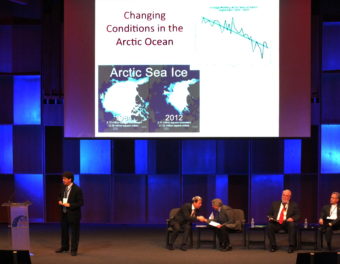
Dewey suggests that a storm in August 2012 blew out much of the summer sea ice in the Arctic. The lack of ice cover allowed for more heat retention in the Bering Sea and Arctic Ocean, and less cold water eventually flowed south into the Gulf of Alaska.

“It’s not so much as where did the warm water come from,” Dewey said. “We had an absence of cooling.”

There’s evidence that an earlier version of the warm water anomaly appeared in 2004 and 2011, and some scientists believe the current Blob may be dying or already dead. But dissenters like Dewey believe there is still enough heat energy deep below the surface to keep anomaly active through this summer.

“Is it dead yet?” Dewey asked. “So, the Monty Python reference here: ‘I’m not quite dead’ to go on the cart. But, no, perhaps it’s very ill.”

Ecologists, biologists and oceanographers appear to be hoping for the worst for The Blob.

“That’s what frightens me,” Peterson said. “It’s not so much the big problems we’ve had last year and this year. But if this goes on one more year, we’re going to have a lot of dead salmon on the beach, a lot of dead sea lions, a lot of dead fur seals, a lot of dead auklets, murres. It’s just going to be a nightmare.”

Alaska UME bears feeding on whale
Bears feeding on a fin whale carcass on the southwest shore of Kodiak Island, near the mouth of the Sikhoi River in June 2015. (Photo courtesy of NOAA/edson_ca)

One big wild card is El Niño, the phenomenon associated with equatorial warming of the Pacific Ocean. This year’s El Niño is among the top three strongest events ever recorded, and it could influence marine and atmospheric circulation patterns that stir up the water column and cool the sea surface. It could help kill The Blob, or as one scientist suggested, it could also set the scene for an oceanic tag team wrestling match in which The Blob’s impacts are later exacerbated and prolonged by El Niño along the West Coast.

Oceanographers and atmospheric scientists say there is a good chance that El Niño will probably peter out by summer, followed by the pendulum swinging the other way to equatorial cooling, or La Niña, later this year.

“So, we have to pray for La Niña,” quipped Miller after hearing hours of dire reports of possible cascading biological catastrophes.

About 100 researchers specializing in salmon ecology will participate in a three-day conference in Juneau in late March. Discussions will center on how the recent warm water conditions may affect this season’s salmon production from Alaska to California.

(Correction: Restored dropped contraction in the sentence referring to correlation vs. causation that was the result of an editing error.)

Researcher: Science must protect key species from climate change-driven extinction

Mark Urban and other researchers say climate change could wipe out one-sixth of Earth’s species that won’t be able to adapt to the warming planet.

Mark Urban shown under a sheet of auefis in Alaska. These ice sheets form over Arctic underground springs but have become less prevalent with global warming. (Photo courtesy of Mark Urban)

“Some species will be just fine – in fact, will do better in a changed climate,” Urban said. “But then there are the others that are in serious danger.”

Urban is an associate professor of ecology and evolutionary biology at the University of Connecticut, and he’s studied among other things climate-change impacts on species that live north of the Brooks Range. Urban says that’s given him a chance to see how rapidly the Arctic is warming – and to realize the need for much more research on how to protect the most important species from extinction. Sort of like how an emergency-room physician would employ triage in a mass casualty situation.

“We’re going to have to live through basically a global heat age,” he said. “And we’re going to have to figure out ways to adapt and create resilient communities and also ecosystems in response to that. Because we want to make it through the heat age with the least number of casualties as possible.”

Urban says native lake trout likely would be considered a biotic multiplier of climate change species. (Photo courtesy of the Alaska Department of Fish and Game)

Urban says researchers should identify species he calls “biotic multipliers of climate change” – key species on which whole ecosystems depend. Like the lake trout of Alaska’s far north.

“It’s a species that’s both sensitive to climate change and also has a huge effect on the rest of the ecosystem,” he said.

University of Alaska Fairbanks marine biology professor Russ Hopcroft says Urban’s proposals make sense for smaller ecosystems, such as ponds and lakes, and higher-order animals that live in them.

“So it works for some types of birds,” Hopcroft said. “It works on a lot of mammals. And it can work on some types of fish which are very tied to specific habitats.”

But Hopcroft says Urban’s concepts may not apply in bigger ecosystems.

“When we move into the ocean,” he said, “it’s much harder to start talking about ‘keystone species.’ And, in particular, the ability to do any kind of management or remediation.”

Hopcroft says the best solution to climate change would be a global response that includes protecting all species and habitats.

Early seal hunt highlights unseasonable weather, uncertainty in Northwest Alaska

A bearded seal rests on ice off the coast of Alaska June 21, 2011. (Public Domain photo by John Jansen/NOAA Alaska Fisheries Science Center)

One of the warmest winters on record in Alaska means the spring season for bearded seals, or ugruk, has come nearly two months early for some hunters in Western Alaska. Warm weather makes the hunt a little easier, but locals are concerned about precarious sea ice and unpredictable weather.

The village of Wales sits out on a point, along the Bering Strait coast, midway between Kotzebue Sound and Norton Sound.

“We live right on the bottleneck of the Strait,” explained Clyde Oxereok. He’s a seal hunter in Wales. He says hunters there are already gearing up for their spring ugruk hunt, which usually doesn’t start until April.

“Some of the hunters there are saying we have to get ready now because our leads are opening up, and when they open up, we’re hungry for the fresh meat and the fresh oil, and it’s coming earlier every year,” said Oxereok.

Ben Payana is also a seal hunter from Nome. “I’m a King Island descendant. My dad was born and raised for a little bit on King Island, and he brought me up doing all the ocean hunting, marine mammal hunting and that’s what I do now, every year.”

Payana explained the basics of hunting a seal. “Right now, if I were to go seal hunting, I would try to get up somewhere high and look out on the ice and try to find some leads, and then you’d go load up your snow machine and little row boat or whatever you’re going to retrieve the seals with,” he explains. “(Then you) try to find your way to that lead and then hang out on the edge of the ice there until some seals swim by, and then hopefully you’ll see one, shoot one, and be able to retrieve it in time,” he said.

Seal hunting can happen year-round and there are many species. Hunters usually wait until April to hunt ugruk, but the weather has been unseasonably warm this February.

As Payana stood along the coast in downtown Nome, he looked out over the sea ice.

“I see a lot of jumbled up, not very good ice for traveling,” he said.

Only a few days ago, steam rose from a large swath of open water, but a north wind blew big chunks of ice back up against the coast, so today, the bumpy, blocky edges peak out from windblown snow that seems to stretch for miles. Payana says there’s another problem with this ice.

“ … (it’s) not very thick ice out there for the seals to be denning in, because they should be having their pups in March and April, too,” he said. “I’m not a seal, but I would imagine they would prefer some thicker ice and more snow cover so they can have a nice safe den for their pups,” said Payana.

The story of this year’s sea ice up and down Alaska’s northwest coast is, well, jumbled.

“It’s a complicated picture,” said Becki Heim. She leads the Sea Ice Program for the National Weather Service in Alaska. There is no shore fast ice at Unalakleet to the south, or up in Kivalina to the north this year. Residents along the coast have posted photos and videos of thin ice and open water on social media sites all winter. Heim blames offshore winds.

“(The winds) have continued to blow the thickest ice that keeps refreezing out into the deeper waters offshore,” explained Heim. “What it’s doing is it’s leaving very thin, new ice near shore, so that’s why there’re more leads and thinner ice and access to the water,” she said.

Heim said it’s not rare for wind and sea ice to interact this way. But Clyde Oxereok said in recent years, not only is the ice less reliable but so is the weather.

“We can’t predict the weather,” he said. “We’re not going to 60 or 80 miles, even 30 or 40 miles anymore, which we used to do, because we knew the weather would hold. Now, we can’t predict that anymore. So that being said, we have to harvest what’s there when it’s there when we have the opportunity to go and get it.”

Otherwise, said Oxereok, they could miss out on the ugruk harvest entirely.

Dennis Davis of Shishmaref has also seen the weather become more unreliable in the winter.

“When I was growing up with my grandpa in Kotzebue in the late 80s and early 90’s, when they had dog teams and stuff like that,” said Davis, “you had to know how to read the weather or wonder what it’s going to do. Nowadays, it’s either hit or miss. You never know what’s going to happen,” he said.

People like Davis understand that the Arctic is always changing. But what’s unclear is how best to adapt to the increasing uncertainty of what change means for the sea ice, the weather, and a subsistence lifestyle.

Warm winters threaten retail and recreation in Anchorage

Alaska Mountaineering and Hiking
The snowless parking lot outside Alaska Mountaineering and Hiking in Anchorage’s Spenard neighborhood. (Photo by Zachariah Hughes/Alaska Public Media)

It’s been a terrible winter for Anchorage by just about every measure.

Warm weather systems have turned what little precipitation has reached the municipality into rain and ice, ruining many of the recreational activities residents wait all year to enjoy. Few people’s livelihoods in Anchorage depend on reliable winter conditions. But there may be a hazard to the city’s economic health if winter-loving outdoor enthusiasts decide dark, icy winters aren’t worth sticking around for.

It’s dusk on an icy slope in Russian Jack Park on the east side of town, as 9-year-old Andrew Harmon solemnly puts on his skate skies.

“The conditions right now, we really can’t work with it too well,”he said.

Junior Nordic ski practices this season have been moved around to different trails in search of a bare minimum of usable terrain.

“Basically, there’s like, no snow,” Harmon explained. “Mostly ice and some leaves.”

For him, one of the big problems is it hurts a lot if you fall. For his dad, Art Harmon, who’s coached Junior Nordic for years, it’s a separate set of issues.

“The main difference is that you have to be really flexible with your plan,” Harmon said inside the park’s chalet as young skiers started arriving.

This winter, Harmon has had to adjust what he’s teaching, even putting lessons about ski fundamentals on hold if conditions don’t comply. But flexibility also means a lot more logistical coordination.

On training days, coaches like Harmon leave messages on a hotline for parents and get instructions on which park will host that day’s practice.

“So again, we’ll be at Russian Jack, and we’ll see you at 6:15,” the phone recording crackles.

Harmon said even though an extra 20 minute commute to, say Hilltop on the south side of town, is hardly a catastrophe, and it makes a difference for families.

But for retailers in Anchorage, those same dismal Nordic conditions are less about inconvenience than survival. Some of the most popular winter activities – ones that demand some consumer investment – have dropped off a cliff.

“Last year, as everybody knows it was a very grim winter,” recalled Marcy Baker, who has worked at Alaska Mountaineering and Hiking in the Spenard neighborhood for 30 years. After getting burned last year, the store took a gamble on this season.

“We decided we were going to plan on another poor winter and inventory accordingly. So we only have two big down parkas left in the store,” Baker said, standing before a meager sales rack. “Which is smart.”

It wasn’t just coats. AMH scaled back its overall inventory for winter clothing and equipment.

Many of their core customers haven’t given up on outdoor recreation, though. It’s been a good year when it comes to equipment for ice, whether that’s ice skates for snowless creeks and lakes, or cleats for staying upright on hikes.

“Everybody that’s come in, they’re kind of grumbling a little bit, but they’ve all adapted to do something. The Nordic skating has been joyful and the backcountry skiing’s been good,” she said.

There’s no debating it’s been a bad year for fans of winter weather in Southcentral, but measurements and the causes are multifaceted. Not only was there a record-breaking snow drought, but Anchorage has seen about a third of its average winter moisture. And the precipitation that made it within the boundaries of the municipality has mostly been rain, caused by higher-than-normal temperatures from all the warm air moving up from the southeast.

“And that’s locked out a lot of the more typical – and what we would consider seasonable – cold for a large part of the state, especially southcentral,” said National Weather Service meteorologist Dave Snider.

The causes of that warmth, though, are less straightforward. The Blob, El Nino, micro-climates over surrounding maritime areas, fluctuations in the jet stream 30,000 feet up in the sky – all of these are contributing this year. And though the last three winters have been relatively warm and low on snow, Snider points out that when he moved to Anchorage in the 2011-2012 winter, Anchorage hit a record and had about 5 feet of snow above its average. The consistent trend is less uniformly directional than one of diminishing consistency.

“In the last several years the variability of winter has been pretty broad,” Snider said.

What this means for the character and psyche of Anchorage is a little less certain. An open-ended survey by the Anchorage Economic Development Corp. asked almost 1,275 questions about why they live in Anchorage and why they might leave. One of the most recurrent themes in the answers was recreation. People love the hiking, the skiing, the proximity to whatever outdoor fun can be dreamed up.

For coach Harmon, that means adapting ski practice if need be. On a recent evening, he had his junior Nordic children step out of their bindings for a scavenger hunt.

“A couple of them said, ‘This is the most fun we’ve had at Junior Nordic,’ and we weren’t even on skis,” Harmon said. “I try to hold on to those things because you can be bummed out here about the lack of snow, but as an Alaskan I want to have the feeling that no matter what the weather I can go out and enjoy myself.”

The best medicine for a dreary winter, for Harmon and others in Anchorage, is adaptation. And if all else fails, there’s always hope that next year might be better.

Site notifications
Update notification options
Subscribe to notifications