Climate Change

Winter flooding, warm ocean likely affected Southeast humpies

Humpies
Pink salmon, plus an occasional silver and red, congregate in a pool above the weir before spawning. Biologists say the males will put on displays and fight with other males as part of the competition for mating females which have already started a nest. (Photo by Matt Miller/KTOO)

This year’s pink salmon or humpy runs in Southeast Alaska weren’t horrible, but they weren’t great either. Fish returns weren’t consistent across the Panhandle.

“Northern Southeast turned out good, above average. But southern Southeast just tanked,” said Joe Orsi, a research fisheries biologist at NOAA’s Ted Stevens Marine Research Institute in Auke Bay.

Listen to the audio version of the story:


Orsi speculates that warm sea surface temperatures may be responsible for this year’s high survival rates or larger fish size. But those results don’t appear to be universal for all pink runs in Southeast Alaska.

“Basically it’s about a million or so fish higher than the 10-year average in northern Southeast. But southern Southeast Alaska, it’s been like 10 million fish below the 10-year average. So, there appears to be a split in the production and survival of pink salmon about in the middle of Southeast Alaska.”

Auke Creek fish weir
NOAA’s Scott Vulstek, left, and UAS’s Joshua Russell, center, and Donovan Bell count salmon and take genetic samples at the Auke Creek weir. Native pinks, reds and silvers are put back into the creek above the weir so they can continue to spawn. Wayward hatchery kings and chums are separated out and disposed below the weir. Coded wire tags implanted earlier into the nose of the kings will provide detailed information about their hatchery origin. The kings and chums are then put into the white tube that carries them back down below the weir. Their remains will add to cycle of life at the mouth of the creek. (Photo by Matt Miller/KTOO)

But why? For now, Orsi said they can only speculate on the reasons.

“I know they had a lot of flooding events last winter down there. That’s a possibility,” Orsi said. “There could’ve been a mismatch of the fish entering the marine environment and the timing of the zooplankton down there. There could’ve been an assortment of predators or competitors that came up with the warm Blob that may have impacted the juvenile salmon. There’s just a lot of unknowns.”

The Blob is the nickname given to the ongoing warm water anomaly in the North Pacific, and it is different than El Niño that is now developing in the equatorial Pacific.

Auke Creek sockeye
University of Alaska Southeast intern Joshua Russell holds up a squirming adult red or sockeye salmon before pitching it back into the water so that it can continue up the creek to spawn. (Photo by Matt Miller/KTOO)

Pink salmon returning to Southeast Alaska this year were the children of 2013’s big return that formed the basis for that season’s record harvest of 89 million fish.

Orsi earlier predicted that 54 million pinks would be harvested this season. Going off of his numbers, the Alaska Department of Fish and Game forecasted a range of 37 million to 58 million fish that would be taken by all gear types.

But this season’s harvest barely approached the low end of that range. Orsi conceded that he was way off.

“Last year, we predicted a fairly good pink salmon return to Southeast Alaska,” Orsi admitted. “I kind of have to face the music. We didn’t get that strong return this year.”

According to latest figures released by the Alaska Department of Fish and Game, 34.1 million pinks were harvested in Southeast Alaska during 2015 with fishermen at the dock getting paid $26.2 million. Pinks comprised a significant chunk of the region’s all-species harvest of 46.2 million fish that were valued at $89.3 million. Pinks were a little heavier this season, but about 3 million fewer fish were caught and the price paid to fishermen was about 25 percent less than last year.

John Joyce
NOAA research fisheries biologist John Joyce explains their operation at the Auke Creek Hatchery and Weir, and why 35 years of continuously collecting salmon data is so important for fisheries managment. (Photo by Matt Miller/KTOO)

Outside of Southeast Alaska, Prince William Sound and Kodiak Island also reported very strong pink catches. It’s also unclear whether The Blob or a El Niño had any impact on those runs.

Auke Creek is just one example of how some streams in northern Southeast had better returns than other streams further south. The Auke Creek Hatchery and Weir is a small, federally-operated facility tucked away in the woods in the 1,500 feet between Auke Lake and Auke Bay.

John Joyce, also a research fisheries biologist and one of Orsi’s colleagues at the NOAA institute, spends a lot of his time at the weir. He uses words like “phenomenal” and “incredible” to describe 24,352 big pinks that returned to Auke Creek this summer. That’s over a 51 percent survival rate for the 47,000 juvenile salmon that passed out of Auke Creek and into the ocean last year. Normal survival rates for returning salmon range from 0.1 to 10 percent.

Joyce said returning fish were big, too.

“Pinks are the largest I’ve seen in the last 10 years,” he said. “As big as an average size chum.”

Joyce said local geography and the relatively low drainage area are big factors in the health of the system.

“Flow is very important,” Joyce said.

Auke Creek Hatchery and Weir
Biologists at the Auke Creek Hatchery and Weir have been counting fish for the last 35 years. (Photo by Matt Miller/KTOO)

A low snowpack in the Auke Lake drainage melted early in March and April this year. That was followed by a very dry May and then heavy rain by July.

“So, all of that affects not only the flow in the creek, but also the temperature,” Joyce says.

“Temperature and flow are really important factors for fish that migrate, for juveniles and adults.”

The Auke Creek facility is unique because biologists have data on stream flow and water temperatures that correspond with 35 years of continuously counting salmon that swim in and out of the stream.

Joyce said they noticed silver or coho returns have been compressed into largely a two-week period while pink runs have trended two weeks earlier over the last three decades.

“It’s substantial. And it has ecological implications, too, because these juveniles have adapted to certain timing to enter the ocean,” Joyce said. “That adaption to timing could be differently influenced in fresh water than salt water. So, you could potentially have a mismatch where they’re going faster in fresh water but the ocean is not ready for them.”

Coho genetic sampling
University of Alaska Southeast intern Donovan Bell retrieves a genetic sample from a coho being held by Joshua Russell. (Photo by Matt Miller/KTOO)

Joyce said their research into migratory behavior and ocean survival has implications for resource management.

“If you have salmon that used to run over a month and you could access them and now they’re running over two weeks, it affects your ability to harvest, it affects predators’ ability to kill. So, it does have ecological impacts in terms of the systems, too,” Joyce said.

As an example of some of the research at the weir, Joyce said they collect genetic samples from sockeye and coho salmon that reveal clues about their origin and ocean growth.

Joyce said they’re collaborating with the University of Alaska of Southeast, which is using their 35 year data sets in their research to determine how climate change is influencing migratory behavior, marine survival and productivity.

Warming landscape triggers northward habitat shift

 Much of the North Slope of Alaska is characterized by low, sweeping tundra hills, and a complete absence of trees. (Creative Commons photo by Paxson Woelber)
Much of the North Slope of Alaska is characterized by low, sweeping tundra hills, and a complete absence of trees. (Creative Commons photo by Paxson Woelber)

For years scientists have documented changes in Alaska’s vegetation caused by a warmer climate. Researchers are now seeing animals establish new habitats on the North Slope in response to the altered landscape.

Ken Tape is an Arctic ecologist at the University of Alaska Fairbanks. He says his research often takes him to the North Slope. He’s reported on how shrubs in the region have responded to warmer temperatures and longer summers. They’re thriving — growing taller and moving across the landscape along rivers. It occurred to him those conditions favor moose and, as it turns out, hares. He says that got him thinking.

“’If this change is as dramatic as we think it is, if we look back in the past, maybe there won’t be any moose in these shrub patches.’ And, as it turns out, that’s exactly what I found when I started looking through the literature: A century ago they weren’t there,” Tape said.

Tape says his research, which appears in the journal Global Change Biology, focused on the hares because hunting presents complications when modeling moose populations.

Nevertheless, it’s clear where there were few or no animals in the region before, now they have clearly established habitats. Complete with predators, says Tape, since lynx seem to have followed the hares.

“We sometimes use the phrase ‘formerly boreal wildlife’ expanding along these riparian corridors, because, up until recently, it’s true …. Snowshoe hare, moose … those were strictly boreal species,” he said.

Tape said it’s remarkable how quickly the new habitats were developed. He says it will interesting to see what happens over longer time scales.

Conservation interests fear prized yellow cedar may face extinction

yellow cedar
Yellow cedar in Southeast Alaska. (Photo by Paul E. Hennon/U.S. Forest Service via Bugwood.org )

In some areas, yellow cedar trees stand white and empty of needles against a background of green hemlock. The places appear skeleton-like, bare trees standing with limbs exposed, said Paul Hennon, a research forest pathologist with the U.S. Forest Service.

He said in some of its range, 75 percent of mature trees have died.

“Yellow cedar for me is by far and away the nicest wood to cut lines in and shape in,” said Donald Gregory.

Gregory is Tlingit Raven Beaver from Angoon, but was raised in Juneau. He began carving at a young age, inspired by other local artists.

Gregory carves almost exclusively with yellow cedar. Its wood is strong, yet easy to carve, and the tree has natural anti-fungal properties that inhibit decay. It is one of the few local woods that can withstand the elements over time and avoid rot outdoors.

These are the reasons that yellow cedar is valuable in the market.

Research suggests that yellow cedar could live up to 3,500 years. The tree grows slowly and can survive in nutrient-poor soils.  Bears gnaw on yellow cedar bark and deer shelter within the tree for warmth in winter.

In a 2012 paper published in the journal BioScience, researchers identified climate change as a culprit of yellow cedar deaths. A warmer climate has reduced snow cover and created areas with poor soil drainage. With no blanket of snow for protection, roots freeze, causing immense injury to the base of the tree system.  

This has killed swaths of trees prematurely.

Ecologist Lauren Oakes, a researcher at Stanford University, found that yellow cedar has a more difficult time regenerating in areas that have experienced die-off. She said that even in areas with healthy yellow cedar trees, it is often outcompeted by more vigorous species like western hemlock.

Conservation interests have petitioned to protect yellow cedar under the Endangered Species Act. The petition, citing two scientific journals, described yellow cedar’s decline as “the most severe forest die-off ever recorded in North America.” It claims the species will likely be extinct in the next hundred years without protection.

The U.S. Fish & Wildlife Service is reviewing the petition.

Sealaska Corp. has urged against the ESA listing.

ESA petitioners claim logging companies target yellow cedar, but Sealaska said it doesn’t.

While some scientists worry for yellow cedar’s survival, others are confident in the tree’s resilience. Brian Kleinhenz, a corporate forester with Sealaska, said the tree is thriving in parts of its range, despite mortalities  documented elsewhere.

“I’ve seen a lot of, especially in young forests, yellow cedar regeneration,” Kleinhenz said.  “I’m observing yellow cedar being more successful as we move north in Southeast Alaska, and then as you move up the slope, so as you move up to higher elevations, I’m finding a lot more yellow cedar seedlings coming in.”

Yellow cedar branch
A young yellow cedar branch. (Video still by David Purdy/KTOO)

Sealaska Timber Corp. owns land, manages it and clear cuts across Southeast. Kleinhenz said that yellow cedar is the most reliably valuable wood from the region. He said that yellow cedar wood sells at a high price in Asian markets.

Sealaska sold 28 million board-feet of wood from Southeast in 2014, but would not specify how much of it was yellow cedar or what the wood was worth.

Kleinhenz said he is worried that if yellow cedar is protected under the ESA, Native cultural connections with the tree will fade.

Alaska Natives in Southeast highly regard yellow cedar. The Tlingit and Haida transform it into totems, paddles and weave its bark into blankets. It has medicinal and spiritual importance to the tribes.

Native carver Donald Gregory said his favorite pieces to carve are wooden halibut hooks.

Halibut hook by Donald Gregory
A halibut hook made by Donald Gregory. (Photo courtesy of Donald Gregory)

Gregory said the Tlingit have harvested the tree for a very long time, even before saws. His people believe that all living things have a spirit, including yellow cedar.

“When they harvest the wood from the tree they do a ceremony and they thank the tree for the offerings of the wood. It’s just proper to do that,” Gregory said.

Gregory said the price of yellow cedar has gone up, but he has had no problem getting the wood. He thinks that 20 years from now the wood will be more scarce.

Gregory said that culture and carvers will adapt.

A decision on the yellow cedar listing is expected in 2017, according to the U.S. Fish & Wildlife Service. The listing would forbid taking yellow cedar from federal land, but not private land.

Other ramifications of protecting yellow cedar are undefined, but could affect harvests of other tree species such as spruce, hemlock, alder and red cedar if declared “critical habitat.” Fish & Wildlife defines critical habitat on a case-by-case basis.

Meanwhile, the Tongass Advisory Committee and U.S. Forest Service are creating a plan to transition out of logging old growth timber to only second growth.

Why a local skier is busing around the Lower 48 this winter

Juneau skiers may be forced to accept a future with warmer winters and less snow.

Scientific data suggests that over the last 30 years, Southeast Alaska has experienced a warming trend, matched with more precipitation, and perhaps, less snowfall.

Skier Ben Lyman has adapted by migrating.

“Well, right now I’m converting a bus into an RV and part of the intention of that is being able to go where the snow is,” he said.

Lyman is in Wisconsin working on “Velda the Wonder Bus,” which he plans to use to follow snow.

Velda the Wonder Bus
Velda the Wonder Bus. Skier Ben Lyman is converting the bus into an RV so he can follow the snow. (Photo courtesy Ben Lyman)

“After last winter being surprised to see snow in North Carolina and New Mexico, makes me think I need to be a little more mobile in the winter,” Lyman said.

According to the U.S. Forest Service, climate change is affecting Alaska more than any other state in the country because of its northerly latitude.

Since 1971, Juneau’s average monthly temperature has warmed 3.54 degrees Fahrenheit, according to a University of Alaska Fairbanks research organization. The Scenarios Network for Alaska and Arctic Planning predicts that this warming trend will continue over the next 84 years.

“You can see the temperature creeping up,” said Rick Fritsch, a meteorologist with the National Weather Service in Juneau.

In the past, the average winter temperature in Juneau at sea level was around 32 degrees, Fritsch said. Now, it seems to be slightly higher than freezing. This could mean more rain and less snow.

Eran Hood, a professor of environmental sciences and geography at the University of Alaska Southeast, agreed. He said Southeast is particularly sensitive to climate change.

“Whereas if you go to the interior Alaska where it’s very cold and you change the temperature by a few degrees you are still going to have snow,” Hood said.

This means unreliability for skiers like Ben Lyman.

Lyman, 38, grew up in Alaska and said he’s always skied. He said some of his earliest memories are riding in a baby backpack while his father was skiing. Lyman began teaching skiing at Eaglecrest when he was 14. Now he just skis for pleasure, but he’s noted some changes in snowfall in his lifetime.

“It certainly seems like overall we get less snow down at sea level and certainly at the base area, although I think we’re still holding pretty well at the top,” Lyman said.  “My memories are definitely of more prolific snowfall than we’ve had in most recent years, although we did have a pretty amazing year in 2007.”

Last winter, Eaglecrest had so little snow that the lifts barely ran.

In 2007 a Juneau climate change panel produced a report forecasting the effects of global warming on the city, including the future of Eaglecrest. It predicts warmer temperatures will work their way from sea level up mountainsides.

The panel asserted that “skiing, sledding, ice skating and other snow-dependent activities will be less available to Juneau residents as the climate warms.”

Over the last year, Eaglecrest has created a connection to a chairlift that will enable skiers to get higher on the mountain, cleared additional ski trails and purchased more snowmaking equipment.

“We did buy another snowmaker which increases our snowmaking ability by 33 percent,” said Matt Lillard, general manager of Eaglecrest.

If Eaglecrest doesn’t adapt, skiers will.

In Wisconsin, Lyman’s bus is a work in progress.

“It’s a 1999 International Genesis, 72-passenger rated capacity, 31,000 pounds, and 39 and a half feet long. We just finished painting her today, midnight blue,” he said.

Lyman said that by the time he finishes his bus, he will know where the snow is.

Weather permitting, Eaglecrest Ski Area is scheduled to open Dec. 5.

Why A Neurotoxin Is Closing Crab Season In California

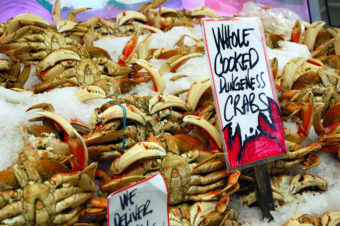
Freshly cooked Dungeness crab sits on a pot of boiling water at Nick's Lighthouse Restaurant in San Francisco, Nov. 5, 2015. Justin Sullivan/Getty Images
Freshly cooked Dungeness crab sits on a pot of boiling water at Nick’s Lighthouse Restaurant in San Francisco, Nov. 5, 2015.
Justin Sullivan/Getty Images

The bloom, created by an organism called Pseudo-nitzschia, produces a neurotoxin called domoic acid that can build up in marine life. It causes vomiting, diarrhea and cramping in humans — and even death, in severe cases.

California’s Dungeness crabs are shipped across the U.S. and internationally, and the $60 million fishery is considered vital to the region’s small fishermen. Both the commercial and recreational fishery will open as soon as test samples show the crab is safe.

So how does this toxin get into marine animals, and when might it clear out?

We spoke with Clarissa Anderson, a research scientist at the Institute of Marine Sciences at the University of California, Santa Cruz, to find out.

Algae blooms off the Pacific Coast aren’t new. But why is this one so large and persistent?

This bloom has been unprecedented in its extent and its persistence. It started in May and continued on to September. And while we were expecting such a bloom in the spring and even into the summer, as has happened in years past, we did not really expect to see this continue into September.

The warm temperatures all along the North Pacific and off the West Coast are contributing to the persistence of this bloom and are allowing it to stay in the surface waters. We’re now starting to see that subside a little bit as we go into fall.

Why are the waters so warm? Is it El Niño?

Well, it’s true that El Niño is on its way. But we’re not quite seeing the manifestations of El Niño in California just yet. For the last two years, we have seen these very high temperatures in the waters off the coast, and we’re calling that the warm “blob.” And that has been interacting with the bloom and sort of creating an unprecedented situation.

How long might these levels of domoic acid last in the ocean?

We know from weekly sampling that domoic acid levels, at least in the surface waters, have been coming down for the last two months. And they’re pretty low now.

An algae bloom has closed crab season in California. The bloom, created by an organism called Pseudo-nitzschia,produces a neurotoxin that can build up in marine life. It causes vomiting, diarrhea, and cramping in humans and even death in severe cases. Christy Juhasz/CDFW/Flickr
An algae bloom has closed crab season in California. The bloom, created by an organism called Pseudo-nitzschia,produces a neurotoxin that can build up in marine life. It causes vomiting, diarrhea, and cramping in humans and even death in severe cases.
Christy Juhasz/CDFW/Flickr

The issue with the crabs is that toxin can persist in the sediments. And those crabs are feeding on all kinds of crustaceans and shrimp along the bottom. And so the crabs are bio-accumulating it in their flesh.

So this toxin, while it might not be continuing to be produced by the algae, it certainly is in the sediments and could last there for quite some time.

Could storms or high winds clear out the algae bloom?

If we start to see some big storms from El Niño, we might start to see the water column turn over and some of these toxins flush away.

But as far as sediments go, it might be a little trickier. But I think that some storms would do a lot to clear this up.

So once a crab has this level of domoic acid in its body, how long does it take for it to clear out of the crab so it’s safe to eat?

We don’t have great data on the clearance rate of domoic acid from crabs. We know that they will clear it out naturally via their kidneys and they will excrete it. But we don’t know just how long it will take if they continue to acquire it and feed an environment where there is a lot of domoic acid.

So the question is: Are they going to continue to acquire it, or will they be able to just excrete it over a number of days to weeks? And then we can move on and start harvesting them.

And it’s not just crabs that are being affected by the neurotoxin, right? People should avoid eating fresh sardines and anchovies.

This toxin can work its way up the food web, and we’ve seen unusual mortality events in California sea lions and also whales farther north, in Alaska. Sea lions have been stranding within California as well as in Oregon and Washington throughout the summer and are continuing to strand.


Lauren Sommer is a science reporter for member station KQED in San Francisco. This post first ran on the KQED website.

Copyright 2015 KQED Public Media. To see more, visit http://www.kqed.org.
Read Original Article – Published NOVEMBER 07, 2015 9:38 AM ET

N.Y. Attorney General Investigates Whether Exxon Mobil Lied On Climate Change

New York’s attorney general would like to know: Did Exxon Mobil lie to you about the risks of climate change and to investors about how those risks might reduce profits?

Attorney General Eric T. Schneiderman’s office confirms that a New York Times story is correct in reporting that an investigation has been launched into Exxon Mobil. That story said Schneiderman issued a subpoena on Wednesday, seeking financial records, emails and other documents.

The goal is to examine whether back in the 1970s, Exxon Mobil funded groups to undermine scientific studies involving climate change. Also, the attorney general is investigating whether the oil giant properly informed its investors of the profit risks that might arise as countries cut back on fossil fuels.

In a statement, Exxon Mobil confirms it is under investigation and says its executives “unequivocally reject allegations that ExxonMobil suppressed climate change research.”

The company added that it “has included information about the business risk of climate change for many years in our 10-K, Corporate Citizenship Report and in other reports to shareholders.” And it noted that its research over the past four decades has been “conducted publicly in conjunction with the Department of Energy, academics and the UN Intergovernmental Panel on Climate Change.”

Recently, Inside Climate News and the Los Angeles Times reported that in fact Exxon Mobil’s own scientific research had long ago proved that climate change posed big risks. The company was even using that research to guide its own long-term planning for drilling in the Arctic, according to the reports.

But while it knew of the potential problems, it funded groups from the 1990s to the mid-2000s to deny climate risks, the story goes. Many environmentalists argue that Exxon Mobil’s activities were similar to the tobacco companies that knew smoking posed grave health but denied their own research.

Earlier this year, the New York Times and other news outlets reported that Wei-Hock Soon, a Smithsonian researcher, had published papers questioning climate science. But it turned out the researcher had gotten funding from fossil fuel companies, including Exxon Mobil.

Inside Climate News reports that all three Democratic candidates for president, along with several members of Congress, have called on the U.S. Justice Department to investigate Exxon Mobil.

CEO Rex Tillerson told Fox Business News in a TV interview that accusations about deceiving the public are unfounded.

Environmentalists are applauding the efforts to investigate the oil giant. One group, 350.org, representing environmental and civil rights groups, has been sponsoring petitions calling for action.

Bill McKibben, co-founder of the group, said in a statement that Exxon Mobil has “joined the category of truly serious scandals.”

The New York Times also is reporting that in a separate inquiry, the New York attorney general is looking at whether Peabody Energy, the nation’s biggest coal producer, adequately informed investors of the financial risks related to climate change.

Vic Svec, a senior vice president for Peabody, said in a statement that the company “continues to work with the New York attorney general’s office regarding our disclosures, which have evolved over the years.”

Under a New York law, the state attorney general has broad authority to investigate financial fraud.

Leslie Garfield, a law professor at Pace University, says other states could join New York in seeking broad settlements similar to those paid by tobacco companies. Those settlements cost corporations tens of billions of dollars.

“If [the attorneys general] are successful with one company, it could be like a domino effect and be successful with many others,” Garfield said.

WSHU reporter Charles Lane contributed to this story.

Copyright 2015 NPR. To see more, visit http://www.npr.org/.
Read Original Article – Published NOVEMBER 05, 2015 5:40 PM ET
Site notifications
Update notification options
Subscribe to notifications