Outdoors

Tongass Voices: Juneau Bike Doctor’s Ken Hill wants to get everybody on a bike

Juneau Bike Doctor owner Ken Hill with a bike that will be donated to a student in need of a bike at Dzantik’i Heeni Middle School. Artist Chloey Cavanaugh and school librarian Luke Fortier painted herrings on the sides in support of the Herring Protectors movement. June 21, 2024. (Photo by Yvonne Krumrey/KTOO)

This is Tongass Voices, a series from KTOO sharing weekly perspectives from the homelands of the Áak’w Kwáan and beyond.

Ken Hill opened Juneau Bike Doctor in 2018, but he’s been part of Juneau’s cycling scene for much longer. Hill wants to get as many people on bikes as possible and values giving back to the community. That includes supporting his favorite local performers from Juneau Drag as much as he can.

Listen:


This transcript has been lightly edited for clarity.

Ken Hill: I’ve been involved in bike stuff, starting back in the late 80s when I moved to town and was just part of the bike community. Started out sweeping floors and changing tires.

Biking here, in general, it’s almost like the community is perfectly made for someone to be a cyclist or to use a bike for transportation. You know, from one point to the next is typically not very far. 

One thing that we’ve been fortunate to have the opportunity to do is we do trade-ins with bikes where somebody has an old bike that they’re not going to do anything with. We may not necessarily put the bike back on the floor. We’ve taken a number of those types of bikes that, during the fall, we have time to kind of refurbish and get them up and running, and we’ve used those to get people on bikes that maybe don’t have the wherewithal to find a bike. 

We had a teacher from [Dzantik’i Heeni Middle School] who wanted to do something to help kids get back engaged with education. She’s a bike person, and we’re certainly bike people, and so we thought that we would do a special bike for them.

And then I thought, it’s cool to have one bike, but there’s a lot of need. There’s a lot of kids in schools that need a bike. So we kind of reached out to our audience and got a bunch of bikes that people donated to us.

And we were able to do — I think it was 17 bikes, is what we got, built up and donated through that program.

One girl received a bike, but, turns out she already had a bike. But she wanted to ride her bike with her mom, and mom didn’t have a bike, so that bike was, you know, transferred over to her mom. And so now we’ve got a family riding bikes together. 

Then we had another young man who had a bike, but his best friend didn’t have a bike. And so now he’s got a riding buddy. 

We work with groups like that — we work with the Juneau Drag crew, and do a lot with that group. NAMI does a Pride Outside event that we’ve been doing for, gosh, since the beginning.

This is where I get emotional. That group when — so when my wife and I started dating, it was totally not something that I was involved in at all. I mean, I had queer friends, I had friends that were performers, but I just didn’t feel like it was a place where I was welcome. And not that any of them wouldn’t be welcoming to me. It was just my own perception. 

And I went to a show with a couple friends, and had just the time of my life. And I told my wife, I’m like, “Now, what do I do? I don’t want to just sit in the crowd,” because I’m not going to, you know — not everybody has a group that wants to go to every show, but I wanted to be in every show. 

So I worked the door there for five or six years, every show. And then when we did the big Glitz programs, I gave myself a title: the head of VIP transportation and security. So when we have out of town guests come. And I just met the most amazing people. 

They’ve been super welcoming to me, and there is kind of a non-traditional family, in a sense, with that group. And so I love them to death.

Garden Talk: The solstice marks an important milestone in the growing season

Fresh weeds (left to right: horsetail, buttercup and chickweed) that have been soaked for two weeks. Buyarski says this makes a smelly, brown soup that can be diluted and used to feed plants. (Ed Buyarski)

Yesterday was Summer Solstice. In Alaska, it can feel like a relief to begin losing daylight again — especially for this Morning Edition host, who’s been struggling to get enough sleep. But the solstice also marks an important milestone in the growing season.

This week, I spoke with Master Gardener Ed Buyarski about things to consider in your gardens as we head into July. 

Listen:

When asked what he’s been up to in his own garden, Buyarski said, “Oh, pulling weeds, pulling weeds, and pulling some more weeds…” 

But Buyarski says those weeds can be useful, post-plucking. 

“Take those weeds, put them in a bucket with water, throw in a handful of seaweed, and let them ferment for two weeks so you get this brown, nasty, slimy stuff,” he said. “Take that out, dilute it about five-to-one, and use that to fertilize the plants that we want to grow.”

That liquid fertilizer can be a great way to keep your plants hydrated, as high summer temperatures dry out the earth. Buyarski said that’s especially important for plants in containers.

“You can almost watch them wilt if they are not being watered again and again on these warm, sunny days,” he said.

It’s almost time to harvest garlic scapes. (Ed Buyarski)

If you’ve already started harvesting from your garden or just finally found the free time to start thinking about getting something in the ground, Buyarski says it’s not too late. 

“We can plant some more broccoli now for later harvest,” he said. “Kale can be planted anytime, and seeds from the mustard family. I did reseed a patch of carrots. The soil is nice and warm, so things are going to sprout quickly, along with the weeds.”

And he says it’s almost time to harvest garlic scapes.

“You can use them just like green onions, but with a garlic flavor for everything from pickling and stir-frying and making pesto,” he said.

Finally, keep your eyes peeled for a full strawberry moon Friday night. It might just break through the clouds.

Japanese expedition completes a Denali first, thanks to help from Alaskans

Subaru Takeda, Genya Takenaka, and Toranosuke Nagayama take a selfie while climbing a route on Denali. (Courtesy of Subaru Takeda)

Toranosuke Nagayama and his two climbing partners spent more than two years planning a major expedition on Denali.

“Alaskan climbing is very special,” Nagayama said. “We are really interested in that, like, a very white world. So we came here.”

Nagayama flew to Anchorage from Canada last month to finally make the long-awaited trek on Denali. His two partners — Subaru Takeda and Genya Takenaka — traveled all the way from Japan.

After they arrived, they left their bags unattended in the lobby of the Anchorage apartment they had rented. And when they came back a few hours later, the bags were gone. Nagayama estimates that between $10,000 to $20,000 worth of climbing gear was stolen. They were devastated.

“I gave up at the time, like I gave up the expedition,” Nagayama said. “I was really ready for climbing, and I was so excited to see the glacier. I was really disappointed at the time.”

The next day, on a whim, Takeda posted a handwritten sign at REI, asking if anyone had information about their stolen gear. Someone took a photo of the sign, and uploaded it to the Alaska Rock Climbing Facebook page.

Subaru Takeda posted a handwritten sign at REI after his climbing gear was stolen. (Facebook screenshot)

Within hours, Alaskans started reaching out, offering to lend equipment. Dana Drummond, owner of The Hoarding Marmot, even organized a spreadsheet of everything they needed — jackets, crampons, harnesses, ice axes and more.

“The Alaskan people were really kind,” Nagayama said. “I didn’t expect it. So it was so quick. And then we thought, ‘Oh, we might be able to continue this trip.’ It was a really good day.”

Their plan was to link two complicated climbs together: the West and East Kahiltna Peaks with the Cassin Ridge of Denali. No one had successfully linked these peaks in one self-supported endeavor.

In 2008, Japanese climbers Tatsuro Yamada and Yuto Inoue tried, but they disappeared near the top of Denali. In 2011, it was attempted again by Yasuhiro Hanatani and Kei Taniguchi, but they did not complete it.

After gathering gear from climbers all over Anchorage, Nagayama, Takeda and Takenaka set out to make their attempt.

They spent two weeks acclimating to the elevation, and then they started traversing. For 10 days, they climbed through difficult weather, and on snow and ice they described as “fragile.” They had hoped to also summit Denali, but a bout of hypothermia turned them around just before the summit. They were happy to complete their main goal — linking the Kahiltna peaks with the Cassin Ridge.

“The glacier was really beautiful, like huge and flat glacier,” Nagayama said. “We are so excited.”

Takeda took iPhone videos of their expedition, especially in rare moments of good weather. One shows the clouds below them as the endless snow glistens in the sunshine. There they are, dancing for the camera and jingling other people’s quickdraws, and dusting off other people’s crampons. Takeda said he thought about this a lot during the climb.

“From the top of me and from the base of me, I wear the other people gears,” he said. “I thought that it is meaningful thing.”

Genya Takenaka (left) and Subaru Takeda (right) are interviewed in Dana Drummond’s house, where they stayed after their expedition. (Photo by Jeremy Hsieh, Anchorage Communities Reporter)

Clint Helander lent ski skins and helmets. He wasn’t surprised that so many were quick to help.

“I think Alaskans are pretty resilient and you really kind of have to rely on people up here,” he said. “Sometimes you think you’re all separate from everybody and you have little disagreements here and there, but it’s really cool just to see how — in the climbing world or just in Alaska in general — how people really come together to help people out.” 

Takeda said he’s so grateful.

“I could never do this without Alaskan people’s help,” he said.

Before flying home last week, they unpacked their borrowed gear and returned it all to the local climbers who — together — helped make their expedition successful.

New cultural ambassadors deepen tourists’ experience of Juneau’s Mendenhall Glacier

Jinkasee.ee Rose Willard explains a náxw, or halibut hook to visitors. She is one of 10 cultural ambassadors at the Mendenhall Glacier Visitor Center on June 13, 2024. (Photo by Yvonne Krumrey/KTOO)

When tourists come to Juneau, the Mendenhall Glacier is usually near the top of their sightseeing list. It gets hundreds of thousands of visitors each summer.

And now, those visitors will have the chance to learn more about Indigenous connections to the glacier through cultural ambassadors.  

For the first time this year, tribal members were hired as ambassadors to share their own experiences and culture with visitors. 

Jinkasee.ee Rose Willard sat at a table inside the Mendenhall Glacier Visitor Center Thursday, while tourists milled around her. They peered at the spread in front of her: books about Lingít culture, small button blankets and pieces of beadwork, and a piece of wood the size of her hand carved in the style of a kootéeyaa, or totem pole. 

A young girl visiting the glacier with her family pointed to a deerskin drum.

“What’s this?” she asked. 

“This is a drum. We call it a gaaw. Can you say gaaw?” Willard said.

Willard handed her the drum, and she beat it a few times before saying it was cool.

Willard is one of 10 cultural ambassadors from the Central Council of the Tlingit and Haida Indian Tribes of Alaska that will spend their summer teaching visitors about Lingít culture — and about how Lingít people are connected to the glacier. It’s part of the new co-management strategy between the U.S. Forest Service and the tribe.

“That’s the first question people ask: Are you Lingít? Are you of this area? Are you a local? People want to know: are you a representation?” she said. “So I think it’s really important for them to know that they are speaking to a person who is from this area.” 

The rest of the year, Willard is a Lingít language teacher at Sítʼ Eetí Shaanáx̱ Glacier Valley Elementary School. So she likes to share pieces of language with visitors, like teaching them to say gaaw for a drum, or náxw for a halibut hook. 

She said when she first introduces herself, people are sometimes confused about why she’s there, and what the connection between Lingít culture and the glacier is

“But a lot of times people don’t know that our history — our Lingít people are here because of the glaciers, and our histories are all tied to the mini-glacier period. So when they receded, our people were able to travel over and under the glaciers to reside on these coastal areas,” Willard said. “Then they’re like, ‘Oh, wow.’ Then they make a connection between Lingít people and this amazing glacier.”

And, she said, it still feels like these interactions are authentic, not superficial or theatrical glimpses into her heritage. 

“I love that we are not selling the culture out here. We are simply sharing the culture about this amazing place,” Willard said. 

Jinkasee.ee Rose Willard is one of 10 cultural ambassadors at the Mendenhall Glacier Visitor Center. June 13, 2024. Photo by Yvonne Krumrey/KTOO.

Sarah Strand has been working for the Forest Service for three years now, and she said Lingít representation at the glacier used to be mostly limited to the short film shown to visitors.

“I think that’s very important to not only talk about the importance of our environment around here,” Strand said. “But the importance of the culture around it as well.”

Cultural Ambassador Supervisor Aankadax̱steen Jeremy Timothy said the Forest Service staff who they work with daily have made it easy for the ambassadors to experiment with the new program. 

He said this first summer is only the beginning. They hope to fill more of the space in the visitor center with even more cultural items and information.

“We’re looking at pop-up artists, maybe having a Chilkat robe, maybe tunics, hats. We’re looking at a kootéeyaa that’s coming back, that used to be out here,” Timothy said. “So we’re looking at possibly doing a ceremony for that, just kind of bringing more of our traditions to light here, and letting the visitors engage with us.”

But for now, Willard and the cultural ambassadors are set up and eager for your questions. 

Garden Talk: Companion planting in Southeast Alaska, with zucchinis

Companion planting at Tidal Wood Food and Forage in Juneau. (Joel Bos)

Companion planting is a technique gardeners can use to increase their yield, boost soil fertility, and reduce weeds and pests. For this week’s Garden Talk, Joel Bos of Tidal Wood Food and Forage shared his companion planting techniques.

Listen:

This transcript has been lightly edited for clarity and length.

Chloe Pleznac: Let’s talk about companion planting. I first learned about this concept when reading the book Braiding Sweetgrass, by Robin Wall Kimmerer. She talks about the “Three Sisters,” which are beans, squash, and corn. Could you give me some examples of companion planting combinations or techniques that you’ve utilized?

Russian kale planted on either side of zucchini plants. (Joel Bos)

Joel Bos: I use zucchini very often in my gardens, and I make mini hoop houses about three and four feet tall to shield them from some of the rain in the colder weather that we have here in Juneau. I like to grow them with brassica family plants or fast-growing plants like lettuce. And then, because the zucchini will just fill in a whole four-foot-wide bed, each planet, you can plant faster-growing plants on the outside and still be able to crop those before the zucchini spreads in and takes over. So for the home gardener, it’s a great way to utilize a small space and get maximum yield. 

The techniques I use to warm up the squash — because squash and zucchini really like warm weather — is to keep the soil dry, which is done in a number of ways. One, you could make a raised bed. I’ll cover it with a green plastic mulch or another name for it is IRT. It’s just a plastic film that allows a lot of warmth through the sun but reflects the wavelengths that weeds need to grow.

This can do two things for you — slow down the weeds and warm your soil and keep it drier. Over top of that, I’ll make it a hoop house, sometimes out of bent metal conduit or sometimes out of PVC pipes, and then over top of that add what we call row cover, which is kind of like a white fleece, over the top of that.

That’ll do two things. One, it’ll warm it a little bit. It’ll shed some of the rain off but allow some through, and it also keeps the insects from coming into your brassica family plants, like your cabbage and your kale. Then maybe later on in June or July, I’ll take the cover off and crop all the brassica family plants and let the squash really fill in.

A hoop house covered up to keep out root maggots flies from laying eggs in the brassica family plants like kale, cabbage kohlrabi and bok choy. (Joel Bos)

Chloe Pleznac: When you’re sowing these starts, how close are you planting them together? Is there a general rule of thumb that you use?

Kohlrabi (lower left) planted alongside zucchini and Russian kale. (Joel Bos)

Joel Bos: On my farm some of the stuff I do is in 30-inch-wide beds because there’s a lot of good tools that work at that width. But when I’m making these hoop houses and growing zucchini, I prefer a four-foot-wide bed. You can do one zucchini every three feet along that right down the middle, and then you can do a row on each side of it, about 12 inches apart, sometimes eight, depending on what plant you’re planting. Some of the lettuces can get closer. Certain kinds of bok choy can grow closer together, too. If you’re trying to do a fast-growing cabbage you may want to give them a foot.

If you’re doing a big red Russian kale, you may want to give those every 18 inches. It gives you a decent crop. I’ve already cropped bok choy back in May that I started indoors, and I’ve replanted another row. I just added some compost and it kept growing, so now that’ll be cropped in late June, and the zucchini went in, with this cold May, only about seven to 10 days ago, and it’s starting to take off.


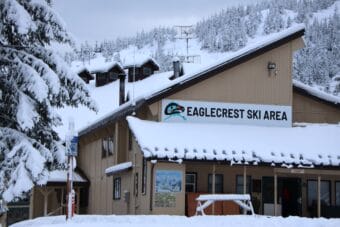
Eaglecrest is hiring a new general manager. Some skiers aren’t happy about it.

Former Eaglecrest board member Dave Hanna speaks to the current board during a meeting on Thursday, June 6, 2024. (Clarise Larson/KTOO)

Eaglecrest Ski Area’s board is hiring a new general manager. The job posting went live on Friday. 

But, at a meeting the night before, local skiers and residents asked the board to reinstate the previous general manager, Dave Scanlan, whom the board asked to resign last month. 

Barney Bogart said he was disappointed in the board. 

“Dave should never have been fired. Give us a reason. Don’t just leave us in the lurch. We’re not stupid idiots,” he said. “We need an explanation. And if you can’t give us one, reinstate him right now.”

Bogart was one of 50 people who came to the meeting at the downtown library. There were so many people that some attendees were asked to step outside the room to comply with fire code. At least another 50 attended online.

Many testified in support of the previous general manager and wanted to know why the board abruptly asked him to leave his role after seven years.

Another resident and former Eaglecrest board member, Dave Hanna, said the board is going to have a hard time finding a replacement for Scanlan. 

“This board apparently failed to engage Dave in his review, and they failed to get his perspective and his advice on dealing with whatever procedural or personnel issues that were perceived to exist,” he said. 

Hanna is also part of a group that is gathering signatures for a petition to demand answers from the board. As of Monday, it had 485 signatures. 

Scanlan’s resignation came after he met with the board late last month to evaluate his performance. The decision to ask him to resign came after the board met in executive session.

Board chair Mike Satre said the details of Scanlan’s performance review and the reasons behind the decision can’t be shared with the public.  

“It is simply not appropriate to disclose items discussed during the review process,” he said. “I doubt that there’s anyone in this meeting who would want the details of their reviews made public.”

Scanlan has said openly that he did not want to resign. At Thursday’s meeting, the board asked the city to move forward with the hiring process for a new manager, despite public opposition. 

According to the city’s Human Resources and Risk Management Director, Dallas Hargrave, the position went live on the city’s website on Friday and will remain up for the next 30 days. The posting lists the starting salary as $100,000 dollars a year. Scanlan was making $114,000 at the time of his resignation.

Site notifications
Update notification options
Subscribe to notifications