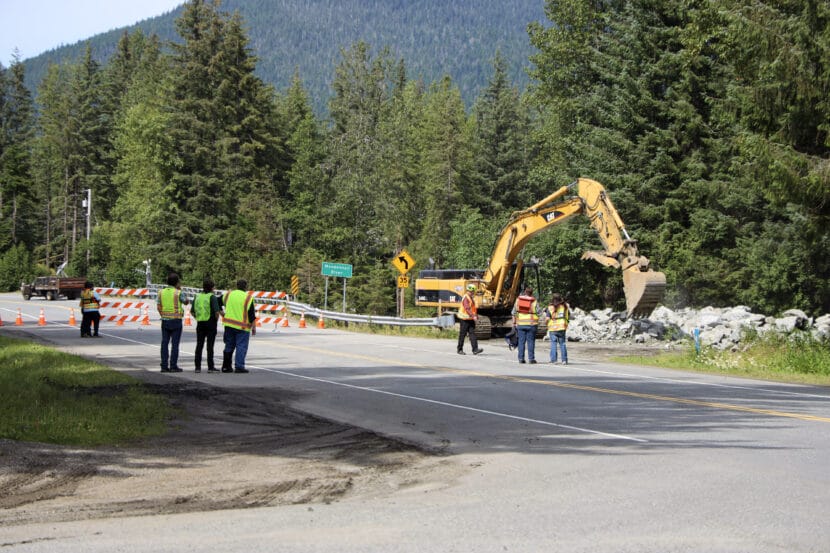
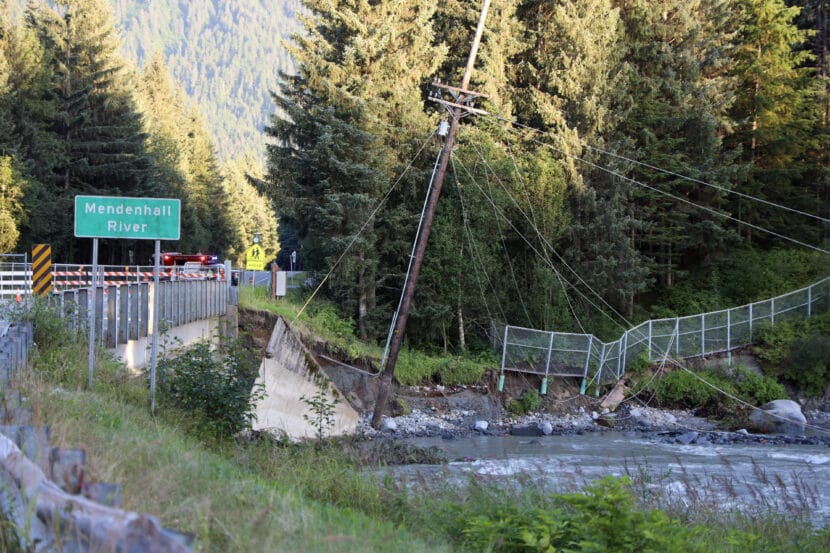
An excavator reinforces Back Loop Bridge with large boulders. The bridge was partially damaged by flood waters on Wednesday, Aug. 13, 2025. (Photo by Clarise Larson/KTOO)
Juneau’s 2025 glacial outburst flood may be over, but recovery and repairs are still ongoing.
Sam Dapcevich with the Alaska Department of Transportation and Public Facilities said emergency repairs are currently underway, but he did not have a timeline for when it will reopen to the public.
“We’re hurrying,” he said. “We’re trying to get it open as quick as we can, but also focused on safety and determining what’s going to need to be done for the long-term fix.”
Restoration of power and internet services has been quicker. The temporary levee the city installed along the Mendenhall River this year protected hundreds of homes nearby. But water still leaked through some sections and flooded several streets, requiring Alaska Electric Light & Power to cut power to some areas.
Debbie Driscoll with AEL&P said power was restored once the flood waters receded. But, she said the flood also crippled a power pole adjacent to Back Loop Bridge, which caused additional outages in some nearby neighborhoods.
Back Loop Bridge is closed after flooding on the Mendenhall River on Wednesday, Aug. 13, 2025. (Photo by Clarise Larson/KTOO)
Driscoll said the power has since been temporarily restored to the impacted neighborhoods and a more permanent fix is expected to be completed later this week.
“We basically made it so that power was isolated and no longer being served to that pole, and then we were able to serve customers through alternate means,” she said.
Internet provider Alaska Communications also confirmed its services have been restored locally.
Multiple local agencies are assisting in the recovery and cleanup effort. The first round of debris collection from flood-impacted neighborhoods on View Drive, Marion Drive, Meander Way and Meadow Lane began Monday, according to the city.
More information about flood recovery and resources can be found on the city’s website.
The Habegers build a berm around their house on View Drive on July 22, 2025. (Photo by Clarise Larson/KTOO)
Listen to this story:
Homes on View Drive were hit the hardest by Wednesday’s glacial outburst flood. Now, as residents there dry out, they’re mulling over a federal buyout program to leave the street for good.
The city reported Friday that 47 homes flooded, but most of the damage was minor in areas protected by the city’s new temporary levee. View Drive is not protected by that levee.
The day before the flood, Don Habeger said he felt confident his home at the end of View Drive would make it out dry. But Wednesday evening, a loud generator pumped water from his bottom floor as he answered the door.
“If you look closely, you can see that the house did flood, and so we have recovery yet once again,” he said.
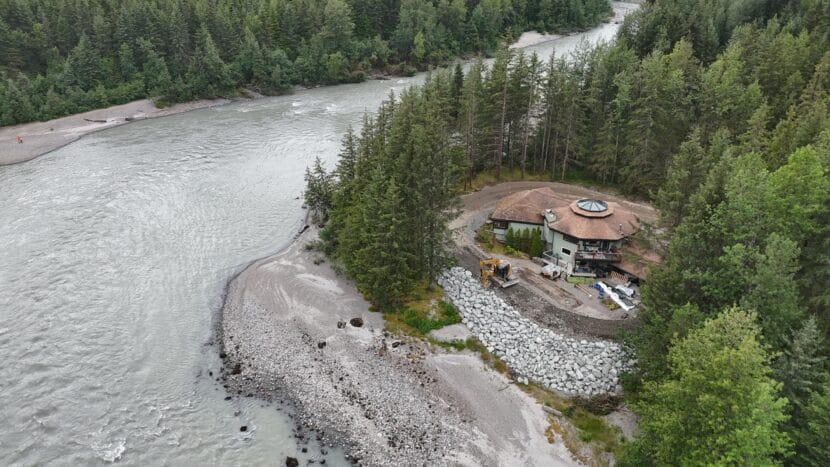
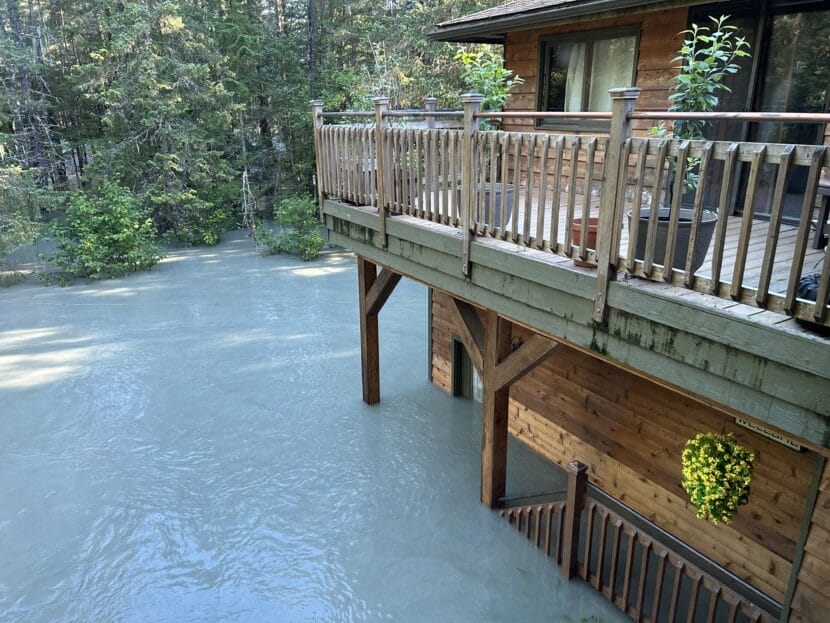
He had tried to avoid that. He and his neighbors paid thousands of dollars to build a colossal berm over the past month in a last-ditch effort to save their homes ahead of the glacial outburst flood. It failed. The berm stayed in place, but water still rose about 20 inches into Habeger’s ground floor — higher than the record-breaking flood last year.
Habeger had put his faith in the berm, so he didn’t take back-up measures like putting up sandbags or moving his furniture to the second story.
“There’s somewhat of a numbing effect in your mind after one of these events, and it’s difficult to get on to the next day or the next day, and so I’m just trying to get through today,” he said on Wednesday evening after floodwaters receded.
Volunteers are helping him and his wife tear out wet insulation and dry what can be salvaged from their flooded family room.
At this point, the Habegers see two possible paths forward: fight the flood again next year, or cut their losses and move away. They’re not sure which path they’ll take.
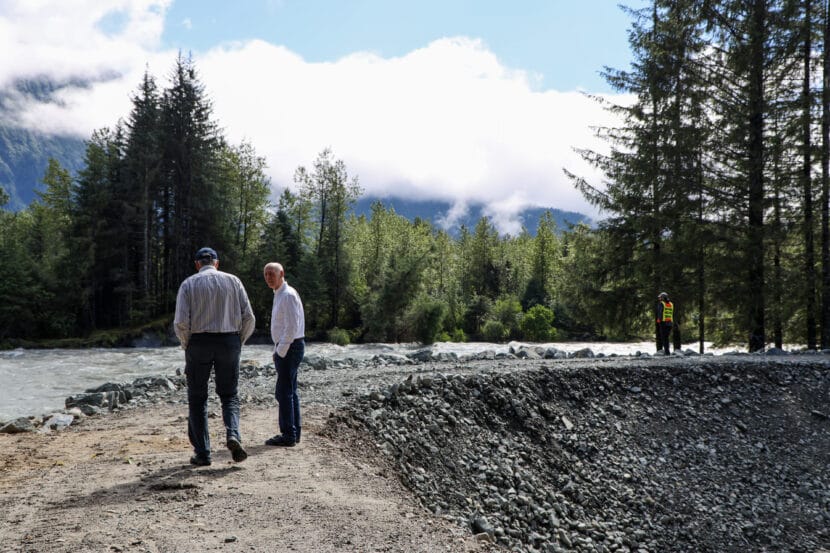
Don Habeger and Wayne Coogan walk on the top of a man-made berm built at the end of View Drive on Tuesday, Aug. 12, 2025. (Photo by Clarise Larson/KTOO)
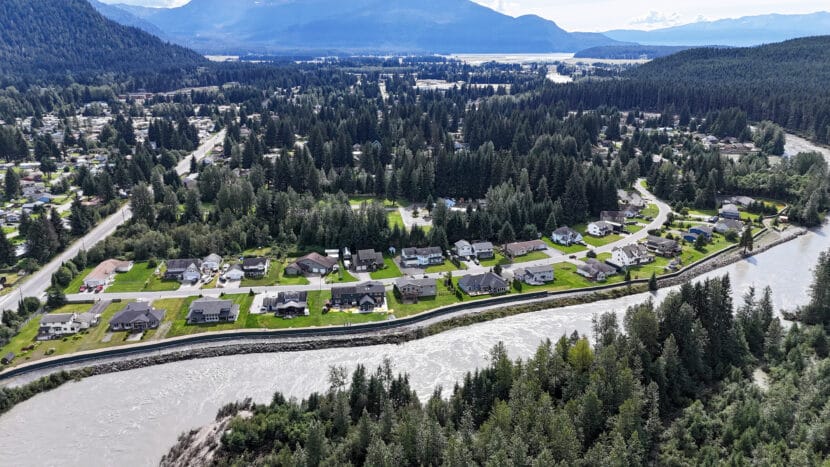
View Drive is a dead-end street in Mendenhall Valley surrounded on three sides by Mendenhall River. Some properties here have flooded for more than a decade, but the past three years have been catastrophic. That’s because outburst floods have grown bigger as Suicide Basin has expanded to hold more water, and the city’s temporary levee didn’t extend to this street.
Scientists don’t yet know how big the floods could get, and staff at the U.S. Army Corps of Engineers say a long-term solution that would protect the entire Valley, including View Drive, is years away.
Brett Nelson is Alaska’s conservation engineer at the Natural Resources Conservation Service. The federal agency oversees a recovery buyout program, which pays people to move out of natural disaster zones.
In July, he met with city staff and some residents of View Drive to explain how the program works to purchase homes, demolish them and transform the land into a park.
“People need a little time to mull the situation over. And that was basically the intent of that initial meeting,” Nelson said.
Nelson estimates the total project could cost somewhere between $18 and $20 million, assuming every View Drive homeowner decides to leave. But the program is voluntary and some people may choose to stay.
Right now, the agency is in the process of appraising the 20 properties on the street. Nelson said that process is a bit complicated.
“There’s two options: They can either be done based on the value, right now, the day the appraisal is being done, they can be valued, or they can be appraised as of the day before last year’s jökulhlaup,” he said. “The catch is, all the properties have to go the same direction.”
The agency has the final say over how homes are appraised, but Nelson said they want to respect residents’ wishes. That appraisal decision will affect the overall price tag of the project, since homes are worth more before they’ve been damaged multiple times.
If the buyout moves forward, Nelson said the cost would be split. The federal government would cover 75% and a local sponsor would cover 25%.
City Manager Katie Koester said she’s exploring potential partnerships with conservation nonprofits that could help pay for the city’s portion if the Juneau Assembly votes to move forward after the appraisal is done.
“The Assembly has been very supportive of us engaging in that conversation, but it is an Assembly-level decision,” Koester said.
Elizabeth Figus lives on View Drive and is drying out after a third year of major flooding in a row. She sees the buyout program as her best option since the city hasn’t made plans to protect her street, but she has questions at this early stage in the process.
“Are we going to be assessed at like, way below what we would expect or need even to, like, pay off our mortgage and move on?” she said. “Perversely, are the people who haven’t gotten wet yet just going to be getting some sort of handout that also might make the Assembly say we can’t afford this?”
Figus also said it would make sense to compare the cost of turning the street into parkland with the cost to protect it somehow.
But Nate Rumsey, the city’s deputy director of engineering and public works, said the city hasn’t done an official assessment of what it would take to protect View Drive. He said it’s probably not viable to put HESCO barriers there because the soil might not hold up under their weight. Last year, a sinkhole opened in the middle of the street due to flooding.
Floodwater rises into Douglas Smith’s house on View Drive on August 13, 2025. (Photo Courtesy of Douglas Smith)
Several fans blow in Douglas Smith’s ground-floor bedroom, where a layer of fine grey silt covers the floor after floodwaters breached the height of the aluminum siding he’d installed.
He said that he loves his community in Juneau and planned to spend the rest of his life here. Now, he’s thinking of taking a buyout and moving somewhere in the Lower 48.
“At this point, if that works, we’ll probably take it,” he said of the buyout program. “It’s probably our best option, because there doesn’t appear to be an option for protecting the house, and you know, what else are we going to do?”
Difficult decisions for View Drive residents and the Juneau Assembly are expected in the coming months, once NRCS issues its assessment of the street. Nelson said that if the buyout moves forward, the process would take around a year.
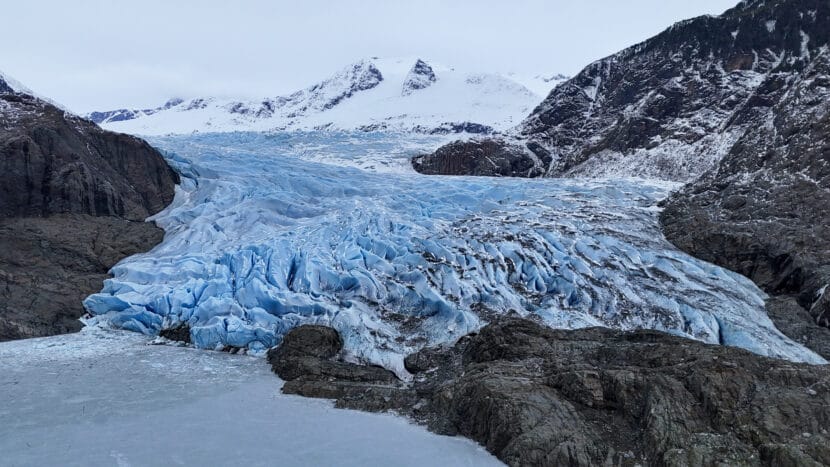
The Mendenhall Glacier on Friday, Feb. 21, 2025. (Photo by Clarise Larson/KTOO)
Hundreds of people in Juneau’s Mendenhall Valley are living on the front line of a climate change disaster they didn’t see coming. This is Outburst, the story of how glacial outburst flooding has escalated faster than human imagination – and public policies to protect people.
KTOO takes you from the floodwaters to the glacier’s edge to uncover why the annual floods happen, how they got out of control and what can be done to keep Juneau safe.
Juneau city officials are looking at everything from dams to explosives to keep Mendenhall Valley residents safe from future glacial outburst floods.
As Suicide Basin fills up each year, Mendenhall Valley residents are more anxious about the coming flood. They want the U.S. Army Corps of Engineers to figure out a permanent fix and build it quickly, but the Corps says a long term solution could take years.
The third episode of Outburst looks at how other countries have protected residents from glacial outburst floods and why a local solution is taking so long.
KTOO’s Alix Soliman takes listeners from a Swiss community facing similar threats to the halls of the U.S. Senate to understand when residents might get a permanent fix – and what that might look like. KTOO reporter Clarise Larson cowrote this episode.
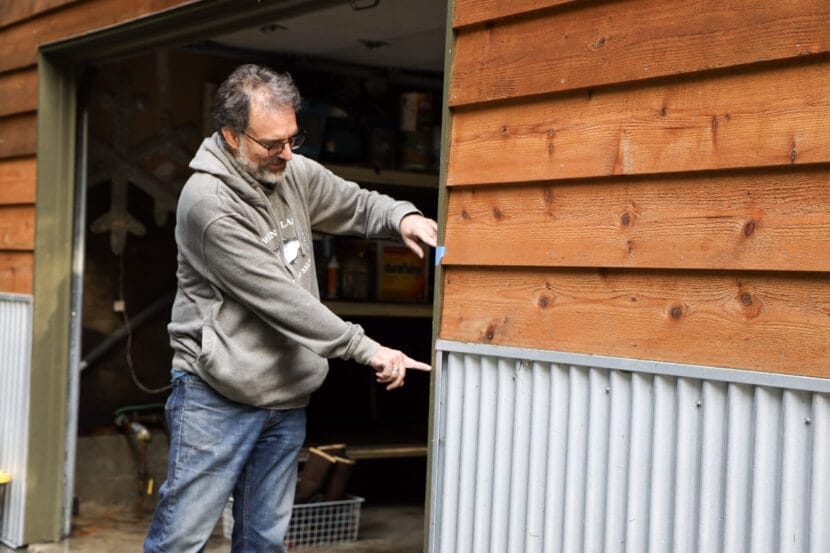
Douglas Smith compares the flood heights between 2024, bottom finger, and 2025, top finger, at his home on View Drive on Wednesday, Aug. 13, 2025. (Photo by Clarise Larson/KTOO)
After the water receded from this week’s all-time record breaking glacial outburst flood, Mendenhall Valley residents spent Thursday taking stock of the damage.
Jeff Garmon’s bottom floor flooded on Meander Way. He spent the day drying out his belongings on a tarp in the front yard.
Garmon is head of the National Weather Service in Juneau.
“You’d think a meteorologist could choose better where to buy a house, but there wasn’t a lot of availability when we bought a house,” he said.
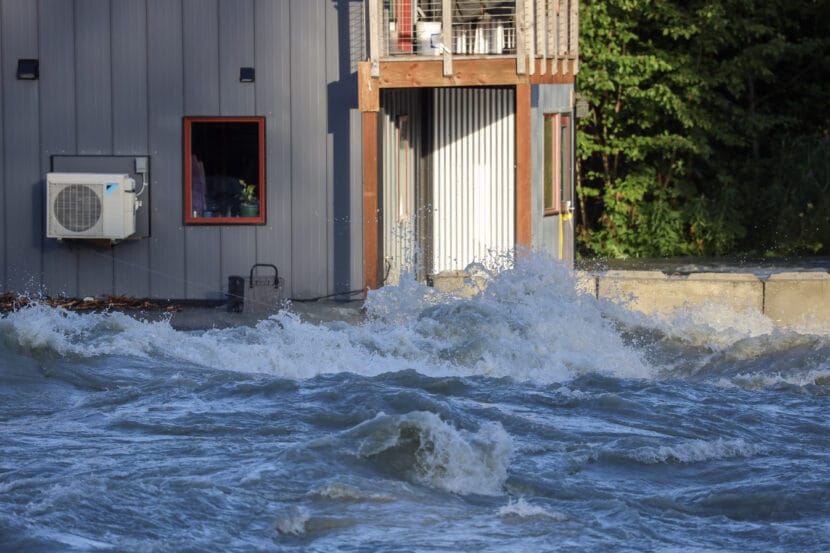
The temporary levee that the city put up this spring protected hundreds of homes, but water seeped through in some areas. The leakage caused the most damage at the end of Meander Way, where a handful of homes had flooded crawl spaces and garages.
City engineers say they will be assessing every single HESCO block that makes up the levee, and will make a plan for how to reinforce them ahead of next year’s flood.
On View Drive, a street along the river not protected by the city’s barrier, residents report that flooding was more catastrophic than ever before.
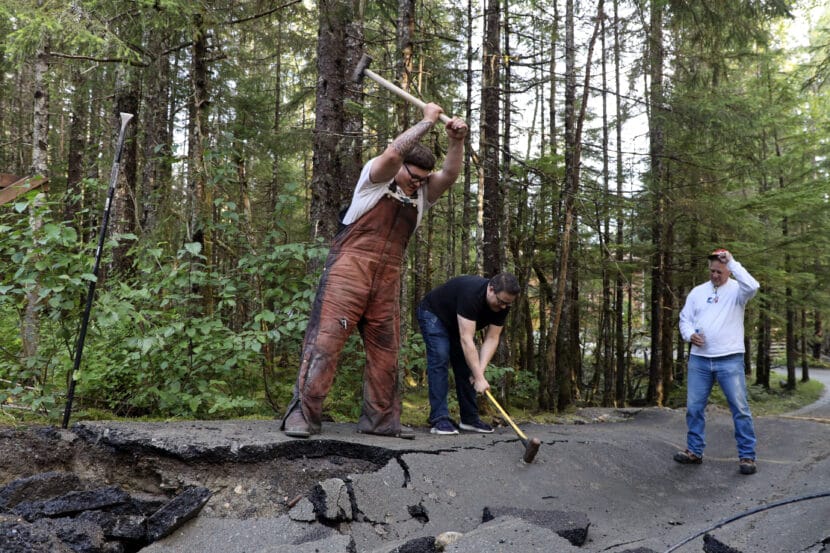
Parker Fenumiai, left, and Donovan Grimes, right, use sledge hammers to smash up a driveway damaged by flood waters on View Drive on Wednesday, Aug. 13, 2025. (Photo by Clarise Larson/KTOO)
It reached chest height in Douglas Smith’s garage, and about six inches in his first-floor bedroom. Water went over the aluminum siding and vapor barrier in his house.
“We raised our family here, but now we’re trying to think of options,” Smith said. “Maybe it’s not realistic to stay here, because we don’t — we’ve kind of exhausted all the possibilities that we know so far to protect it.”
On Long Run Drive, Beth Cayce has stayed dry for the third year in a row. She she originally didn’t want the city to build a levee in her yard.
“I’m glad they did, now, in hindsight, because had these barriers not been in place, we would have been flooded,” Cayce said.
City officials are going door to door to assess the damage. They plan to report how many homes were hit and the total cost of the damage soon.
The city plans to hold a press conference at 11 a.m. Friday. KTOO will carry it live at ktoo.org/flood.
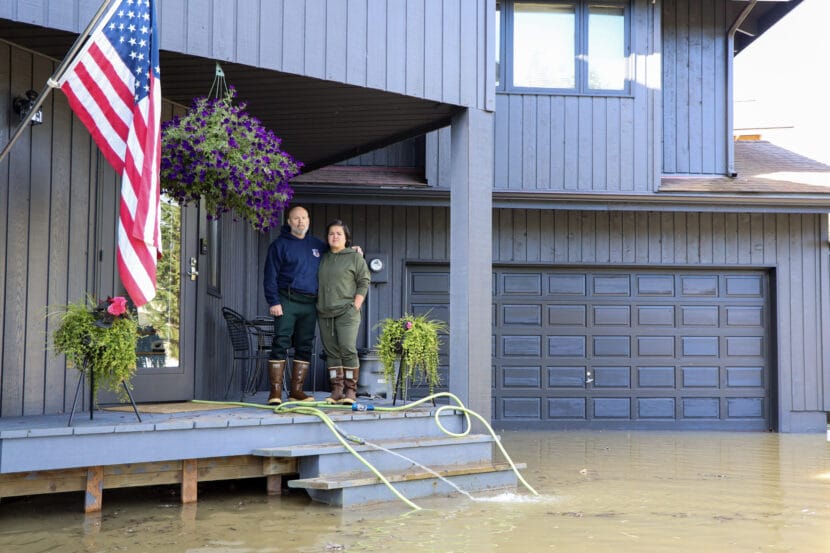
Locke and Melissa Brown stand on the porch of their home that was flooded on Meander Way on Wednesday, Aug. 13, 2025. (Photo by Clarise Larson/KTOO)
Listen to this story:
Floodwaters from Juneau’s glacial outburst are receding. The flood reached a record-breaking crest of 16.65 feet at about 8 a.m. Wednesday.
The temporary levee the city installed along the Mendenhall River this year protected hundreds of homes nearby. But water still leaked through some sections and flooded several streets.
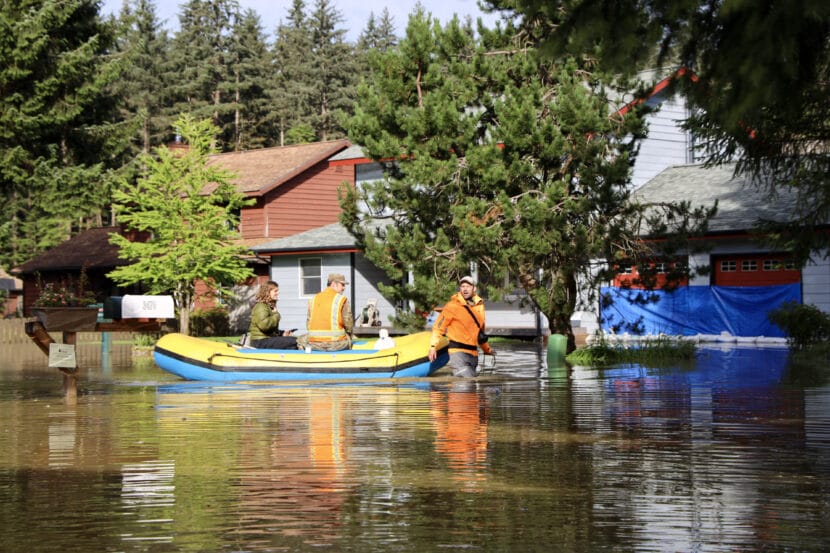
In the middle of Meander Way, Sean Smack tugged a raft through muddy floodwaters. He ferried diesel jugs to neighbors so they could run generators to pump the water from their homes since power was cut Wednesday morning as the river level rose.
“The Meander Way water taxi service — once a year, have no fear,” he said.
He delivered a jug to Locke and Melissa Brown’s house. Water from their crawl space flowed through a bright green garden hose down their porch steps.
Sean Smack pulls people on a raft through floodwaters on Meander Way on Wednesday, Aug. 13, 2025. (Photo by Clarise Larson/KTOO)
The Browns have HESCO barriers stacked up in their backyard. But water worked its way through the barriers and rose through storm drains, hitting a handful of homes at the end of Meander Way.
The Browns were glad that the barriers are there, even with the seepage. This is the third year in a row their home has flooded.
“If they weren’t here, it would have been catastrophic for us,” Locke Brown said.
It’s not as bad this time. But he says they want a long-term solution before they have to sell their home in a few years. Melissa is on active duty in the U.S. Coast Guard.
“We’re going to be doing this for five years in total, and then we’re forced to move on military orders,” he said. “How are we going to sell our house?”
Around the corner, Andrew Hills walked along the grey pool in the middle of Northland Street with his toddler, Waylon, up on his shoulders. Their house got hit by the flood last year, but this year it was spared.
“This is awesome. I could not be happier,” Hills said. “I feel terrible for the people at the end of Meander, but, you know, really happy it didn’t hit us.”
He said he spent the night walking the streets and saw the barriers leaking.
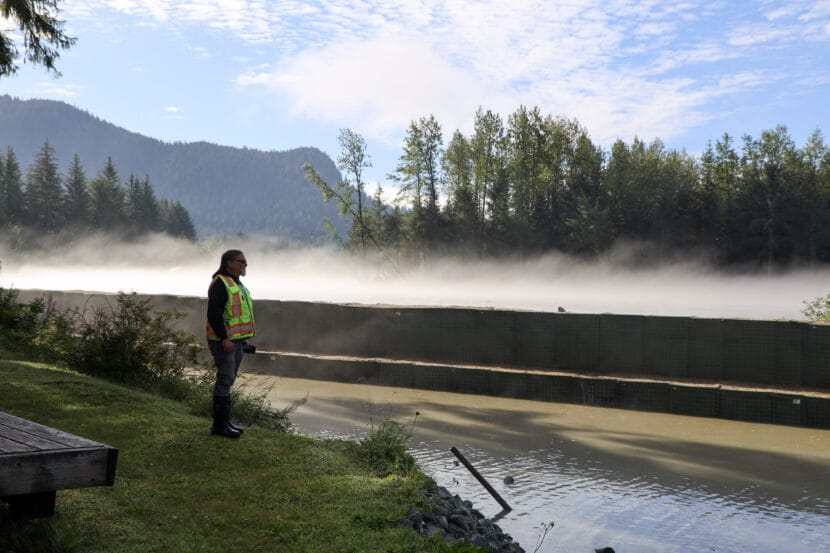
A city worker inspects HESCO barriers set up along Meander Way in the Mendenhall Valley on Wednesday morning, Aug. 13, 2025. (Photo by Clarise Larson/KTOO)
At a press briefing Wednesday morning, Juneau City Manager Katie Koester said the barriers were largely a success.
“I know we’re not entirely out of the woods, but the HESCO barriers really have protected our community,” Koester said. “If it weren’t for them, we would have hundreds and hundreds of flooded homes.”
Building the levee was a controversial process, and it is considered a stop-gap solution. It’s only meant to work for around a decade, and the city doesn’t know how it would perform in floods higher than 18 feet. Experts still don’t know whether that could happen. This year’s record-breaking crest was more than half a foot higher than last year’s peak of 15.99 feet, which was also a foot higher than the previous year.
City officials are still assessing the damage and monitoring areas that saw some flooding, including parts of Meander Way, Meadow Lane, Marion Drive, Parkview Court, Center Court, View Drive, Long Run Drive, Betty Court, Gee Street and the Safeway parking lot.
Christopher Goins with the Alaska Department of Transportation said Back Loop Bridge was damaged by tree strikes and erosion. The bridge was closed to traffic Tuesday night.
“We are beginning to lose portions of the road associated with that abutment there, and that’s the main support where we have piles that go into the ground that hold up the bridge sections themselves,” he said Wednesday morning, adding that the bridge should be fine with some repairs.
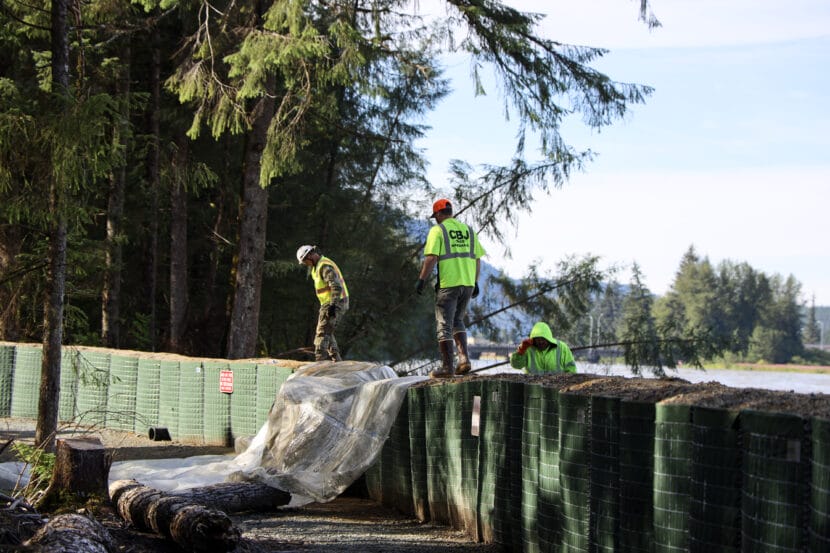
The current swept away tons of trees from the riverbank, including one that crushed a HESCO barrier. The city reinforced it with massive sandbags called supersacks.
City workers repair a HESCO barrier damaged by a tree near Dimond Park Field House on Wednesday, Aug. 13, 2025. (Photo by Clarise Larson/KTOO)
Nicole Ferrin, the warning coordination meteorologist for the National Weather Service in Juneau, noted the significance of this flood.
“This is a new all-time record-high crest for the Mendenhall Lake and river system,” Ferrin said.
The crest happened sooner than initially predicted. On Tuesday evening, the National Weather Service updated the forecast from an expected peak Wednesday afternoon to earlier that morning. Aaron Jacobs, senior service hydrologist at the agency, said that’s because rainfall from the prior few days masked when Suicide Basin started to release.
“It really hides the signal that we would be looking for if water was coming from Suicide Basin,” he said.
Jacobs said it now looks like the release began sometime on Monday morning.
HESCO barriers remain standing after flooding along Killewich Drive on Wednesday, Aug. 13, 2025. (Photo by Clarise Larson/KTOO)
Just outside the city’s emergency shelter on Floyd Dryden campus, Shari Weimer smoked a cigarette as sunshine broke through the fog. She and her husband Carl evacuated from Lakeview Court at around 10 p.m. Wednesday night.
“I’m right one street over from the river, and I just chose to evacuate because my life is worth more than home,” she said.
Their house flooded the past two years. This time, with a higher peak and concerns about the temporary levee, Shari said she didn’t want to deal with the panic again.
Just seven people stayed in the shelter overnight. Some residents stayed with friends and family in town, and others stayed home. Capital City Fire/Rescue Assistant Chief Sam Russell said during a Wednesday’s press conference that emergency responders did not need to make any rescues overnight as waters levels rose.
Emergency officials issued an alert Wednesday afternoon that the flood threat had ended and evacuated areas are now open to residents only. The National Weather Service flood warning expires at 8 a.m. Thursday.
Water rushes past a house along the Mendenhall River on Wednesday, Aug. 13, 2025. (Photo by Clarise Larson/KTOO)
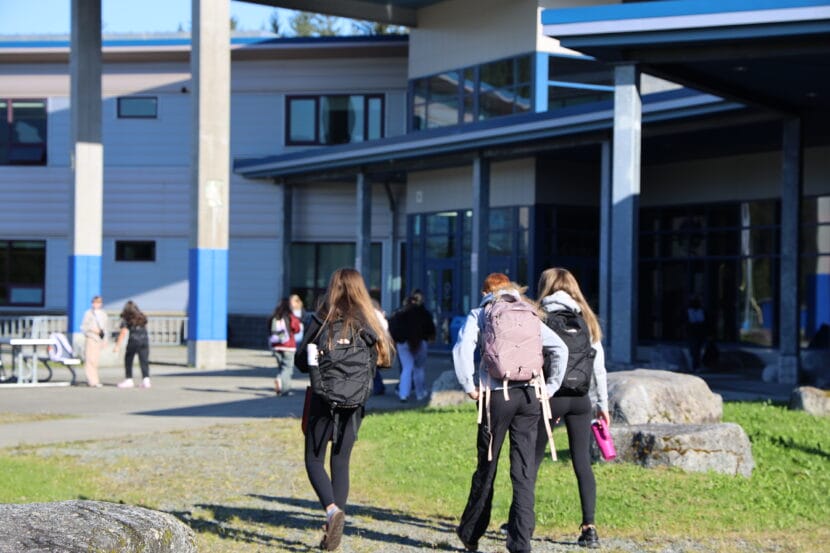
Students walk to the Thunder Mountain Middle School entrance for the first day of school on Thursday, Aug. 15, 2024. (Clarise Larson/KTOO)
Juneau schools will remain closed Thursday following a record-breaking glacial lake outburst flood event in the Mendenhall Valley. The Juneau School District plans to delay the start of school until Friday.
Superintendent Frank Hauser said at a press conference Wednesday morning a flood warning from the National Weather Service remains in effect until 8 a.m. Thursday.
“We have three schools in the area,” he said. “Delaying the start of school by one day will allow Unified Command staff and safety crews to assess damage in the Valley area.”
The district closed Kax̲dig̲oowu Héen Elementary School, Mendenhall River Community School and Thunder Mountain Middle School Tuesday afternoon as a safety precaution for staff. Hauser said there isn’t any damage reported at the schools in the flood zone as of Wednesday morning.
All school activities, including the first day of high school for ninth graders, are also canceled Wednesday.
Hauser said afterschool child care such as the Relationships and Leadership Learning for Youth program, or RALLY, will not be provided while schools are closed.
The district will continue to update families through automated calls, texts, emails, the Juneau Schools app and the district website.
Close
Update notification options
Subscribe to notifications
Subscribe
Get notifications about news related to the topics you care about. You can unsubscribe anytime.