Environment

Governor issues preemptive disaster declaration for Juneau as Suicide Basin nears capacity

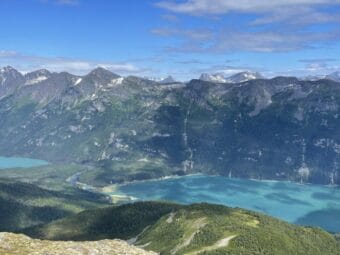
An image of Suicide Basin from the official webcam Sunday afternoon. (Courtesy of National Weather Service & USGS)

Gov. Mike Dunleavy issued a state disaster declaration Sunday in anticipation of a glacial lake outburst flood expected to hit Juneau’s Mendenhall Valley very soon.

That follows a preemptive disaster declaration issued Friday by the City and Borough of Juneau and the Central Council of the Tlingit and Haida Indian Tribes of Alaska.

According to the latest data, Suicide Basin — the glacial lake that is expected to unleash an outburst flood soon — is about to reach its full capacity. That capacity is the same or larger than the total water volume seen in prior years.

The annual release has been happening since 2011, but record-breaking outburst floods struck the Mendenhall Valley in August the last two years. Last year’s flood damaged hundreds of homes.

“Our goal is to act early to reduce impacts and preserve community safety,” Dunleavy wrote in the declaration.

Current reports from the National Weather Service estimate the basin will be full Monday, but a release can happen at any time.

Find the latest news on glacial outburst flooding and resources for how to prepare at ktoo.org/flood.

Gathering, processing, and applying seaweed in your fertile garden

On this episode of Garden Talk, host Bostin Christopher talks with Darren Snyder about the various ways to gather, process, and apply seaweed to your fertile garden.

Seaweed and other beach gatherings serve as a mulch in this garden bed featuring recently planted garlic. For empty garden beds, it's preferable to mix the seaweed into the soil so that it decomposes faster.
Seaweed and other beach gatherings serve as a mulch in this garden bed featuring recently planted garlic. For empty garden beds, it’s preferable to mix the seaweed into the soil so that it decomposes faster. (Photo by Matt Miller/KTOO)

On this episode of Garden Talk, UAF Cooperative Extension Agent and Associate Professor Darren Snyder discusses the benefits of using seaweed to create a fertile, living garden soil. Snyder shares that seaweed provides essential micronutrients and macronutrients like potassium, which are crucial for plant growth. He offers practical advice on ethically gathering seaweed from shorelines, emphasizing the importance of collecting only detached seaweed. The episode also covers methods for processing and applying seaweed, such as “seaweed tea” or directly incorporating it into the soil as a fall amendment or a protective mulch to enrich the soil and suppress weeds.

For more episodes, visit the Garden Talk page on KTOO, or subscribe in your podcast catcher of choice.

Garden Talk is a production of KTOO.
This episode aired first as a live segment on Juneau Afternoon with Bostin Christopher.

USGS expands landslide monitoring in Southeast Alaska

A landslide on Gastineau Avenue in Juneau on July 14, 2024. (Photo by Clarise Larson/KTOO)

The U.S. Geological Survey is expanding its landslide monitoring efforts in Southeast Alaska. The goal is to eventually develop an emergency alert system. 

Data from Juneau’s Mount Roberts went online last month. 

Dennis Staley leads the Alaska Landslide Hazards Project at USGS. He said that even though people in Southeast die from landslides, there aren’t forecasts for them yet. At least a dozen people have died in landslides in the region over the past decade. 

“We’re trying to understand the hydrometeorological conditions that make landslides,” he said. 

In Juneau, Staley said his team chose research sites on the northwest and southwest slopes of Mount Roberts partly due to the danger posed to the downtown area. Numerous recent and historic landslides have struck the town, including one in 1936 that killed 15 people

The agency’s end goal is to build a model that can use weather forecasts to reliably predict when slopes are likely to be unstable, then warn those who live beneath them. But Staley said it will take years to amass a large enough data set to create such a model. 

The team deployed several sensors on Mount Roberts to gather the data. The first is a heated rain gauge that measures rain and snow. The others are buried in the ground to measure three main factors in the soil: saturation, cohesion and the water pressure between soil particles. The data will help the USGS measure how strong the slope is and how that changes in response to the weather.

Even after scientists make the model, Staley said that they won’t be able to anticipate precisely where the land will give way. 

“Locally, there can be tremendous variability in the way soil responds to the introduction of water, even at very short distances,” he said. 

So far, the USGS has established research sites in Juneau and Sitka. The agency plan to add another Southeast community this fall, but Stale said they are not prepared to announce where yet.

Juneau issues preemptive disaster declaration ahead of glacial outburst flood

Juneau City Manager Katie Koester, left, and the Central Council of the Tlingit and Haida Indian Tribes of Alaska’s first Vice President Kus.een Jacqueline Pata, right, answer questions during a press briefing at the Juneau Police Department on Friday, Aug. 8, 2025. (Photo by Clarise Larson/KTOO)

Juneau city and tribal officials announced a preemptive disaster declaration Friday in anticipation of the glacial outburst flood expected to hit the Mendenhall Valley soon. 

Ku.seen Jacqueline Pata is the Central Council of the Tlingit and Haida Indian Tribes of Alaska’s first Vice President. At a press briefing, she said declaring a disaster before the flood could expedite recovery efforts, such as financial aid applications with the state. 

“Being ahead of the curve really makes a big difference,” she said. 

The tribe has already ratified the declaration and the Juneau Assembly will hold a special meeting next Friday at noon to do the same.

The city and tribe have ramped up their communication with the public ahead of this year’s flood, compared to previous years. Ashley Heimbigner, the city’s communications and engagement director, said that’s a response to feedback from the public.

“For better or worse, we’ve had folks that lived through this last year, and they knew what information our residents were looking for, where we were lacking in terms of quick response with that information, and so it gave us sort of a workbook of how to do better this year,” she said.

Nicole Ferrin is the warning coordination meteorologist at the National Weather Service in Juneau. She says that Suicide Basin — the glacial lake that will soon release the flood — is nearly full. 

“Based on recent mapping by [University of Alaska Southeast] that were up there just a couple days ago, it has about 15 feet before it will be actually overtopping the ice dam,” Ferrin said at the briefing. 

She says that in the past, it has taken between one and six days for the flood to release out of Suicide Basin after water flows out over the top of Mendenhall Glacier. 

All agencies are on high alert because the basin can release at any time, no matter how full it is.

Outburst, Episode 1: The flood zone

Mendenhall Valley residents dry out their belongings following Juneau’s annual glacial outburst flood on Tuesday, August 6, 2024. (Clarise Larson/KTOO)

Hundreds of people in Juneau’s Mendenhall Valley are living on the front line of a climate change disaster they didn’t see coming. This is Outburst, the story of how glacial outburst flooding has escalated faster than human imagination – and public policies to protect people.

The KTOO newsroom and reporter Alix Soliman take you from the floodwaters to the glacier’s edge to uncover why the annual floods happen, how they got out of control and what can be done to keep Juneau safe.

On Aug. 6, 2024, many residents of Juneau’s Mendenhall Valley woke to freezing water rushing into their homes. Glacial outburst floods aren’t new to Juneau, but they’ve escalated dramatically in the last few years.

The first episode of Outburst unravels why so many people were surprised by the sudden severity of recent glacial outburst floods – and why Alaska’s capital city wasn’t prepared.

We’ll examine the science behind glacial outburst floods and how human psychology plays into policy.

KTOO’s Alix Soliman is our guide from flooded basements to assembly chambers and Juneau schoolrooms to understand how a disaster that’s been ramping up for years could shock people. KTOO reporter Clarise Larson cowrote this episode. 

Cave sediments found on Prince of Wales Island could help scientists understand Earth’s climate history

Paul Wilcox descends into Devil's Canopy Cave on Prince of Wales Island. (Photo courtesy of Jessica Honkonen)
Paul Wilcox descends into Devil’s Canopy Cave on Prince of Wales Island. (Photo courtesy of Jessica Honkonen)

Listen to this story:

An unlikely discovery in a cave on Prince of Wales Island could help scientists understand Earth’s climate history. A small pile of sand and stones tells the story of formidable glacial meltwater floods that washed through Southeast Alaska during the last Ice Age. 

Paul Wilcox is a paleoclimate researcher at the University of Lapland in Finland. While looking for stalactites and stalagmites on Prince of Wales Island in 2022, he stumbled across something odd in Devil’s Canopy Cave. 

“I found this very impressive pile of sediment in one of the cave rooms,” he said.

The pile is made of rounded cobbles and pebbles on top of sand, which is unlike what he usually finds in most caves. 

“It often is either like a goopy mud or the rocks are very sharp-edged,” Wilcox said.

The rounded and weathered rocks looked like they traveled a vast distance over land, and the layers gave Wilcox a clue that the sediments could have been transported by multiple floods. 

He and his colleagues dated them using a method called optically stimulated luminescence that traces when quartz crystals were last exposed to sunlight. They found that the sediments were preserved in the cave like a time capsule between 17,000 and 20,000 years ago.

The researchers say the pile is evidence of enormous glacial meltwater floods coming from the Cordilleran Ice Sheet that covered much of British Columbia and parts of Alaska, including Southeast, South Central and the Aleutian Islands, during the last Ice Age. 

“These meltwater events were a common occurrence during the height of the last Ice Age,” Wilcox said. 

The finding could help researchers unravel the mystery of how Earth’s climate rapidly fluctuated thousands of years ago. 

Maureen Walczak, a researcher at the University of Washington, named these prehistoric floods Siku events, an Iñupiaq word for ice. 

She said this pile is significant because Siku sediments are a rare find on land. The glacial ice usually destroys everything in its path when it advances forward. 

Paul Wilcox samples Siku sediments inside Devil's Canopy Cave. (Photo courtesy of Jessica Honkonen).
Paul Wilcox samples Siku sediments inside Devil’s Canopy Cave. (Photo courtesy of Jessica Honkonen)

Walczak didn’t work on this cave study, but she and her team discovered evidence for Siku events in the Gulf of Alaska in 2020. 

“The ice basically picks up the rock, and it gets mixed up with the ice, and then the icebergs float out to the middle of the ocean and drop it,” she said.

Along with boulders at the bottom of the ocean, she found glacial silt fanned far out from the coast of Alaska. Radiocarbon dating revealed these floods started around 40,000 years ago. 

Walczak said that the timing is key. It could shift how scientists understand the chain reaction that led to prehistoric climate swings.

The same sort of glacial calving and flooding events happened on the other side of the globe, in the North Atlantic Ocean. They’re named Heinrich events after the scientist who discovered them in the late 1980s. 

The tremendous influx of cold freshwater into the North Atlantic is thought to have changed the ocean’s circulation. Ocean circulation affects climate, so many climate scientists think that Heinrich events could have played a big role in abrupt climate fluctuations during the last Ice Age. 

But Heinrich events started after the more recently discovered Siku events. 

Paul Wilcox explores another cave on Prince of Wales Island. (Photo courtesy of Jessica Honkonen)

Walczak suggests that Siku events may have even triggered Heinrich events, or they just responded to the same trigger earlier. What could have set them off is still a mystery. But once they were in motion, researchers say they could have created a feedback loop that further destabilized Earth’s climate. 

“We’re talking about shifting a paradigm here,” Walczak said. “This is right in the beginning of changing how we’re thinking about the role of the Cordilleran [Ice Sheet] in the global climate system.”

Historically, the Pacific Ocean was seen as a relatively passive entity in climate systems. When it came to driving global climate, the North Atlantic got the most research attention. 

“Probably because it’s the easiest thing to study, and it’s ringed by a bunch of big, illustrious academic institutions,” Walczak said. 

But she said that’s changing, especially since scientists understand the Pacific and Southern Oceans play important roles in shifting global patterns now. 

Walczak said that understanding climate changes in Earth’s history can help us prepare for the effects of future warming now.

“We don’t have in historic times any kind of analog. So we have to go back, you know, over 10,000 years ago to understand what this might look like,” she said.

Sometimes, to understand Earth’s history, digging around in Alaska’s caves can help. 

Site notifications
Update notification options
Subscribe to notifications