Environment

Army Corps says permanent glacial outburst flood solution is years away, but patience is wearing thin

Erin Stockdale, Curtis Lee, Mike Records and Leif Hammes from the U.S. Army Corps of Engineers present the federal process to come up with a long-term flood protection solution for Mendenhall Valley on July 30, 2025. (Photo by Alix Soliman/KTOO)

Listen to this story:

As the next glacial outburst flood looms over Juneau’s Mendenhall Valley, around 200 residents filed into the Thunder Mountain Middle School auditorium last night to talk about a permanent solution. Officials from the U.S. Army Corps of Engineers said it’s years away. But residents in the flood zone said they need a solution sooner to feel safe in their neighborhoods.

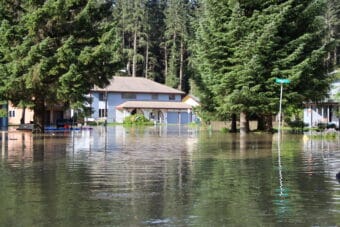
Dominic Walsh’s home on Northland Street flooded last year. The temporary levee the city put up this year is meant to protect his home until there’s a permanent fix, but he doesn’t feel confident in that. 

“I don’t feel any safer with the HESCO barriers, maybe a little bit, but not really,” he said.

This is the first time the levee will be put to the test. Although city officials said they are confident the levee should work properly, they are urging residents in the flood zone to evacuate when the flood warning is issued. 

Walsh said he’s spent all year recovering from the last flood and preparing for the next one, and it’s challenging to imagine that he’ll be living with that anxiety for several more years while the federal process unfolds. 

Craig Loken lives on Emily Way, a street that got hit hard by the flood last August. He said the Army Corps’ slow approach is painful to watch.

“If it takes 10 years, there won’t be anybody left in the Valley to benefit from all these studies,” he said. 

His family has lived in the Valley for three generations. Loken said they are thinking about moving away, depending on how this long-term solution pans out. 

The Mendenhall Glacier and Lake are on federal land, so anything built there is under federal jurisdiction. The Army Corps is starting with a technical study to gather all of the physical data about the baseline conditions in the Valley. Congress allocated $4.75 million to the study and Army Corps officials said it will take a few years to finish.

That study will inform another report called a feasibility study. That’s where the Army Corps weighs each option and picks one. It could take another couple of years and millions of dollars more.

After that, engineers have to design the solution they pick, which can take another couple of years. Then the Army Corps has to build it.  

Leif Hammes is chief project manager in the civil works branch of the Army Corps in Alaska. During Wednesday’s meeting at Thunder Mountain Middle School, he explained that the building timeline depends on how big the project is, but that this is a top priority in his office. 

“We do look for ways to go faster, save time, get us there quicker, but from sort of where we are today to physical construction is multiple years — you know, six, seven, ten-ish years is not an unreasonable timeline,” Hammes said.  

Added together, Mendenhall Valley residents can expect a decade or more before there’s a permanent fix.

Hammes said that Army Corps staff can’t change the agency’s process because it’s grounded in federal laws. 

But Erin Stockdale, chief of the planning section at the Army Corps, told residents to speak up and tell their stories since Congress has the power to make things move quicker. 

“The ‘just build it’ avenue is not common, but I will say the squeaky wheel gets the grease,” she said. 

Lots of ideas were floated, including a tunnel through the ice, a lake tap at the bottom of Suicide Basin and a permanent levee. At this stage in the process, Hammes said the Army Corps isn’t ruling anything out yet. 

But one idea got more attention at the meeting than any other: a dam on Mendenhall Lake.

Dave Hanna has lived in Juneau his whole life. Although his place on Auke Lake isn’t in the flood zone, he said glacial outburst floods are the most devastating issue Juneau is facing. And he thinks a dam is a simple fix. He went up to the microphone and told the Army Corps as much.

“If you put a dry dam across the outlet of the lake, it would serve as a pedestrian bridge,” he suggested. “Find out what you’ve got to build on, and then figure out how to build it, because we can’t wait seven years.”

The crowd erupted into applause. Many residents agree with him.

Scientists are beginning to research other lakes farther up Mendenhall Glacier that might release outburst floods in the future. No one knows how big the risk is yet, but it could narrow down the options for a permanent solution. 

That’s a major reason Hanna is pushing for a dam. 

“Anything we do at Suicide Basin is probably not the correct thing to do, because it doesn’t address future basins,” Hanna said. 

Bob Deering lives along the Mendenhall River and is a retired engineer who once worked at the Army Corps. He thinks a dam is the only viable solution, and said that the process the agency laid out is too slow. 

“Frankly, it’s unacceptable,” he said. “I mean, everybody’s going through all this stress right now, with the flood, you know, looming above us, and we’re going to go through that for another 10 years?”

Suicide Basin is expected to be full around mid-August, but National Weather Service forecasters don’t yet know exactly when it will unleash the next flood. 

Find resources and the latest stories on glacial outburst flooding in Juneau here. 

Aleutian communities on edge after massive earthquake sends waves to U.S. coasts

looking down on buildings in the distance from a green hillside. mountains and fog in the background
The City of Adak seen from the island’s tsunami shelter on Bering Hill Tuesday, July 30, 2025. (Courtesy of Breck Craig)

A tsunami advisory was lifted for the Aleutians and the Pribilof Islands Wednesday morning, after one of the most powerful earthquakes ever recorded struck off the coast of Russia’s Kamchatka Peninsula at about 3:25 p.m. Alaska time.

The magnitude 8.8 earthquake sparked tsunami warnings across the Pacific and sent a series of waves to the coastlines of several states and countries, including Japan and Russia, where damage was reported.

The largest wave in Alaska, at 2.7 feet, hit Adak Island at 11:21 Tuesday night, according to the U.S. Tsunami Warning System, which is part of the National Weather Service.

Adak City Manager Breck Craig and most of the community of about 50 people gathered to wait for the wave at the Bering Hill Chapel on Tuesday evening. A wave was forecasted to arrive at 5:40 p.m., but Craig said he saw no sign of one. He said people cleared out around 7 p.m.

“Everybody still went home and loaded up their trucks and gassed up their vehicles and got their generators gassed up, and we were all ready, in case, you know something happened,” Craig said Wednesday morning.

He said he didn’t get much sleep Tuesday night.

“I slept in my clothes like everybody else in town, I think, did,” Craig said.

Craig said people in Adak didn’t feel the initial magnitude 8.8 earthquake or any of its aftershocks. And thankfully, he said, they haven’t found any damage.

“We checked the pier. We checked the small boat harbor. We’re still in the process of just checking things, just to be double sure,” Craig said. “Even small waves, you know, can do damage. So far, we’re not finding anything.”

Craig said the town’s emergency systems were ready for the alert — they’d just held a tsunami siren test Friday.

“The downside of that was we had to make sure we said ‘Hey, this is not another test. This is real, please evacuate to the tsunami center,'” Craig said.

Other communities in the western Aleutians also saw tsunami waves — including Atka and Nikolski, which both had observed wave heights of over a foot, according to the National Weather Service. Waves of just under a foot were also observed in Unalaska.

Dave Snider, a tsunami warning coordinator with the National Tsunami Warning Center, said there may still be some unusual currents and water levels in coastal communities over the next several days.

“Don’t be surprised if that happens, and be extra cautious in places that you’re familiar with. Every community knows their coastline better than anybody else,” he said.

A tsunami warning had initially been in effect for communities along the western Aleutian Chain, including Atka and Adak, as well as the Pribilofs. An advisory remains in effect for parts of the California coastline as of Wednesday afternoon.

People in those places are advised to stay out of the water and away from beaches and waterways.

A magnitude of 8.8 would make this one of the ten largest earthquakes ever recorded worldwide, and the largest in more than a decade.

KUCB’s Sofia Stuart-Rasi and Theo Greenly contributed reporting.

Tsunami warning lifted for Aleutians, advisory still in effect following M8.8 earthquake in Russia

A sign marking a tsunami evacuation route in Sand Point, Alaska on July 29, 2025. (Theo Greenly/KDSP)

A tsunami warning was lifted for Alaska communities in the western Aleutians on Tuesday evening, after a magnitude 8.8 earthquake struck off the coast of
Russia’s Kamchatka Peninsula at about 3:25 p.m. Alaska time. A tsunami advisory is still in effect for the western Aleutians, including Adak, Atka and Amchitka.

A tsunami warning had initially been in effect for communities along the western Aleutian Chain, including Unalaska, Atka, Adak and the Pribilofs.

An update at 5:27 p.m. Alaska time canceled the tsunami watch for the Alaska Peninsula east of Chignik Bay as well as southern and Southeast Alaska, after an alert had been issued earlier that day for much of the state’s coast.

A map showing the tsunami warning area along the southern Alaska coastline
(Courtesy of U.S. Tsunami Warning System)

Much of the U.S. West Coast also remains under a tsunami advisory, with parts of California and Hawaii still under a warning.

A tsunami warning means people should evacuate inland or to higher ground. Under an advisory, people are advised to stay out of the water and away from beaches and waterways.

The Tsunami Warning Center said that waves of a foot or under had been observed in communities across the Aleutians, including Unalaska, St. Paul and Nikolski. Adak and Atka saw wave heights of over one foot, according to the center, with waves in Atka measuring 1.4-feet.

“A tsunami did occur,” said Dave Snider, a tsunami warning coordinator with the center. “A tsunami is not just one wave, it’s a series of powerful waves. And so it’s entirely possible that the first wave is not the largest and may not be the last.”

Snider said there may still be some unusual currents and water levels in coastal communities over the next several days.

“Don’t be surprised if that happens, and be extra cautious in places that you’re familiar with. Every community knows their coastline better than anybody else,” he said.

In Adak, City Manager Breck Craig and most of the community gathered to wait for the wave at the Bering Hill Chapel on Tuesday evening. The town’s village public safety officer, Mike Lejarzar, peered out to Kuluk Bay with his binoculars, looking for any signs of a tsunami.

“Are you seeing anything, Mike?” Craig asked. “You don’t see anything?”

A wave was forecasted to arrive at 5:40 p.m., but Craig saw no sign of one.

Craig said that by then, most of the town had evacuated to the chapel, which acts as the city’s tsunami shelter.

“We sounded the tsunami siren and collected everybody up and got everybody up here,” Craig said. “We’re all just kind of hanging out, waiting for what they’re thinking is a one foot or three foot wave maybe to come in.”

Craig said everyone had gone home by about 7 p.m., but the city would stay vigilant and watch any updates over the next 15 hours. According to the National Weather Service, tsunamis are a series of waves, and a large tsunami can continue for hours or days in some locations.

In Atka, one of the westernmost communities in the Aleutian Chain, Mayor Luke Snigaroff said that no wave had materialized as of 6:12 p.m., but roughly two dozen residents in the Unangax̂ village had evacuated to high ground.

“We’re still under warning,” Snigaroff said in a telephone interview. “Everybody’s up at the water treatment plant or the quarantine shelter.”

A magnitude of 8.8 would make this one of the ten largest earthquakes ever recorded worldwide, and the largest in more than a decade.

KUCB’s Maggie Nelson and Theo Greenly contributed reporting.

Juneau and other Southeast communities broke high temperature records Monday

The sun shines on Eaglecrest Ski Area in Juneau. (Photo by Clarise Larson/KTOO)

The sunshine that Southeast Alaskans felt yesterday will go down in history. Multiple towns in the region reached record high temperatures.

The highest record breaking temperatures were in Yakutat and Juneau, which both reached 81 degrees. That broke Yakutat’s 1996 daily record by nearly 10 degrees and tied Juneau’s 1982 record.

Temperatures also broke or matched records in Haines, Gustavus and Klawock.

National Weather Service Meteorologist Grant Smith said it’s important to track record-breaking days. 

“So when we see these extremes, yes, it’s impressive,” he said. “If we see more of them in a short amount of time, then yeah, it could mean something.” 

Over decades, he says, that data can help tell the story of how the local climate is changing. But just a single day of record heat can’t alone tell that story.

This year, Alaska updated its heat advisory levels to match how temperatures feel in northern latitudes. 

In Southeast, a forecast of 80 degrees now triggers a heat advisory. Juneau just had its first one.

The new advisories reflect that hot weather often feels hotter here.

“The sun angle is so much higher, so all that light energy is much more direct on us, on the concrete, on our skin,” Smith said. 

Smith describes it as a flashlight shining down on a table. When it’s shining directly down, the light is concentrated in a small circle, so it’s more intense — that’s what Alaska is like in the summer. When the flashlight is angled, it shines as a large cone at a much lower intensity — that’s what we experience in the winter. 

Monday’s heat gave way to clouds and rain across much of Southeast on Tuesday. Aside from a few days of warmth here and there, cool weather has dominated this summer so far.

Correction: This article has been updated to specify that Yakutat and Juneau saw the highest record breaking temperatures in the region, but not the highest temperatures overall. 

Dead humpback whale calf washes ashore in Juneau

A U.S. Coast Guard boat approaches the humpback whale carcass on Saturday, July 26. (Photo by Jamie Diep/KTOO)

A dead humpback whale calf washed ashore near Douglas Harbor over the weekend. National Oceanic and Atmospheric Administration officials completed a necropsy, but don’t yet know how it died. 

The dead whale drew a somber crowd Saturday as officials collected the animal.

Frank Lynn Pierce was one of the onlookers. He’s a local photographer who’s lived in Juneau for nearly 50 years. He says it’s odd to see humpbacks in Gastineau Channel.

“I’ve been documenting this unusual situation,” he said with his camera in hand. “I’ve never seen a whale in this area before, let alone a dead one.”

As the tide came in, Pierce snapped pictures of the bloated male calf. It was upside down, bobbing partially out of the water. 

Julian Caballero was among the crowd watching. 

“It wasn’t even that bloated a couple hours ago, so it must be pretty fresh,” he said. 

He said it’s sad to see such a young whale dead. He saw NOAA researchers tie a buoy to the body, and then a U.S. Coast Guard boat towed it through the channel to an area where researchers could do a necropsy. 

The NOAA Fisheries Alaska Marine Mammal Stranding Network completed the examination on Sunday. But Jennifer Angelo, a communications manager for NOAA Fisheries, said the tissue samples that help determine the cause of death can take months to analyze in a laboratory.

Juneau get its first-ever heat advisory

A man and his dog play frisbee on the beach
Rodger Healy and his dog play frisbee on the beach at Auke Rec on June 1 2022. (Photo by Paige Sparks/KTOO)

Sunshine and warm temperatures brought a heat advisory to Juneau and surrounding communities on Monday.

The National Weather Service issued the advisory for Juneau, the Upper Lynn Canal, Gustavus, Hoonah, Tenakee Springs and Yakutat – where temperatures were expected to reach 80 degrees.

It’s the first-ever heat advisory for Juneau and much of the region, though the Weather Service issued similar advisories for the Haines Highway and Klukwan earlier this summer.

Heat advisories are new for Alaska. National Weather Service Forecaster Grant Smith says they started issuing them this year after establishing localized criteria that allows them to distinguish extreme heat conditions in Alaska from the Lower 48.

“We’re just not used to those warmer temperatures, and so we were starting off just working with our state climatologist and local management,” Smith said. “We have a threshold of 80 degrees is our starting point, and then we’ll adjust as need be going forward.”

Smith says Alaskans generally are not used to such high temperatures since they don’t happen very often. That can make it more dangerous for people with health issues and for pets.

“When we get to these warmer temperatures on sunny days, a car parked in a parking lot in the sun, an 80 degree temperature, the inside of the car can reach over 100 degrees in 15 to 30 minutes,” he said.

He also said that many people who have spent time outside Alaska notice that it often feels much warmer here than what thermometer shows. Part of that has to do with the sun’s angle.

“It’s so much more direct on us because it’s so much higher up,” he said. “It’s just all that sun’s energy is beating down right on you more directly, and so it feels warmer.”

Cloudy conditions are expected to return in the coming days, but while the warmth persists it’s important to stay hydrated, wear sunscreen and keep an eye out for heat exhaustion.

Site notifications
Update notification options
Subscribe to notifications