Environment

Trump’s EPA could revive controversial Pebble Mine in southwest Alaska

Donald Trump Jr. and his son in river shallows. Trump jr. holds in front of him a sockeye salmon that is bright red with a green head.
Donald Trump Jr. is among the opponents of the Pebble Mine. He posted this photo of himself on Facebook in 2014. (Photo via Facebook)

The Trump administration is reviving the hopes of the company behind the proposed Pebble Mine in southwest Alaska.

Vancouver, B.C.-based Northern Dynasty, the parent company of the Pebble Limited Partnership, says it’s in talks with the Environmental Protection Agency and hoping the agency will swiftly withdraw its veto of the project.

The proposed open-pit copper and gold mine would be upstream from Bristol Bay and is widely opposed in Dillingham and the region, where it is seen as a threat to the bay’s prolific salmon runs.

Environmental studies found it would damage or destroy miles of salmon streams and more than 2,000 acres of wetlands.

National sportfishing groups have also campaigned against the mine.

Northern Dynasty has a pending lawsuit in U.S. District Court in Anchorage to get a prior EPA veto of the project thrown out. A document filed in that case says the company and the agency are discussing a possible settlement and expect to reach an agreement by July 17.

In his first term, President Trump seemed to run hot and cold on Pebble. His first EPA administrator in 2017 let the project move forward, then reversed course a few months later. The mine proposal seemed to get back on track, but then the U.S. Army Corps of Engineers denied Pebble’s permit application in 2020.

That came after Donald Trump Jr., a sportfisherman who visited the region, publicly announced his opposition.

Juneau releases hazard mitigation project list for public comment

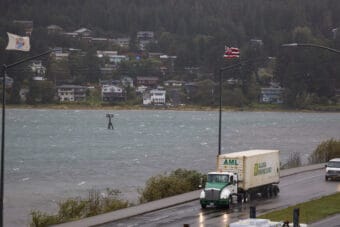
Downtown Juneau on Monday, June 9, 2025. (Photo by Clarise Larson/KTOO)

Juneau officials released a list of potential hazard mitigation projects for public review on Thursday, July 10. 

The city and the Central Council of the Tlingit & Haida Indian Tribes of Alaska are considering more than a hundred projects to reduce risks in the Juneau area. Officials came up with some of the project ideas, while others were pulled together from past hazard mitigation plans, a public survey and even Facebook posts. 

Projects that officials choose will go into an updated plan to make the city eligible for federal disaster funding. 

Potential projects range from plans to increase affordable housing to elevating buildings in flood zones. One idea is to explore a federal buyout program for homes in high-hazard areas. Another is to regulate new construction in severe hazard zones. 

Other ideas include renovating buildings to handle earthquakes, installing landslide and avalanche monitoring equipment and encouraging electric utilities to bury power lines. 

The city’s last hazard mitigation plan expired in 2017. The update must be finished by October for the city to qualify for a federal grant to fight glacial outburst floods in Mendenhall Valley. 

Officials said the full draft hazard mitigation plan will be published next week. 

The public comment period closes July 25. Residents can submit comments via email to laura.young@fairweather.com

Juneau Animal Control shares how to prepare pets for emergencies

Animal Control Officer Thomas Young-Bayer holds jars full of cat litter as part of his emergency go-bag for his pets on July 2, 2025. (Photo by Mikko Wilson/KTOO)
Animal Control Officer Thomas Young-Bayer holds jars full of cat litter as part of his emergency go-bag for his pets on July 2, 2025. (Photo by Will Mader/KTOO)

Like much of Alaska, Juneau has its share of disasters and emergencies. Part of living here is planning ahead for scenarios that may require evacuating your home. Juneau Animal Rescue wants to inform residents about how best to prepare to evacuate their pets too. 

They have a list of things all pet owners should know and have on hand to make sure their pets are safe in an emergency or crisis. 

Thomas Young-Bayer is an animal control officer. He said it’s a good idea to gather the things our furry friends may need for a few days away from home. 

“One of the best ways to prepare yourself, your family and your pets for an expected emergency is to pack a go-bag,” he said.

He unpacked his own go-bag for his dog and cat. In it: a muzzle, jars of kibble, and a well-loved blanket.

“These are a couple of my dog’s favorite toys,” he said, holding the disembodied arm of a stuffed animal. “And you know, they might even just be a scrap of a toy, but if that dog loves that, if that’s what helps it feel safe and familiar and with a new situation and want to play and kind of get out of its fear and anxiety stage, then that’s what you should grab and have ready to go.”

The go-bag should be waterproof and have the pet’s medications, three days worth of food, water, and hygiene supplies. 

For the full list, watch this video breakdown of the pet go-bag:

And Young-Bayer said Juneau Animal Rescue can be that temporary landing place for pets in emergencies. 

“Whether they be fire, flood, landslide, or people who are suddenly unhoused for another unexpected reason, or even expected reasons, such as eviction,” he said.

If that moment ever arises, he said there are some things pet owners can do to make it easier for JAR to house pets, like making sure pets are spayed and neutered, and their vaccinations are up to date. Pet owners should give JAR all their pet’s information: medical history, vaccination and sterilization records, microchip numbers, and photos of the pets with their people. 

The organization keeps that in a file with the owner’s contact information, he said. That also helps if a pet gets loose in an emergency or is otherwise separated from its family. 

“Having them microchipped is very, very helpful for us to identify who a particular pet is that we might encounter and who that pet belongs to and where its home is,” Young-Bayer said.

JAR offers microchipping and their staff can scan a pet’s existing microchip to make sure the information is up to date.

But the best way to keep your pets safe in the event of a landslide or flood, he said, is to identify a friend or family member in Juneau who lives outside of the same hazard zone, is familiar with your pet, and can be prepared to care for the animal if you’re evacuated.

Young-Bayer also encouraged pet owners to be prepared for their pet to be anxious—dogs may be more reactive in a crisis, and cats may hide in hard to reach places. And he said, if there’s a known threat of an emergency, bring outdoor cats inside where they’ll be easier to evacuate. 

If Juneau residents have a pet emergency, they can reach animal control by calling JAR or through the Juneau Police Department after hours dispatch line at 907-586-0600.

Compensation program for health damage from Alaska weapons tests is extended

Harlequin Beach on Amchitka Island is seen in this undated photo. The island, now part of the Alaska Maritime National Wildlife Refuge, was the site of atomic weapons tests in 1965, 1969 and 1971. (Photo provided by the U.S. Fish and Wildlife Service)

People who might have been exposed to radiation from atomic weapons tests conducted in the Aleutians half a century ago have extra time to apply for compensation from a federal program, under the sweeping tax and budget bill passed by Congress and signed into law last week.

The bill, which was signed by President Donald Trump on July 4, includes a provision reviving the Radiation Compensation Exposure Act, which was enacted in 1990.

The act’s compensation system distributed one-time payments to people who were exposed to radiation from the weapons tests and who later were diagnosed with certain types of cancer. The program has distributed about $2.7 billion to date, according to the U.S. Department of Justice.

While most of the tests covered by the act were conducted in Nevada, the program also covers health damages from underground weapons tests conducted on Alaska’s Amchitka Island in 1965, 1969 and 1971.

The program covers former uranium mine workers, as well, many of whom were Navajo Nation members.

The compensation program had been on track to expire, with a previous deadline of June 10, 2024, for any new claims.

The budget bill extends the deadline for new claims to Dec. 31, 2027, and it sets a Dec. 31, 2028, sunset date for the trust fund that administers the claims.

The bill also raises compensation amounts. For “downwinders,” people who were not on site at the time of the tests but may have been exposed to radiation carried by the wind, the compensation is hiked from $50,000 to $100,000. For on-site workers, the compensation is raised from $75,000 to $100,000.

Of the Alaska weapons tests, the third — called Cannikin — was the most controversial.

It was the biggest underground nuclear test ever conducted by the United States. The tested bomb was 5 megatons, about 250 times as powerful as the bomb dropped on Hiroshima, Japan, in 1945. There was widespread opposition to the project, including from environmentalists who later founded the organization Greenpeace.

Legal opposition to the test went all the way to the U.S. Supreme Court, which ultimately allowed the project to proceed.

The test created what was the equivalent of a magnitude 7 earthquake, killing up to 2,000 sea otters and thousands of fish.

The island continues to undergo environmental monitoring, for which the U.S. Department of Energy is responsible. The Alaska Department of Environmental Conservation and the Aleutian Pribilof Islands Association, a tribal organization, are partners.

29 homes have been lost in Denali Borough fires, officials say

Smoke-covered hills near Chena Ridge in Fairbanks on July 8, 2025.
Smoke-covered hills near Chena Ridge in Fairbanks on July 8, 2025. (Shelby Herbert/KUAC)

Twenty-nine homes, along with 34 other structures, have been lost in the fires near Healy since they began last month, borough officials said Tuesday. Officials say that no structures have burned in the Fairbanks North Star Borough.

So far this week, scattered rain and cooler weather have been helping firefighters protect homes and infrastructure from the Interior wildfires. Over 200 fires are burning across the state, but firefighters are concentrating their efforts on the roughly two dozen that are threatening residential areas.

Meanwhile, smoke from the fires is a growing health concern. Air quality levels in Fairbanks dropped into the “unhealthy” range early this week. The city is shrouded in a pale haze that smells like a campfire, and borough officials are urging people to stay inside as much as possible.

Alaska Division of Forestry spokesperson Liv Stecker says she’s been asked a lot about whether recent rain will also help clear up the air. She says that unfortunately, that’s not the case.

“It kind of creates this blanket, this weight, the increased humidity that traps smoke in lower levels a little bit,” she said. “So you have kind of this smoky, humid condition around Fairbanks and beyond where the fires are impacting, which can definitely help slow fire behavior, but it decreases that air quality.”

Kaitlin Wilson is a spokesperson for the Fairbanks North Star Borough mayor’s office. She says the borough has opened its breathing room at the local public library, where residents can get a break from the smoke during regular business hours.

“As long as we’re having these unhealthy smoke levels, unhealthy air quality, we’re just urging residents to stay inside, limit prolonged exertion in the smoke,” she said.

Rain showers are expected to continue throughout the week, with a chance of thunderstorms. Fire activity is still slowing traffic on parts of the Parks and Elliott Highways, and drivers should expect delays.

Paralytic shellfish poisoning moves beyond Alaska’s shoreline

The beach in Sand Point July 2023.
The Knik Tribe tested for marine toxins along the coast in Sand Point. Typically found during the summer months, paralytic shellfish poisoning is becoming more prevalent throughout the year, due to Alaska’s warming climate. (Theo Greenly/KSDP)

Just back from the beach in Sand Point, Jackie McConnell carried a bucket of clams and cockles into her motel room at the Anchor Inn.

McConnell is the project coordinator for the Knik Tribe’s program for monitoring paralytic shellfish poisoning, or PSP — a dangerous and often fatal neurotoxin that can show up in local shellfish.

PSP is typically found during the warm summer months, but McConnell says the toxin has been showing up in butter clams and cockles for much longer.

“They are basically hot all year round,” she said.

McConnell was sorting through the bucket of shellfish with Bruce Wright, the tribe’s chief scientist. He’s studied PSP levels in Alaska for about 20 years. On this trip, he said he is particularly interested in Arctic surf clams — also called pink-neck clams — a favored food of walruses.

“There’s people that, when they catch a walrus, they like to take the stomach and eat the undigested clams,” Wright said.

That’s one example of how saxitoxin moves through the food web — starting in shellfish, then traveling into larger animals. But the researchers say they’re also finding high levels of saxitoxin in animal droppings far from the coast.

“We’re finding that wolves, bears, their scat in areas where they’re not even feeding from the ocean, that they can have moderate levels of PSP in their scat,” Wright said.

They’ve concluded the inland contamination comes from cyanobacteria, a type of blue-green algae found in ponds and lakes. That suggests a second, freshwater source of saxitoxin is entering the food web.

Saxitoxin — one of about 50 neurotoxins found in shellfish — commonly accumulates in freshwater systems in the Lower 48, where warm weather creates favorable conditions for the bacteria. Its presence in Alaska’s cooler climates is relatively new.

Despite the elevated readings, the researchers said local shellfish can still be safe to eat if it’s been tested first.

“We’ll pay for the shipping, we’ll pay for the analysis, and we’ll and we’ll take care of that consultation after the data comes back,” Wright said.

He said residents can leave their harvest in a bucket and send a sample to the tribe. Results are typically returned within one or two days.

Site notifications
Update notification options
Subscribe to notifications