Weather

Take a break from the holiday hustle to explore Earth’s oceans, atmosphere

Market squid
Market squid hatch in the wet lab at the Ted Stevens Marine Research Institute this summer. (Photo by Matt Miller/KTOO)

Looking for something to do during the holiday season aside from Christmas shopping and holiday parties? Perhaps something that is educational as well as entertaining? And free?

Staff at the National Oceanic and Atmospheric Administration’s Ted Stevens Marine Research Institute are offering free tours through next week.

Outreach educator Ralph Steeves says the tour focuses on the two missions of the Point Lena facility: assessment of the North Pacific fisheries stocks and study of the climate and health of the ocean.

“So, we visit the biology labs, the chemistry labs, the genetics labs,” Steeves says. “We will go into what they call the wet lab where we have live specimens going that are going through experimentation in regards to climate and water temperature. We also talk about some very interesting technology that keeps the building warm. This is a building is one of the only ones in the federal government that relies on no fossil fuels for heat.”

The hourlong tour through the facility includes artifacts from scientists studying Alaska’s fisheries and marine mammal populations, the wet lab where many of the research experiments are conducted, the heat exchange system which uses ocean water to heat or cool the facility and the lobby aquarium. It’s a bit like the tour offered to visitors during the summer season.

Science on a Sphere
Science on a Sphere that was located at the now-demolished Alaska State Museum shows ocean currents in this view. (File photo by Matt Miller/KTOO)

“And then, we have a presentation on the Science on the Sphere which is that globe you may have seen at the (Alaska State) Museum in the past. Of course, it’s decommissioned right now while they’re building SLAM,” Steeves says. “In Juneau (we’re) very fortunate. We’re the only city in the entire world that has two of them. One of them is here at NOAA. We have a presentation on that that talks about the other things that NOAA does beside fisheries, and some current data on climate change.”

Steeves says the Science on a Sphere presentation runs about 25 minutes and the whole experience at the lab runs about an hour and a half.

Tours are offered every weekday at 1 p.m. through next week. There’ll be no tours on Christmas Day, the following Friday of next week or New Year’s Day, when the facility is closed.

Call ahead at 789-6050 if you want to reserve a spot in the daily afternoon tours that are usually limited to a dozen people 16 years and older. Tours can also be arranged by appointment.

Most importantly, Steeves says don’t forget to bring your camera.

Related videos:

NOAA’s Joe Orsi describes a large ocean sunfish that was caught in a trawl during summer 2015.

NOAA’s Gordon Garcia describes an attempt to hatch market squid during summer 2015.

Snow could make for messy Monday morning commute in Juneau

On street parking downtown is free until sometime next month. (Photo by Heather Bryant/KTOO)
(Photo by Heather Bryant/KTOO)

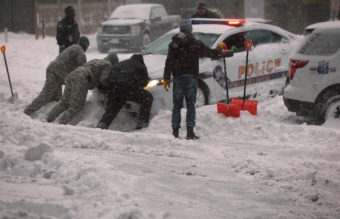
Juneau could get three to seven inches of snow starting in the middle of the night through Monday afternoon. The National Weather Service issued a winter weather advisory in effect from 3 a.m. to 3 p.m. Monday.

“I think the worst of it will actually happen during your morning commute on Monday morning. Going into midday, especially in the afternoon, I think things will turn a bit messy. We could have a changeover to rain,” said Wes Adkins, meteorologist with the National Weather Service in Juneau.

Adkins said the rain will dampen snow totals. Besides a hazardous morning commute, people can expect reduced visibility and possible disruption to aviation operations.

Adkins says Juneau could get a break between systems on Wednesday before another heads in by the end of the week.

Update: Mendenhall Valley air emergency lifted

Update | Dec. 6, 1:14 p.m.

The air emergency and wood burning restrictions in the Mendenhall Valley  have been lifted. The valley air quality monitor reported levels of harmful fine particulate matter falling into a safer range this morning.

Original story | Dec. 5, 8:43 p.m.

Wood stove (Photo by Christen Bouffard)
(Creative Commons photo by Christen Bouffard)

An air emergency and wood burning ban is in effect for the Mendenhall Valley.

The city issued the emergency Saturday afternoon after measurements of harmful fine particulate matter spiked.

According to preliminary data from the Department of Environmental Conservation’s rooftop monitor at Floyd Dryden Middle School, it peaked at 55 micrograms per cubic meter in the valley around 1 a.m. Saturday. The state’s threshold for unhealthy air is 35 micrograms.

A pm 2.5 chart of preliminary data from DEC's air quality monitor at Floyd Dryden Middle School for Dec. 5, 2015.
Preliminary data of fine particulate matter readings from DEC’s air quality monitor at Floyd Dryden Middle School.

Nicole Ferrin is a meteorologist with the National Weather Service’s Juneau office. She said there have been inversion events in the valley over the last two days. An inversion is a weather phenomena in which cool, still air gets trapped near the surface. Inversions prevent air pollution from dispersing, and helped the fog persist that disrupted flights in and out of Juneau.

Ferrin said two weather fronts are near the area and may break up the inversion Saturday evening or during the day Sunday.

“Those larger synoptic features will be giving us more mixing in the atmosphere and should get rid of this inversion, but they’re also weakening as they move further north,” she said.

More information about the wood burning restrictions are available on the city’s air emergency website.

12 to 18 inches of snow expected in Juneau

Recent snowfall in downtown Juneau (Photo by David Purdy/KTOO)

Juneau could receive up to 18 inches of snow by Wednesday afternoon. The National Weather Service issued a winter storm warning for the borough, which is in effect until 4 p.m. Wednesday.

Jonathan Garner with the National Weather Service office in Juneau says snow showers will move east across Juneau.

“Heavy snow showers with a short period of lighter snow or even maybe no snow, and then another shower will move across and we’ll get another period of heavy snow,” Garner said. “We’re expecting 12 to 18 inches of total snow fall accumulation through Wednesday afternoon.”

Garner says Juneau could get another snow event on Thursday.

Eaglecrest Ski Area is reporting 40 inches of snow accumulation to date.

Editor’s Note: A previous version of this story overstated the amount of snow at Eaglecrest.

High winds in Unalaska cancel school, blow out windows

Aleutian storm satellite image 11 04 2015
A MODIS satellite image from NASA, showing a storm over the Aleutian Islands on Nov. 4, 2015.

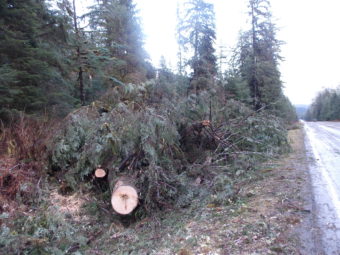
A powerful windstorm blew through Unalaska on Wednesday, closing schools and causing minor damage.

Meteorologist David Kochevar at the National Weather Service office in Anchorage said his agency clocked wind speeds of 91 mph at the Dutch Harbor Airport around 6:30 a.m. A wind gust clocking in at 93 mph hit the Akutan airport at 6:35 a.m.

Sustained gusts blew over 70 mph on Captains Bay throughout Tuesday night.

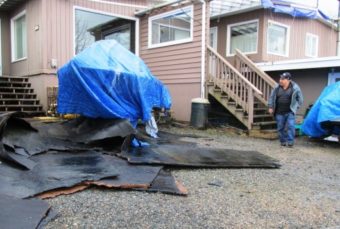
Wednesday morning, Unalaska Deputy Police Chief Mike Holman said the public safety office responded to calls about windows breaking out, a container flung across a roadway and a streetlight that blew down near the South Channel Bridge.

Aleutian wind damage
90-plus mph winds early Wednesday ripped off part of this Trapper Drive home in Unalaska. (Photo by Greta Mart/KUCB)

One person was treated at the clinic for glass in the eye from an imploding window. A window also blew out at the Harbor office. Holman said high winds damaged the roof of a home near the base of Haystack Hill.

Wednesday afternoon, neighbors gathered at a home on Trapper Drive to help the homeowner patch gaping holes in his roof. Earlier in the morning, high winds blew off a large section of the home’s roof and blew out the two-car garage door.

The Unalaska School District announced Tuesday afternoon schools would close Wednesday due to a threat of severe weather. Eagle’s View Elementary and Unalaska City School were expected to resume classes Thursday.

Why a local skier is busing around the Lower 48 this winter

Juneau skiers may be forced to accept a future with warmer winters and less snow.

Scientific data suggests that over the last 30 years, Southeast Alaska has experienced a warming trend, matched with more precipitation, and perhaps, less snowfall.

Skier Ben Lyman has adapted by migrating.

“Well, right now I’m converting a bus into an RV and part of the intention of that is being able to go where the snow is,” he said.

Lyman is in Wisconsin working on “Velda the Wonder Bus,” which he plans to use to follow snow.

Velda the Wonder Bus
Velda the Wonder Bus. Skier Ben Lyman is converting the bus into an RV so he can follow the snow. (Photo courtesy Ben Lyman)

“After last winter being surprised to see snow in North Carolina and New Mexico, makes me think I need to be a little more mobile in the winter,” Lyman said.

According to the U.S. Forest Service, climate change is affecting Alaska more than any other state in the country because of its northerly latitude.

Since 1971, Juneau’s average monthly temperature has warmed 3.54 degrees Fahrenheit, according to a University of Alaska Fairbanks research organization. The Scenarios Network for Alaska and Arctic Planning predicts that this warming trend will continue over the next 84 years.

“You can see the temperature creeping up,” said Rick Fritsch, a meteorologist with the National Weather Service in Juneau.

In the past, the average winter temperature in Juneau at sea level was around 32 degrees, Fritsch said. Now, it seems to be slightly higher than freezing. This could mean more rain and less snow.

Eran Hood, a professor of environmental sciences and geography at the University of Alaska Southeast, agreed. He said Southeast is particularly sensitive to climate change.

“Whereas if you go to the interior Alaska where it’s very cold and you change the temperature by a few degrees you are still going to have snow,” Hood said.

This means unreliability for skiers like Ben Lyman.

Lyman, 38, grew up in Alaska and said he’s always skied. He said some of his earliest memories are riding in a baby backpack while his father was skiing. Lyman began teaching skiing at Eaglecrest when he was 14. Now he just skis for pleasure, but he’s noted some changes in snowfall in his lifetime.

“It certainly seems like overall we get less snow down at sea level and certainly at the base area, although I think we’re still holding pretty well at the top,” Lyman said.  “My memories are definitely of more prolific snowfall than we’ve had in most recent years, although we did have a pretty amazing year in 2007.”

Last winter, Eaglecrest had so little snow that the lifts barely ran.

In 2007 a Juneau climate change panel produced a report forecasting the effects of global warming on the city, including the future of Eaglecrest. It predicts warmer temperatures will work their way from sea level up mountainsides.

The panel asserted that “skiing, sledding, ice skating and other snow-dependent activities will be less available to Juneau residents as the climate warms.”

Over the last year, Eaglecrest has created a connection to a chairlift that will enable skiers to get higher on the mountain, cleared additional ski trails and purchased more snowmaking equipment.

“We did buy another snowmaker which increases our snowmaking ability by 33 percent,” said Matt Lillard, general manager of Eaglecrest.

If Eaglecrest doesn’t adapt, skiers will.

In Wisconsin, Lyman’s bus is a work in progress.

“It’s a 1999 International Genesis, 72-passenger rated capacity, 31,000 pounds, and 39 and a half feet long. We just finished painting her today, midnight blue,” he said.

Lyman said that by the time he finishes his bus, he will know where the snow is.

Weather permitting, Eaglecrest Ski Area is scheduled to open Dec. 5.

Site notifications
Update notification options
Subscribe to notifications