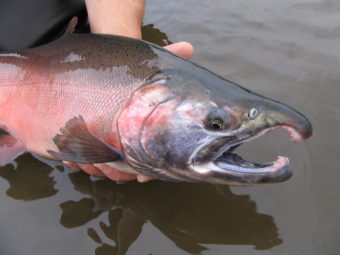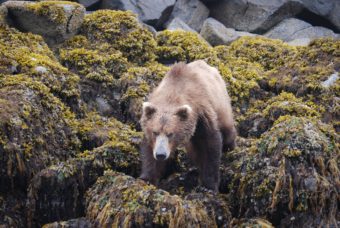
Polar Bears (Photo by Atwell Gerry, U.S. Fish and Wildlife Service)
The United States will not support an international ban on the trade of polar bear products at an upcoming meeting on endangered species.
In a statement released last week, the U.S. Fish and Wildlife Service said it remains concerned about the commercial use of polar bear hides, but it said it won’t encourage the ban.
“We are putting our resources into working in collaboration with other polar bear range states to address climate change and mitigate its impacts on the polar bear as the overwhelming threat to the long-term future of the species,” the agency said in its statement.
Inuit leaders and organizations from Canada have been lobbying the U.S. for the last year. Polar bear sport hunting is an important industry to the Inuit economy.
Polar Bear sport hunting has not been legal in the U.S. since the passage of the Marine Mammal Protection Act in 1972.
Delegates from across the globe will meet in South Africa this fall at the Convention on International Trade in Endangered Species of Wild Fauna and Flora, or the CITES Conference.
The 2013 CITES Conference was the last time the U.S. attempted to ban the international trade of polar bear products. Forty-two countries voted against the ban, and 38 voted in favor of it.
African bush elephants on Fothergill Island, Zimbabwe. DEA/G. Sioen/De Agostini/Getty Images
Zimbabwe says it is putting some of the wild animals in its reserves up for sale because of the severe drought that has hit the country.
That’s according to a statement from the Zimbabwe Parks and Wildlife Management Authority (known as ZimParks) that was carried by Reuters and CNN.
It says the country intends to “destock its parks estates” by selling animals to “private wildlife reserves” but offers few additional details, CNN reports.
The network says that according to the statement, interested parties should:
“… provide the following information about the habitat [in] which they intend to put the acquired animals: name and address of property, size of property, ownership of the property, description of current land use, intended use for the acquired animals and existing infrastructure e.g. fences, water availability, roads, fireguards, protection/law enforcement capacity and management.”
CNN adds that “conservation groups will be watching closely to see if any animals appear destined for hunting concessions.”
It’s unclear whether foreign buyers can apply, Reuters reports. ZimParks spokeswoman Caroline Washaya-Moyo would not comment on the number of animals for sale or whether they could be transported outside Zimbabwe.
“We do not have a target. The number of animals depends on the bids we receive,” she said, according to Reuters.
The government intends to use the money raised “to buy food and secure water facilities for distressed animals,” Environment, Water and Climate Minster Oppah Muchinguri-Kashiri says, CNN reports.
The region is facing a severe drought that has taken a toll on food harvests. According to UNICEF, 37 percent of households in Zimbabwe are hungry. The dry conditions have “decimated” livestock. In February, the situation prompted Zimbabwean President Robert Mugabe to declare a state of disaster.
According to Reuters, “about 54,000 of Zimbabwe’s 80,000 elephants live in the western Hwange National Park, more than four times the number it is supposed to hold.” The wire service adds that drought conditions at Hwange are already “critical” and “expected to worsen.”
Last year, Zimbabwe sold dozens of elephants to China in a bid to raise money for conservation efforts, according to The Guardian. The sale was sharply criticized by wildlife protection groups.
Copyright 2016 NPR. To see more, visit http://www.npr.org/.
A Canadian company exploring an Alaska mineral prospect near a wildlife preserve is drawing criticism from residents who say the risk is not worth the potential economic benefits.
Vancouver, British Columbia-based Constantine Metal Resources Ltd. has applied to expand exploration near the Alaska Chilkat Bald Eagle Preserve in Haines.
The Chilkat River stays open well after other southeast Alaska rivers freeze up. Up to 4,000 bald eagles gather there each year to feed on salmon carcasses.
Constantine officials say they’re not sure a mine will ever be built, but if it is, Alaska’s stringent regulations will ensure it’s done safely.
But critics such as Haines environmental activist Gershon Cohen says a debate on a future mine upstream of important wildlife habitat should start before a company spends millions on exploration.
GPS radio-collared female mountain goat on Lion Head Mountain, overlooking Berners Bay. (Photo courtesy ADF&G)
State biologists now have a clearer picture of how mining impacts mountain goats. The first-ever Alaska-based study on mining and mountain goat habitat was published recently. It tracked the movements of goats in the area around Kensington Mine, a gold mine between Haines and Juneau, near Berners Bay.
The Alaska Department of Fish and Game study confirmed what biologists already suspected: mining impacts mountain goat habitat selection.
The study’s inception coincided with the start of Kensington mine’s development in 2005. Biologists mapped where mountain goats live in Kakuhan Range. They captured and put GPS radio collars on 75 animals, 18 of which were collared near the mining area. Biologist Kevin White led the research.
“Within this area, the types of activities that are occurring involve blasting, helicopter activity, heavy equipment operation and vehicle traffic,” White explained.
The question was, how much would that activity affect mountain goat habitat selection? In other words, would mountain goats avoid areas close to the mine?
At a presentation at the Takshanuk Watershed Council office last week, White showed a map that included Lion’s Head Mountain, where some of the goats spend summers. The mountain is bordered on the east and west by what his team identified as critical winter habitat, which is at lower elevations.
“Those animals are summering up on that ridge, and in the winter they have a decision,” White said. “Are they going to go down into the bowl where’s there’s critical habitat that’s close to the mine? Or are they going to go down to the other side of the ridge where there’s area far away from the mine?”
Overwhelmingly, the goats veered away from the mining activity. Most chose to winter east, near Berners River, instead of west, toward Johnson Creek.
“It’s pretty striking; just looking at this map, you can see there’s virtually no locations in these critical habitat areas that are within 1,800 meters of the mine. They’re simply avoiding using that area.”
White says the animals stay away from areas within 1,800 meters from the mine. That’s equal to 1.8 kilometers and 1.1 miles. How does that one-mile threshold impact how much habitat the mountain goats have left to choose from? White says it takes away 42 percent of the winter habitat.
“So essentially that’s habitat functionally being taken away from the mountain goats,” White said. “So there’s been a roughly a 42 percent decline in winter habitat as a function of the mine.”
“It’s not earth-shattering,” said Ryan Scott, Fish and Game’s Wildlife Conservation regional supervisor “Intuitively it makes sense that when you have some kind of disturbance, whether it’s mining or other things, that mountain goats are going to avoid certain areas,” Scott said. “And we’re seeing that.”
What are the implications of these findings? White says the first is obvious. Mining activity should not occur within 1 mile of mountain goat winter habitat. But in some cases, like the Kensington Mine, it’s too late.
White says when winter habitat is reduced mountain goat populations’ productivity and resilience could be damaged. Fish and Game will continue to monitor the animals to see if there are detrimental changes to the population.
“Goats are a tough one,” Scott said. “They live in a tough spot, they’re slow to reproduce, they don’t handle disturbance too well. But there are things we can do to help them out, to try to minimize the amount of impact.”
Scott says there has not yet been a conversation about whether there’s anything to be done about the disturbances around Kensington.
As for the mineral exploration that’s happening near Haines, Scott says this study will influence the recommendations he makes. Constantine Metal Resources recently filed a proposed plan to expand operations at the Palmer Project, where the company is exploring for gold, silver, copper and zinc. An environmental assessment of the plan from the Bureau of Land Management is out for public comment. Scott says Fish and Game will file a comment related to mountain goat habitat protection.
Overall, the biologists say the discovery of the one-mile buffer zone is really important. It will help inform how Fish and Game looks at future mining decision in mountain goat land.
The American martens range extends from northern New Mexico to the northern limit of treeline in arctic Alaska and Canada. (Public Domain photo by the U.S. Fish and Wildlife Service)
A marten dragging a chicken across North Tongass Highway caused a two-vehicle collision just before noon on Saturday.
According to the Alaska State Troopers online dispatch, the marten was fighting and dragging the chicken across the southbound lane on the curve at about Mile 10 North Tongass.
A 75-year-old Ketchikan woman was headed southbound in a 1999 Honda Civic and hit the brakes abruptly when she rounded the curve and saw the animals in the roadway. A 47-year-old Ketchikan man driving a 1998 Dodge truck behind her attempted to stop to avoid a collision, but due to heavy rain, his truck slid and rear-ended the Honda.
A passenger in the truck said he had a possible injury, and was transported to PeaceHealth Ketchikan Medical Center for evaluation. All parties reported wearing seatbelts.
Martens are carnivorous and are members of the weasel family, according to the Alaska Department of Fish and Game website. Adult martens are about 20 to 25 inches long and weigh up to 4 pounds. Their natural prey includes voles, squirrels and birds.
For the last time, elephants were used in a performance by Ringling Bros. and Barnum & Bailey Circus last night. The circus elephants are seen here during a show last month in Washington, D.C. Andrew Caballero-Reynolds/AFP/Getty Images
For the Greatest Show on Earth, there is no longer an elephant in the room. The 145-year-old Ringling Bros. and Barnum & Bailey circus held its last show featuring elephants Sunday night, in a move that’s being applauded by animal rights activists.
Ringling announced its plan last spring, saying it is sending all its Asian elephants to live on the company’s Florida nature reserve. The original plan called for phasing out elephants’ role in the circus by 2018. But in January, Ringling’s parent company, Feld Entertainment, said it was moving up the timetable.
At the time, Feld Entertainment’s vice president of communications, Steve Payne, told NPR’s Jackie Northam that the family that controls the company “decided that removing the elephants from the circus units and bringing them to the Center for Elephant Conservation was in the best interest of the company and, most importantly, the elephants.”
The decision came after years of growing public concern for the elephants’ well-being, with activists criticizing Ringling for forcing intelligent animals that, in the wild, sustain complex social relationships, to live in captivity and isolation.
News that Ringling would stop bringing elephants from city to city on its circus tours landed like a bombshell last year, with Humane Society CEO Wayne Pacelle comparing the case to SeaWorld’s use of killer whales — and saying that for Feld, which had long resisted calls to stop using elephants in its shows, to agree with activists was “almost like the [fall of] the Berlin Wall within the animal welfare [community],” as the Two-Way reported.
A total of 11 elephants took part in their last shows on Sunday, in circuses at Wilkes Barre, Pa., and Providence, R.I. The elephants will now join about 30 others at the Ringling Bros. Center for Elephant Conservation, a 200-acre facility that says it now hosts “the largest Asian elephant herd in the Western Hemisphere.”
In addition to Ringling, Feld Entertainment operates a range of high-profile traveling shows, from Monster Jam and Supercross to Marvel Universe Live and Disney on Ice.
Copyright 2016 NPR. To see more, visit http://www.npr.org/.
Close
Update notification options
Subscribe to notifications
Subscribe
Get notifications about news related to the topics you care about. You can unsubscribe anytime.