Wildlife

Endangered species listing denied for Alexander Archipelago wolves

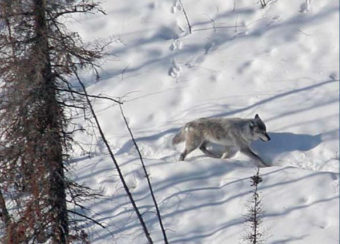
An Alexander Archipelago wolf. (Photo courtesy of the Alaska Department of Fish and Game)

Alexander Archipelago wolves in Southeast Alaska do not warrant an endangered species listing, the U.S. Fish and Wildlife Service announced Tuesday. The decision comes four years after a petition was filed by conservation groups asking for greater protection for the wolves.

They are known as Alexander Archipelago wolves, a subspecies of the gray wolf, and they range all over Southeast Alaska down to the British Columbia-Washington border. The population is estimated to be between 850 and 2,700 wolves, which is healthy according to the USFWS.

“In the majority of its range, the wolf population appears to be stable,” says Drew Crane, regional endangered species coordinator with the Fish and Wildlife Service.

The agency’s review compiled data on the wolf and its habitat from the U.S. Forest Service, the Alaska Department of Fish and Game, the University of Alaska Fairbanks and British Columbia.

It found that the population on Prince of Wales Island has declined 75 percent since the 90s due to hunting, logging and road development. Crane says the federal government is aware of that fact.

“We do have concern for the wolf population on Prince of Wales Island but Prince of Wales Island in general only constitutes 6 percent of the rangewide population of the Alexander Archipelago wolf,” he said.

In other words, a decline on just one island in the wolf’s total range doesn’t warrant an endangered species listing.

Larry Edwards with Greenpeace hasn’t read all of the 94-page decision yet but says logging and development in the region over the decades has negatively affected the wolf’s habitat.

“It’s very odd to us that the Fish and Wildlife Service acknowledges a 75 percent decline in the Prince of Wales wolf population and then basically writes that population off,” he said.

An ESA listing would have meant greater restrictions on hunting or trapping wolves and may have impacted logging or other development.

The management of Prince of Wales’ wolf population is the State of Alaska’s responsibility and they think the right decision was made with the report. Bruce Dale, the state’s director of wildlife conservation, says the overall population is in good shape.

“There’s no doubt that these populations are sound and will persist,” Dale said. “Throughout the area where they are distributed, they’ve been there for a long time, through a lot of change and we have no concern for this population.”

The state kept track of the island’s wolf numbers since the late 80s. A state study last summer found 89 wolves were on Prince of Wales and nearby islands, down from 221 the year before.

“But the densities that exist still on Prince of Wales Island and in Game Management Unit 2 are still amongst the highest in Alaska,” Dale said.

He says the state will continue to keep an eye on the island’s wolves and manage hunts accordingly.

The decision to not list the Alexander Archipelago wolf as endangered is the final act coming from the federal government for now.

Greenpeace’s Edwards says he doesn’t yet know what the conservation groups will do about the new decision.

Bacterial infection to blame in Kachemak otter die-off

A dead sea otter on the beach at the Homer Spit on December 22, 2015. Photo by Daysha Eaton/KBBI)
A dead sea otter on the beach at the Homer Spit on December 22, 2015.
Photo by Daysha Eaton/KBBI)

Tests results are back on dead sea otters from Kachemak Bay. About 82 percent of them had streptococcus syndrome, according to biologists with the U.S. Fish and Wildlife Service. Leslie Slater is a USFWS wildlife biologist at the Alaska Maritime National Wildlife Refuge in Homer.

“So also in this stretch of beach, which has been under 200 yards or so that we’ve walked, we’ve come across now, looks like a yearling sea otter that’s died and a sub-adult male that’s died too,” said Slater.

Along the black pebbled beach at the Homer Spit, we step closer to a frozen otter near the Land’s End Hotel and condominiums.

“So you can tell that it’s a sub-adult because of its size and the tooth wear is pretty minimal, it’s got very white teeth. And this one happened to freeze in shape so you can see that the skin is sort of draping against the rib cage and it looks to me like it probably did die of starvation. We’ll have to thaw it out and do a necropsy on it to see what really happened with this one,” said Slater.

Since summer, more than 300 otters have died around Kachemak Bay. Joel Garlich-Miller, a biologist with the U.S. Fish and Wildlife Service Marine Mammals Management office in Anchorage, says they’re still finding them.

“Things have dropped off quite a bit but we’re still getting reports of three or four animals a week, primarily from Homer area beaches,” Garlich-Miller said.

He added that test results recently confirmed that it was the streptococcus syndrome that killed the otters in most cases.

“This is a syndrome caused by bacterial infection, streptococcal infection and it manifests itself in a variety of ways such as valvular endocarditis or septicemia or encephalitis. It looks like a pretty high percentage of the animals that we recovered this year, about 82 percent, appear to test positive for this syndrome,” said Garlich-Miller.

Garlich-Miller says most of the otters appeared to have deteriorated rapidly and succumbed to encephalitis.

The Fish and Wildlife Service has been tracking a streptococcus illness in Kachemak Bay area otters for some time. Otters with the illness usually appear sickly and emaciated. But many of the otters that have died since August appear healthier.

Garlich-Miller says although strep syndrome appears to be the main cause of the deaths, there are hints that some could have had a virus as well. Garlich-Miller says biologists are now collecting more dead otters to test for viruses.

Back at the beach, biologist Leslie Slater explains what you should do if you come across a dead otter.

“It’s best to call the sightings into the marine mammal stranding hotline, whether they’re alive or dead, and then there is another group of folks in town who will come and evaluate the carcass to see if it will be forwarded on for further pathology studies,” said Slater.

Biologists hope those studies will shed more light on whether viruses had anything to do with the huge number of sea otter deaths this year.

Dead or dying sea otters and other marine mammals should be reported to the Alaska SeaLife Center’s Marine Mammal Stranding Network hotline at 888-774-SEAL (7325).

Murre die-off around Kachemak Bay estimated to be in the thousands

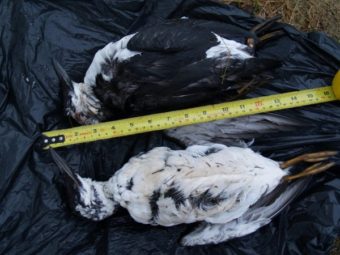
Wildlife Biologist Leslie Slater holds one of about a dozen dead Common Murres found along a short stretch of beach at the Spit in Homer Tuesday, Dec. 22. (Photo by Daysha Eaton/KBBI)

Die-offs of common murres have been happening across Alaska since this summer. The latest report comes from Kachemak Bay, according to biologists with the Alaska Maritime National Wildlife Refuge in Homer.

Wildlife biologist Leslie Slater says there have been two waves of mortality.

“This die-off started to be noticed around mid-July in certain parts of the state. And so it continued at some level — a fairly high, noticeable level — for a couple of weeks and then it seemed to diminish. Then there seemed to be resurgence again of the number of carcasses that we were seeing on beaches. That happened in mid-November or so,” Slater said.

There have been die-offs reported of the penguin-like seabirds in Cold Bay in July and in Kodiak in November. Slater says they’ve also had reports from Seward, Sitka and Prince William Sound. In November, starving and dead murres turned up around the Mat-Su and Anchorage areas, farther inland than usual.

“It seems that then they would either be disoriented, which could be the result of ingesting a toxin, or they could be very desperate in searching for food and just kept traveling up the inlet,” Slater said.

Seabird die-offs have been recorded all along the West Coast of the U.S. in Washington, Oregon and California this year. Slater estimates that a large number of murres have died around Kachemak bay.

“Based on the duration of the time that we’ve had carcasses being reported to us, I would say, it’s into the thousands, certainly, throughout Kachemak Bay,” Slater said.

The dead murres are being counted by citizen scientists all along the Spit and along the beach up to Anchor Point.

“They’ve been doing this for several years and so there’s been a baseline established of what we would consider being a normal winter … and so far, it’s been at least six times the normal background amount that’s been observed,” Slater said.

Slater says citizen scientists mark the murres with color-coded zip ties around a wing or foot and if you see a bird with a zip tie she says you should not disturb it because it’s part of a study.

Anecdotal reports of dead murres and other birds are coming in from across the bay. They’ve also had reports of dead tufted puffins, horned puffins and an ancient murrelet. She says the birds, along with murres, feed on small fish or dive to get invertebrates during summer. They dive for squid, crustaceans and krill during winter.

Slater says murre carcasses were sent to the National Wildlife Health Center in Madison, Wisconsin where bird flu was ruled out. The dead birds seem to have starved, but Slater says there could be other factors.

“There are analyses that are pending. So it could be something that had to do with PSP, like paralytic shellfish poisoning that was ingested at some point, but that is still unknown,” Slater said.

Results from those tests should be back in January. That’s also when Alaska Maritime National Wildlife Refuge biologist Heather Renner will present a paper on the murre die-off at the Alaska Marine Science Symposium in Anchorage.

Stranded Nome ugruk released back into the wild

The bearded seal was released back into the wild at Nome’s west beach. (Photo by Gay Sheffield/University of Alaska Fairbanks Alaska Sea Grant)

Last Friday evening a bearded seal made its way out of Nome’s iced-in port and up into the west side of town. The seal spent the night at Nome’s Public Safety Building and after observing its behavior, it was clear what to do next.

“It was feisty, it was fat, it wanted to be left alone,” said Brandon Ahmasuk. “So the decision was made to release it.”

Ahmasuk is the Subsistence Director for Kawerak as well as the Bering Strait Commissioner for the Ice Seal Commission, two roles that prepare him for strandings such as this one.

Besides looking a little patchy and out of place in the snow-covered parking lot, there didn’t seem to be anything usual about the seal. Ahmasuk explained that the recent arrival of sea ice might help explain the stranding.

“At the end of the port, about a week ago, the ice hadn’t come in yet so it was our belief that it was just hanging out right inside the port on the ice and then that ice, the sea ice, came in and blocked off its exit,” he said.

In the case of a marine mammal stranding in our region, there are three options: release the animal back into the wild, harvest it for subsistence, or send it down to the Alaska SeaLife Center in Seward, which handles marine mammal rehabilitation.

Although this particular seal wasn’t acting unusually, the region does have a history of seal sickness.

Gay Sheffield, who works for the University of Alaska Fairbanks Alaska Sea Grant, is Nome’s local stranding responder and was one of the first on the scene. She explained the unusual mortality event, or UME that struck the region a few years back.

“2011 was the year it was most pronounced,” Sheffield said. The seals seemed tired and wouldn’t move out of peoples’ way. She also explained that they had both internal and external problems, including sores.

“Since then we haven’t seen conditions like that,” Sheffield said, “but we do keep seeing seals that have lost their ability to grow their coat properly.”

Ahmasuk said it was that same condition that discouraged locals from harvesting the seal.

“We did ask around town other subsistence users if they wanted it,” Ahmasuk said, but everyone said no.

“Subsistence users, they’re pretty leery about harvesting something that they don’t even know what’s causing it. If they ingest it is that disease going transfer over to us?”

Sheffield said it’s been an uphill battle to figure out exactly what’s been preventing seals from growing a proper coat. She said there’s a long list of diseases they’ve eliminated, but still haven’t pinpointed one to explain it all.


Using a large fish tote donated by the Norton Sound Economic Development Corporation, the seal was transported back down to the beach. Along with needing extra hands to move the tote with the 200-pound seal, local hunters also helped determine the best place to release it.

“The seal was released off the west beach and sea ice conditions were not terribly stable, but the guys who released it, the marine mammal hunters, are extremely knowledgeable in ice conditions,” Sheffield said.

Sheffield went back to the beach the following day; she says there were at least four seals hauled out on the sea ice. She described it as a “good ending for our unexpected visitor.”

The statewide marine mammal stranding hotline is (877) 925-7773.

Stranded ugruk rescued from Nome parking lot

The bearded seal made its way of out the iced-in port up into a parking lot. (Photo by Emily Russell/KNOM)

A bearded seal came ashore Thursday night and made its way into a parking lot on Nome’s west side of town. Gay Sheffield was one of the first on the scene.

“We’re east of the harbor on Lomen right in front of the Crowley office building,” Sheffield explained, “and we have a young bearded seal that’s crawled out of the iced-over harbor and is in the parking lot.”

Sheffield works for the Alaska Sea Grant program at the University of Alaska Fairbanks and is the local stranding responder. NOAA Fisheries created the National Marine Mammal Stranding Network to response to incidents like this one. Local stranding responders like Sheffield are trained in stranding response, animal health and disease.

Sheffield explained that this isn’t the first time a seal has made its way toward downtown Nome.

“Last year we had a spotted seal that also got iced out of the harbor and was headed into town.”

But, often the stranded seals are on the smaller size. Kevin Keith explained that that wasn’t exactly the case with this one.

“It’s an ugruk, which are the bearded seals, which are quite large,” Keith said.

Keith is a fisheries biologist for Norton Sound Economic Development Corporation. Adult bearded seals average around 600 pounds, but this one was only a pup, so Keith estimates it was 150 to 200 pounds.

While Sheffield is authorized to transport stranded marine mammals, due to this one’s size she called for reinforcements.

Keith picked up a fish tote from the seafood plant.

The seal was held overnight at Nome’s Public Safety Building. (Photo by Mitch Borden/KNOM)

“The fish tote is probably 5 feet by 5 feet, so we tipped the fish tote on its side and Gay basically wrestled the seal into the fish tote,” Keith explained.

It took four people to lift the tote with the seal in it onto the bed of a truck. The seal was then transported to Nome’s Public Safety Building where it was kept overnight.

While much is still unknown about the health of the animal and the reason for its behavior, Sheffield said that the seal’s coat may hint at why it came ashore.

“What’s unusual is that he has symptoms of the seal sickness, where the seals have lost the ability to grow their coat,” Sheffield explained. “So this is why he’s looking so patchy.”

According to Sheffield, there are three different options for what to do next with the animal. The seal could be used for subsistence, released back into the wild, or sent down to the Alaska SeaLife Center in Seward, which handles marine mammal rehabilitation.

As of Friday evening, calls for an update on the seal were not returned.

Prince of Wales wolf season to close, 5 kills reported

A 5-month-old male wolf pup from Honker Divide on Prince of Wales Island. (Photo courtesy of the Alaska Department of Fish and Game)

The contentious wolf hunting and trapping season on Prince of Wales Island will close on Sunday.

According to the U.S. Forest Service, hunters have reported taking five wolves since the season opened. Trappers have two weeks to report their take, so the various agencies have agreed to close the season to ensure the overall kill doesn’t exceed the quota of nine wolves for Game Management Unit 2.

The season officially closes for the winter at 11:59 p.m. on Sunday.

Wolf hunting on POW was hotly debated this year after the State Department of Fish and Game released a population study, announced in June, that indicated 89 wolves were on Prince of Wales and surrounding islands. That’s a steep drop from the previous year’s estimate of 221.

That study prompted increased calls from conservation groups to protect the remaining wolves in Game Management Unit 2. The groups asked for a suspension of this winter’s wolf hunting and trapping seasons, and when that was denied, petitioned for an emergency Endangered Species Act listing for the wolves. That request also was denied.

Conservation groups previously filed an ESA petition for the POW wolf population, and that is going through a review process. A decision on that is expected this month.

Site notifications
Update notification options
Subscribe to notifications