Wildlife

How a deer can cause a plane crash

Heather Bauscher is a wildlife specialist for the USDA. Her job is the clear the runway of airborne creatures. But lately, her bigger problem is deer. (Photo by Emily Kwong/KCAW photo)
Heather Bauscher is a wildlife specialist for the USDA. Her job is the clear the runway of airborne creatures. But lately, her bigger problem is deer. (Photo by Emily Kwong/KCAW)

Throughout this year’s hunting season, Sitka’s airport has been contending with an unusual issue: dead deer. Carcasses have been washing up on the runway since November, attracting birds. And this is a big problem.

You know those contraptions where a hammer hits a ball which drops into a bucket which cracks an egg or something? Well, this story is set inside Sitka’s very own Rube Goldberg machine.

Heather Bauscher works for the U.S. Department of Agriculture as a wildlife specialist. Her job is to clear of the runway of wildlife that could interfere with air traffic. Mostly it’s creatures of the sky: eagles, seagulls, and ducks.

But lately, Bauscher’s biggest nemesis is deer.

“There’s a lot of steps between somebody pitching some animal remains overboard or leaving them on the beach and planes crashing,” Bauscher said. “But it can happen.”

Carcasses have been washing up on the runway ever since the subsistence hunting season opened on Nov. 1.

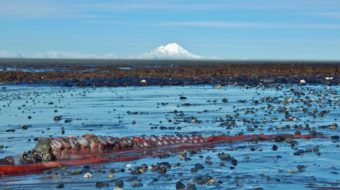
In her truck, Bauscher speeds down the exposed airport runway. It’s like a tarmac popsicle sticking out into the middle of the Pacific Ocean. Because of its design, carcasses tend to wash up on or near the runway every week. It’s like a buffet called for birds.

Sitka’s runway is encompassed by the Pacific Ocean. The tides bring in debris and some of that debris attracts birds, creating a natural buffet (Photo by Emily Kwong/KCAW photo)
Sitka’s runway is encompassed by the Pacific Ocean. The tides bring in debris and some of that debris attracts birds, creating a natural buffet. (Photo by Emily Kwong/KCAW)

“Some of these coves really act as a catch all. You’ll see all sorts of debris. I mean, look at the way the waves are crashing and the water is pushing things in,” Bauscher noted as she slowed her truck near a wind sock. She catches a glimpse of something in the rocks and scrambles down. Someone’s sneaker is floating in there.

“Yep, all kinds of debris,” Bauscher says.

It’s debris soup really. But with her keen eyes, Bauscher spies a white tuft of hair.

“See a little bit right there?”

A deer head.

Since November, Bauscher has been seeing one to three deer wash up on the runway every week. (Photo by Emily Kwong/KCAW photo)
Since November, Bauscher has been seeing one to three deer wash up on the runway every week. (Photo by Emily Kwong/KCAW)

She picks up a branch that had washed up nearby and pokes the deer head, eventually spearing it. She scales the rock wall triumphantly, and holds the deer head high in her gloved, blue hand. It smells like death.

Bauscher chucks it into the back of her truck. One section is smeared with blood and animal parts. She has to wash it pretty often.

Bauscher loads a deer carcass, picked clean by birds, into the back of her truck. (Photo by Emily Kwong/KCAW photo)

Now think about it: all this collection work for one deer head that could theoretically attract a bird that could theoretically collide with a plane. Is it worth all the fuss?

Bauscher said that on a runway as exposed and wild as Sitka’s, it’s essential. This year alone, she’s counted 136 species of birds in the vicinity of Sitka’s runway.

“If a bird strikes a plane, chances are it could severely damage the turbine to the point of completely destroying that engine,” she said.

In 2010, an eagle flew straight into the engine of a Boeing 737 that was roaring down Sitka’s runway. No one was hurt – commercial planes have two engines – but at other airports across the country, wildlife strikes have downed planes and killed passengers before.

In 2009, pilots had to make an emergency landing in the Hudson River after birds knocked out both engines. Public pressure from that event motivated the Federal Aviation Administration to release data that year, which reported 60,000 bird strikes since 2000. Basically, it can happen to any plane with any bird. All it takes is some bad timing. And Bascher said the USDA doesn’t want to take the risk.

“Because we’re not going to have a ‘Miracle on the Hudson’ in Sitka,” she said. “I mean … look at it! There’s too many rocks. And how many times are you on a plane where you know the other people on that plane? Always. There’s always people you know on that plane and the way the flight runs from Seattle to Anchorage, if there was something horrible that happened because of a bird strike, there would be no way this whole community wasn’t impacted much less all of Southeast Alaska. And I think it would be a real shame for that to be because of some deer carcasses or fish carcasses or something that could have been preventable.”

Bauscher enjoys having the runway as her office space. “It’s pretty neat to be able to get to be out here. I feel pretty lucky to have this job,” she said. (Photo by Emily Kwong/KCAW photo)
Bauscher enjoys having the runway as her office space. “It’s pretty neat to be able to get to be out here. I feel pretty lucky to have this job,” she said. (Photo by Emily Kwong/KCAW)

Phil Mooney, the area management biologist with the Alaska Department of Fish & Game, urged those hunting to be more conscious of this very real connection between the sea and sky. And that means not dumping your carcasses on the side of the road.

“Don’t put it on the roadside. Don’t throw it in the water particularly. If you can put it in your garbage can, that’s great,” Mooney said.

And if pick-up isn’t for awhile or the carcass is getting stinky, Mooney recommends taking it to the Jarvis Street Transfer Station or the Alaska Raptor Center. Fortress of the Bear said it’s not accepting carcasses, but will begin again in the spring.

Mooney sympathizes with Sitkans who want to return the wildlife carcasses back to nature, but stresses that that kind of thinking is too risky in a city of 9,000 with over half a dozen daily flights. “People think, ‘OK, this one deer carcass isn’t going to hurt anything, or these two deer carcasses.’ But take that times how many hunters we’ve got out here and a good deer year and it gets to be a problem,” Mooney said.

Between Delta and Alaska Airlines, over half a dozen flights come into and out of Sitka daily. After clearing the runway of some ducks, Bauscher looks on as a plane takes off. (Photo by Emily Kwong/KCAW photo)
Between Delta and Alaska Airlines, over half a dozen flights come in and out of Sitka daily. After clearing the runway of some ducks, Bauscher looks on as a plane takes off. (Photo by Emily Kwong/KCAW)

Back on the runway, Bauscher has just enough time to scatter a group of ducks. She shoots pyrotechnics out of a gun. One called a silver comet explodes in the air. It’s blue with sparkles.

She notifies traffic control the runway is clear. Her eyes follow the noon plane’s takeoff. She says her superpower of choice would be to talk to animals and tell them not to hang out on the runway, as beautiful as it may be. Bauscher clearly loves her job.

Amid budget gloom, federal gun tax makes Alaska wildlife programs flush with cash

Amid all the budget gloom, one branch of state government actually has more money than it can use. It’s the Department of Fish and Game’s Division of Wildlife Conservation. The division is largely funded by a federal tax on the sale of guns and ammunition, and sales nationwide are booming. But this fall, the division may have to give back a portion of its bounty.

An odd chain reaction is at work around the country. A mass shooting can kick it off. So can the inevitable calls for gun control that follow. Campaigns for more “stand-your-ground” laws can, too. All three send Americans running out to buy more guns and ammunition. And then, as customers go home with new handguns and rifles, money pours into state wildlife conservation programs.

That last link in the chain is thanks to Pittman-Robertson, a 1937 federal law that levies a 10 percent tax on handguns, and 11 percent tax on other guns and ammo. The law funnels the revenue into wildlife preservation and habitat acquisition. It has sent billions of dollars to the states and is credited with bringing several species back from the brink.

wood bison at Alaska Wildlife Conservation Center
Wood bison at the Alaska Wildlife Conservation Center. The reintroduction of wood bison is one of the projects supported by gun tax revenues. (Creative Commons photo by kat)

“It’s a great model, because it’s basically the hunters and shooters that are paying the way,” said Steve Klein, who manages the program in Alaska for the U.S. Fish and Wildlife Service. “And then that money comes to the Fish and Wildlife Service, and the state writes grants, and they do the management and research, and then that benefits the hunters and shooters with the ranges and healthy resources.”

Alaska gets a substantial share of the national pie — the maximum 5 percent, due to its geographic size. Maria Gladziszewski, deputy director of the state Wildlife Division, said the federal gun tax revenue pays for most of the 290 jobs in her division, and most of the research they do.

“It funds our core mission,” she said. “It is the core of wildlife conservation in the nation.”

Maria Gladziszewski
Maria Gladziszewski. (Photo by Lisa Phu/KTOO)

With the surge in national gun sales, the money the feds send to Alaska has gone up and up. Gladziszewski said the total bounced around $9 million a year in the early 2000s. In 2010, it hit $20 million. Last year, Alaska’s share was almost $35 million, plus another $1.4 million to fund hunter safety courses and three shooting ranges in each of Alaska’s largest cities.

Gladziszewski said her division is not growing at the same rapid pace.

“Because we viewed it as a bubble,” she said. “You don’t want to organize your staffing around funding that is probably going to come back down.”

The state has two years to spend each year’s allocation. Gladziszewski said the state has made use of its full allocation every year. Until now.

“These dollars have continued to go up for more years than we expected,” she said. “So we will likely revert some money for the first time, in September.”

That’s right: they’re going to give money back to the feds. Gladziszewski said it will be at least $2 million.

“We’re of course facing the same travel restrictions and spending restrictions that other state agencies are. So we might even leave some more on the table, depending on how that goes,” she said.

The other problem is that the federal money requires a 3-to-1 match. To receive $30 million, the state has to contribute $10 million.

“And at this point we don’t have enough to match all of the federal dollars,” she said.

The Wildlife Division gets money from the sales of state hunting licenses and tags, but they amount to only about $8 or $9 million, Gladziszewski said. Alaska’s hunting and outdoors groups are now rallying to increase the license fees, which haven’t gone up since the early 1990s. Juneau resident Ron Somerville, a board member of the Territorial Sportsmen and a former Fish and Game deputy commissioner, said it’d be a shame to leave federal conservation money on the table because the state can’t afford the match.

“Resident hunting (license) is $25. We’re recommending $40. In other words, in most cases, rather than argue about a dollar here or a dollar there, we raised everything 85 percent, or something close to that,” Somerville said.

A bill to increase the hunting license fees passed the state House last year, but Somerville said it doesn’t raise them high enough.

“We’re the only group in Alaska that’s asking the government to allow us to pay more money,” he said.

Even if they succeed in raising license fees, the goal posts continue to move. Based on the number of pre-purchase background checks, it looks like national gun sales may have hit an all-time high in December. That would send even more Pittman-Robertson money to Alaska. If the state can cope with the prosperity.

Murre die-off count now on par with Exxon Valdez spill kill, biologist says

Dead murres on the beach in Haines on Jan. 12, 2016. (Photo courtesy of Tim Ackerman)
Dead murres on the beach in Haines on Jan. 12. (Photo courtesy Tim Ackerman)

The number of dead common murres showing up on Alaska’s beaches is growing, and the scale of the die-off is now on par with the grounding of the 1989 Exxon Valdez in Price William Sound when 22,000 birds were collected.

Heather Renner with U.S. Fish and Wildlife Service said it is already one of the largest die-offs in history and, unlike when the tanker went aground, not many people have gone out to remote beaches to survey for dead seabirds.

“The exactly same number is purely a coincidence,” said Renner. “Our number is changing every day as people call in more reports. But certainly there was a lot of effort put into searching beaches then. Now people are just calling in and telling us about them. And we haven’t gotten a chance to look at much of the remote coastline.”

Renner told the Alaska Marine Science Symposium that dead murres started showing up on beaches last summer, but since those numbers were spread out over a large area, they weren’t noticed until the thousands started showing up on beaches in January.

“It was 10 times what it normally is, but you still had to walk a long ways before you found a carcass,” said Renner. “Then suddenly since Christmas you can’t walk a beach without finding them everywhere. You see them along the Seward Highway here in Anchorage. They’re foraging in Cook Inlet, which they never do. But there’s dead murres on the ground everywhere, and it’s hard not to notice them.”

The reason for the dead birds is still a mystery, but Renner said both the huge area that they are being found in and the fact that it began last summer and has continued over a long time indicates it might be the result of a change in the food web caused by the unusual “Blob” of warm water pressed up against Alaska’s coast.

“I think it rules out short-term acute events like immediate poisoning events. I think it suggests something more related to the food web structure,” said Renner. “But there are a lot of hypotheses. That certainly these things all contribute to each other, so at a time when you have a big storm you have a large pulse of numbers because the birds are stressed and weakened already.”

Murres are found farther down the West Coast, in areas where the water is much warmer, but scientists think it was the abrupt change in water temperatures and conditions that may have changed the food web making it impossible for the birds to survive.

Researchers have now examined more than a hundred of the birds but have seen no sign of toxins in their stomach contents, but then again, Renner said, the birds were so starved that there was hardly anything in their stomachs to analyze.

New arrivals in Kotzebue Sound preying on belugas

Orcas. (Creative Commons photo by Chis Michel)

Kotzebue Sound is changing and beluga hunters are facing new competition. Researcher Manuel Castellote at the Alaska Fisheries Center placed underwater microphones in the Sound. Instead of belugas, he found the source of the problem — killer whales.

“It turns out when we look at our data what we found was mainly killer whales. So that’s why the project quickly became a killer whale project.”

Things have gotten so bad in Kotzebue Sound that belugas there don’t sing out as much as they do elsewhere. Researchers suspect the belugas are afraid killer whales will find them and eat them.

“… because they know that if they are happy they will hear them and they might be predated. So they try to be silent.”

As in so many areas in the Arctic, changes are happening more quickly than further south. In Kotzebue Sound, the seabirds that used to eat fish have declined while those eating plankton have increased.

Denali proposes new wolf protections

A wolf carrying a caribou leg. (Public Domain photo)

Denali National Park and two conservation groups are asking the Alaska Board of Game to consider proposals aimed at protecting park wolves. The proposals are not currently in line for review until next year.

Denali National Park chief of resources Dave Shirokauer says the park’s proposal would eliminate overlap of state spring wolf hunting and bear baiting seasons along the park’s northeast boundary.

“We do know that two members of the East Fork pack were harvested in association with a bear baiting station last spring,” Shirokauer said.

He said the deaths are likely why Denali’s once popularly viewed East Fork pack did not den this past spring, an issue given the park’s overall wolf population is at an all-time low of fewer than 50 animals.

The hunting season adjustment is more modest than what the Alaska Wildlife Alliance and Denali Citizen’s Council are seeking. DCC Secretary Nancy Bale describes a proposal which would ban wolf harvest on a swath of state land.

“Set aside an area that includes the wolf townships and the Nenana Canyon area, which are areas where wolves take forays outside the park,” Bale said.

The Game Board eliminated an earlier wolf buffer zone in 2010 and imposed a 6-year moratorium on consideration of Denali wolf proposals. That’s set to end, but Bale says a change to the regional meeting schedule means further delay.

“Last year, the Board of Game changed their cycle of meetings from every two years to every three years as a cost-saving measure,” she said.

The sponsors of both Denali wolf proposals are requesting the Game Board consider them out of cycle at a statewide March meeting in Fairbanks.

Long Thought To Be Extinct, Bizarre Tree Frog Surfaces In India

Amphibian biologist and scientist SD Biju holds a preserved female frog named Frankixalus jerdonii at Systematics Lab of the University of Delhi. Altaf Qadri/AP
Amphibian biologist and scientist SD Biju holds a preserved female frog named Frankixalus jerdonii at Systematics Lab of the University of Delhi.
Altaf Qadri/AP

For nearly 150 years, a bizarre tree frog species in India was believed to be extinct.

Now, scientists have found the elusive Frankixalus jerdonii in India’s West Bengal state, in the foothills of the Himalayas.

Last seen in the wild in 1870, the frogs were rediscovered by accident during a 2007 expedition led by Indian biologist Sathyabhama Das Biju. “We heard a full musical orchestra coming from the tree tops. It was magical. Of course we had to investigate,” he told the BBC.

What’s more, a subsequent study published this week by Biju and a team of researchers looks at the frog’s “enigmatic lineage,” and concludes that the amphibian represents an entirely new genus.

The study’s co-author Ines Van Bocxlaer tells National Geographic that “the frog’s DNA, odd feeding behavior and anatomy shows the species ‘represents a deep evolutionary split in tree frog evolution.’ ”

That led scientists to change the frog’s name from the original, Polypedates jerdonii, to Frankixalus jerdonii to reflect the new genus.

“Most tadpoles of other frog species eat plant material,” National Geographic says. Not the Frankixalus jerdonii. Here’s how National Geographic describes what happens after the female lays eggs inside tree holes:

“Females attach their eggs to the insides of tree hollows, which hold pools of water. When the tadpoles hatch, they fall in the water, where the females feed them unfertilized eggs until they turn into froglets.”

The tadpoles each had “3-19 eggs in their intestines,” the study says. And unusually, these tadpoles do not have tooth rows, which differentiates it from similar species.

There are a few theories about how the tree frogs stayed hidden for nearly 150 years, the BBC reports.

“The golf ball-sized frog lives in tree holes up to 6m (19 feet) above ground, which may have helped it stay undiscovered,” the BBC says, “although other scientists have suggested it may have gone unnoticed simply because there are so few scientists working in the remote region.”

But its survival is uncertain. Citing “alarming” threats, the study says that multiple areas where the species is believed to live are disturbed by slash-and-burn deforestation.

Copyright 2016 NPR. To see more, visit http://www.npr.org/.
Read original article – January 21, 2016 12:20 PM ET
Site notifications
Update notification options
Subscribe to notifications