Wildlife

No signs of invasive Elodea in Southeast, survey in the works

Elodea canadensis
Elodea canadensis. (Creative Commons photo by Frank Vincentz)

One wee fragment of it can flourish into a swath of green growing strands that entangles float planes and boat engines. Across the state, it has been found in 18 freshwater lakes and rivers. Many people decorate their fish aquariums with it.

It’s called Elodea.

Last week, the aquatic plant was a topic of discussion at the Alaska Invasive Species Workshop in Juneau. Researchers have traced the beginning of the invasive plant’s transmission around Alaska to people dumping out their aquariums into nearby lakes. An aggressive hitchhiker, Elodea will cling to float planes and spread further.

Tom Heutte, an aerial survey coordinator with the U.S. Fish & Wildlife Service, described one encounter in Cordova.

“We were flying along and one of our aerial surveyors looked out the window and sees a bunch of weeds stuck to the rudder of the float plane,” he said.

Elodea outcompetes native plants by blocking sunlight and degrades salmon habitat. The plant has been found from Fairbanks to Cordova, but not in Southeast.  Heutte hopes that the region has avoided invasion.

He surveyed the float plane pond at Juneau’s airport for Elodea and found none. Heutte said that saltwater is a likely Elodea killer, one reason Southeast may have avoided the plant invasion. He also believes that lack of a road system, and difficulty of access to remote lakes, may have kept Elodea from spreading here. Over the next two years Heutte plans to survey lakes throughout the region in order to find out for certain.

It all begins with one plant fragment, he said.

Experts discovered a weapon against Elodea called fluridone. The herbicide disrupts Elodea’s capability to photosynthesize.  It prohibits the plant’s ability to produce its own food, killing by starvation, yet harms few native plants. In some parts of Alaska scientists have completely eradicated Elodea with fluridone, said John Morton, supervisory fish and wildlife biologist at the Kenai National Wildlife Refuge.

Elodea is just one front in a battle against invasives.

“We are only at the beginning of the invasion curve for novel species,” Morton said.

You can learn more about invasive species on the Alaska Department of Fish & Game’s website.

Dip in Kenai brown bears linked to liberalized harvest quotas

A 2010 federally sponsored study is the first to deliver a reliable count of the Kenai Peninsula’s brown bear population. Last week a Kenai National Wildlife biologist explained the study during a presentation at the Pratt Museum in Homer. The Museum is preparing to launch a new summer exhibit all about bears, specifically brown and black bears.

The number of brown bears on the Kenai Peninsula fell from about 582 to fewer than 500 between 2010 and 2015. That’s according to John Morton, a Kenai National Wildlife Refuge biologist.

“It has to do with the fact that harvests have been liberalized by the Board of Game since 2012. So our harvests [have been] higher in the last couple of years, particularly in 2013 and 2014,” said Morton.

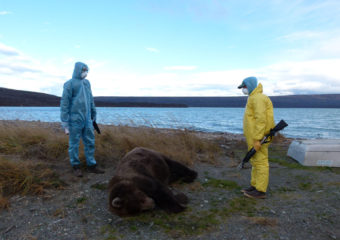
The U.S. Fish and Wildlife Service and the U.S. Forest Service paid for Morton and his team to spend part of their summer counting brown bears using a method called mark recapture. Mark recapture is pretty much what it sounds like. The researchers caught the animals, marked them, released them and then they tried to recapture the animals they’d marked. Morton’s team marked the bears by collecting their hair and analyzing their DNA.

“And the key here is it’s not the number of animals we detect with DNA it’s actually our recapture rates. That goes into a model and we base our population estimate not on the number of bears we detect but actually on the number of bears we mark,” said Morton. “Obviously you can see from the slides it was pretty complicated both logistically and statistically.”

Morton says before this count there had never been an “empirically based population estimate of Kenai brown bears.” The dense tree cover on the peninsula made “conventional” aerial surveys impractical.


Rocky Horror Picture — snake!

A Rocky Horror Picture Show concluded with 6 feet of slithering scales in an Alaskan town where reptiles only survive in heated cages.

Collette Costa, owner of the Gold Town Theater in Juneau, tweeted the incident.

Costa heard a scream, which preceded the snake’s discovery.

“Well, that’s impossible, there are no snakes in Alaska except the ones up in the Capitol,” Costa said.

She tells the tale:

“But he insisted there’s a snake so I came over to look and there was a thing on the ground, and it was between two pieces of furniture so I could only see a bit of it. And it was kind of an incredulous thing to see.  You can’t imagine there’s a snake there of that size.  I mean, it wasn’t a boa constrictor, but it was bigger than a garter snake.  And I said, ‘That can’t be real,’ and so I was going to pick it up and then it slithered.  It moved.  And then I said, ‘That is a snake.’”

Costa described the snake as red and yellow-banded, longer than herself.  She believes it is a corn snake.

Red corn snake. (Public Domain photo by Mike Wesemann)

Red corn snakes (Pantherophis guttatus) are native to the eastern United States from New Jersey to Florida and Mexico.  They have been introduced to some of the Caribbean islands so their range has expanded with human help.  Red corn snake native populations are considered stable.  The snakes’ habitat is variable, ranging from pine forests to grasslands.

According to Dr. Johanna Fagen, assistant professor of biology at the University of Alaska Southeast, snakes are uncommon in the wild here, but do live in many parts of British Columbia.

Fagen shared a few likely reasons that snakes wouldn’t find this area favorable.  Firstly, Juneau’s recently deglaciated land has not yet been colonized by a wide array of species, including reptiles.  Snakes are common in dry climates, rather than wet ones with many freeze-thaw episodes throughout the winter.

Due to the climate and geological history in Southeast, snakes normally only survive in cages.  This can mean guest appearances after horror films.

Alaska Raptor Center director retires after 13 years on the job

The Alaska Raptor Center’s office pal, Tootsie, a saw-whet owl, eyes departing executive director Debbie Reeder. After 13 with the organization, Reeder is leaving her perch. (Photo by Brielle Schaeffer, KCAW)

Debbie Reeder is leaving her post as executive director of the Alaska Raptor Center in a few short weeks. During her decade-plus career, she saw the center expand and develop into a world-class attraction.

Reeder sometimes loses track of time in the raptor center’s bald eagle flight training aviary. Like other staffers, she’ll check on something and then become entranced watching rehabilitating birds eat and play.

“We’ll find that half-hour or 45 minutes have gone by and we’re still standing there watching birds.”

It wasn’t always like that. The bookkeeper-turned- executive director gained an appreciation for the winged creatures while on the job the past 13 years.

“I’ve always thought they’re beautiful, but you take them for granted. In the sky, you don’t have interactions with them but they’re really pretty interesting. They’re really pretty individual they all have their own personality just like people or other animals and so they’re kind of fun to observe.”

The center has some 20 resident birds, which cannot survive in the wild. It also rehabilitates hundreds more each year. Reeder started at the nonprofit, full-service avian hospital as the operations manager in 2002.

“I was actually hired because they needed a bookkeeper here,” she said. “My husband and I had sold a small business and I was so excited to go to work for somebody else and not have to be so responsible and take work home with me and here I am.”

During her tenure, Reeder oversaw the center’s expansion and numerous other projects that made it a must-see attraction. One of her biggest accomplishments was creating an endowment fund to ensure the continuation of education, research and raptor rehabilitation.

She’s also seen some curious and upsetting things when it comes to the eagles, owls, hawks and falcons the center helps. More than 80 percent of their injuries have to do with human interaction. One eagle, Volta, collided with a powerline. Others were hit by cars or ingested poison. One time, she says, a man came running into the center with an injured eagle tucked under his arm like a football.

“Now we don’t recommend anybody ever, ever do that again, but we looked up and there was a man in running shorts and a tank top with a bald eagle under his arm running through the building it was pretty funny,” Reeder said.

Established in 1980, Reeder has been at the center nearly half of that time. She’s ready to step down for herself and the organization.

“When you get to the point and you come to work and somebody suggests or requests you do something and you think, ‘Oh, darn, I don’t want to do that,’ instead of ‘Hey, great idea, let’s go do it,’ I think that it’s probably time to move on,” she said.

While Reeder is leaving the center, she’s not quite retiring. She plans to continue bookkeeping. She will also work for the railroad in Skagway next summer. And she’s going to spend some time in a much drier climate – Arizona.

Reeder is leaving a big nest to fill, the center’s new director Peter Colson said.

“All’s you have to do is go to trip adviser or talk to anybody who has been here and they just rave about how compassionate and professional the staff is here with the mission that they’re doing,” he said.

A career administrator, Colson used to travel around the nation to see raptors. He has big visions for the future of the center –things that could not have taken flight without Reeder’s leadership in the last decade.

Reeder’s last day is Nov. 7, the date of the Alaska Raptor Center’s fundraiser Raptoberfest.

Park Service bans controversial methods to hunt wolf, bear

Gray wolf. (Creative Commons photo)

The National Park Service has published its final rule on hunting in Alaska’s national preserves, turning a corner in a long-running tussle with the state. While most state hunting rules continue to apply, the Park Service is now enacting a permanent ban on several controversial hunting practices allowed under state law. The new Park Service ban includes using artificial lights to shoot black bears in the den, and using bait to hunt bears.

Bruce Dale, the state’s director of Wildlife Conservation, says the banned methods are not common hunting practices, and the state doesn’t allow them everywhere. But he says the new federal rules will still hurt certain hunters.  And, Dale says, it’s a federal incursion on the legal right of the state to manage its own fish and game.

“It’s a problem for us,” Dale said. “We’ve been given the authority to be the primary managers and we take that very seriously, and we think we’re good at it.”

Dale says the state is considering its next move.

The new rules apply to sport hunting on 20 million acres of preserve land, managed by the National Park Service. They don’t change federal subsistence rules, and don’t apply in National Parks themselves, where sport hunting is illegal. The feds say they are really re-imposing bans on methods the state used to consider illegal, including harvesting wolves and coyotes in denning season, when their pelts aren’t valuable.

When the rule was pending, it drew more than 70,000 public comments.

Jim Stratton, the newly retired Alaska director for the National Parks Conservation Association, is delighted to see the final rule.

“Literally … I was doing backflips,” he said. “I’ve been working on this issue for over 10 years.”

Stratton says the state Board of Game has allowed hunting methods that are incompatible with the mission of the Parks Service, the agency in charge of managing the national preserves.

“Bear snaring and bear baiting and spot lighting bears – you know, shooting Boo-Boo when he’s taking his winter nap in his den — that just doesn’t have any place in lands managed by the National Park Service.”

At the heart of the issue is a conflict over the point of wildlife management. By law, the state’s goal is “sustained yield” –basically, keeping moose and caribou numbers high enough for hunting, sometimes by shrinking bear and wolf populations.  But the National Park Service tries to preserve natural ecosystems, and spokesman John Quinley says its policies prohibit manipulating natural predator numbers to favor prey.

“Our mandate from Congress is different (from) the state of Alaska’s.”

Rod Arno, a hunting advocate and director of the Alaska Outdoor Council, says he suspects this is just the beginning of a federal power play. Arno says the feds are starting by banning rare practices, like using lights to kill bears in the den, because they’re not popular.

“That is such a small group that would ever participate in that there would be very little draw,” Arno said. “And the other thing is that people, when they hear those things, most people who aren’t subsistence users, they look at hunting and they’re always concerned about fair chase.”

Arno says killing bears in the den is a traditional practice in parts of the state, and using a flashlight is a safety measure. Now that the rule is finally published, Arno says he hopes the state will challenge it to the U.S. Supreme Court.


Writer Nick Jans captivates audience with tales of Romeo the wolf

Romeo the wolf. (Photo courtesy Nick Jans)

Writer Nick Jans calls the years between 2003 and 2009 “a magical and transformative time” in Juneau’s history. It was during those years that a wild black wolf, who came to be known as Romeo, lived in the community, played with dogs and interacted with residents.

Jans spoke at the University of Alaska Southeast last week about his 2014 book “A Wolf Called Romeo.”

Nick Jans speaks about Romeo the wolf at the Egan Library during the University of Alaska Southeast's Evening at Egan lecture series. (Photo courtesy Katie Bausler/UAS)
Nick Jans speaks about Romeo the wolf during the University of Alaska Southeast’s Evening at Egan lecture series. (Photo courtesy Katie Bausler/UAS)

Nick Jans was living in a house near Mendenhall Glacier when he noticed tracks right outside his door “and out into the lake and at the end of those tracks was a wolf.”

Jans said it wasn’t just any wolf, “He’s like the combined version of the young Arnold Schwarzenegger wrapped up in the young Paul Newman of wolves.”

The wolf continued visiting Jans’ house.

“The old expression of a wolf at the door took on a completely new meaning,” Jans said. “I mean, how are we not going to interact with this wolf? (Be)cause there he is, practically every damn morning. We could stay inside the house and sometimes the tracks would lead right up to the door, literally.”

Jans said it was this social behavior that led to his naming. The wolf was fond of Jans’ yellow lab Dakotah, of whom Jans’ wife was very protective.

“It’s her child and the most precious thing in this universe so, of course, she’s concerned about who her child hangs out with. And one morning the wolf is curled up in the yard waiting for Dakotah to come out and take a pee, which sooner or later, she’s got to do, and my wife with her arms folded says, ‘There’s that Romeo wolf again,'” Jans said.

Romeo often played with Dakotah, Nick Jans' yellow lab. (Photo courtesy Nick Jans)
Romeo often played with Dakotah, Nick Jans’ yellow lab. (Photo courtesy Nick Jans)

Dakotah was one of several dogs that Romeo interacted with socially. There was a Border Collie who’d run away with Romeo but always came back. Other dogs raced around the frozen lake with him.

“The wolf briefly took up the sport of pug bowling when, in the space of two weeks, he grabbed two different pugs owned by two different people on two different sides of the lake and ran with them for a short period in his mouth and dropped them,” Jans said. He suspected Romeo thought the dogs were puppies and was just trying to play with them.

Many people visited the glacier, where Romeo often spent time, in hopes of glimpsing him. Jans described him as the community wolf. He said Juneau was lucky to be able to know a wild animal so well.

“One of my fondest memories my whole time in Alaska was lying with my head on my pack, with my dog Gus’ head on my knee and the wolf lying 15 feet away, and we all took a nap out there on the ice. Everybody trusted each other enough to shut our eyes and just be,” Jans said.

He said several people in Juneau shared moments like that with Romeo. And many more heard his echoing howls.

“They’d travel for sometimes a couple miles at night and you could hear him on the far side of the lake. You could hear him sometimes way up the West Glacier Trail and they just filled the whole universe,” Jans said.

(Photo courtesy Nick Jans)

After six years in the community and interacting with hundreds of dogs, Romeo was killed in 2009. A plaque remembering him is affixed to a rock near the glacier. A Juneau Community Foundation fund is raising money to build an exhibit in his honor at the Mendenhall Glacier Visitor Center.

“And it’ll be part of Juneau’s legacy and something that visitors and residents will be able to point to and to look at and to know that we didn’t somehow dream this up, that it was real,” Jans said.

Despite how he may have died, Jans doesn’t think the story of Romeo the wolf is a tragedy. He thinks it’s a triumph. It’s the magical story of a friendship between a wolf and a community.

Site notifications
Update notification options
Subscribe to notifications