Judge Thomas Nave has sided with the trapper John Forrest in the small claims case against a woman who sprung his traps. While he sided with the trapper, he didn’t impose any cash award. Nave wrote that Forrest failed to prove any damages.
The trap springer, Kathleen Turley, was pleased with the outcome.
Each side is responsible for their own attorneys’ fees.
Original story | 12:00 a.m.
A Juneau judge heard closing arguments in a small claims case between a trapper and a trap springer Thursday afternoon.
On Thursday, only the lawyers spoke. Forrest is being represented by Fairbanks attorney Zane Wilson. Turley’s lawyer is Juneau-based Nick Polasky.
Wilson questioned Turley’s honesty; Polasky questioned whether Forrest’s traps were set in a safe manner. Both had a different interpretation of the statute on hindering lawful trapping.
An opinion by District Court Judge Thomas Nave is forthcoming.
“When you read it, no matter who you are, please keep in mind the fact that it will represent what the law requires. It will not represent any notions of approval or disapproval on my part of trapping or any passion or particular point of view consistent with Ms. Turley’s. It will be a strict application of the law and I hope that when you read it, it will be self-evident that it’s objective and fair,” Nave said.
Turley has admitted to springing a total of three traps. She said she did it out of safety for hikers and dogs. She also freed a bald eagle that was caught in two other traps belonging to Forrest.
Alaska Wildlife Troopers had originally cited Turley in January for hindering lawful trapping, which carries up to a $500 fine and 30 days in jail, but the state dropped its case.
Forrest is asking for an award of $1,000-$1,250 in damages.
Nave says he’ll have the written opinion out around noon Friday.
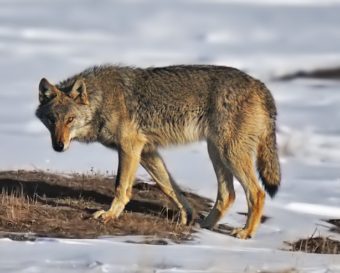
The Alexander Archipelago wolf. (Photo courtesy Alaska Department of Fish & Game)
A petition asking for emergency Endangered Species Act listing for Prince of Wales Island wolves was essentially denied by the U.S. Department of the Interior office in Anchorage.
Six conservation groups asked in mid-September for the emergency listing, citing a state study that shows a steep drop in the number of Alexander Archipelago wolves on Prince of Wales and nearby islands.
Conservation groups initially had asked state and federal agencies to suspend the winter wolf hunting and trapping season in the area, but that request was denied. The emergency ESA listing was the next step for the groups.
In a letter effectively denying the emergency ESA request, Assistant Regional Director Mary Colligan writes that an emergency listing is not something that can be petitioned by outside groups, and is a process “left to the discretion of the Secretary of the Interior.”
Petitions for emergency listing are therefore treated the same as petitions for a general ESA listing, and there already is a petition for POW wolves that is going through that process. A finding on that petition is expected by Dec. 31.
The federal subsistence wolf hunting season started Sept. 1, and the subsistence trapping season starts Nov. 15. The state hunting and trapping season opens Dec. 1. The quota for this year, state and federal, is nine wolves, and conservation groups say that’s too many to take from a small population.
The six conservation groups that requested the emergency listing are Alaska Wildlife Alliance, Cascadia Wildlands, Center for Biological Diversity, Greater Southeast Alaska Conservation Community, Greenpeace and The Boat Company.
Gov. Bill Walker addresses the fourth annual Alaska Federation of Natives and National Congress of American Indians conference at the Egan Center in Anchorage. (Photo by Jennifer Canfield/KTOO)
Gov. Bill Walker announced Wednesday the creation of an 11-member tribal advisory council.
“We need to do things differently. We need to do things collaboratively. We need to have the vehicle to have a discussion and bring things to us, and so when we have an issue we have a mechanism to go out to the village leaders to solicit your input,” Walker said.
The council will advise on education, health care, subsistence, energy, public safety, justice, wildlife and fisheries, economic development, housing, language and culture and transportation. There will be one representative for each issue.
Richard Peterson, president of the Central Council of Tlingit and Haida Indian Tribes of Alaska, said he was excited about the announcement. Of all the issues covered by the council, Peterson said energy should be a priority, but land into trust is also something he’d like to see addressed before too long. He thinks it’s an issue of the state recognizing the tribes’ rights.
“Obviously they recognize tribes and our importance, but there’s never been a formal recognition and I think that needs to take place,” Peterson said. “What I would hate is to have all this great forward movement under this administration and then another administration comes in and just ignores (it), and it’s back to the way it was previously when tribes didn’t have the impact that we have now.”
Walker made the announcement Wednesday at the Alaska Federation of Natives and National Congress of American Indians annual conference in Anchorage. Several cabinet members addressed the conference that morning. Walker said he’d like for the meeting with AFN and NCAI to become an annual event for his administration.
It’s Friday night and Marc Webber, with the U.S. Fish and Wildlife Service in Homer, has already had two calls for sick otters.
“Well I just was out on the spit having dinner with my family and a call came in as I was coming into the station of two otters ashore on mariner this evening,” he said.
Webber is part of a group trained to respond to sick and injured marine mammals. He’s Deputy Refuge Manager for the Alaska Maritime National Wildlife Refuge which runs the Alaska Islands and Ocean Visitors center in Homer.
“And so I was able to get to one of them down below the rock wall along the spit road and that individual is in very bad shape,” Webber said. “It is in a somewhat depleted condition, but demonstrating something we’ve also seen a little bit of which is a set of neurological conditions where it was twitching.”
Webber says he’s responded to around 50 calls for dead and dying otters over the past couple of months, and what he’s seeing seems different than what he’s seen in the past.
“Something is hitting them harder and faster, in addition to the disease that we’re familiar with seeing, something else seems to be involved,” Webber said. “That’s just speculation, we don’t have any evidence yet, but that’s what we’re seeing on the beach.”
Webber and trained volunteers try to keep people away from sick otters and get a vet to euthanize them when necessary.
Large numbers of dead or sick sea otters are turning up in the Kachemak Bay region. Officials with the U.S Fish and Wildlife Service say the agency has received about 200 reports of sick or dead otters over the past couple of months.
“We’re finding otters all over the Homer area,” he said. “They’re found from outer Bishop’s Beach all the way around the spit on both sides and around the shores of Mud Bay, so pretty wide spread.”
The wildlife service has teamed up with the Alaska SeaLife Center in Seward and they’re running tests to try to find out the cause. In the meantime, they’re asking for the public’s help.
Report dead or dying sea otters and other marine mammals to the Alaska SeaLife Center’s Marine Mammal Stranding Network hotline at 888-774-7325.
Otters play an important role in their ecosystem, Webber notes, so when something is going wrong with them, something is likely affecting the entire ecosystem.
Otters were nearly hunted to extinction during the fur trade of the 1700s and 1800s and suffered again after the Exxon Valdez oil spill.
The sea otters in Kachemak Bay are part of a population that stretches from Cook Inlet to Prince William Sound. In the 1970s they received protection through the Marine Mammal Protection Act and remain protected. At last count in 2012, the Kachemak Bay otter population was around 5,900.
Cari Goertz is a veterinarian with the Alaska SeaLife Center. She’s been examining sick otters.
“This summer started off fairly typical with a couple of otter carcasses or few otter carcasses being found every week,” Goertz said. “However as the summer went on into august and September we were getting up over 20 carcasses or moribund animals each week.”
“And it’s in those animals that we’ve seen different presentations.”
She says they’ve been tracking a streptococcus illness in Kachemak Bay area otters for some time and those otters usually appear sickly and emaciated. But the otters that have died since August seem different.
“Most recently what we’ve seen more of is animals in a healthier condition that seem to have been taking care of themselves well but have died acutely and that has become more common in the ones that we’ve been seeing in the last couple of months,” Goertz said.
If you see a beached live otter or a dead one, officials want to know about it. They’re asking people to call the Alaska SeaLife Center Stranded Marine Mammal Hotline.
They say otters shouldn’t be approached because streptococcus related illness can be passed to humans. Dogs should also be restrained, as the illness can be passed to them too. In addition, a sick otter could get defensive.
Officials with the Fish and Wildlife Service and the Alaska SeaLife Center say they’re waiting for lab tests to get back in the next few weeks.
In the lobby of the Dimond Courthourse on Monday morning, attorney Nick Polasky hands trapper John Forrest court documents before the trial. Polasky is Kathleen Turley’s lawyer. (Photo by Lisa Phu/KTOO)
Monday’s small claims case between a trapper and a trap springer was supposed to last an hour, but after about two and half hours in District Court, it’s stretching into a second day.
Juneau trapper John Forrest is suing hiker Kathleen Turley for springing his lawfully set traps on Davies Creek Trail.
“I want her to realize she did something wrong that was against the law. My thoughts are if the prosecutor had done his job on the first go-around, we wouldn’t be here wasting our time and more money. What she did was wrong. She had good intentions,” Forrest said.
Alaska Wildlife Troopers had originally cited Turley for hindering lawful trapping, which carries up to a $500 fine and 30 days in jail.
Forrest, a 55-year-old Juneau resident, makes his living chopping firewood and, less substantially, trapping. Forrest estimates he’s owed $500 to $750 in damages.
He’s been trapping for about 45 years and said his traps have been destroyed or stolen numerous times.
“Kind of puts a sour taste in your mouth when you put all this time and effort into something and somebody comes along and fools around with it,” he said. “It’s kind of like going out and setting your string of crab pots and going out a week later and two of the pots are gone and the crabs have been taken out of the rest. It’s like, what the heck am I doing out here?”
Forrest has a 3-mile trap line near Davies Creek trail. On Dec. 27, he said three of his marten traps were sprung–two boxed traps on the ground and one trap that was in a bucket hanging in a tree. He reset them. On his way out, he found one of the ground traps and the one in the tree had been resprung.
“And never in my life have I had to reset the same traps twice in a day due to human interaction. That yanked my chain,” Forrest said.
Kathleen Turley encountered this eagle stuck in two traps Dec. 24, 2014. She freed the eagle and tampered with other legally set traps in the area. (Photo courtesy Kathleen Turley)
Aside from these three traps, two others targeting wolverine had been sprung as well. These two had caught a bald eagle. Forrest calls that the ugly side of trapping.
“It’s kind of like fishing. Most of the time you catch what you want, sometimes you catch something that you don’t. It’s not something I look forward to, but it happens and it’s part of the whole trapping thing,” Forrest said.
Turley had come across the eagle three days earlier when she was scouting the trail with three dogs. The eagle was still alive and she attempted to save it. She tied up the dogs and sprung another trap that she said was 10 feet away.
“When you set off that marten trap right there, what was going through your mind? What were you thinking about?” Turley’s lawyer Nick Polasky asked.
“That I didn’t want one of my dogs to get caught in that trap while I was working on getting the eagle out,” Turley said.
It took Turley an hour to free the eagle out of the two traps. As she was walking out with the eagle, she said she sprung another trap on the ground.
“I grabbed a stick as I got close to it and then leaned over and tossed the stick in the trap as we went by, because I knew I could easily keep my dogs under control as I was doing that, but I didn’t want to go past the trap and have one of them break control 20 feet later and run back to it. I didn’t want to deal with trying to get another animal out of a trap that day. It was almost dark by then,” Turley said.
Three days later, Turley was back on Davies Creek Trail leading a group of hikers. She said she sprung this same trap as she was walking out because it was dark and she didn’t want her dog or other hikers to stumble into it.
On both days, Turley said she saw a trap hanging from the tree, but didn’t spring it. She said another group of hikers was also on Davies Creek Trail on Dec. 27.
Nick Polasky talks with his client Kathleen Turley before trial Monday morning. (Photo by Lisa Phu/KTOO)
Turley is an avid outdoors person and a hunter. She raises rabbits for food and is not opposed to trapping.
As Forrest’s lawyer Zane Wilson questioned Turley over the phone, she admitted springing two different traps, one on two separate days.
“Did the thought ever cross your mind about the impact you’d be having on a trapper when you’re out there springing their traps?” Wilson asked.
“No,” Turley replied.
“‘Cause you don’t care about the impact it had on the trapper?” Wilson said.
“Safety of my dogs and my group were foremost on my mind. I didn’t think about what effect it would have on the trapper,” Turley said.
“And the safest thing for your dogs would be for you to leave them at home, correct?” Wilson said.
“Safest thing for any of us would be to stay at home all the time and never go anywhere,” Turley said, which drew a subtle reaction from the roughly 20 people sitting in the audience. Most appeared to be there in support of Turley.
The trial is scheduled reconvene Thursday afternoon.
A Juneau trapper has lowered the amount of damages he’s seeking in a lawsuit against a hiker who sprang his traps last December. John Forrest sued Kathleen Turley in September. The case will appear in small claims court in Juneau Monday morning at 9.
Forrest originally sued for $5,000 in damages and the cost of attorney fees. On Oct. 1, the damages sought were lowered to $1,000.
Turley says she sprang three traps on two separate days out of concern for the safety of dogs and hikers. She also freed an eagle that was caught in two traps. The eagle was later euthanized.
Alaska Wildlife Troopers cited Turley for tampering with traps that Forrest had legally set, not for freeing the eagle. But at the arraignment, the state dropped the case.
Forrest is being represented by Fairbanks attorney Zane Wilson. Wilson helped win a high profile case against a wildlife biologist who freed a wolf from a snare in Tok in 1997. On Monday, Wilson will represent Forrest by telephone.
Juneau lawyer Nick Polasky is representing Turley pro bono. Polasky is a former state assistant district attorney. He was the primary prosecutor for fish and game offenses in Ketchikan and Juneau.
Close
Update notification options
Subscribe to notifications
Subscribe
Get notifications about news related to the topics you care about. You can unsubscribe anytime.