Wildlife

Massive seabird die-off hits Kodiak

Common Murre ( Uria aalge), also known as Common Guillemot. Photographed at Alaska SeaLife Center in Seward, Alaska. (Creative Commons photo courtesy of Dick Daniels)

Kodiak Island residents have been reporting a large number of common murres washing up dead on local beaches.

The small black and white seabird usually establish breeding colonies on the Alaska Peninsula and in the Aleutian Islands.

Kodiak National Wildlife Refuge bird biologist Robin Corcoran said there are a few colonies on the island, but they’re less than 200 birds.

Corcoran said the refuge first started receiving reports in April and May about a handful of murre die-offs.

“They were showing up in places where people don’t normally see them. These are birds that are usually pretty far off shore,” she said. “We were getting all these reports of them being seen close to shore, foraging.”

Corcoran said more and more reports of dead birds started coming in August. She said some beaches have a large number of carcasses; there are over a hundred on the shores of Pasgashack.

She said she doesn’t know what could have caused the deaths, but it could be related to the birds’ inability to catch fish because they’re currently going through a flight feather molt stage.

“They spend about 70 days where they can’t fly, and so the die-off seems to coincide with this flight feather molt where they’re flightless and it might be that they don’t have the mobility to move to locations where they can find the forage fish,” Corcoran said,

Making things worse is that the birds are in a mostly unfamiliar territory. No one knows why they’re congregating on Kodiak Island. Corcoran hypothesizes that colony abandonment in other areas could be a factor.

Corcoran said 2012 the last year they saw a major bird die-off, that time of both murres and grebes in January through March. They collected carcasses and sent them to the National Wildlife Health center in Madison, Wisconsin, where they ruled starvation as the cause of death.

The carcasses they’ve sent this year have been emaciated. Corcoran said the murres’ plight it could be connected to recent whale die-offs.

“[We’re] looking into the possibility of harmful algal blooms. … It could be related to the warm ocean temperatures having an impact on forage fish populations,” she said.

Corcoran said refuge survey data indicates that several other bird species’ numbers have declined, like the pigeon guillemot and the marbled murrelet. She said she’s read about the die-off reaching Homer, as well as along the Alaskan Peninsula and into the Aleutians.

Nome Troopers investigate unsalvaged grizzly; meanwhile, bear population surveyed

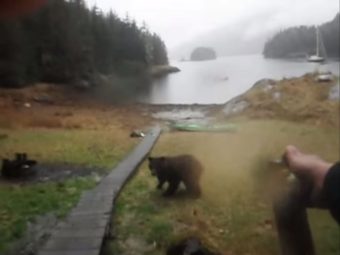
Troopers are looking for information about a bear (pictured) that was shot and left to die at the Cape Nome quarry. (Photo: courtesy of the Alaska Wildlife Troopers)

Between three bears spotted at the edge of town and another grizzly shot and left to die at the Cape Nome quarry, bears are out and about in the Nome area.

The Alaska Department of Fish and Game issued a brown bear advisory last week after sightings near Icy View, the Norton Sound Hospital, and along the Beam Road. Meanwhile, Alaska Wildlife Troopers are searching for the person or people who failed to salvage the meat of a bear killed earlier this month. In an online dispatch released Friday, Troopers said the bear was shot near Cape Nome around Sept. 5.

Despite the recent sightings, Letty Hughes said the number of bears is not unusual.

“It has been an excellent fish year. It’s been an excellent berry year, so that helps out. But it’s probably no more than usual,” said Hughes, an assistant area wildlife biologist with the Fish and Game. “When you consider where Nome is situated — we’ve got the coast, we also have the Nome River and the Snake River — bears are just passing through.”

This year, Hughes said the department has actually received fewer reports of bears breaking into cabins. Still, she said the bears are out there — and the population seems to be doing quite well.

“We hear reports from folks that they see cubs with sows,” Hughes said. “So even without having any definite numbers, they appear to be healthy.”

And definite numbers are on the way. Hughes said Fish and Game teamed up with the National Park Service earlier this year to survey the brown bear population on the Seward Peninsula.

“We spent two weeks doing this bear survey, using a lot of small plane time,” she said. “A lot of hours were spent flying around the peninsula this spring.”

A biometrician is using the data collected to estimate the bear population, and Hughes said the final count will be released later this fall. The number will be another important piece of information about the local animals, which Hughes said are also analyzed when they’re hunted and salvaged properly.

“We gather information that way on our brown bears,” she said. “A hunter has 30 days to get their bear sealed. What sealing requires is bringing in the hide with the claws attached, the evidence of sex attached, and the skull. We pull a tooth, measure the skull, and look at the hide for any abnormalities — anything that might be interesting.”

With current sightings, Hughes said everyone should continue to practice basic bear safety. Make noise and maintain a safe distance while viewing bears, hiking, and picking berries. And keep trash contained so fish and game scraps don’t attract animals. Hughes said anyone who sees a bear can report sightings to the Department of Fish and Game, the Troopers, or the Nome Police Department.

Whale mAPP brings power of mobile technology to marine biology

The Whale mApp is a new technology to aid citizen scientists in reporting sightings of marine mammals. Screenshot from whalemapp.org.

Southeast Alaska is a summer haven for whale researchers. However, limited resources means they can only study a handful of whales at a time.

Scientists are now calling on citizens with Android smartphones to aid their cause.

Brenna Campbell has been sailing up and down the Inside Passage every summer for the past 25 years. Campbell is a retired geologist and a small 2 berth sailing boat in Petersburg’s North Harbor is her home.

She’s at the center of an experiment that a group of scientists in the Pacific Northwest hope will change the future of whale research.

The Whale mAPP app allows users to log sightings of marine mammals. The entries are entered into a database and sent back to Oregon State University where researcher Courtney Hann tries to figure out what the data means.

Hann is the brains behind the project and says in order to understand whales and other marine mammals, we have to use all resources available.

“Instead of looking at the study of one whale in one small area … let’s gather all of our forces together and work together to [see] how these animals move across really vast distances,” she says.

Scientists might not be able to travel across these distances, but the myriad people who boat up and down the Pacific Northwest during the summer months can and often do.

“Last summer I had 1,200 sightings recorded over three months over the entire area of Southeast Alaska, and there was no one else who was able to collect that type of data,” Hann says.

She says collecting all this data helps scientists understand the behavior patterns of marine mammals, but it also aids the development of a new scientific field.

“In which we get back to saying yes every person can be a scientist and every person can learn and study different amazing animals that are around the world,” she says.

Despite her optimism, Hann isn’t blind to the drawbacks of citizen data. She understands civilians’ eyes aren’t as informed as scientists and so the app has built-in a rating system to counter errors in sightings.

Just like you can rate your favorite song on iTunes, Whale mAPP has a starring system for judging how confident you are about what you saw. This allows novices like Brenna Campbell to use the app without worrying about making a mistake.

Currently, the app is only available in limited release on Android but if Courtney Hann has her way, citizen scientists and smartphones will help shape the future of whale research in the Pacific Northwest.

In unnerving trend, 35,000 walrus haul out at Point Lay

Thousands of Pacific walrus gather on shore near Point Lay in 2014. (Photo courtesy of Corey Accardo/NOAA)

In what’s becoming an increasingly common sight, tens of thousands of walrus have hauled out on the coast of the Chukchi Sea near the Native Village of Point Lay.

An estimated 35,000 Pacific walrus are currently crowding a barrier island just north of Point Lay, a phenomenon that has become more and more common.

The U.S. Geological Survey, the U.S. Fish and Wildlife Service, and the Native Village of Point Lay hosted a media teleconference last month to offer updates on the haulout and guidelines for the media. Tony Fischbach, a USGS wildlife biologist started off the call with an overview of the issue.

“So the main point here is that this is a new phenomenon of large coastal haulouts forming on the U.S. shores of the Chukchi Sea that has only been seen during years of complete loss of sea ice in the Chukchi Sea.”

The haulouts were first observed in 2007, coinciding with a record sea ice melt in the Arctic, as sea ice extent plummet to 39 percent below average. Female walruses and their young generally spend their summers on the sea ice, foraging in shallower areas for food. But as summer sea ice retreats, walrus are forced to spend summers on shore.

The haulout are concerning both to scientists and those who rely on them for food, as any disturbance can lead to deadly stampedes. Last year an estimated 60 young walruses were killed due to the concentrated haulouts.

Wildlife biologist Jonathan Snyder with Fish and Wildlife Service commended the nearby village for providing a safe place for the animals to haul out.

“I think the fact that walrus continue to haul out near the community of Point Lay year after year is testament of the fact of the great stewardship role that that community has taken. I’d imagine if that were not a safe place the walrus would not keep returning.”

Point Lay is doing its best to keep the walrus safe, but the village frustrated by the media that won’t keep their distance. In conjunction with Fish and Wildlife Service, USGS, and NOAA, the village of Point Lay issued a statement urging the media to keep their distance.

“The community does not have the capacity to house anybody visiting. This is a small community. Our population is only about 246 and it’s a subsistence community.”

Leo Ferreira the III, Tribal Council President of the Native Village of Point Lay, says the media isn’t listening. At least one person has disobeyed the villages’s multiple requests to keep their distance.

Gary Braasch, an environmental photographer, flew over the haulout on August 23rd. While he says he obeyed flight guidelines, a spokesperson for the Fish and Wildlife Service speaking to the Guardian newspaper, says his photos show walruses that appear to be agitated, fleeing the area.

Ferreira vented his frustration at the media.

“It’s very disturbing when you guys disrespect our way of living, disrespect our community and our wishes for the fact that you guys want a story and think you guys can come here and then go rent a boat, rent somebody’s boat and go across and disturb the walruses on your own,” he said. “That’s not permitted. Not even our own people are permitted to go over there and disturb the walruses with a mass haulout like this.”

The community is working with the Federal Aviation Administration to issue notices and guidelines to pilots in the region. Ferreira says resident hunters have also have been reduced or redirected away from the haulout.

With freeze-up not expected until mid-October, the walruses are hunkered down on shore and the community and scientists hope that disturbances are kept to a minimum.

Making A Case For The Minds Of Animals

Elephant with its baby. iStockphoto

Carl Safina, in his new book on animal minds — Beyond Words: What Animals Think and Feel makes a strong case for the claim that animals, such as wolves, elephants — and maybe also crayfish — have rich mental lives.

The tendency to talk about “humans and animals” as if animate life in all its variety is helpfully sorted into these two disjoint categories is preposterous, argues Safina. Humans are animals and all animals have common origins and shared makeups.

The question, he suggests, shouldn’t be: “Do non-human animals have minds?” or “Is there emotion or consciousness among the non-humans?” The question ought rather to be: “What are all the different kinds of minds that there are?”

The fact that an elephant or a dolphin doesn’t have a mind exactly like ours is not grounds for denying that it has a mind at all, Safina says. Dolphins and elephants perceive, feel, evaluate and react, too, even if they do it in their own distinctive modality.

The book contains well-told stories and observations, sometimes very touching. The focus is on the lives of elephants and wolves — and the author does a good job bringing out how simply unreasonable it is to be skeptical about things like whether animals grieve (here he agrees with, and cites approvingly, our own Barbara King) or whether wolves can be magnanimous. Animal lovers will delight in — and be moved by — these tales of animal feeling and understanding. Many readers also will be saddened by the book’s tales of human destructiveness.

Safina is right to criticize the academic scruples run amok that might lead us to refuse to admit that, sometimes, we can tell by looking what an animal thinks and feels. Sometimes, you can see pleasure in an elephant baby’s face, just as, sometimes, you can see its mother’s fear.

But Safina’s own theoretical accounting of our relations to the minds of animals is not quite satisfying. He denies the behaviorist’s conclusion that behavior alone can never prove claims about what is going on inside the mind. But he seems to accept, again and again, the behaviorist’s basic premise that all we ever have to go on, when it comes to knowing other animals, or other people, is their behavior. The mind of another person or animal, Safina and his behaviorist opponents seem to be in full agreement, is not really knowable.

Safina wants to have it both ways. On the one hand, he believes that “evidence, logic and science” should lead us to the conclusion that animals have rich mental lives. On the other hand, he insists on describing his own investigations as “speculations” and he reminds us, again and again, that when it comes to evidence we are limited to the outward behavior and movements of the animals or people who interest us. “Informed guessing based on experience and body language” is the best we can do when it comes to knowing what others think and feel.

“We” does double duty here. He means us, normal people, in our relations with other humans and animals. He writes: “If a sketchy-looking stranger crosses the street to come toward us, our first problem is that we can’t know what they’re thinking.” True, he admits, “we observe, we resonate, but ultimately we guess.”

But he also means “we” scientists. His conclusion, then, could be summed up like this: We, people including scientists, have the same kind of access to the minds of elephants as we do to the minds of other people; we can make educated guesses about them.

Now, it is quite true — indeed, it is a truism — that we frequently don’t know what another is thinking. We couldn’t play cards or flirt or negotiate a deal if it were not possible to conceal our thoughts, feelings and intentions from each other. The fact that we can be uncertain what another wants or intends to do is one of life’s existential preconditions. Safina is right about this — and he is right to emphasize it. We ought to cherish our inalienable cognitive and experiential privacy. My beliefs and values are, in a sense, no one’s business but my own.

And yet, it is one thing to say that other minds can be private or concealed, and quite another to suggest that the best we can do when it comes to knowing each other, or other animals, is to make educated guesses. That later claim is preposterous. Sometimes, for example, you can just see what a person is looking at. You can see, for example, that a driver sees you waiting to cross the street. And, likewise, mothers and fathers do not typically need to guess about the emotional state of their raging or hungry or fearful or joyful children.

Safina approaches the grieving elephant or the person at the cross walk as educated guesswork. He suggests you can’t deny it, yet in a way contradicts this claim by saying you can never truly know. In effect, he insists that our personal relation to each other is just like that of his elephant watchers on the game reserve and their elephants: It is a theoretical one. We can never know the mind of another — not an animal other, not a human other. The mind of another is hidden. The mind of another is an unobservable. Safina insists on this. The best we can do is make conjectures about what’s going on in their minds on the basis of what we see, namely, behavior.

But I don’t think he is right. We do perceive the thoughts and feelings of others — including other animals — and we do so directly, at least a lot of the time. I don’t infer that my partner is irritated with me by watching what she says and does. I don’t need to interpret her behavior or her words. She expresses her feeling in what she says — and in her actions. The glowing smile is not evidence that she has positive emotions; it is the veritable face of those emotions. Which is, of course, not to deny that sometimes the smile is a false one or that, sometimes, the urge to smile is suppressed.

I worry that Safina’s “evidence, logic, science” approach manifests his commitment to just the hyper-rationalistic, behaviorism his narrative practice would urge us to give up. Safina would have it that our fundamental epistemic relation to each other and to animals, as scientists and as people, is like that which we might have to an unknown sketchy stranger moving in our direction in the night. But sometimes we stand in a very different relation to others. Sometimes, even when we are studying them, we are with them as companions.

You don’t care for the animals — crabs, dolphins, lobsters or wolves — because the evidence justifies the educated guess that they have thoughts and feelings, too. It’s the other way around. It is your caring, your concern, your interest in and valuing of animals and other people that first makes it possible for you to perceive, in all its fullness, their minds.

The mind is not a complete unknown unobservable about which we can only make guesses from the evidence of the senses.


Alva Noë is a philosopher at the University of California, Berkeley, where he writes and teaches about perception, consciousness and art. You can keep up with more of what Alva is thinking on Facebook and on Twitter: @alvanoe

Copyright 2015 NPR. To see more, visit http://www.npr.org/.
Read Original Article – Published SEPTEMBER 11, 2015 7:44 AM ET

Judge: National Environmental Policy Act probably doomed King Cove road

King Cove road, Izembek National Wildlife Refuge, Cold Bay map

A federal judge in Anchorage has ruled against a group from King Cove seeking an emergency road to Cold Bay.

Judge H. Russell Holland says Interior Secretary Sally Jewell’s 2013 decision to reject an 11-mile road through the Izembek National Wildlife Refuge is in keeping with the National Environmental Policy Act, known as NEPA. The judge says that, given the sensitive nature of the lands in the proposed road corridor, the need to follow NEPA probably doomed the project. “Perhaps Congress will now think better of its decision to encumber the King Cove road project with a NEPA requirement,” he wrote.

Sen. Lisa Murkowski says she was disappointed in the decision, but she’s already working on a Congressional solution. She has inserted a rider in a spending bill that would allow a land exchange and take the road decision away from the Interior secretary.

King Cove residents want a road to reach Cold Bay’s long, paved runway, to allow medical evacuations in rough conditions.  King Cove Mayor Henry Mack spoke of the need in a call to APRN’s Talk of Alaska this week.

“We would love to get our sick grandmas and grandpas and young children who need (it) to get out safely, instead of waiting in a clinic in miserable nights in bad weather,” he said. “Why, we could drive over there.”

The city joined with local tribes and the Aleutians East Borough to bring the legal challenge. They say they’re evaluating their next legal move.

Environmental groups argue that a road would diminish important waterfowl habitat. They say most of the world’s population of Pacific black brant and emperor geese rest and feed in the Izembek Refuge during migrations. Tim Woody, spokesman for the Alaska branch of The Wilderness Society, says their position does NOT amount to placing bird needs above human needs.

“Everyone is respectful of King Cove’s concerns and their need for emergency transportation,” Woody said, “but we need to start looking for a solution that meets their needs while keeping the wilderness of the refuge intact.”

Woody says other transportation methods – like helicopter service or a ferry — might serve the community better. Road proponents say those alternatives aren’t realistic.

Site notifications
Update notification options
Subscribe to notifications