Wildlife

The World’s Most Trafficked Mammal Is One You May Never Have Heard Of

A pangolin is released into the wild by officials at a conservation forest in Indonesia in 2013. The animal was among 128 pangolins confiscated by customs officers from a smuggler's boat off Sumatra. Jefri Tarigan/AP
A pangolin is released into the wild by officials at a conservation forest in Indonesia in 2013. The animal was among 128 pangolins confiscated by customs officers from a smuggler’s boat off Sumatra.
Jefri Tarigan/AP

Lisa Hywood remembers the first time she ever set eyes on a pangolin. It was in 1994, and she had just founded the Tikki Hywood Trust, a wildlife conservation sanctuary in Zimbabwe. One morning, someone dropped off a strange-looking, injured creature that had been confiscated from an illegal trader.

“This animal arrived in a sack and smelling something horrendous,” she recalls. “And I looked at this animal and I thought it’s like no other mammal that I’ve ever encountered.”

The pangolin is about the size of a raccoon and looks like an artichoke with legs. Its head and body are covered with an armor of thorny scales, giving it the appearance of a reptile. When a pangolin is scared, it curls up into a tight ball.

“I actually, at that moment, felt completely helpless because I had no idea how to take care of that animal,” Hywood says. “At that moment, I actually said to myself, ‘Right, you need to figure this out.’ ”

Since then, many pangolins have been brought to Hywood’s sanctuary doorstep. The shy, nocturnal creature is the most trafficked mammal in the world, says Jeff Flocken, a regional director with the International Fund for Animal Welfare. Almost a million pangolins were trafficked in the past 10 years.

“They are finding literally crates filled with pangolin scales, you know — entire boats with bags and bags of live or frozen and dead pangolins that are being taken from the wild,” Flocken says.
Indonesian officials show live pangolins confiscated from suspected smugglers in 2013. AP
Indonesian officials show live pangolins confiscated from suspected smugglers in 2013.
AP

Rising Demand

All eight species of this animal, which is found over large parts of Africa and Asia, are facing extinction, according to Jonathan Baillie, a pangolin specialist at the International Union for Conservation of Nature in London.

“The demand for the pangolins is actually in China and Vietnam,” he says. “And the Asian pangolin, particularly the Chinese pangolin, has basically been wiped out.”

The animal has long been prized for its scales, which are used in traditional Chinese medicine. But Baillie says nowadays, pangolin meat is considered a luxury item by a growing middle class in Vietnam and China.

“We’re seeing that the body is actually being eaten as some sort of celebration when a business deal is done,” he says. “The price can go up to many hundreds of dollars per kilo.”

As the number of Asian species declines, Baillie says, there is an increasing demand for African pangolins. International trade of the African species is allowed with the right paperwork. But they’re being poached and sent to Asian markets at an alarming rate.

Hywood, the Zimbabwe sanctuary director, says the trade has caught many African governments off-guard.

“In Africa, you are dealing with a species that most of the authorities, up until, I can honestly say, this year, are not aware of the plight of the pangolin,” she says. “They do not understand why the pangolin has such a demand in Asia.”

Last month, Indonesian customs officials seized more than a ton of frozen pangolins bound for Singapore. The animal is critically endangered, due to high levels of hunting and poaching for its meat and scales. Jefta Images/Barcroft Media/Landov
Last month, Indonesian customs officials seized more than a ton of frozen pangolins bound for Singapore. The animal is critically endangered, due to high levels of hunting and poaching for its meat and scales.
Jefta Images/Barcroft Media/Landov

Improving Awareness

Pangolin products are showing up in the U.S. as well. Part of the problem is the pangolin doesn’t have a high profile like the elephant or rhino, so it’s easier to slip the live animal or its byproducts past customs officials, says Luke Bond, a criminal intelligence officer with Interpol’s environmental crime program.

“There’s opportunities to conceal these animals,” he says. “They’re small. Border control agencies are often not trained enough to recognize what they actually might be.”

Bond says the illegal trafficking in pangolins is linked to other global crimes.

“I’ve seen it firsthand in every operation I’ve been in for the last 10 years or so,” he says. “I’ve seen drugs and weapons and financial crime activities associated with the wildlife trade.”

But the sheer speed with which the pangolin is being trafficked is now pushing governments and conservationists into high gear to get the message out that it has to be saved. That’s not easy when many people haven’t heard of the pangolin, says Rosemarie Gnam of the U.S. Fish and Wildlife Service.

The agency is stepping up coverage of pangolins on its website, to include interactive maps and pages for children to discover the mammal.

“We’re really trying to put the word out there about pangolins, building on the public’s awareness of the rhino and elephant,” Gnam says.

A pangolin will soon be making a debut on an Angry Birds game, and one recently appeared in a Mark Trail comic strip.

There’s also an effort to list all eight species under the U.S. Endangered Species Act, and another to make it illegal to trade the pangolin under CITES, the multilateral treaty to protect endangered animals.

For Hywood, the effort to save the pangolin is paramount. In the two decades since that first scared and injured pangolin was dropped off in a sack, she has created a sanctuary for rehabilitating pangolins. It’s one of only a handful in the world.

“It’s not an animal that you can just collect and put in a cage and feed an artificial diet,” she says. “That’s not going to work. Pangolins don’t adapt very well to captivity at all.”

At the moment, Hywood is caring for nine pangolins. Each one forages in the wild — with its own security detail to protect it from poachers.

Copyright 2015 NPR. To see more, visit http://www.npr.org/.
Read Original Article – Published AUGUST 18, 2015 1:58 PM ET


Dead herring, poison mussels found on Unalaska shorelines

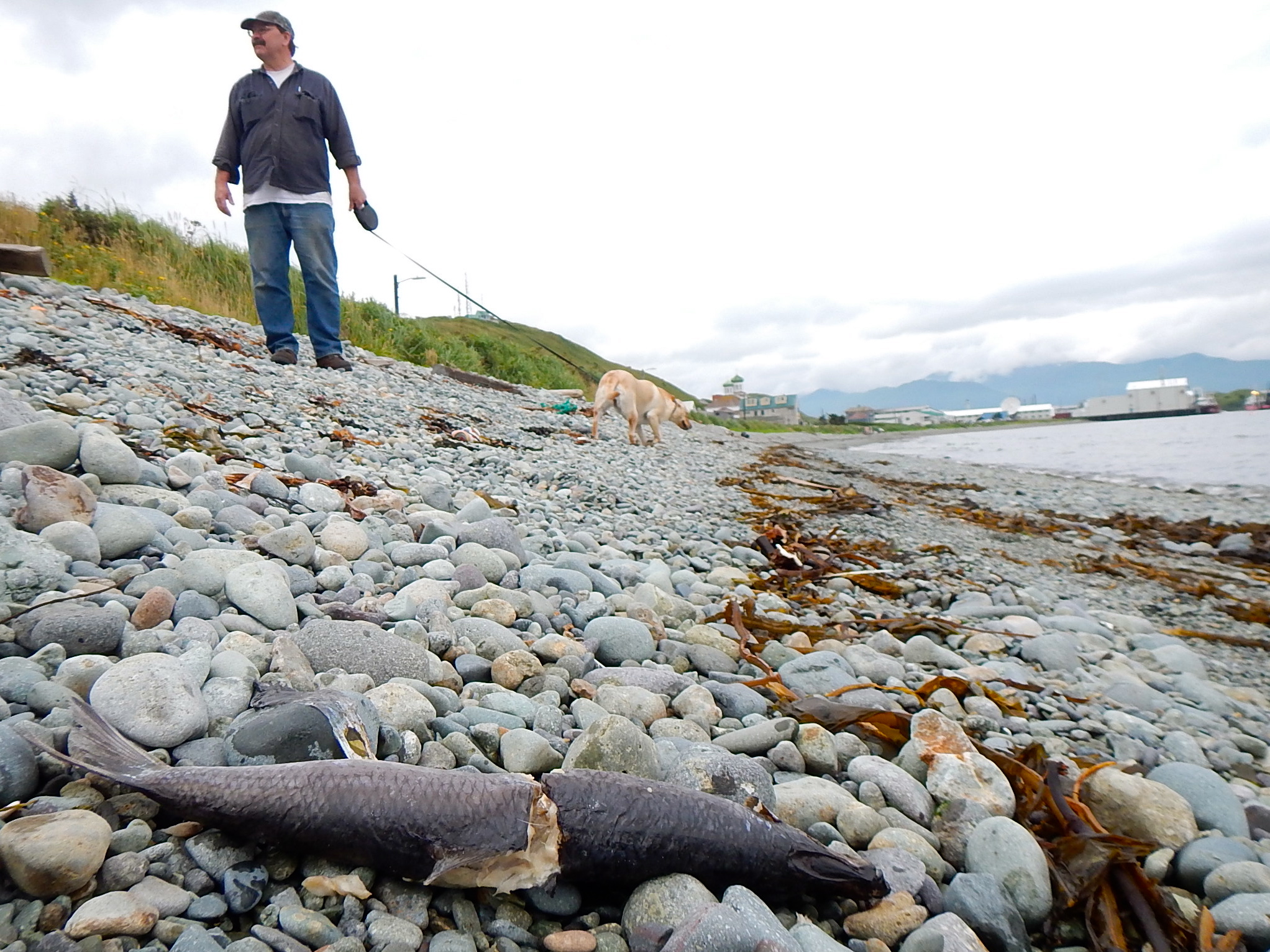
Caleb Livingston takes his dog Hazel for a walk on Unalaska’s Front Beach. (Photo by John Ryan/KUCB)

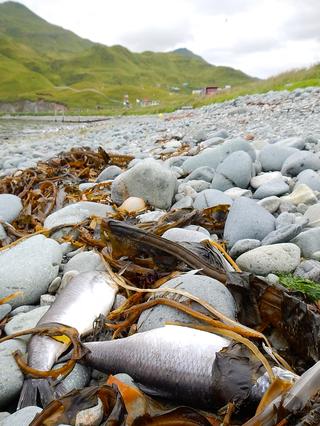
Hundreds of dead herring washed up on Front Beach in downtown Unalaska on Tuesday.

“Hundreds of herring floating in the water,” Caleb Livingston, who lives nearby, said as he was walking his dog Hazel on the beach. “But what really got my attention was the few that drifted on the beach were not being eaten by the eagles, or seagulls or terns.”

Scientists have been receiving reports of dead and dying whales, birds and the small fish known as sand lance in the Aleutian Islands.

A dead Steller’s sea lion washed ashore in Unalaska in July with no wounds or other obvious causes of death.

Researchers think the killer might be toxic algae proliferating in unusually warm ocean waters.

Mussels taken from two different bays in Unalaska this spring have had levels of the toxin that causes paralytic shellfish poisoning two to four times higher than the level considered safe by the U.S. Food and Drug Administration.

Livingston said he doesn’t think toxic algae killed the herring he saw on Front Beach.

“I’m guessing that somebody shoveled them off a boat,” he said.

Herring are used as bait by crabbers and longliners.

Boats shouldn’t do that in close. If they’re going to get rid of this stuff, they should do it further out,” Livingston said. “It’s probably not that harmful, other than critters like Hazel gobbling on it, but it is a form of pollution.”

Scientist Melissa Good with University of Alaska Fairbanks agreed, after a quick bit of beach forensics, that these dead fish were probably dumped in the water.

Dead herring on an Unalaska beach on Wednesday. (Photo by John Ryan/KUCB)

She said the herring had lost their scales, suggesting the fish had been poured through a chute en masse.

“Their fins are deteriorated while their eyes are intact,” Good said. “I think it’s probably bait fish that got dumped.”

Even so, Good said she would send herring that she and Livingston collected on the beach to an Alaska Department of Environmental Conservation lab for analysis.

This spring, Good collected mussels from Captains Bay and Summer Bay in Unalaska to see if they had the toxin that causes paralytic shellfish poisoning.

She just got the results back: Mussels had up to 3.3 parts per million of the potent PSP toxin. That’s four times higher than the FDA’s 0.8 parts-per-million limit.

“Anything above that is unsafe to eat,” Good said.

“I would suggest people take caution and probably not harvest mussels or any other clams or bivalves within the Unalaska area because we are seeing high toxin levels for the previous spring months,” she said. “It’s likely these levels are higher now, after the summer algal blooms.”

In an email, Bruce Wright with the Aleutian Pribilof Islands Association said butter clams tested in June at Sand Point, in the Shumagin Islands, just east of the Aleutians, showed even higher levels of the toxin.

One of the largest algal blooms ever recorded has been spreading throughout the Northeast Pacific Ocean, from California to Alaska. Scientists believe a giant blob of warm water is fueling the harmful algal bloom.

Sled dog killed, another injured in muskox goring outside Nome

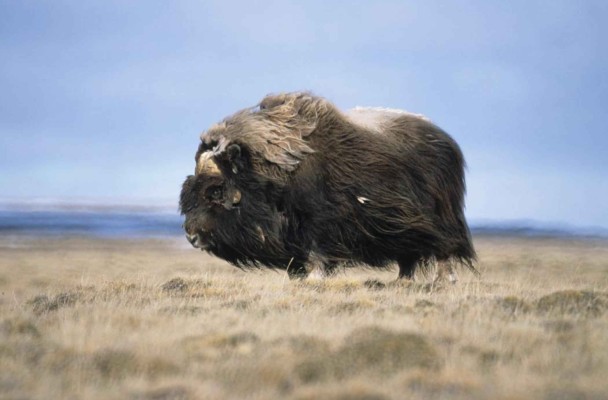
A bull muskox. (Photo by Tim Bowman/U.S. Fish and Wildlife Service)

A grimly familiar sight to Nome dog owners returned with the fatal goring of a local musher’s dog by a bull muskox Wednesday.

Alaska Department of Fish and Game wildlife biologist Bill Dunker said Nome police called his office Wednesday afternoon to report two dogs were injured—one fatally—in the attack before the bull muskox was killed in what Dunker calls a clear case of “defense of life or property.”

“Everything appears to be a justifiable DLP,” Dunker said.

The dogs belonged to musher Rolland Trowbridge, who ran the Kuskokwim 300 earlier this year. He also ran the Yukon Quest in February—withdrawing near the race’s midpoint. Daughter Janelle Trowbridge also ran dogs from the family kennel in her 2014 Junior Iditarod run.

Trowbridge declined to comment on the incident.

Dunker said it’s the first fatal clash between muskox, and Nome residents and their animals, so far this summer. That’s a far cry from the multiple gorings and dog fatalities seen last year, including a DLP kill of a muskox harassing a dog and a similar DLP kill in the community of Wales.

“This summer has been much better with regard to conflicts with muskox,” Dunker said. “We’re still having them on occasion, but certainly last year was kind of the ‘perfect storm’ of muskox conflicts in the Nome area. It’s certainly been the case that this year has been much less active with regard to muskox conflicts.”

But just what makes up that “perfect storm” isn’t fully understood. Dunker said “anecdotal” observations on brown bear predation may have pushed muskox into the Nome area last year. But so far this summer, that’s not the case.

“We haven’t made those same observations this year,” he said, “so we can’t say one way or the other that it was brown bear predation that was the smoking gun that ultimately drives them into the Nome area.”

Dunker said Fish and Game’s muskox mitigation is ongoing. Failed attempts last year included everything from rubber bullets to bear decoys and the spraying of bear urine. This year he said ADF&G is trying an experimental electric fence installed at the Nome airport. Biologists are still waiting to see if the fence is effective.

“But to be honest,” Dunker said, “we haven’t had a muskox bump into the fence yet. So we’re still investigating its effectiveness.”

As for the DLP kill, salvage requirements include surrendering the meat from the animal, but in this case, the meat will stay local: it’s been donated to the Nome Covenant Church. The animal’s hide and the skull were salvaged and turned over to the department.

Pastor Harvey Fiskeaux with the Covenant Church said the muskox in currently hanging in a church member’s shed, and a group from the church will be processing the meat tomorrow and putting it into the church’s freezer.

Fiskeaux said they’ll be serving muskox roasts and stew at their Friday soup kitchens beginning in September.

Female Grizzly Bear In Yellowstone Euthanized After Killing Hiker

Lance Crosby was allegedly killed by a grizzly bear last week in Yellowstone National Park. National Parks Service/Associated Press
Lance Crosby was allegedly killed by a grizzly bear last week in Yellowstone National Park.
National Parks Service/Associated Press

DNA tests confirm a captured grizzly bear was the animal that killed Lance Crosby while he was hiking in Yellowstone National Park last week. The bear was euthanized Thursday, according to a National Park Service news release.

The tests also conclude that, in addition to the adult grizzly, cubs were at the site of the attack, the statement says:

“An important fact in the decision to euthanize the bear was that a significant portion of the body was consumed and cached with the intent to return for further feeding. Normal defensive attacks by female bears defending their young do not involve consumption of the victim’s body.”

Two cubs will be transferred to a facility that is accredited by the Association of Zoos and Aquariums. That facility is expected to make an announcement on Friday.

The Elephant Back Loop Trail and Natural Bridge Trail, which have been closed since the attack, will be reopened on Friday.

As we reported earlier, Crosby had been working for an organization that runs urgent care facilities in the park.

The NPS said that:

“The decision to euthanize a bear is one that we do not take lightly. As park managers, we are constantly working to strike a balance between the preservation of park resources and the safety of our park visitors and employees,” said Dan Wenk, superintendent of Yellowstone National Park. “Our decision is based on the totality of the circumstances in this unfortunate event. Yellowstone has had a grizzly bear management program since 1983. The primary goals of this program are to minimize bear-human interactions, prevent human-caused displacement of bears from prime food sources, and to decrease the risk of bear-caused human injuries.”

Copyright 2015 NPR. To see more, visit http://www.npr.org/.
Read Original Article – Published AUGUST 13, 2015 7:20 PM ET

Man in bear costume reported harassing bears on Chilkoot River

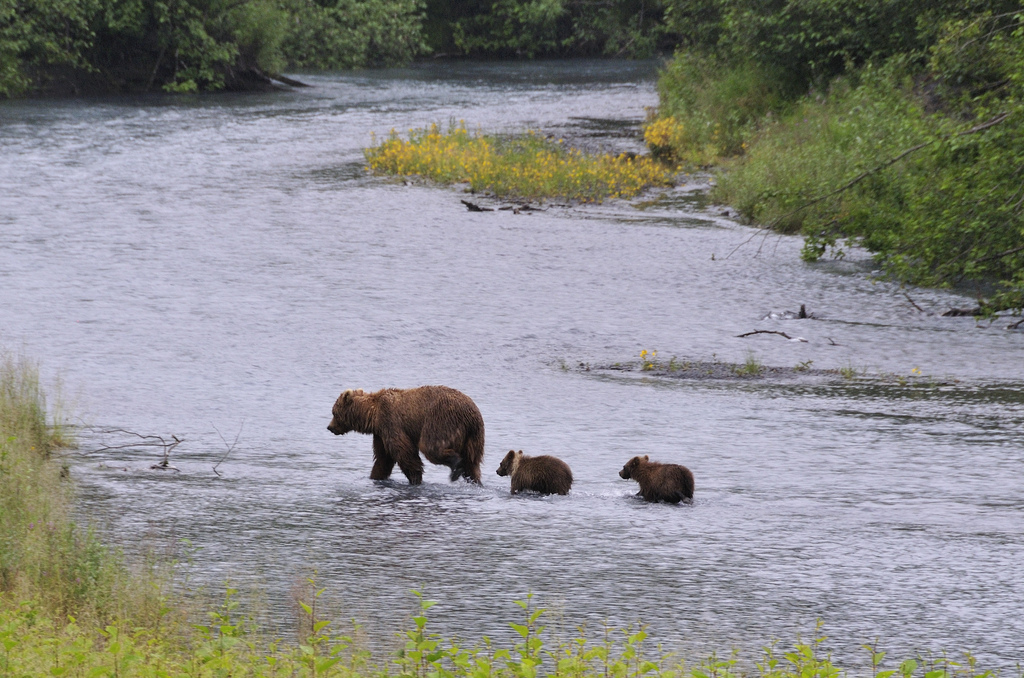
A brown bear sow with two cubs crossing the Resurrection River near mile 3 of the Seward Highway. Seward, Kenai Peninsula, Alaska. (Photo by Dan Logan/ Flickr CC)

A man dressed in a bear costume was reported to state troopers this week for harassing a sow and bear cubs on the Chilkoot River.

Mark Sogge with the Alaska Department of Fish & Game in Haines says their Chilkoot Lake weir technician witnessed and wrote a report about the incident.

Technician Lou Cenicola reported that around 7:30 p.m. Monday, a man in a “realistic-looking” bear costume ran through a group of people standing on the side of the road bear-watching. The man ran “waving and jumping” up to the weir gate, trying to get the attention of a sow with cubs. Cenicola says the man in the costume got within 5-10 feet of the cubs.

Cenicola reported that he ran toward the man to stop him, telling him he could be cited for wildlife harassment. The man then left without identifying himself. Sogge says Cenicola did get the man’s license plate number, and Fish & Game reported the incident to state troopers.

Troopers Spokesperson Megan Peters says they know about the incident and are investigating. No charges have been filed.

Sogge says getting that close to bear cubs when their mother is present could have ended tragically. He says wearing a bear costume will not deter a mother bear from attacking a person if she thinks her cubs are threatened.


Looking and listening for Alaska’s rarest whale

A right whale in the southeastern Bering Sea in 2005. (Photo by Brenda Rone/NOAA Fisheries)

Researchers are cruising the Gulf of Alaska on the lookout for one of the world’s rarest animals, the North Pacific right whale.

Their needle-in-a-haystack quest is made slightly easier by one fact — these needles make noise.

Scientists with the National Oceanic and Atmospheric Administration left Kodiak Sunday for a monthlong research cruise to track down the critically endangered whales.

“There [are] so few of these animals, and we know so very little about them,” spokeswoman Maggie Mooney-Seus with NOAA’s Alaska Fisheries Science Center in Seattle said. NOAA’s fishery survey vessel, the Reuben Lasker, cruised up from California studying gray whales. Now it’s turning its attention to the scarcest whales known to science.

“It’s going to be definitely difficult,” Mooney-Seus said. “We actually did hear this morning that they had heard a right whale call that gunshot call that we have a recording of up on our website.”

Here’s that gunshot call of a right whale.

Underwater microphones can usually hear the deep tones of a whale call much farther away than the human eye can pick out a whale when it surfaces.

“Even if they hear an animal, by the time they locate it, the animal’s moved on,” Mooney-Seus said.

The best estimate is that about 30 right whales survive today in the eastern Pacific Ocean, with perhaps 20 males and 8 females. A few hundred live in the western Pacific and a few hundred more in the North Atlantic.

Nineteenth-century whaling and illegal Soviet whaling in the mid-20th century decimated the populations, and they have not bounced back.

Researchers spotted a young right whale off Kodiak in 2012 and heard others in 2013. The vast majority of eastern North Pacific right whales have been detected in the Bering Sea between Bristol Bay and the Pribilof Islands.
Interior Department funding for right whale studies in the Bering Sea dried up after the Obama administration put plans for drilling in Bristol Bay on hold in 2009.

NOAA still has four mooring buoys that listen for whales in the Bering Sea. Researchers gather data from the buoys annually.

Bioacoustician Ana Širović with the Scripps Institution of Oceanography in La Jolla, California, studies right whales. She has heard the up-calls, down-calls and shotgun calls of right whales in the Gulf of Alaska but said she’s never seen one.

“They’re very rare,” she said. “There’s been a lot of effort studying right whales in the Bering Sea, and very little in the Gulf of Alaska. Given how small their population is, it’s important to know what their range truly is.”

If NOAA researchers can get close enough, they hope to get photos, tissue samples and even attach satellite tags to whales to monitor their movements.

Map of NOAA’s 2015 right whale survey route.

The NOAA cruise will run a zigzag pattern from Prince William Sound almost the full-length of the Alaska Peninsula and out to about 200 miles offshore.

Mooney-Seus with NOAA could not provide an estimate of the cruise’s cost.

Whalers considered the species the “right whale” to hunt because they would swim slowly and close to shore and because their carcasses float.

In the 1960s, the Soviet Union carried out what NOAA scientists call a “massive campaign of illegal whaling.” Soviet ships killed 372 right whales in the Gulf of Alaska and Bering Sea, severely depleting what was likely a recovering population.

Today, the biggest threat to the tiny population’s survival may be collisions with ships.

“These whales cross a major trans-Pacific shipping lane when traveling to and from the Bering Sea; their probability of ship-strike mortalities may increase with the likely future opening of an ice-free Northwest Passage,” NOAA scientists warned in a 2010 study in Biology Letters.

The right whale was declared an endangered species in 1970, under the precursor to the 1973 Endangered Species Act. A recovery plan for the North Pacific population was not issued until 2013, 40 years later.


Site notifications
Update notification options
Subscribe to notifications