Wildlife

Humpback researchers see ‘Old Timer’ again after 44 years

Old Timer’s Flukes captured from the deck of the M/V Northern Song July 12th. (Jim Nahmens/Nature’s Spirit Photography)

Whale researchers in Southeast Alaska have broken the record for the longest resighting of a humpback whale.

Forty-four years ago, the first sighting of a humpback known as Old Timer coincided with both the end of commercial whaling and the establishment of the Endangered Species Act. The whale’s resighting July 12 in the waters outside Petersburg interacts with a fierce debate within the conservation community over the future status of these mighty marine mammals.

Back in the 1970s it was so rare to see a humpback whale in Frederick Sound that sightings were often dismissed as wild rumors.

Now the area is so abundant that on a recent trip the humpback whales turned Cape Fanshaw into a meadow of blowholes and tail flukes.

It was here that Adam Pack, a professor at the University of Hawaii sighted a whale who breaks the record for the longest resighting of a humpback. Back on shore in Petersburg, Pack looks out at the Sound from the deck of the Northern Song, the boat he was on when he saw the whale he calls Old Timer.

“I was on the deck out here and Jim Nehmans, my colleague, was adjacent to me and then we saw this one fluke at the same time,” he says. “We just looked at each other and said ‘there’s Old Timer’ and we literally jumped up and high-fived right there on the front of the boat.”

Old Timer was first sighted here when Richard Nixon was still president and “American Pie” was No. 1 on the Billboard Top 100. Since then Pack and his fellow researchers have built a whole database of the humpbacks that grace these waters. And to him they’re all individuals with their own quirks and personalities.

He shows me a catalog of all the whales who congregate in Frederick Sound. Pack describes how the whale’s tail fluke is like a humpback’s fingerprint. He points to one: “This is stumpy. He’s missing half a fluke blade,” he tells me. “We’d call that one Crazy Eyes. This is angelfish because that looks like an angelfish up there, this looks like a mosaic painting.”

Old Timer’s fluke is black with white shading like dots of shaving cream left on a full beard. Pack says the fact he gets to see whales like after 44 years is a testament to the protection and conservation the species has been given since 1972.

That protection together with the decision to ban commercial whaling back in 1970 has been so successful, in April the National Oceanic and Atmospheric Administration proposed that humpback whales in the Pacific should be removed from the endangered species list.

“This recognizes the fact that things have improved for the whales,” says Marta Nammack, the Endangered Species Act listing coordinator for NOAA.

Nammack’s heading up the proposals which would take humpbacks off the endangered species list in 10 of the 13 places they reside across the world.

But some wildlife and conservation groups think those proposals spell danger

“It’s premature to remove those protections when so many threats like climate change, ocean acidification and ocean noise are increasing,” says Kristen Monsell, a Staff Attorney at the Center for Biological Diversity.

She says NOAA’s move is shortsighted. The reason humpbacks are doing so well is because of the endangered species Act.

“The ESA is a very powerful tool that helps to protect, conserve and recover imperiled species,” Monsell says.

But Marta Nammack, from NOAA, says what’s the point in having a list at all if you can’t recognize when an animal no longer belongs on that list.

“The whole goal of the endangered species act is to get them off that list,” she told me. “It’d be nice if we can see some more.”

Recently NOAA opened up a public comment period in order to hear the concerns of groups like Kristen Monsell’s. That ended July 20 and the organization will now take those comments into account before making a final proposal sometime early next year.

Whatever happens between now and then Adam Pack says seeing whales like Old Timer again and relisting can be celebrated but that doesn’t mean they can be complacent.

“It means we’ve done pretty good, but we have to continue to be vigilant,” he says. “We have to make sure that they are there for generations to come.”

And if the whales living in Frederick sound are anything to go by it doesn’t look like they’re going anywhere fast.

Bird death reports are up In Homer, food sources possibly to blame

The Alaska Maritime National Wildlife Refuge is receiving multiple reports indicating a significant increase in dead and dying birds found on beaches in the Homer area over the last two weeks. The reports are coming from beach walkers and local citizen scientists dedicated to surveying seabird populations. Leslie Slater is the Gulf of Alaska Unit Biologist for the Alaska Maritime National Wildlife Refuge. She says the number of birds reported is in the dozens.

Bishops Beach. (KBBI file photo)

“So it’s hard to give a real exact number of the normal number. I would say on a given stretch of beach we normally don’t find more than one within a couple of miles stretch.”

Slater says there are a lot of potential reasons for the increase in fatalities but the prevailing cause is likely tied to the birds’ food sources.

“What we’re seeing more precisely is that birds seem to be starving. That’s sort of the ultimate cause of their deaths but something might be happening before that. We might be having a PSP (Paralytic Shellfish Poisoning) outbreak or another situation called domoic acid where these biotoxins can build up through the food chain and ultimately cause the deaths of these birds.”

These deaths don’t seem to be isolated to Homer’s beaches. There are reports of similar deaths down the Alaska Peninsula and the eastern edge of the Aleutians. Slater says it’s possible they could be related to dead whales found near Kodiak. To narrow down causes of death Slater says the refuge will send carcasses of Homer’s birds to the National Wildlife Health Center in Madison, Wisconsin.

“There they have a whole team of expert epidemiologists and other wildlife disease specialists who will be able to examine them and probably come up with a real good conclusion.”

Slater expects the center to receive the carcasses by the end of this week and believes there could be a reply within two weeks. She asks that people continue to call in dead birds with the species name and specific directions to the bodies’ location. She warns the public not to touch dead birds because they could be carrying disease.


After years of teaching, a shy Western screech owl retires in Sitka

Peanut is a 13-year-old Western Screech Owl currently living at the Alaska Raptor Center. (Photo by Vanessa Walker/KCAW)
Peanut is a 13-year-old Western screech owl currently living at the Alaska Raptor Center. (Photo by Vanessa Walker/KCAW)

There’s a new bird at the Alaska Raptor Center in Sitka, and she’s a little shy. After a long career in education, she doesn’t have a lot of patience for the classroom. She’s now settling into a comfortable retirement.

On a cold and rainy day, the yellow-eyed, grey Western screech owl peers out of her small owl house in a cage at the raptor center. Her name is Peanut, and her right wing sticks out just a little further than her left. She’s injured and unable to fly. She used to live in California and at some point moved to Alaska.

“We know she’s about 13 years old, which is really old for a screech owl. They usually live to be about 8 or 9,” says says says Jen Cedarleaf, an avian rehabilitation coordinator at the center.

Peanut arrived at the center in July, after the bird educational facility she lived at in Ketchikan shut down. Before that she belonged to a California falconer. Cedarleaf says the raptor center tried using Peanut as an education bird at first but it didn’t work out, so the center decided to let her rest.

“She’s really enjoying, I think, not being an education bird,” Cedarleaf says. “She really seems to like her little habitat. She gets around in there and doesn’t have to deal with people all day long.”

Peanut has already laid 4 or 5 eggs, more than she probably ever has, says Cedarleaf. The little owl is now living a somewhat quiet life.

“Peanut is a little beast,” Cedarleaf says. “A lot of times she’ll try to run away from you, but sometimes she’ll come after you. It’s kind of funny because she’s so tiny; she can’t really hurt us that much, but she thinks she can.”

Peanut is one of three screech owls currently at the Alaska Raptor Center, and one of about 20 permanent residents that include bald eagles, red tailed hawks, great horned owls and ravens. There are also more than 20 birds being rehabilitated, mostly bald eagles.

The center took in a bird nearly every day in June, making it a particularly busy month.

Peanut is a 13-year-old Western Screech Owl currently living at the Alaska Raptor Center. (Photo by Vanessa Walker/KCAW)
Peanut is a 13-year-old Western screech owl currently living at the Alaska Raptor Center. (Photo by Vanessa Walker/KCAW)

They don’t know how Peanut injured her wing, but Cedarleaf says common human-related owl injuries are caused by cars.

“It’s very possible she was hit by a car. Owls get hit by cars more often than you would think, because they use the headlights to help find their prey, and they’ll swoop in front of a car without realizing it, and then they get it,” she says.

Despite Peanut’s reclusive nature, Cedarleaf says visitors stand to learn a lot from her.

“She’s a very good bird for teaching us about longevity and just about the different kinds of birds that are out there in the environment that you don’t always see all the time.”

It’s not every day you see a Western screech owl. However, if you’re lucky, Peanut may look your way the next time if you’re ever at the Alaska Raptor Center.


Feds ask cruise ships, boats to stay farther away from seals

Harbor seals rest on ice near South Sawyer Glacier in 2007. (Photo courtesy NOAA's Alaska Fisheries Science Center)
Harbor seals rest on ice near South Sawyer Glacier in 2007. New federal guidelines suggest, but don’t require, vessels to stay about 500 yards away from the marine mammals to lessen disturbances. (Photo courtesy NOAA’s Alaska Fisheries Science Center)

Federal officials are asking cruise ships, tour boats and kayaks to stay far away from harbor seals in Alaska’s glacial fjords.

The marine mammals rest, sleep and birth their pups on floating ice. NOAA Fisheries says new research shows the marine mammals are much more likely to dive into the water when vessels approach the current legal limit.

NOAA spokeswoman Julie Speegle says that stresses the animals and lowers their chance for survival.

“They expend far more energy when they are flushed off the ice floes and that uses up their energy reserves and that’s very important if you’re an animal that lives in that icy environment,” she says.

The federal Marine Mammals Protection Act requires ships to stay about 100 yards away. New guidelines, which are voluntary, call for about 500 yards, if it’s safe to do so.

A harbor seal pup and its mother rest on ice at the base of Northwestern Glacier in Kenai Fjords National Park in June of 2011. More than 350 female seals with pups were spotted in the area. (Photo by Gregory "Greg" Smith/Creative Commons)
A harbor seal pup and its mother rest on ice at the base of Northwestern Glacier in Kenai Fjords National Park in June of 2011. More than 350 female seals with pups were spotted in the area. (Photo by Gregory “Greg” Smith/Creative Commons)

They also ask ships to be as quiet as possible, avoid causing wakes and make no abrupt course changes. They suggest vessels schedule tours for the early morning or evening, when fewer seals haul out.

“At this point, because they’re voluntary, we will be monitoring the vessel and seal interactions to see if these new voluntary approach guidelines provide sufficient protection for the seals,” she says.

NOAA Fisheries says its research shows about three-quarters of seals on ice dive into the water before an approaching ship reaches the current legal distance. Other studies found different numbers, but they still document significant disturbances.

The most popular fjords, in Southeast and Southcentral Alaska, see multiple visits a day.

Speegle says the new guidelines, if followed, should help protect young seals.

“We certainly want to do all that we can to ensure that pups are not separated from their mothers during the nursing stage,” she says.

Calls to several companies offering fjord tours were not immediately returned.

Dead fish, wildlife in Aleutians may be victims of toxic algae outbreak

Melissa Good with UAF Alaska Sea Grant collects a sample from a Steller’s sea lion carcass by Unalaska’s Summer Bay. (Photo by John Ryan/KUCB)

Scientists have been receiving reports of dead and dying mammals, birds and small fish in the Aleutian Islands.  They think the killer might be toxic algae proliferating in unusually warm ocean waters.

“All the signs are that we’re having a major harmful algal bloom event,” Bruce Wright with the Aleutian Pribilof Islands Association said.

Wright said it could be the algae that cause paralytic shellfish poisoning; the algae that generate domoic acid are another possible culprit.

Melissa Good with University of Alaska Fairbanks has been looking for the microscopic green suspects around Unalaska.

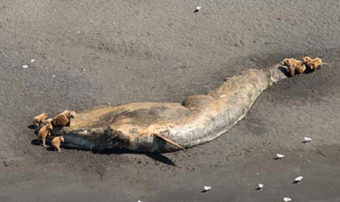
“They’re a suspected cause for some of the mass deaths we’ve been seeing–the 10 fin whales that were spotted dead off of Kodiak Island; I know Adak has seen a lot of dead birds, King Cove, I believe [birds in] False Pass have been washing up. We don’t know the cause of that yet either,” Good said. “In the past, we’ve seen incidences where sand lance, a little plankton-eating fish, was accumulating these high toxins from these algae in their system. The birds were eating sand lance, these small forage fish, and were dying. No one that I know of is sure what happened.”

This week, Good has been taking water samples around Unalaska and shipping them off to labs for full analysis. Even just looking in her microscope on the desk in her office on Thursday, she found large numbers of the domoic acid algae in one of her recent water samples.

She’s also sampled the stomach and flesh of a Steller’s sea lion that washed up dead recently on Unalaska’s Summer Bay, north of the town landfill.

“I didn’t see anything external that looked like a cause of death.  Sometimes, there’s gunshot wounds, ship strikes. Those things can be very obvious,” she said after looking over the 10-foot carcass on Thursday.

She thinks toxic algae might have killed this sea lion. One that washed up dead last year near here had very high levels of PSP.

In addition to the stomach, scientists sometimes study fluids in the eye for algal toxins and the whiskers. But eagles had already gotten to the eyes, and someone, Good presumed an Alaska Native with permission to use part of the protected species for materials to decorate a traditional bentwood hat, had removed the whiskers.

Melissa Good with UAF Alaska Sea Grant points out domoic acid-generating “pseudo nitzschia” algae. (Photo by John Ryan/KUCB)

Standing next to the fresh carcass, Good said people in the Aleutians should be wary of eating clams or mussels right now.

“We just don’t know if they’re going to be toxic or not,” she said. “You’re taking a lot of risks there.”

Unlike bivalves (such as mussels and clams), crabs don’t retain the toxins in their meat, but in their digestive tracts. Scientists warn people to remove the dark viscera from crab before cooking it.

Shellfish in King Cove and False Pass recently have tested for twice the level of toxins that the U.S. Food and Drug Administration says is safe.

Potentially harmful algae are always present in seawater, but it’s only when they bloom into dense concentrations that they can cause much harm to the things that eat them.

One of the largest harmful algal blooms ever recorded has been taking place this year from California up through British Columbia.  Officials in three states have closed beaches to razor clamming and other types of shellfish harvesting.

Researchers think the West Coast bloom, and recent events in Alaska, are related to unusually warm water temperatures.

“We are seeing large blooms throughout Alaska, of different species,” Good said. “When you get warmer water temperatures, they became more prolific, they bloom. You’re getting a high concentration of algae.”

Good says paralytic shellfish poisoning appears to be getting more common in the Aleutians due to increasing water temperatures.

She’s waiting for results on her samples for more conclusive answers. She and Bruce Wright both ask anyone noticing sick or dead predators in the Aleutians to report them. And if you see dead sand lance fish, put a half dozen in a zip-lock bag, freeze it and send it to them.

Denali wolf hunt planned despite low population numbers

(Photo by Ken Conger/National Park Service)

Wolf hunting season is scheduled to open next month in and around Denali National Park, despite record low wolf numbers. This spring, Park biologists counted fewer than 50 Denali wolves, heightening a long-running battle over the popularly viewed animals.

Spotting a wild wolf in Denali National Park is a coveted sight many visitors haven’t enjoyed in recent years as the park’s wolf population has dwindled. Some of that’s attributed to hunting and trapping take just outside the park’s northeast boundary where the animals commonly range. Anchorage biologist Rick Steiner and other conservationists contend harvest restrictions are the only tool wildlife managers have to boost Park wolf numbers.

Steiner and others have asked the Park Service and the state to cancel wolf hunting seasons set to begin August 10th. Steiner says seven or fewer Denali wolves are taken annually, mostly outside the park.

State Fish and Game Commissioner Sam Cotton issued an emergency closure of spring wolf hunting in May on state lands northeast of the park. Division of Wildlife Conservation Director Bruce Dale says ties that specifically to overlapping hunting seasons.

Dale says there was concern about bear hunters also taking wolves, upping the normally low Denali area harvest. Dale attributes the Denali wolf decline primarily to natural causes.

The Board of Game has turned down repeated emergency petitions requesting re-instatement of a wolf protection zone along the Park’s northeastern edge, maintaining there’s no biological emergency. Meanwhile, Steiner and other conservationists also continue to eye a more permanent solution.

Steiner says Denali wolf advocates met with Governor Bill Walker last month, and the solution seemed to resonate, adding that the Park Service is also on board.


Site notifications
Update notification options
Subscribe to notifications