Wildlife

Garbage bear killed after damaging property in Saxman

A black bear in a tree in Mendenhall Valley last summer.
A black bear in a tree in the Mendenhall Valley in 2012. (Photo by Heather Bryant)

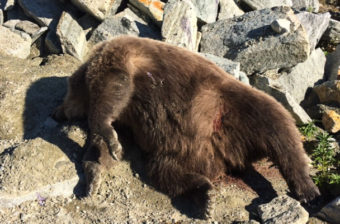
A black bear that broke through a garbage enclosure and into a truck at a Saxman family’s home was shot and killed by the homeowner Sunday evening.

Alaska Department of Fish and Game Wildlife Biologist Boyd Porter said there have been several bears reported in Saxman, moving through residential neighborhoods that are close to the forested areas and looking for food. The bear that was killed had been seen before, accompanied by two older cubs.

Porter said the bear had gotten into the home’s garbage previously, so the homeowners secured their garbage storage area with an extra latch.

“By that time, it had already had access to the garbage in the past and so it was able to rip through the plywood door they put up, and got access to the garbage in the cans,” he said.

While the bear was there, it caught a whiff of something even better than garbage.

“There was a deer in the back of a camper shell,” he said. “You can imagine, a pretty strong smell of fresh killed deer. The bear was able to get into the camper shell through the back and took the entire deer out.”

Porter said that shooting a bear on your property is allowed in certain situations.

“You’re not allowed to shoot a bear just because it’s getting in your garbage,” he said. “Garbage is not your property. But destroying property or threatening people’s lives, then you could defend yourselves if you had an area where you could safely shoot.”

Porter said safely shooting a bear is a problem in residential areas, which is why homeowners should first contact law enforcement. The Saxman homeowner did follow that protocol, and was given instructions on how to safely shoot the bear.

Porter said bears killed in defense of home become the property of the state, so he collected the bear’s carcass and it will be destroyed.

From photographs he’s seen, Porter said the two cubs left behind appear to be about 2 years old.

“We’re still working on that one. I’m trying to get a look at those cubs,” he said. “It’s likely that they will end up being killed in Saxman, just because they’re not used to foraging on their own. They’re used to following mom around. So, there’s probably two more bears that will end up being killed in that area.”

Porter said that at this time of year, bears are searching for more ways to fatten up before winter. To discourage bears from foraging in neighborhoods, he recommends ratchet straps on garbage can lids, and keeping other potential attractants as secure as possible.

Juneau hiker who freed eagle and sprung traps sued by trapper

Kathleen Turley encountered this eagle stuck in two traps Dec. 24, 2014. She freed the eagle and tampered with other legally set traps in the area. She's now being sued. (Photo courtesy Kathleen Turley)
Kathleen Turley encountered this eagle stuck in two traps Dec. 24, 2014. She freed the eagle and tampered with other legally set traps in the area. She’s now being sued. (Photo courtesy Kathleen Turley)

The woman who freed a trapped eagle and was cited for springing other traps is heading back to court. In January, the State of Alaska dropped its case against Kathleen Turley. Now, the trapper is suing her for damages in small claims court.

Pete Buist is a past president and board member of the Alaska Trappers Association. He’s now its spokesman. Buist doesn’t know the Juneau trapper, John Forrest, but understands why he’s suing. He says if it were him, he’d do the same thing.

“I say bravo for the trapper. The state won’t do what’s right. He should do what’s right,” Buist says.

Forrest, who’s suing Kathleen Turley for at least $5,000, declined to comment.

In January, Turley (formerly Kathleen Adair at the time of the events) says she sprang three traps on two separate days out of concern for the safety of dogs and hikers. She also freed an eagle that was caught in two traps. Despite her efforts to save the eagle, it was later euthanized.

Alaska Wildlife Troopers cited Turley for tampering with traps that Forrest had legally set, not for freeing the eagle. Hindering lawful trapping is a violation of state law that carries up to a $500 fine and 30 days in jail.

Turley wasn’t fined or jailed. At the arraignment, the state’s prosecutor used his discretion and advocated for the case to be thrown out, and it was.

Buist says members of the trappers association weren’t happy.

“I can fully understand why the lady rescued the eagle. I don’t have any problem with that whatsoever. And I think if she had just rescued the eagle, the trappers would’ve supported that. But she didn’t. She went back and tampered with the traps and broke the law,” Buist says.

Shortly after the State of Alaska dropped its case against Turley, Buist says several members of the trappers association complained to the attorney general’s office.

“And basically we were summarily dismissed as the fringe element and it fizzled after that,” Buist says.

Forrest has a lawyer, though it’s not required in small claims court. Attorney Zane Wilson is no stranger in the trapping community. He helped win a high profile case involving wildlife biologist Gordon Haber who freed a wolf from a snare in Tok in 1997. The biologist was being funded by an international animal advocacy organization. The trapper sued and the Tok jury awarded him $190,000.

Wilson is with Fairbanks firm Cook Shuhmann & Groseclose. He relayed through an employee he was “not authorized” to speak to me. Wilson is a lifetime member of the trappers association. Buist says Wilson’s uncle is Dean Wilson, a well-known trapper and fur buyer who’s been called the state’s patriarch of trapping.

A fellow Juneau trapper and a state wildlife biologist have said Forrest partially relies on trapping for income. The most targeted species in the Juneau area is marten. In the 2012-2013 season, the average price for raw marten fur was about $140. A state report says one even fetched $1,300. In Southeast, trappers also target mink, otter, wolf and beaver, among other animals.

Kathleen Turley in the Dimond Courthouse after the State of Alaska dismissed the case against her. (Photo by Lisa Phu/KTOO)

Turley, who freed the eagle and sprung the traps, doesn’t think she owes Forrest anything. She says she’s never been contacted by him. Until she received the complaint in the mail in July, she didn’t even know his name.

“I was very surprised and confused. … I hadn’t heard anything about it. I had no idea that he felt there was money owed,” Turley says.

Turley is Alaska-raised and has lived in Juneau for 30 years. She grew up fishing and hunting and shot a bear at age 16. As an avid outdoors person, she’s seen traps before, but had never tampered with any before the eagle incident. Turley says she’s not against trapping, but thinks it’s better suited for other parts of the state.

She says she didn’t damage the traps when she sprung them. Turley hasn’t been on the Davies Creek Trail where she found the eagle since.

“I’ve completely avoided that area, which is a beautiful area, a very nice trail, but I haven’t gone anywhere near it. I don’t want anything do to with it,” Turley says.

She says the whole incident and the lawsuit have caused her a lot of stress and grief.

The trial is scheduled for Oct. 12. Turley doesn’t have a lawyer yet.

State sets Prince of Wales wolf harvest quota at 9

A 5-month-old male wolf pup from Honker Divide on Prince of Wales Island. (Photo courtesy of the Alaska Department of Fish and Game)

According to a joint news release from the U.S. Forest Service and the Alaska Department of Fish and Game, biologists have set the state harvest  for Game Management Unit 2 (Prince of Wales and surrounding islands) at nine wolves.

Nine wolves is half of the maximum allowable harvest, based on a population estimate, announced in June that showed the number of wolves on Prince of Wales Island and surrounding islands was 89. That’s a steep drop from the previous year’s estimate of 221.

That drop prompted calls to cancel all wolf hunting and trapping in the area. Six conservation groups sent requests to state and federal officials, asking them to help preserve the remaining animals.

David Person is a former Alaska Department of Fish and Game biologist, who now lives in Vermont. His work in Alaska focused on wolves, and he has helped conservation groups in their work to protect the Prince of Wales Island population.

Person said a legal harvest of nine wolves means an actual take of up to 15 when poaching is taken into account. He said there isn’t a hard and fast number that biologists can point to as a threshold for viability, but Person believes the wolf population for Game Management Unit 2 is too low, partly because of genetics.

“Because it is an island population, it’s mostly isolated,” he said. “So, when you eliminate entire packs, it’s like eliminating an entire salmon run in a stream. You potentially lose the entire genetic stock. So, if you reduce that population, keep bottlenecking it down to very low levels, you end up with very few breeders left and you end up with potential genetic inbreeding and genetic depression.”

Alaska Department of Fish and Game Southeast Region Supervisor Ryan Scott has said that while state biologists agree that the wolf decline in the area is something to keep an eye on, the department isn’t concerned yet about the viability of that population.

But Person said there are examples in other parts of the world where wolf populations dropped and were not able to rebound. He said state and federal officials have no idea what the viable population is for POW wolves.

“The reality of that, then, is you should be very conservative,” he said. “And a population – I think their latest estimate for the fall last year was 89 wolves, minus 29 reported killed, so that means 60, minus some that were probably not reported and killed, so the population could be 50 or below.”

Person believes many hunters and trappers would not have a problem with a closed season this year if it helps keep wolves in the ecosystem over the long term.

“Unless you are someone who said, ‘Boy, I would just rather see wolves disappear from this ecosystem,’ well, if there are hunters and trappers that have that viewpoint, well, they’re just wrong. If there are hunters and trappers out who have a conservation bent, which I think is most of them, then they should want a viable population of wolves, as well as a harvestable population of wolves,” he said.

Larry Edwards runs the Sitka Greenpeace office, which is one of the groups that asked for a closed wolf season this year. He said he’s shocked that the department is allowing any harvest. Like Person, he pointed out that more wolves have been taken since last year’s estimate, so it’s unknown how many are left.

“One thing that we do know, from a conversation I had with one of the folks at Fish and Game, is that during their field season this spring, they found only one active den with one pup. That isn’t a good indication, either,” he said. “I think that we’re really in a crisis situation with the wolves on Prince of Wales and I’m totally shocked that Fish and Game would have an open season on them.”

Edwards adds that such a low harvest quota is difficult to manage, because hunters and trappers have two weeks to report their kill, and the quota could be surpassed before anyone knows it.

He said if the federal Office of Subsistence Management also allows a wolf hunt this season, that will add even more pressure to POW wolves.

The Federal Subsistence Board has scheduled a public hearing in Klawock on Prince of Wales Island, to get input regarding a subsistence wolf harvest.

“That will give them five days to make a decision, hopefully before their season starts on Sept. 1st, which is quite a while before the Fish and Game season starts in December,” he said.

Edwards said there are some steps conservation groups can take, such as requesting an emergency Endangered Species Act listing.

The Federal Subsistence Board public hearing starts at 6 p.m. Thursday at the POW Vocational and Technical Education Center in Klawock.

Below is the conservation groups’ request to close the wolf season this year.

Garbage bear season is in full swing in Ketchikan

One of the many Ketchikan bears that have figured out the nuances of the bungee cord. (Photo by Rita Leighton)

Local garbage bandits have been making their bi-yearly rounds in Ketchikan, leaving messes in their wake.

There are brown bears and black bears. And then there garbage bears.

More than a few Ketchikan residents have woken to the sound of a garbage can lid banging or a can tipping over, quite aware that it’s probably a bear looking for a free meal.

Jenn Tucker lives near the landfill in an area she affectionately calls “dump hill.” She says she has been plagued by bears nearly every night of every summer.

“We’ve been here seven years now. It would be almost every two hours and the bears would be back,” she says.

One night she had a bear pushing his nose against the screen door of her house; she zapped it with an electrified fly swatter. Even that didn’t keep the bear away.

Jen Tucker’s vehicle after a bear broke in on Aug. 5th. She says he likely got in through the unlocked passenger door. She now locks her doors while at home. (Photo courtesy of Jenn Tucker)

“Later that night he broke into my car and ripped out my seat, and took a nap in the back seat. I don’t think he was after food because there was a peanut butter and jelly sandwich he didn’t eat,” she says.

For revenge?

“Yup, revenge.”

She says she’s given up on fortifying her garbage cans, and taken up another method.

“We’ve built an enclosure, he ripped that apart. We used to use chains and straps on the trash can, and he actually literally ripped a lid in half. And so we’ve kind of given up,” she says. “This year we just go to the dump every day.”

Ketchikan’s Solid Waste Superintendent Lenny Neeley says that Tucker’s case is unusual, and he has only ever seen one bear-destroyed garbage lid. He says the best bet is to buy a ratchet strap.

“It’d keep the lid tightly sealed, and it minimizes odors or materials from falling out. I mean, I’ve seen them flip the cans over, jump up and down, and they’re like ‘Enough of this,’ and they just head on down the street,” Neeley says.

He says putting stinky meat or fish garbage in the freezer until garbage day is best, better even than having an expensive bear-proof can. He says big bears can dent the lids on many of those so-called bear-proof containers and render them useless.

However, he says that using only bungee cords and ropes won’t cut it because they are often easy for a bear to stretch open a little bit, and once a bear gets a whiff of that garbage, they’ll go for it.

Alaska Department of Fish and Game Biologist Boyd Porter says that the first taste is what leads to problem bears. Oftentimes, he says it’s bad for the bears in the end.

“Once people train them, then a lot of times, either myself, the Alaska State Troopers or the Ketchikan Police Department will have to go in and kill the bear,” he says.

Porter says they’ve killed as many as 15 bears during a particularly bad year. He says there are about 30 bears around the Ketchikan area this year, and he really doesn’t want to kill any of them. He says if garbage cans are secure, with either ratchet straps or an enclosure, a bear might look around, but won’t stick around.

Ketchikan Police Chief Alan Bengaard says it’s the bears that start standing their ground that must be shot.

“After a period of time, they get so familiar with being around humans that they don’t back down and they stand their ground on territory, and they’re becoming a danger,” Bengaard says.

He says there’s usually only one or two bears a year in the city that need to be killed, but police end up chasing off a lot of bears with rubber bullets and even Tasers.

He says there is one bear in town right now hanging around 3rd Avenue that is becoming a problem.

“I actually ran into one of the bears that we’ve been having an issue with,” Bengaard says. “He’s a big bear. I mean, he’s probably upper 300-pound range.”

The bear was just walking down the street in broad daylight, with no concern for people.

Bengaard says the law states garbage is supposed to be put out no earlier than 4 a.m the day of garbage pickup. He says they have some leniency with that, but that they’re serious about people who don’t secure those garbage cans. Citations are $200 each. So far this year, he says he’s only given out warnings, but also says this is one of the busiest times and is getting busier.

Jenn Tucker says she knows bears will be around foraging every night for at least a few more weeks, but she says she doesn’t mind too much.

“It’s worth it. I mean, look where I get to live,” she says. “I don’t know, other places have raccoons, rats, but we have bears. Our rodents are just bigger.”

Fur seal numbers boom on Aleutians’ remote Bogoslof Island

Northern fur seal pups on St. Paul Island, Alaska. (Photo courtesy of NOAA)

Northern fur seals have been declining for decades in their stronghold on St. Paul Island in Alaska’s Pribilof Islands, but their numbers are taking off on Bogoslof Island, a couple hundred miles to the south.

A team of scientists with the National Marine Fisheries Service has been camped out on isolated, mile-long Bogoslof, just north of the Aleutian chain, trying to piece together why.

Bogoslof is the top of a 6,000-foot volcanic cone about 50 miles west of Dutch Harbor. Only the top 300 feet of the cone rise above the Bering Sea.

“We first saw breeding animals there in the 80s,” Mike Williams with the National Marine Fisheries Service said. “Now we’re looking at a large portion of the Alaska population is on Bogoslof, where there weren’t any in the 80s.”

For centuries, most of the world population of northern fur seals has bred in the Pribilof Islands. Russian navigator Gavriil Pribylov even located the then-uninhabited islands in 1786 by following the barks of fur seals through the fog.

Commercial hunting of fur seals stopped in the 1980s, but the big St. Paul population has continued falling.

“We’re concerned about the decline, so we want to keep track of what’s happening with this increasing population versus the populations in the Pribilofs and be able to at least have some idea of how their populations are moving,” Williams said.

Williams said why the Bogoslof population is increasing is “the million-dollar question. “I wish we knew.”

A half million or more fur seals haul out onto the Pribilofs each summer. Many of them head down into the Aleutians other times of the year.

Scientist Bruce Wright with the Aleutian-Pribilof Islands Association, the federally recognized tribal organization of the Aleut people, said nobody knows why the Pribilof populations keep plummeting.

Only a small subsistence harvest of about 2,000 animals a year is taken. Wright said declining populations have made getting food harder in the Pribilofs.

“People out there have less access to that marine mammal, which they use for a food resource, so they’re suffering from that,” Wright said.

Scientists have lots of educated guesses but few answers about the decline – from the impacts of fisheries to climate change.

Is toxic food to blame?

Wright has a hypothesis of his own: toxic food.

Blooms of harmful algae can cover the ocean in a living layer full of toxic muck. This year has one of the largest harmful algae blooms on record in the North Pacific. It reaches all the way to the Aleutians. At least two different toxins have turned up in unusually high amounts this year: domoic acid and the toxin that causes paralytic shellfish poisoning.

The small fish that fur seals eat, like sand lance, can accumulate toxins from the algae. Wright said he wants to know if the Pribilof seals have been getting doses of poison when they feed in the Aleutians.

“But now we have this population off Bogoslof, in the Aleutian Islands, and I’m really interested to find out where those fur seals are feeding,” Wright said. “If they’re feeding in the Aleutian Islands, then that would help reject this hypothesis. But maybe they’re feeding out on the continental shelf of the Bering Sea and they’re not at risk, at least right now, of encountering toxic sand lance.”

Algae grow faster when the ocean is warmer. With warming ocean temperatures, it’s only a matter of time before we see big algae blooms in the Bering Sea and Arctic Ocean like we’ve seen in the North Pacific this year, according to Wright.

The NMFS fur seal researchers on Bogoslof are counting pups and females and putting satellite tags on a few of them to see where Bogoslof seals get their meals.


Mysterious whale deaths spike in the Gulf, prompts investigation

Handout map shows this summer's reported whale strandings. (Courtesy NOAA)
A NOAA map shows this summer’s reported whale strandings.

Federal scientists have launched a coordinated investigation to find the cause of this summer’s mysterious die-off of whales in the Gulf of Alaska, and they want the public’s help spotting and reporting stranded whales.

Thirty large dead whales have been observed floating or washed ashore in coastal Alaska since May. That’s over three times the average for Alaska waters.

National Oceanic and Atmospheric Administration’s declaration Thursday of the whale die-offs as an unusual mortality event allows federal, state and tribal biologists to develop a coordinated response and investigation plan, and allows more access to financial, technical and logistical resources. There have been three such events declared for unusual marine mammal or whale deaths in Alaska in the last 15 years. Over 60 have been declared nationwide.

Eleven fin whales, 14 humpbacks, one gray whale and four unidentified whales have been observed stranded along the Gulf of Alaska coastline from Seward down to just past Cold Bay. Nearly half of the stranded whales were spotted just in the Kodiak Island area. It’s unknown if the increased mortality is caused by disease or a biotoxin from recent algae blooms.

Aleria Jensen with the NOAA Fisheries Stranding Network says it’s important that fishermen, boaters and beachcombers report a dead or live distressed whale as soon as possible. Contact a local stranding coordinator, the Marine Mammal Stranding Network Hotline at 877-925-7773 or the U.S. Coast Guard through VHF channel 16.

“We caution the public not to approach any animals that are sighted, or touch or handle in any way, or intervene,” Jensen says. “Most important thing is to report. Also, keep pets away from any animals that are sighted to avoid the risk of any transmission of harmful agents.”

Bears feeding on a fin whale carcass in Larson Bay, Alaska, near Kodiak. (Photo courtesy of NOAA)
Bears feeding on a fin whale carcass in Larson Bay near Kodiak. (Photo courtesy NOAA)

Biologists have only been able to do a limited necropsy on one of the 30 whales so far. It may be a challenge, if not impossible, for biologists to access some of the stranding sites because of rugged geography. Bears or other predators feasting on a carcass may also make it unsafe, and high tides may carry beached carcasses away.

“One of the issues here is that a lot of these carcasses are seen floating and it might be someone who’s not very versed to determine whether a carcass is fresh or not,” says Kate Savage of NOAA Fisheries in Juneau. Savage says it’s important to sample the whale tissue, fat, eye liquid, bile, feces and urine as soon as possible.

“The condition of the carcass is paramount in taking samples,” Savage says. “And the fresher, the better. Once the tissue starts to degrade, the quality of the samples we can take and also the realm of samples we can take starts to decrease. From what I understand, the level of toxin that you would expect to find would also decrease as the carcass degrades.”

Savage and Jensen were part of a panel of American and Canadian scientists which fielded questions from the media Thursday about the investigation.

Paul Cottrell, Pacific marine mammal coordinator with the Canada Department of Fisheries and Oceans, says they’ve observed four humpbacks, a fin whale and a sperm whale that were stranded on the central and northern British Columbia coast. With the exception of the fin whale in May, all of the other strandings happened earlier this month.

“Most recently, we had a sperm whale off the west coast of Haida Gwaii, Graham Island, which is again like we see in Southeast Alaska. It’s a fairly isolated area,” Cottrell says. “It’s a carcass that was observed quite a while after it hit land because it was so isolated. So, it’s fairly decomposed.”

Results from two British Columbia whale necropsies are due back in a few weeks.

Teri Rowles, NOAA Fisheries lead marine mammal scientist and National Marine Mammal Stranding Network coordinator in Maryland, says the higher whale deaths appear limited to the far northeastern Pacific Ocean.

“In comparison to what is happening on west coast of the U.S., large whale strandings are not increased in the same time frame as they are increased locally in the western Gulf of Alaska,” Rowles says. “So, this is not a coast-wide event at this point.”

One leading theory is the whale deaths are due to biotoxins from algae blooms caused by this summer’s abnormally warm sea surface temperatures, but there’s no conclusive evidence yet. Some form of an infectious disease or a virus is also a possibility. But the panel said flatly that there is no evidence the whale mortality is due to recent military exercises in the Gulf of Alaska, and they referred reporters to contact a military spokesman on that issue.

Coming up with any answer as to the potential cause of death of the 30 whales may take months, if not years.

Site notifications
Update notification options
Subscribe to notifications