Local Government

Juneau’s ski area is facing a multimillion-dollar deficit. Its future is riding on a gondola.

Parts of the city-owned gondola sit outside at Eaglecrest Ski Area on Dec. 10, 2023. (Clarise Larson/KTOO)

Juneau’s city-owned ski area expects to run a deficit for the foreseeable future. That’s because officials plan to repair some broken and aging infrastructure while boosting pay to employees and preparing to operate year-round. 

But their plan to dig out of the deficit relies heavily on revenue from a gondola that has yet to be built.

Deferred repairs and maintenance for Eaglecrest Ski Area’s aging infrastructure have built up over decades of use. At a Juneau Assembly finance committee meeting on Wednesday, Eaglecrest’s board president Mike Satre said it’s reaching a tipping point. 

“We have to do something different, or we will essentially be shutting down the operation as infrastructure fails or is beyond its useful life,” he said. 

Eaglecrest Ski Area’s board president Mike Satre speaks to the Juneau Assembly on Wednesday, May 14, 2025. (Photo by Clarise Larson/KTOO)

That something different is a gondola that the city bought for about $2 million three years ago. It’s still sitting on the ground and it’s unclear how much it will cost to get it going.

But the plan is that once it’s up and running, it will allow the ski area to operate year-round and eventually make enough money for it to be self-sustaining. 

That’s likely still years out. In the interim, the ski area’s management says some repairs need to happen to other infrastructure. According to General Manager Craig Simmons, those come with a cost.

“None of those numbers are small,” he said. 

Eaglecrest officials also want to increase staffing levels and pay as they transition to operate year-round. That means they’re going to be spending more money than they’re making until the gondola is open. 

At the finance meeting, the Juneau Assembly moved forward with a plan that would allow the city-owned ski area to run a deficit, but it set aside about $3 million in the city’s restricted budget reserve in case Eaglecrest can’t dig itself out. That safety net is required by city code.

“If Eaglecrest was to have their full budget run through next fiscal year and then Douglas fell off into the ocean and didn’t exist and there was no way that they could recover that, then that hole would need to be filled,” city Finance Director Angie Flick said. “That reserve is there in case that hole needs to be filled in the future.”

This isn’t the first time Eaglecrest has run a deficit. It operated with a negative fund balance for almost a decade after its board gave refunds and credits to season pass holders in 2003 to make up for a poor snow season.

The black line represents Eaglecrest Ski Area’s projected expenses, while the blue line represents its projected fund balance leading into the 2033 fiscal year. (Courtesy of Eaglecrest Ski Area)

At the meeting, Assembly member Alicia Hughes-Skandijs voted in favor of the plan. But she said she’s still skeptical of how much it will cost to get the gondola off the ground. 

“I would bet a lot of money that we can’t build the gondola without infusing a significant amount of money in it,” she said. “That’s just outside of Eaglecrest’s control – it really just has to do with the cost of building anything in the world.”

A local Alaska Native corporation, Goldbelt Incorporated, invested $10 million in the gondola in 2022 in exchange for a revenue-sharing agreement. Satre said that funding has helped pay for most of the expenses so far, but with the Trump administration’s new tariffs kicking in, costs could go up.

“I would expect it to exceed the $10 million that we have, and then we’ll have to make some decisions,” he said. 

Assembly member Wade Bryson was the only member to vote against the plan to reserve money for Eaglecrest. He argued that Eaglecrest has had financial issues for years. For at least the past 25 years, Eaglecrest has required support from the city’s general fund for its operations. 

“When do we stop?” he said. “How high does their ask have to be before we say, the community cannot afford this?” 

He recently asked city officials to find out what it would take to privatize the ski area. 

“I fully believe that Eaglecrest is the gem of the community — that does need a new chapter written for it,” he said. “I don’t believe that there’s enough money in the CBJ government to do that.”

The Assembly still needs to finalize the city budget and the plan is still subject to change. Members are expected to vote to finalize it in mid-June. 

Juneau Assembly approves Mendenhall River levee extension

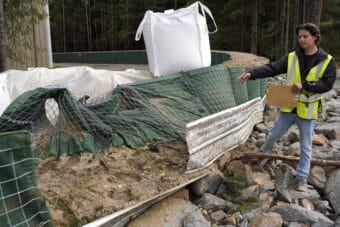
HESCO barriers partially built along Riverside Drive on April 2, 2025. (Photo by Alix Soliman/KTOO)
HESCO barriers along Riverside Drive on April 2, 2025. (Photo by Alix Soliman/KTOO)

The Juneau Assembly voted Monday to extend the Mendenhall River levee meant to protect Valley homes from annual glacial outburst floods. This comes after new inundation maps were released last week, showing how the levee should work. 

The HESCO barriers were initially set to stop at Rivercourt Way. But if a future flood is larger than last year’s 16-foot event, the new maps show downstream infrastructure could be saturated, including two schools, a library, a post office and Safeway. 

“It’s apparent from these maps that we need to do more to protect our community from higher events,” said City Manager Katie Koester.

The Assembly approved the first phase of the levee’s extension down to Kax̱dig̱oowu Héen Elementary School. That section will be built on city property and cost an estimated $500,000. Koester said the levee project is roughly $2 million dollars under budget and there are leftover HESCO barrier materials. City funding that was not used for the initial levee will pay for it — this will not include money from property owners that paid into the Local Improvement District. 

But to protect the homes and businesses even further downstream, the Assembly also discussed a second phase of the extension, from the elementary school to Brotherhood Bridge. Koester said this would affect private properties, and could mean that the city may propose another local improvement district or a local tax district. 

The city has not yet laid out a plan for how that would work, nor have they mapped how the barriers would work in a possible second phase of the extension. City officials said a further extension will be discussed at the Committee of the Whole Meeting on June 2.

New flood models show how Mendenhall River levee should work during next glacial outburst

HESCO flood barriers line the Mendenhall River on Wednesday, April 2, 2025. (Photo by Clarise Larson/KTOO)

Listen to this story:

Flood inundation maps that model how Juneau’s Mendenhall River levee should perform have finally arrived, and there’s a lot of information to wade through.

The maps show that the levee would protect Mendenhall Valley residents against a flood of the same 16-foot magnitude as last year. Deputy City Manager Robert Barr said the levee built from HESCO barriers would effectively push water into a western floodplain where nobody lives. 

“At an event similarly sized and somewhat higher than what we saw last year, the HESCOs are extremely protective of property in the Valley,” he said.

Although the barriers end at Rivercourt Way, the levee is modeled to also protect downstream buildings like Safeway, the Mendenhall Valley Public Library, Thunder Mountain High School and the Alaska Club. Upstream, the maps appear to show that there’s almost no difference between having the levee or not at this flood height. 

An 18-foot flood would be a different story. In terms of volume, Barr said this would be about 50% more water than the 16-foot scenario. While the maps show that water would not flow over the top of the levee, some water would seep around the end of the barriers near Dimond Park and flow through Meander Way.

In this scenario, models show that more homes and businesses both upstream and downstream would be severely flooded, including the neighborhood near the Juneau International Airport. The levee would still protect against some of that downstream damage, and could possibly increase some upstream damage. But Barr said that the barriers wouldn’t cause water to reach areas that weren’t already going to flood in their absence. 

In the 18-foot scenario, some households that are not helping to pay for the levee would also benefit from it. That’s because when the city passed an ordinance creating a Local Improvement District to fund and approve the project, the highest flood modeled at that point was 16 feet. 

Insulation piled outside of a home on Meander Way, which took on water during the record-breaking glacial outburst flood on Aug. 6, 2024. (Photo by Anna Canny/KTOO)

The city’s model of a 20-foot flood only shows what would happen without the barriers. Barr said maps projecting whether the levee would work in such a catastrophic flood are forthcoming. 

Barr said this would be double the water volume seen in last year’s flood. He said the model shows the absolute worst-case scenario, combining every possible thing that could happen at once. 

“Think things like twice as much water in the basin, faster discharge rate, a 200-year atmospheric river event, high tide,” he said.

The likelihood of such an event is unknown because the maps simply show what might happen if Mendenhall Lake rose to a certain level. Put in a number, and the model spits out a scenario. It’s not predicting the probability of these scenarios.

Barr said that because the model is built on recent flood data, it is most likely to be accurate at predicting where the water will go in floods similar to those the community has experienced: 16 feet and below. 

“The model that we have is a model, and it’s a best guess, and it’s most accurate based on what happened in the past,” he said.

Where the maps show flood heights that have never happened before, from 17 to 20 feet, they have a lower confidence rating.

The maps also only show whether areas would flood or not — they don’t show how deep the water would be on any given property. Barr said that researchers are working on an interactive website so people can mouse over the maps and see projected depths. Those maps are expected to be released later this month.

City officials will take this information to the Assembly on May 12 to discuss whether to extend the barriers further down. Residents can tune in.

City officials also encourage Mendenhall Valley residents to apply for federal flood insurance and to send their questions to floodresponse@juneau.gov.

Correction: This article has been updated with the correct spelling of Dimond Park.

Federal cuts could limit Alaska library services and hours at Juneau branches

Shelves at the Juneau Public Library Downtown Branch on May 5, 2025. (Photo by Yvonne Krumrey/KTOO)

Libraries in Alaska may no longer be able to request books from out of state, or mail books and other media to Alaskans who don’t live near a library. 

Trump administration cuts to federal staff that distributes funding for libraries means has left funding for the state’s Interlibrary Loan services and the Alaska Library Extension program are uncertain after the end of June.

Juneau Public Libraries Director Catherine Melville said these programs mean people who live in small communities without libraries can still access library books.

“Alaska Library Extension fulfills the State of Alaska’s mission to make sure that everybody, no matter where you live in Alaska, you receive some form of library service,” she said. 

In March, President Donald Trump issued an executive order that heavily reduced the Institute of Museum and Library Services, the federal agency that funds museum and library programs across the country.

Since then, IMLS staff have been placed on leave. A federal judge has granted an injunction to pause Trump’s dismantling of IMLS, but Melville says there’s still uncertainty that Juneau’s libraries will receive the funding they were awarded. 

Three Juneau library staff positions that facilitate these programs would be cut in the absence of other funding, and losing those positions would mean a reduction in library hours. 

“We have no communication saying the money is coming, or even communication saying the money is not coming,” Melville said. “And because this program employs staff and operates year round, it’s not it’s not something that we can just pause or wait. I have to either be paying my staff or not.”

The library is asking the City and Borough of Juneau for $130,000 to compensate for how the potential funding losses would affect local library users. The federal uncertainty doesn’t prevent Alaska libraries from sending books to other libraries the state’s library consortium, but any requests for materials outside of that may be affected. Melville said she suspects cuts to IMLS will have broader impacts in Alaska in the long term.

Correction: This article has been corrected to reflect that Trump administration cut the staff that distributes federal funding to libraries, rather than the funding itself.

Juneau Assembly moves forward with Telephone Hill demolition plan that would evict residents this fall

A preliminary concept drawing of what the Telephone Hill neighborhood redevelopment could look like. (Courtesy of the City and Borough of Juneau)

The Juneau Assembly chose a preliminary redevelopment plan on Monday night for the downtown Telephone Hill neighborhood that — if approved — would evict residents by Oct. 1. 

The move marks a major step toward breaking ground after years of planning. But, the city would be asking for evictions before a developer has signed onto the project.

The plan would demolish all of the existing houses and structures on Telephone Hill this fall. City officials want to lay the groundwork for a developer to build newer, denser housing where the historic neighborhood once stood next summer. The city has not yet put out a formal request for proposals from potential developers.

“You might need to invest in demolition and site preparation just to be able to attract developers,” City Manager Katie Koester told Assembly members at Monday’s Committee of the Whole meeting.

Members decided to move forward with a plan that would spend $5.5 million to fund the first phase of demolition and site preparation of the downtown neighborhood.

Assembly member Alicia Hughes-Skandijs called investing in developing new housing a priority amid Juneau’s housing crunch. 

“I think if we want affordability, I think if we want them to densify in this site, it is going to require a big commitment of capital funds from the city,” Hughes-Skandijs said. 

The Telephone Hill neighborhood in downtown Juneau on Thursday, April 3, 2025. (Photo by Clarise Larson/KTOO)

The Assembly will take public comment and hold a final vote on the ordinance before any work can begin. That’s expected to happen on June 9. But, if approved, it would give the tenants living there about four months to move out of their units and find new housing.

Assembly member Wade Bryson said he thinks the city has given residents more than enough notice already to find a new place. 

“We’re asking these people to vacate during the easiest time of the year to find housing,” he said. “We are not being haphazard or careless, this has been talked about and has methodically gotten to this point.”

The neighborhood sits on roughly four acres of land on a hill that straddles the State Office Building downtown. It was state-owned from the 1980s until 2023 when the city took it over. The state originally intended to build a new Capitol complex there, but that never panned out. All people living there are renters. 

Last year, the Assembly voted to redevelop the neighborhood to build denser housing in response to Juneau’s ongoing housing crunch. The new plan would be an official start to the process. 

But not everyone thought it was the best idea. Assembly member Paul Kelly was the only member to vote against the plan. He said he wants a more defined plan before asking tenants to leave. 

“I don’t feel good about moving forward when we don’t have a guarantee for more housing, we’re going to be asking people to leave,” he said. “I would like us to be able to guarantee that we’re not going to have something that’s going to potentially sit idle.”

The $5.5 million slotted to fund the demolition and site preparation would be pulled from a few city funding sources. Some Assembly members were concerned that costs could skyrocket if they wait. Koester said that’s always a risk, but especially now amid the Trump Administration’s tariff policies. 

The ordinance will be introduced at an Assembly meeting on May 19. Koester said the city will send eviction notices to tenants sometime that week. 

Demolition would begin between October and December, so a developer could begin construction next summer. Developers would be on the hook for any road construction costs related to the project.

Mendenhall River levee plaintiffs say they want compensation after judge blocks stop work order

Samuel Hatch, a new plaintiff in the case, stands on the porch of his home on Meander Way. (Photo by Alix Soliman/KTOO)

Listen to this story:

A lawsuit originally aimed at stopping the construction of flood barriers along Mendenhall River has shifted its goals. The plaintiffs now say they want the city to pay them for building the levee on their land.  

The shift comes after a judge denied a motion to halt construction of the levee meant to protect hundreds of homes in Mendenhall Valley from annual glacial outburst flooding because doing so would be against the public interest. Another homeowner has also joined the case. 

Samuel Hatch lives next to the Mendenhall River on Meander Way. During the 2023 glacial outburst flood, he opened the hatch to his crawl space and saw water lapping just beneath the floorboards. The flood cracked his foundation.

“My foundation is shaped like a Pringle — so it’s high in one spot, kind of in the middle, and then down on all the corners,” he said. “So my house essentially folded around the corners where it settled.”

At that point, the city hadn’t proposed a flood mitigation plan yet, so he and his wife felt they had two options: try to move their family of five with Juneau’s tough housing market, or retrofit their home to defend against future floods. 

They chose the latter and paid thousands of dollars to lift their house about four feet above the ground on steel pilings and re-do the foundation. More than a year later, their home is still under construction with Tyvek wrap covering the outside and missing pieces of flooring. 

Last week, Hatch joined the lawsuit with another homeowner who’s suing the city for putting flood barriers on their land without compensating them.

Unlike the other homeowner in the case, Stephen Bower, Hatch is fine with hosting the barriers — though he’s frustrated that he can’t access half of his land by the river, now blocked by an eight-foot wall.

Hatch’s main issue comes down to fairness. Almost all of the 466 landowners in the flood-impacted area are expected to pay the same amount — up to about $6,300 — over 10 years, whether or not they are losing part of their property to the levee that will be there until the city comes up with a permanent flood protection solution. It could be a decade before that happens. 

“I get paying my share, but at the same time, the other people on the interior, they’ve lost nothing to this, and they’re paying the same as me,” Hatch said. “I just feel like fairness isn’t happening, so that’s why I joined the suit.”

He wants the city to pay for what he calls the “flood control easement” on his land.

That’s the new focus of the case.

After a judge denied a preliminary injunction on Monday that aimed to exclude Bower’s property from having flood barriers installed, the case has shifted from preventing the barriers from being built on his land to deciding how the cost will be divided up when it’s finished. 

Emily Wright, the city’s attorney, said the judge’s order was a sigh of relief for the city.

“The consequences of having a 140-foot hole in the barriers had the potential to be tremendous,” Wright said. 

HESCO flood barriers line the Mendenhall River on Wednesday, April 2, 2025. (Photo by Clarise Larson/KTOO)

Nate Rumsey, the city’s engineering deputy director, said that they would have found a way to build the barriers so that they could still protect nearby homes. When the motion to stop work was filed last week, the contractors building the levee skipped over Bower’s land to wait for the judge’s decision. Since then, barriers have gone up on Bower’s lawn.

In the order, the judge weighed the merits of the case, opening a window into how the court might rule on key questions. 

The first question is whether the Juneau Assembly followed the right process when it passed an ordinance creating a Local Improvement District, or LID. That ordinance approved the levee project and laid out a plan to spread 40% of the barrier construction among the landowners. Landowners had the opportunity to vote it down in February, but only a quarter formally objected

Scott Perkins, the attorney representing Bower and Hatch, said the Assembly was wrong to assume abstentions as ‘yes’ votes. But the judge wrote that the homeowners misinterpreted the law.

The city initiated the LID process, so specific rules apply for how it could have been voted down. Objecting landowners would have needed to represent half of the estimated cost to be borne by residents overall. Even then, the Assembly would have had the option to override their veto by a vote of eight members. That didn’t prove necessary and the judge wrote that the city’s actions were lawful, so the LID is expected to hold up in court.

That’s separate from the constitutional question at the core of this case. 

“So this case is now simply going to be about, did the city have the powers to put up the barriers and not pay for them, or are they going to have to pay for them under the Fifth Amendment?” Perkins said.

Both the U.S. Constitution and the Alaska Constitution forbid the government from taking private land for public use without paying the owners. 

It’s unclear which party will prevail on that question. Perkins said he’s confident the homeowners will. If the court agrees with him, Wright said the city’s strongest argument is that taking the land is necessary to protect the public. 

“When there’s an emergency we have to act,” she said. “Sometimes that means that the individual is put secondary to the greater good of the whole.”

There could be a special emergency exception. In an Alaska Supreme Court case from more than a decade ago, Brewer v. State, landowners sued the state because firefighters burned their land to help fight an approaching wildfire. The court ruled that the state is not required to pay if using private property is “necessary to prevent an impending or imminent public disaster from fire, flood, disease or riot.” 

Whether a flood likely to happen in a few months will be considered “imminent” enough will be a matter argued in court. 

There are also forthcoming facts that Wright said could change the case. 

On May 8, the city expects to release long-awaited flood inundation maps that will show whether the levee will work for floods up to 20 feet high, and if there will be unintended consequences upstream or downstream from the levee. 

Rumsey said the maps are still under final review. An initial review, he said, confirms the levee will work as intended. 

“We’re very confident that this is going to help protect the community from future [flood] events, and I’m excited to put my name on this project,” he said. 

A trial has been scheduled for September 15 to 17 before Judge Daniel Doty in Juneau.

Site notifications
Update notification options
Subscribe to notifications