Evacuees from Tuntutuliak arrive in Bethel on Friday, Oct. 17, 2025. (Eric Stone/Alaska Public Media)
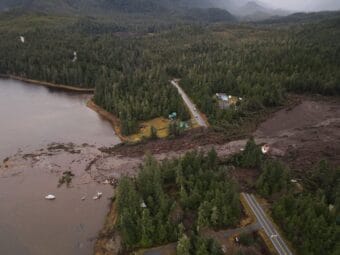
Gov. Mike Dunleavy requested Thursday that President Donald Trump declare a federal disaster after remnants of Typhoon Halong brought high winds and record-breaking floods to coastal villages in Western Alaska.
“This incident is of such magnitude and severity that an effective response exceeds state and local capabilities, necessitating supplementary federal assistance to save lives, to protect property, public health, and safety, and mitigate the threat of further disaster,” Dunleavy wrote in a letter to the Federal Emergency Management Agency.
Dunleavy and members of his cabinet were scheduled to visit Kipnuk and Kwigillingok on Friday.
The disaster declaration would unlock federal resources to respond to the Lower Kuskokwim and Lower Yukon regions in Western Alaska, in addition to the Northwest Arctic Borough. The Association of Village Council Presidents, a consortium of tribal governments in the Yukon-Kuskokwim Delta, urged a federal disaster declaration in a letter to the White House on Tuesday.
Loading…
Previously, officials coordinating the state’s response in the immediate aftermath of the storm said federal resources were not necessary. But with damage widespread, leaving evacuees unsure when they’ll be able to return home, Dunleavy said the state’s resources may not suffice.
“Due to the time, space, distance, geography, and weather in the affected areas, it is likely that many survivors will be unable to return to their communities this winter,” Dunleavy wrote. “Agencies are prioritizing rapid repairs to all lifelines where possible, but it is likely that some damaged communities will not be viable to support winter occupancy, in America’s harshest climate in the U.S. Arctic.”
“The people of Western Alaska are once again facing the onset of winter and the immense challenge of rebuilding in the aftermath of another coastal storm,” they wrote. “Quick federal action will help ensure that families remain safe, critical services are restored, and communities are stabilized before winter arrives.”
Trump was expected to sign the declaration Friday afternoon.
This is a developing story. Check back for updates.
Alaska Public Media’s Liz Ruskin contributed reporting.
Chad Millen has lunch with his daughters at the IBEW building on Thursday, October 16, 2025. (Photo by Alix Soliman/KTOO)
Volunteers in Juneau are offering free lunches for federal employees who were furloughed when the government shut down on Oct. 1. So far, more volunteers than furloughed workers have attended.
On Thursday afternoon, half a dozen volunteers laid out sandwich fixings, bags of chips, muffins and homemade pumpkin bread at the International Brotherhood of Electrical Workers building downtown.
Chad Millen prepared a turkey and cheese sandwich and sat down at a foldout table with his two young daughters. He was furloughed from NOAA Fisheries, where he works as an IT specialist on a system that tracks commercial fishing catches.
Millen said he saw the shutdown coming.
“It’s like the game of chicken, and you’ve got the two cars driving towards each other,” he said, referring to the two political parties in a gridlock. “They’re both acting crazy, expecting the other side to yield, and we’re passengers in the car, and so that’s what it feels like, is, you know, it’s not really about you, but you’re in the middle of it.”
Millen said his division at NOAA recently joined the National Federation of Federal Employees, or NFFE. Coming to lunch is a good opportunity to learn more about the labor union.
Millen was one of just two furloughed workers who attended lunch Thursday.
Eric Antrim is the recording secretary for NFFE Local 251 and one of the free lunch volunteers. He was furloughed from the U.S. Forest Service, where he manages bridge inspections across the Tongass and Chugach National Forests. He said his last paycheck came on Oct. 10.
“We’ve got a lot of members that are paycheck to paycheck,” Antrim said. “This next paycheck that we’re going to miss, I think that’s when, you know, maybe a baloney sandwich starts to sound a little bit better than it did last Monday.”
Antrim said they hosted one other lunch so far this year, last Monday, but only a few furloughed workers came.
NFFE Local 251 represents nearly 500 U.S. Forest Service employees across Alaska. Antrim said that 330 of its members are furloughed, according to data he obtained from human resources.
He said the volunteers plan to keep providing lunch and a space to gather for federal workers on Mondays and Thursdays until the shutdown ends.
Correction: Eric Antrim manages bridge inspections across both national forests in Alaska, not just the Tongass.
Alaska pollock, shown here from a harvest, make up the nation’s top-volume single-species commercial seafood catch. Each December, the North Pacific Fishery Management Council sets the next year’s harvest levels for pollock and other groundfish. Those decisions are based on scientific analysis that could be compromised this year by the federal government shutdown. (Photo provided by the National Oceanic and Atmospheric Administration)
For the organization that oversees commercial fisheries in federal waters off Alaska, the most significant impact of the federal government shutdown might materialize in December.
That is when the North Pacific Fishery Management Council is scheduled to issue harvest limits for Alaska pollock – the nation’s top-volume commercial harvested species – and other types of groundfish harvested in the Bering Sea and Gulf of Alaska, such as Pacific cod and sablefish.
The Bering Sea and Gulf of Alaska pollock harvests start in January.
To set the groundfish harvest levels, the council relies on federal scientists’ analysis of fish stocks in the ocean, work that is based in large part on scientific surveys conducted over the summer.
But during the shutdown, most National Marine Fisheries Service employees, including the scientists who analyze survey data to assess the conditions of commercially targeted fish stocks, are furloughed.
On Wednesday, the last day of the council’s October meeting, the members considered how to deal with scientific uncertainty if the government shutdown prevents completion of the detailed analysis that is usually provided in time for the December meeting.
Council member Nicole Kimball referred to a warning issued eight days prior by Bob Foy, director of the NMFS Alaska Fisheries Science Center, the organization that does the stock assessments. Foy said then that a shutdown lasting more than five days would compromise the ability to complete stock assessments and that a shutdown beyond 15 working days would “dramatically impact” those assessments.
The 15-day threshold is not too far away, Kimball said.
“How does the council and the public understand what to expect in December, in between the October and December meeting, relative to stock assessments?” she asked.
Diana Evans, the council’s deputy director, said impacts are yet to be determined, but the public will be notified of them as soon as possible.
“We don’t think we can answer that until we have a better sense of exactly where we land and how many days of work are remaining between the time that government workers are back and able to resume that work and the meeting,” she said.
Advocates with environmental organizations said they worry about shutdown effects on scientific information needed for harvest decisions, which would add to the effects of mass firings and retirements at NMFS and other agencies.
“I’m terrified at the prospect of flying blind into the next fishing season, especially as the Trump administration has decimated the ranks of scientists who monitor the health of our oceans,” Cooper Freeman, Alaska director of the Center for Biological DIversity, said by email. “I’m especially worried about fisheries like the massive pollock trawl fleet that has been harvesting millions of tons annually at the expense of the larger ecosystem.”
“The first challenge with this shutdown is the instant level of uncertainty it creates. Normal processes face delays that can easily impact or inhibit active fisheries. Potential staff losses will exacerbate that,” Michelle Stratton, executive director of the Alaska Marine Conservation Council, said by email.
“But beyond the concern for continuing day to day services, are those major efforts — like stock assessments and (total allowable catch) setting — that rely on substantial NMFS staff input, data processing and expert analysis. If this continues to the point where we are unable to set catch limits for the start of the 2026 seasons, we’ll be in seriously uncharted territory, and could well see massive economic impacts to our fishing communities and fleets,” she said.
The shutdown forced the council to rearrange its October meeting because federal representatives were unavailable to present information.
One major agenda item was postponed: review of a work plan for assessing essential fish habitat. Other items on the agenda were abbreviated.
The shutdown has already affected fishery management operations to some degree, said council member Jon Kurland. As Alaska regional director for NMFS, Kurland is one of a small group of agency employees remaining at work during the shutdown.
Kurland, in comments last week at the start of the meeting, said some services have been unavailable during the shutdown, such as the processing of harvest quota transfers.
NMFS is still doing basic management of ongoing fisheries, monitoring and closing them as needed, and is supported by contractors, he said. But that level of work has its limits, he said.
“If there are significant unforeseen problems, we will have limited ability to address those. Fingers crossed,” he said then.
Sen. Dan Sullivan addresses the Alaska Legislature on Feb. 21, 2024 (Clarise Larson/KTOO)
WASHINGTON — President Trump is sending military troops to Chicago, over the objections of the elected leaders there, and U.S. Sen. Dan Sullivan thinks it’s a good idea.
Sullivan says Chicago’s violent crime rate justifies the deployment.
“It’s just horrendous that you have young, mostly African American kids who are killed every single weekend in Chicago. I think Labor Day weekend there’s like, maybe 10,” he said. “So something needs to be done. And these are tough issues, but, you know, most Americans would want whatever we can do to bring down crime rates.”
Sullivan spoke Saturday in Wrangell. A KSTK reporter asked what he thought of sending military troops to fight crime in Chicago and Portland, where elected leaders don’t want them.
“I think when you get more resources to law enforcement, to bring down crime, to bring down drug dealing, to help our communities, I think it’s important,” he said.
Trump’s deployment of troops to police Democratic-led cities raises legal questions, and it challenges the principle that the military shouldn’t be used for political purposes. Sullivan comes to the issue with a substantial background in both law and the military. He served as attorney general of Alaska and was also a colonel in the Marines until last year.
In a nearly three-minute answer to KSTK, Sullivan expressed no reservation about the Chicago deployment, then just getting underway.
Trump has given several reasons for sending troops to Chicago and Sullivan endorsed two of them — to protect federal buildings or agents from violence, and to reduce homicides.
Illinois Gov. JB Pritzker, a Democrat, has called it an invasion and said Trump is punishing states that didn’t vote for him.
Sen. Lisa Murkowski considers the Chicago deployment inappropriate.
“I have concerns, again, about bringing in our military without the consent, without the agreement of a governor, and really taking over the role of law enforcement, at the direction of the president,” she said on “Talk of Alaska” Tuesday.
Aside from the legal questions it raises, Murkowski is skeptical that it lowers crime rates in the long run.
Alaska Congressman Nick Begich declined an interview request but sent a statement saying the troops are filling a gap created “by mayors, governors and district attorneys who have put criminals above law-abiding citizens.” Begich’s statement says the troops are “ensuring every resident’s freedom of movement.”
KSTK reporter Colette Czarnecki contributed to this story from Wrangell.
Sen. Dan Sullivan (R-AK) speaks during a hearing of the Senate Commerce, Science, and Transportation Committee in the Russell Senate Office Building on January 26, 2021 in Washington, DC. (Tom Williams | Pool/Getty Images)
The FBI searched the cellphone records of Republican Alaska Sen. Dan Sullivan and seven other U.S. senators and a member of the U.S. House as part of its investigation into the Jan. 6, 2021 insurrection at the U.S. Capitol, a newly released document shows.
The call logs cover several days during and around the insurrection, when rioters stormed the Capitol in an attempt to support then-incumbent President Donald Trump, who falsely claimed to have won reelection in 2020.
The logs do not show that the FBI obtained phone call recordings, only that an investigating agent was interested in who the senators were talking to, when they talked, how long they talked, and where the callers were. The document, released this week by the U.S. Senate Judiciary Committee, does not say why those senators were identified in particular and it does not say whether any investigative leads resulted from the records.
Sullivan himself is not under investigation.
According to a news release from the committee, the FBI sought and obtained data about the senators’ phone use in the days before, on and after the Jan. 6 insurrection, from Jan. 4 through Jan. 7, 2021.
The U.S. Department of Justice indicted Trump in 2023 for allegedly conspiring to overturn the results of the 2020 presidential election, but the special prosecutor in charge of the investigation abandoned that case after Trump was re-elected in 2024. Department policy says that sitting presidents cannot face criminal prosecution, and after the 2021 insurrection, the U.S. Supreme Court issued a decision limiting a president’s liability for conduct while in office.
Asked whether Sullivan had any contact with people who participated in or organized the riot at the U.S. Capitol, Devyn Shea, a spokesperson for Sullivan, said, “absolutely not.”
In a written statement, Sullivan called the FBI investigation “an absolute outrage.”
“We’ve just learned the Biden FBI was engaged in what appears to be an unprecedented fishing expedition against at least nine sitting Republican members of Congress — none of whom were under any type of investigation — surveilling our personal cell phone calls with family members, staff and colleagues. This is a new low in the political weaponization of the Justice Department,” Sullivan’s statement said.
The other seven senators were Cynthia Lummis (R-Wyo.), Lindsey Graham (R-S.C.), Josh Hawley (R-Mo.), Tommy Tuberville (R-Ala.), Ron Johnson (R-Wis.), Marsha Blackburn (R-Tenn.), and Bill Hagerty (R-Tenn.). Rep. Mike Kelly (R-Pa.) was also on the FBI list.
Some senators, including Hawley and Tuberville, voted to object to the certification of the electoral results of the 2020 election.
Sullivan voted to support the certification of the election, and in a statement the day after the Jan. 6 violence at the Capitol, he called the event “sad” and “dispiriting.”
All have been supporters of Trump and his policies; in office, Sullivan has been a reliable vote for the president and his agenda.
In this screenshot from a White House news conference, Interior Secretary Doug Burgum points to a map of Alaska on Monday, Oct. 6, 2025, as he announces the Trump administration’s decision to reverse a Biden administration action that canceled a right-of-way permit for the Ambler Road. (Screenshot)
The action removes a major hurdle for the project, but developers would still need to overcome lawsuits and opposition from environmental and tribal groups. They would also need approval from NANA and Doyon Ltd., two Alaska Native regional corporations who own land in the road’s path.
Ambler Road, planned by the state of Alaska’s development bank and supported by state officials and Alaska’s congressional delegation, would link the Dalton Highway with a mineral-rich region of northwest Alaska, providing access to the mining of rare minerals needed for batteries and high-technology manufacturing.
“It’s an economic gold mine, so to speak. I signed this years ago, and Biden un-signed it for me,” Trump told reporters on Monday at the White House.
Last year, the U.S. Bureau of Land Management concluded that the road would have a litany of negative impacts, and the Biden administration issued a record of decision saying that the best route for the project was no route at all.
The Alaska Industrial Development and Export Authority, Alaska’s state-owned investment bank and the road’s developer, sued the Biden administration, seeking a reversal.
U.S. Interior Secretary Doug Burgum, speaking at the White House on Monday, said the state of Alaska requested an appeal of that decision, and that under federal law, President Trump has the executive authority to make decisions on land use.
The appeal in question was filed by AIDEA under Section 1106 of the Alaska National Interest Lands Conservation Act of 1980.
“This opens up a wealth of resources,” Burgum said, adding that the federal government will also take partial ownership of Trilogy Metals, one of several firms exploring for minerals in northwest Alaska.
As currently planned, the road would consist of a gravel strip stretching from the Dalton Highway almost to Kotzebue. It is envisioned as a toll road, with no public access, and the cost of construction would be paid for via fees levied on users, similar to the way the AIDEA-funded DeLong Mountain Transportation System provides a port for lead and zinc exported from the Red Dog Mine in northwest Alaska.
In a special late-September meeting, AIDEA’s board voted to authorize limited negotiations with landowners in the road’s path.
The road is expected to cross more than 10 miles of land owned by Doyon Ltd., the regional Alaska Native corporation for Interior Alaska.
To date, that corporation hasn’t expressed official support or opposition for the road. Sarah Obed, senior vice president of external affairs for Doyon, said by email that Monday’s announcement was “not a surprise to Doyon” because of a different executive order signed earlier this year.
NANA Regional Corp. owns more than 20 miles of land in the path of the road. In a written statement, NANA President and CEO John Lincoln said the company “appreciates the Trump Administration and Governor Dunleavy’s support for economic development in Alaska and their work towards stabilizing the federal permitting process” but he declined to express support for the road.
Lincoln said that still stands: “Our position on the Ambler Access Project has not changed and will only be reconsidered if and when our established criteria are satisfied, in consultation with shareholders, local communities, and other stakeholders.”
Trump’s action on Monday restores a federal right-of-way grant issued in 2021, at the end of the first Trump administration. It also requires federal agencies to issue clean-water permits and other approvals needed for the road.
A lawsuit challenging the 2021 right-of-way grant remains open in U.S. District Court in Anchorage. Attorney Bridget Psarianos with the non-profit law firm Trustees for Alaska is one of the attorneys challenging that right-of-way.
By phone, she said she hasn’t ever seen a president use the authority that Trump did on Monday.
“He’s wielding this presidential power like a cudgel, including to overturn decisions that his own agencies have made and provided good reasons for,” she said.
Several dozen communities and Alaska Native tribes in Interior Alaska have opposed the road to date.
“I think it’s also just important to remember that there’s widespread opposition to this road in Alaska and by local communities, and the reason the alums said no to this was because they found that there would be significant impacts to subsistence and to communities and their health along the road corridor,” Psarianos said.
Athan Manuel, director of the environmental non-profit Sierra Club’s Lands Protection Program, offered similar thoughts in a written statement. “This order ignores those voices in favor of corporate polluters. The Ambler Road will lead to significant harm to fragile Alaskan landscapes and the local communities and wildlife that rely on them,” he said.
Most of the road’s path is on land owned or controlled by the state of Alaska; an easement allowing the road remains under consideration by the Alaska Department of Natural Resources, but approval is expected.
In a statement published after Trump’s announcement on Monday, Gov. Mike Dunleavy thanked the president for his action, saying, “this decision will unleash development opportunities, create new jobs for Alaskans and secure access to strategic minerals.”
Similarly, all three members of Alaska’s congressional delegation expressed support for Trump’s decision.
“By advancing this access, we are creating new opportunities for Alaskans while strengthening America’s supply chain and reducing dependence on foreign adversaries for our critical mineral needs,” said U.S. Rep. Nick Begich, R-Alaska. “I applaud the President’s decision to support this appeal, and I look forward to working with the Administration, state leaders, and Alaska Native communities to ensure this project moves forward in a way that benefits all Alaskans.”
U.S. Republican Sens. Lisa Murkowski and Dan Sullivan also thanked the president for his action.
“The President’s re-approval will unlock a world-class mining district, deliver quality-of-life benefits for communities in the region, and help grow Alaska’s economy. It will also improve our national security by strengthening our mineral security and enabling us to produce more of our most important resources here at home,” Murkowski said.
Sullivan said, “I’m glad to see another critically important project for our state’s economy and working families being put back on track.”
Close
Update notification options
Subscribe to notifications
Subscribe
Get notifications about news related to the topics you care about. You can unsubscribe anytime.