Federal Government

In antimony race, companies working in Alaska want feds’ financial support. This one is getting it.

Stibnite, the predominant ore mineral of antimony, is shown.
Stibnite, the predominant ore mineral of antimony, is shown. (U.S. Geological Survey)

As the race to mine antimony is gaining traction in Alaska, so is the rush for the federal government’s financial backing.

Now, the Trump administration is injecting millions of dollars into an Australian company’s project about 100 miles northwest of Anchorage.

Nova Minerals isn’t the only antimony interest in Alaska hoping for investment from the feds, but this week, the Pentagon awarded a grant worth more than $43 million to the Alaska subsidiary of Nova, Alaska Range Resources. The money is intended to turn the company’s Estelle Project, located in the Mat-Su Borough, into a hub for producing munitions materials.

Nova CEO Christopher Gerteisen said the project is on a two-year schedule, and that he doesn’t anticipate that the ongoing government shutdown will affect the funding.

“And so what this grant is for is to further define our resource out there, and then to mine the material, and then … process the material, to produce the munitions-grade ‘antimony trisulfide,’ they call it,” he said in a short interview.

Antimony, which is often associated with gold deposits, has a number of possible applications, including flame retardants, solar panels, semiconductors and ammunition. The U.S. government considers it a critical mineral.

Antimony was mined in Alaska off and on between 1905 and 1986, typically in response to wartime needs or higher prices. The revived interest comes amid a push from the federal government to boost mineral production and China’s ban on antimony exports to the U.S. China has been the United States’ biggest supplier of the mineral.

The award to Nova Minerals comes through Title III of the Defense Production Act, which allows the President to approve aid for businesses that buttress productive capacity for national defense purposes. That’s a lever the Biden administration also pulled to bolster critical mineral production and reduce reliance on foreign supply chains.

Gerteisen said the award will fund what he calls a pilot phase. He said Nova hopes to later build a refinery at Point MacKenzie in Southcentral to produce more than munitions with Alaska’s antimony.

“This grant is so important for Alaska because the race is on. Other states have some antimony discoveries, and this and that,” he said. “And the race is really on as to … where is the antimony refining hub is going to be for the United States.”

Other companies with antimony projects in Alaska may have different models, goals, and stages than Nova. But, on top of the mineral they want to mine, the companies share at least one other thing in common: They’re also looking to tap the Trump administration for funds.

Dallas-based U.S. Antimony plans to recover the mineral from discarded rock waste at historic mining sites in Alaska and truck the ore down to its smelter in Montana. The company began its first small-scale antimony reclamation in Alaska in early September at the Mohawk Mine near Ester.

And last week, U.S. Antimony inked a $245 million contract with the Defense Logistics Agency to supply antimony ingots to the Defense Department’s store of critical minerals.

In response to a question about U.S. Antimony’s efforts to secure federal funding, Vice President of Investor Relations Jonathan Miller sent KUAC a link to a September investor’s conference.

During the conference, Miller said the company has been working with Pentagon officials throughout the year.

“At the DoD’s request, we put together scope papers and white papers for a grant, essentially outlining what would be needed for us to expand our operations and our claims,” he said at the time.

Miller said in the presentation that the company will likely announce a federal award of just under $30 million in the near future. That was before the government shutdown began, however, and it wasn’t immediately clear how, or if, that timeline might be affected. Miller also did not say whether the money would be directed toward the company’s Alaska operations during the conference.

In an email Wednesday, Miller congratulated Nova on their award, and suggested companies should approach the endeavor collaboratively.

“We believe it’s critical to build bridges with Nova and with all miners in Alaska who are producing, or will produce, antimony in the future,” he wrote.

Another Australia-based mining company, Felix Gold, still says it’s targeting the end of this year to start mining antimony at its Treasure Creek project just north of Fairbanks.

Similar to the other two companies, Felix Gold has also formally sought federal support for that plan, and the company is touting a visit from officials with the Environmental Protection Agency and Federal Permitting Council, saying their recent stop at Treasure Creek represents a “substantive milestone.”

In a call with investors last month, Felix Gold Executive Director Joseph Webb said the visit was “as good as you can get” and helped the company’s case, but that he couldn’t guarantee anything just yet.

Women, Infants and Children food benefits are at risk if shutdown lasts

IGA Foodland grocery store in Juneau on Dec. 20, 2022 (Photo By Paige Sparks/KTOO)

Among the most vulnerable Alaskans to the ongoing federal shutdown could be thousands of parents who depend on WIC (wick) to help them buy food.

WIC is the acronym for Women, Infants and Children, a federal program administered by the state. It provides food benefits to women who are pregnant or breastfeeding, and families that include a child under 5, as long as the household meets income limits.

Jeff Turner, a spokesman for Gov. Mike Dunleavy, says Alaska has enough money in the program to last through the first week of the shutdown. Whether cash reserves last beyond then is unclear.

In past funding lapses, Alaska found the money to keep paying WIC benefits. A statement from the governor says the state will have to reassess if the shutdown goes on beyond a month.

Nationally, WIC depends on money Congress must appropriate each year. In that way it is unlike the larger SNAP food program, which is considered an entitlement.

More than 8,000 Alaska households receive WIC benefits. For now, WIC offices around the state are open.

Congress seems no closer to passing a funding bill. The Senate adjourned until Monday.

Federal shutdown could complicate Juneau’s plans to address future glacial outburst floods

Water floods Meander Way on Wednesday morning, Aug. 13, 2025. (Photo by Clarise Larson/KTOO)

Listen to this story:

Juneau is mulling over how to prepare for next year’s glacial outburst flood.

The city’s temporary levee protected most Mendenhall Valley neighborhoods from a record-breaking flood this summer, but it needs repairs and, potentially, some upgrades. Now, the U.S. government shutdown could complicate the city’s decision-making process.

City staff presented major questions about ways to protect Valley neighborhoods from flooding to Juneau Assembly members during a committee meeting Monday. The four largest questions are how high to build the levee for next year, whether to expand it, whether to sponsor a buyout program for those left unprotected and how to pay for those projects. 

In an interview, Deputy City Manager Robert Barr said the answers to some of those questions will depend on federal information and funding that might be delayed by the U.S. government shutdown

“That’s what we’ll be working on over the next week, is figuring out kind of who’s still at the table, who still can be at the table, and trying to kind of keep things moving as best as we can,” Barr said.

How high should the levee be?

Barr said the model that projected how the city’s levee would perform during the flood wasn’t entirely correct. 

“We certainly saw things in real life this summer that the model did not predict,” Barr said at Monday’s meeting. “And we got a little bit lucky with the height of the HESCOs and where things landed.”

The levee leaked, flooding a couple dozen homes. The city’s memo to Assembly members said floodwater also flowed over the top of the levee in some areas. 

Water rushes past and leaks through HESCO barriers set up along Meander Way in the Mendenhall Valley on Wednesday morning, Aug. 13, 2025. (Photo by Clarise Larson/KTOO)

So, how high should they build it? Experts won’t be able to forecast the height of the next glacial outburst flood until it’s underway. But record-breaking floods have grown over the past three years. It reached 15 feet in 2023, then 16 feet in 2024. The flood this August made the record at 16.65 feet. 

Barr said the city won’t be able to make an educated guess about how high to build the levee until researchers publish the data from this year’s flood. That data will include the volume of Suicide Basin, the speed of the torrent and how the river channel has changed. 

Aaron Jacobs is the senior service hydrologist at the National Weather Service in Juneau and a member of Juneau’s flood science team. He said the agency is exempt from the federal furloughs that began Wednesday because its work is deemed essential for public safety.

“The Weather Service work is going to go on,” Jacobs said. “So our analysis and our work of looking at the data and forecasting the events and stuff like that, that’s still going to go forward.”

The flood science team is made up of federal workers at the National Weather Service and the U.S. Geological Survey and scientists at the University of Alaska Southeast.

Jason Amundson, a glaciologist at UAS, said the university’s flood researchers haven’t been affected by the shutdown. But he said one of his colleagues at USGS went up to Suicide Basin on Tuesday to maintain the monitoring equipment before the agency’s staff were furloughed the next day. 

“He was able to get up and make sure the cameras were up and running and should be hopefully good to go through the winter,” Amundson said. 

He said he thinks the team will be able to get data to city decision-makers without delays, but that could depend on how long the shutdown lasts.

Suicide Basin looking south
View of Suicide Basin looking south shows some of the instruments and how they are placed there. (Photo and illustration by Christian Kienholz, UAS/USGS)

How to fund levee upkeep?

The second big question is how to pay for the levee’s ongoing maintenance. The stacked baskets of sand, called HESCO barriers, sustained an estimated $1 million in damage during the August flood

Earlier this year, the city used what’s called a local improvement district, or LID, to split the cost of building the barriers 60/40 with landowners in the flood zone. It was controversial

Barr said it might not be the best way to pay for upkeep. 

“LIDs aren’t really a mechanism to care for ongoing costs,” he said. “LIDs are a great mechanism to pay for big one-time upfront capital expenditures. That’s what they’re designed for.” 

The other options are to pay for upkeep with general city funds or to establish a service area, a designation that allows the city to offer specific services in that area. It means the city could charge landowners in the flood zone an additional tax. It would need a majority vote from registered city voters within service area bounds. 

Barr said one drawback is that the landowners wouldn’t know in advance how much they’d have to pay in additional taxes each year.

Expand the temporary levee?

The third major question is whether to extend the temporary levee to protect more properties. A proposed Phase 2 of the HESCO project would expand the levee both upstream and downstream, so it would stretch from Back Loop Bridge to just before Juneau International Airport. 

Phase 2 is estimated to cost roughly $19 million. That’s more than double the expected cost of the existing barrier, which hasn’t been finalized yet. Barr said it would be much more expensive because the riverbanks would need more boulders to armor against erosion. 

“There’s a much, much larger number of properties that aren’t already sufficiently armored,” he said.  

City staff said Monday that getting help paying for an expansion through the Federal Emergency Management Agency, the U.S. Army Corps of Engineers or an act of Congress ahead of the next flood will depend on how long the shutdown lasts and what funding is still available when it ends. Either way, if the city decides to go forward with Phase 2, the Assembly will probably need to find a way to pay for at least some of it — perhaps through another LID or a service area.

Juneau’s City Manager Katie Koester explains the next steps for glacier lake outburst flood mitigation at an Assembly committee meeting on Monday, Sept. 29, 2025. (Photo by Clarise Larson/KTOO)

But there’s another potential project that could expand flood protection. City Manager Katie Koester said the Army Corps is talking about a solution that could come sooner than its original seven-to-10-year timeline

Koester said Army Corps staff are working on a recommendation for what that solution would be and construction could start as early as the end of 2027. But she said moving that quickly would restrict the opportunity for public feedback, and the project still depends on continued federal funding. 

City staff said they don’t know where that plan stands now amid the shutdown, but if it moves forward, it could influence how much of Phase 2 the city decides to build.

A spokesperson at the Army Corps said agency staff were still working as of Wednesday. The spokesperson said it’s too early to comment on how quickly an expedited enduring solution could come.

Sponsor a View Drive buyout?

Finally, the fourth major question is whether to sponsor a federal buyout program for View Drive, the street that’s been hit hardest by flooding and is left unprotected by the city’s levee. A buyout would pay residents to leave, demolish their homes and transform the land into a park. 

Water recedes from View Drive on Wednesday, Aug. 13, 2025. (Photo by Clarise Larson/KTOO)

If all 18 eligible properties participated, it would cost around $25 million. If the Juneau Assembly votes to sponsor it, the city would have to pay around $6 million. Federal staff working on this project at the National Resources Conservation District have been furloughed due to the shutdown and were unable to respond to a request for comment. 

The city plans to hold a special Assembly meeting to discuss these questions in detail on Oct. 30. City staff said final decisions won’t be made until December. 

Update: This story has been updated to clarify a statement made by a city official and include a statement from the U.S. Army Corps of Engineers.

14 small public broadcasting stations in Alaska will receive one-time grant funds

Landscape with port in background
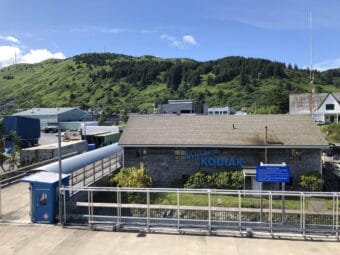
Unalaska is the largest community in the Aleutian Chain. Its port is Dutch Harbor. (Berett Wilber/KUCB)

Months after Congress defunded public broadcasting, 14 public media stations in Alaska got some good news this week.

The Interior Department has put them on the list to be funded through a program that supports tribal stations, to make up for the money they’re no longer getting from the Corporation for Public Broadcasting.

Lauren Adams, general manager of KUCB in Unalaska, got an email Wednesday with the exact figure: $282,728.

“So roughly the amount that we received in our CPB Community Service Grant,” she said.

That gets KUCB through the year. But it is a one-time grant, so Adams still has a big challenge ahead.

Meanwhile, the plight of the little station in the Aleutians won the hearts of public radio supporters around the country.

Alerted by stories in the New York Times and other national media outlets, contributors found their way to the donate button on KUCB’s website. Others were matched through an organization called Adopt A Station. More than 100 people sent contributions from afar, Adams said, and the station gained roughly $25,000 in membership fees. The accompanying notes buoyed the staff.

“A lot of the comments were really, really touching. And just saying that ‘the local work you do in your community makes a difference. Keep doing it. Keep up the good work,'” she said. “Really morale boosting.”

It was a similar story for KYUK in Bethel. General Manager Kristin Hall said contributions from afar helped cheer the staff, even if they didn’t approach the value of the federal funds the radio and TV station lost. The new Interior Department grants make KYUK whole, at least for one year. They come to nearly $250,000 for radio operations and more than $800,000 for TV, Hall said.

“This funding that has been earmarked for stations, they are truly some of the most vulnerable in our country at this moment,” she said.

KYUK and KUCB are not tribally owned, but they partnered with their local tribes to receive the grants. There’s one more hurdle though: Hall said she thinks her station won’t actually get the money until the government shutdown ends.

Editor’s note: KTOO is not one of the stations included in the grants. Those stations are KNBA, KBRW, KYUK, KCUK, KDLG, KRFF, KZPA, KIYU, KOTZ, KSKO, KSDP, KUHB, KNSA and KUCB. 

The federal shutdown is upon us. Murkowski warns it could be a long one.

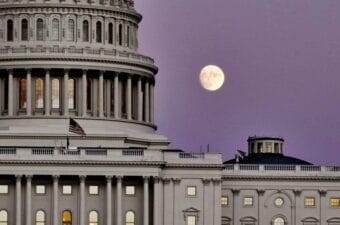
Photo of U.S. Capitol by Liz Ruskin
U.S. Capitol (Liz Ruskin/Alaska Public Media)

WASHINGTON — Funding has lapsed for the federal government. A short-term bill to keep government operations going failed in the U.S. Senate Tuesday, so a government shutdown began at midnight.

Both Alaska senators voted for the stop-gap spending bill, to continue funding while Congress works on a longer-term bill. It got 55 votes but needed 60.

President Donald Trump is threatening mass federal layoffs. And by not passing a spending bill, Congress is giving Trump free rein, Sen. Lisa Murkowski said.

“When you’re in a shutdown, you do not have equal branches of government,” she said. “You just don’t. The legislative branch has just kind of ceded this.”

Senate Democrats are holding out to get Republicans to agree to continue health care subsidies and restore cuts to Medicaid. Some of the subsidies are due to expire at the end of December, which will double or triple the monthly costs for millions of Americans who buy marketplace plans.

Murkowski would also like to continue insurance subsidies that some 25,000 Alaskans depend on. But, she says, negotiations went nowhere last week so Tuesday she voted for the bill to keep the government operating.

Murkowski warned that the partisan standoff could be a long one because each side believes voters will blame the other party.

“No one has an incentive,” to end a shutdown, she said. “If the Democrats feel that they’ve got the edge, where’s their incentive for them to get out of it? If the Republicans feel like we’re gaining with our base, what gives us any incentive to end it?”

Key functions of government will continue through a shutdown, including mail service and Social Security payments. Some federal employees, like the military and law enforcement, are deemed essential and have to work without pay until Congress agrees on a spending bill.

A spokesman for Alaska Gov. Mike Dunleavy said the state has funding to pay SNAP food benefits through October but only enough money to cover the first week of the month for WIC, the nutrition benefit for Women, Infants and Children.

Hours before the shutdown was to begin, only some agencies had published their shutdown plans.

Alaska’s Climate Adaptation Science Center will stay open amid closures elsewhere

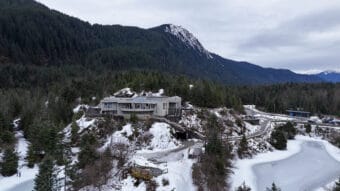
The Mendenhall Glacier dams water in Suicide Basin. As the glacier calves, it could be creating more storage space for water. That could cause bigger glacial outburst floods in the future. (Photo by Anna Canny/KTOO)

The Alaska Climate Adaptation Science Center, or AK CASC, is so far spared from closures coming to a third of such climate science centers across the country, as first reported by The Washington Post

In other regions of the U.S., some centers are expected to run out of money soon because the federal government has stalled funding and essential agreements with universities that the U.S. Geological Survey needs to manage the centers.

But Alaska’s center is safe for now.

Kristin Timm, AK CASC’s university co-director at the University of Alaska Fairbanks, said the center’s funding through next summer has already been disbursed. 

“But of course, we’re worried about how long our funding will continue to last,” she said.

The center’s budget is roughly $2.2 million dollars per year. AK CASC signed an agreement with the University of Alaska in 2023 that maintains their partnership through July of 2028, which should ensure the center’s existence until then.

Timm said that about 25 university employees receive a significant portion of their salary through the CASC.

But she said that two grants through the USGS are on hold. One would have funded communications interns and the other would have funded a study on how climate change could affect a caribou herd that’s important to subsistence hunters. 

She said the center does projects that Alaskan communities and decision makers have asked for. 

“If we don’t get funded, you know, one of the major projects that would really affect Alaskans is the work around the glacier outburst flood and Suicide Basin,” Timm said.

The center funded the interactive website that helped inform Juneau’s Mendenhall Valley residents about the threat to their homes during August’s flood. The center has also funded research around improving wildfire forecasts and how climate change is affecting salmon in the Yukon River Basin.

Site notifications
Update notification options
Subscribe to notifications