Federal Government

The White House upped the cost of H1B visas. Alaska Schools could face major consequences.

Gutierrez answers questions about the immigration process to a crowd of teaching candidates.
Serjoe Gutierrez, one of the first H1B recipients at the Kodiak Island Borough School District, on a recruiting trip to the Philippines in February 2025. (Brian Venua/KMXT)

In an executive order, President Donald Trump announced he would hike the price of H1B work visas, which used to cost about $5,000. Those visas will now cost $100,000 per person, per year, according to the new executive order.

H1B visas are generally used to fill high-skill jobs, like nurses, and allow for longer careers in the U.S. by providing a path to permanent residency, like a green card. In recent years, H1B visas have become increasingly popular for Alaska schools to hire teachers from abroad.

But there’s concern that many Alaska school districts can’t afford the price hike.

“With a pen stroke, we possibly have ruined the future of education for Alaska students,” said Cyndy Mika, the Kodiak Island Borough School District’s superintendent. She said she texted that to another superintendent in Alaska after she heard the news this weekend.

“I can’t imagine what our classes would look like without our classes would look like without those international teachers filling the need.”

There are over 30 teachers in Kodiak’s school district who were hired abroad, many of whom currently hold H1B visas. And earlier this year, Mika organized a recruiting trip to the Philippines for administrators representing the Nome, Bering Strait, and Kenai Peninsula school districts.

Districts across the state have faced shortages for teaching staff and struggled to fill positions with domestic hires, including from the Lower 48. For some, international hiring efforts are a sort of stopgap measure to ensure classrooms and kids’ needs are met.

Much of the justification outlined in Trump’s executive order, however, targets large information technology firms. But immigration lawyers, like Anchorage attorney Margaret Stock, say multiple industries – like Alaska’s public education system – are collateral damage.

“It’s been complete chaos since last Friday,” Stock said.

She said Alaska’s university system, healthcare, accounting, and financial service, and tourism sectors all use H1B visas, too. And Trump and his team haven’t had consistent messaging about how they might be affected.

“It’s hard to figure out what to do when the president issues a proclamation that is then contradicted by everybody who works for the president,” said Stock. “It’s just hard to advise clients.”

She’s seen the White House and various federal agencies issue conflicting statements surrounding the new H1B fees. A staffer with Sen. Dan Sullivan’s office said via email on Tuesday that previously approved visa applications won’t be subject to the new fees. Mika’s heard something similar from the school district’s legal team.

But it’s unclear what final decisions will be made.

“They seem to be motivated mainly by collecting a lot of money from people, but they didn’t even roll out a way to pay this $100,000 per person fee,” Stock said.

Mika said she’s already working with Alaska’s congressional delegation to find some kind of solution for Kodiak and other school districts.

Rep. Nick Begich III, who was in Bethel this week, said he’s already brought up how important internationally hired teachers are with the Trump administration.

“I do support the ability to bring in J1 and H1Bs to support as a supplement to local Alaskans and Americans generally,” Begich said on a visit to KYUK in Bethel on Tuesday. “The education workforce in rural Alaska – we know it’s a hard job to fill and when you’ve got positions that go unfilled, it means kids are going uneducated.”

Staffers for Senators Sullivan and Lisa Murkowski both also said via text and email on Sept. 23 that there’s a lack of clarity and want schools to have the resources they need.

For now, the consensus is that everyone’s waiting for more details from the White House.

KYUK’s Sage Smiley contributed to this reporting. 

Trump administration plans to close unknown number of US Forest Service offices in Alaska

A ranger stands in front of a crowd as a black bear and cub cross a paved trail in front of them.
A Forest Service ranger with the Mendenhall Glacier Visitor Center acts as bear crossing guard as visitors look on. (Photo by Cam Byrnes)

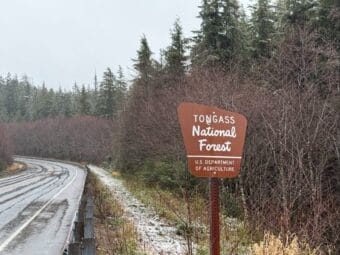
The Trump administration is planning to close some U.S. Forest Service offices in Alaska under a national reorganization announced this summer by the U.S. Secretary of Agriculture.

Public comment on the reorganization is open through Sep. 30.

The Forest Service, which is part of the U.S. Department of Agriculture, currently has offices in Anchorage, Juneau, Cordova, Valdez, Girdwood, Seward, Craig, Hoonah, Ketchikan, Petersburg, Sitka, Thorne Bay, Wrangell and Yakutat. It isn’t clear how many of those offices will remain open after the reorganization.

The status of the Forest Service’s tourist-focused visitor centers in Portage, Juneau and Ketchikan also isn’t clear.

Contacted for details, a spokesperson for the U.S. Department of Agriculture said by email on Friday, “Some aspects of the reorganization will take place over the coming months, while others will take more time. We will continue to provide updates as the reorganization moves forward.”

They added, “We recognize this may be difficult, but we are hopeful that affected employees will remain with us through this transition as we work to improve and continue delivering benefits to the people and communities we serve.”

In a July memo outlining the basic details of the plan, U.S. Secretary of Agriculture Brooke Rollins said she intends to close the Forest Service’s nine national regional offices “over the next year” but “will maintain a reduced state office in Juneau, Alaska, and an eastern service center in Athens, Georgia.”

Research stations, like the Juneau Forestry Science Laboratory in Auke Bay, will be closed and “consolidated into a single location in Fort Collins, Colorado.”

Nationally, Rollins said she intends to scatter more than half of the Agriculture Department’s 4,600 Washington, D.C.-based administrators to five regional hubs; one each in Utah, Colorado, North Carolina, Missouri and Indiana.

This follows prior actions by the federal Department of Government Efficiency, or DOGE, which earlier this year fired about 3,400 Forest Service employees nationally, including more than 100 in Alaska.

Before the firings, the Forest Service had about 700 employees in Alaska.

Rollins’ proposed Forest Service budget for the coming year calls for a 34% cut to its operations, likely requiring further layoffs.

5 things for Alaskans to know as another federal shutdown nears

The East Plaza of the U.S. Capitol. (Liz Ruskin/Alaska Public Media)
The East Plaza of the U.S. Capitol. The Senate is due to vote on a short-term spending plan Monday, but it is not expected to pass. (Liz Ruskin/Alaska Public Media)

The U.S. Congress has yet to agree on a short-term spending plan, so federal agencies are preparing for a government shutdown that is likely to begin Wednesday, the first day of the next fiscal year.

With the federal government’s outsized influence in Alaska, the impacts could be acute in the 49th state.

To some extent, what will happen is predictable, based on past shutdowns. This year might be different, though, because the White House Office of Management and Budget issued an unusual pre-shutdown memo late Wednesday. It directs agencies to take the shutdown as an opportunity to fire employees working on any program that is not funded by another law and not “consistent with the President’s priorities.”

Is it a bluff? Maybe. The memo is overtly political. It names Democrats and their “partisan demands” as the obstacle.

“We remain hopeful that Democrats in Congress will not trigger a shutdown and the steps outlined above will not be necessary,” the memo says.

On the other hand, the Trump administration has shown an appetite for cutting loose thousands of civil servants and disrupting the business-as-usual of bureaucracy.

While there are not a lot of definite answers yet, here are five things to know about the possible federal government shutdown:

Will I get my Social Security check and SNAP benefits? How about mail service? 

Yes. Services that are mandatory or have a funding source other than annual appropriation bills will continue. Medicaid and food benefits for Women, Infants and Children, also known as WIC, should remain on track. The office of Alaska Gov. Mike Dunleavy said SNAP, formerly known as food stamps, is funded through the month of October. However, help desks and administrative services related to these services could be strained. This would not be a good time to change the bank account that your Social Security checks are sent to.

I’m planning to travel. Do I need to cancel my flights?

No. In past shutdowns, air traffic controllers and Transportation Security Administration personnel were considered essential workers and therefore continued to work, for the most part, despite not receiving pay until after the shutdown ended. Flights arrived and departed Alaska largely as normal. Air travelers might want to arrive at airports a little early, though. Some airports in the U.S. reported longer security lines than normal, as some TSA workers reportedly did not show.

I’m a federal worker. Will I get paid? Can I stay home?

Alaska is home to about 15,000 civilian federal workers. They’d be affected differently, depending on what jobs they do and how their agencies are funded.

• Essential workers, like air traffic controllers and FBI agents, would work but without paychecks until the impasse is resolved.

• Other workers would be furloughed. They’d get back pay when Congress passes a bill to restart the government.

• Some workers, if the OMB memo is taken seriously, will receive termination notices.

What about the military?

Service members are also required to remain on the job. A bill pending in the U.S. House would keep paychecks flowing to active duty personnel, including the Coast Guard, civilian base workers and Department of Defense contractors. If it passes before Wednesday or soon after the shutdown begins, the military would likely not experience an interruption to regular pay, although Military Times reports stipends and special pay might be delayed.

What about public lands? And could this disrupt Fat Bear Week?

We’ve sent inquiries to the National Park Service and the U.S. Fish and Wildlife Service. Until they respond, a general rule from past shutdowns is, if a facility or area is inaccessible during non-business hours, it will likely be locked for the duration of the lapse in funding. Most of Alaska’s public lands aren’t fenced or gated, though, so those areas would likely remain accessible, even if staff are not available.

As for Fat Bear Week, a beloved feature of Katmai National Park and Preserve, the champion is due to be crowned on Sept. 30, before the shutdown is supposed to begin.

Alaskans would see spike in health insurance rates if Congress lets subsidies expire

the outside of a hospital
People without health insurance may have no where to go for routine care and turn to hospital emergency rooms, straining hospitals. (Jeff Chen/Alaska Public Media)

WASHINGTON — Unless Congress steps in with a solution, thousands of Alaskans will lose health insurance subsidies at the end of December and see the cost of their premiums shoot up.

For a dramatic example of what will happen, consider an Alaska couple in their 60s who earn about $53,000 a year each.

They now pay less than 9% of their income to get two silver-level plans. If their subsidies go away, they’d spend almost 50% of their income to keep those insurance plans.

That’s an impossible increase, said Sen. Lisa Murkowski.

“Now, you tell me, who out there can find an additional half of their income to go towards insurance?” she asked.

This fictitious middle-aged, middle-income couple are a subset of the roughly 25,000 Alaskans who buy subsidized insurance plans. They are small-business owners and their employees, fishermen or people who work for non-profits — really, anybody who earns modest pay and does not have employer-sponsored insurance.

The imaginary couple, and a few thousand Alaskans like them, would be affected the most if what’s known as “enhanced premium tax credits” expire at the end of the year. But nearly every Alaskan who buys insurance on the marketplace would see their payments rise, too. Ultimately, it strains the health care system everyone relies on, especially so in Alaska, where health insurance rates are among the highest in the nation.

Murkowski isn’t the only person in Congress to notice. The expiring subsidies are at the heart of the budget standoff that has the government teetering on the edge of a shutdown.

Murkowski thinks the list of Democratic demands to avoid a shut down goes too far, but she agrees with them that the enhanced premium tax credits shouldn’t expire this year.

“As we look to how we keep the government open, let’s also figure out how we avoid this looming crisis with the cost of insurance,” she said.

The enhanced tax credits were adopted during the COVID pandemic. They increased the original Affordable Care Act subsidies, and for the first time, extended them to people who earned more than the initial group, such as the fictitious 60-year-olds in our example.

If the enhanced credits disappear, leaving only the classic ACA subsidies, the Alaska Division of Insurance calculates on average, subsidized consumers would have to pay more than double what they pay now.

“Doubling and tripling of premiums is substantial. I think it’s fair to say we can expect to lose quite a few Alaskans in terms of having insurance coverage,” said Alaska Hospital & Healthcare Association President Jared Kosin.

He predicts some people will stop buying insurance, then stop getting routine care at clinics and doctors’ offices.

“They have nowhere else to go, and so that starts to put more pressure on emergency rooms,” he said. “It puts more pressure on hospitals, because that care will be completely unpaid for.”

State Rep. Genevieve Mina, D-Anchorage, foresees cascading effects, just when a number of poorer Alaskans are losing coverage from Medicaid.

“And we all know that uninsured people increases uncompensated care, which increases costs for everybody else,” she said.

The Alaska Legislature passed a resolution this spring calling on Alaska’s congressional delegation to press for an extension of the tax credits.

U.S. Sen. Dan Sullivan did not grant an interview request. A spokeswoman said by email that he’s talking to colleagues and the Trump administration to try to prevent the expiration of the subsidies.

Congressman Nick Begich’s office did not grant an interview request nor provide a statement.

14 Alaska state lawmakers ask Congress to oppose cuts to science agencies

A winding road leading up to a large building with a large smokestack. A sign that says "University of alaska Fairbanks" is in the foreground with "Welcome to Troth Teddha'" on a light-up sign. The scene is snowy with spruce trees on a hillside
The entrance to UAF in Feb. 2022. (Lex Treinen/Alaska Public Media)

Democrats and independents in the Alaska State Legislature are urging Congress to preserve federal funding for science and research. In a letter sent Friday, 14 lawmakers urged the state’s all-Republican congressional delegation to oppose cuts that President Donald Trump proposed in his 2026 budget.

“The University of Alaska – and especially the University of Alaska Fairbanks – conducts world-class arctic research that helps to lead the world in solving practical challenges that face the Arctic and beyond,” the lawmakers wrote.

Fairbanks Democratic Rep. Ashley Carrick wrote the letter asking the delegation to resist cuts to NASA, the National Science Foundation and the National Oceanic and Atmospheric Administration. Her district includes the main campus of the University of Alaska Fairbanks, and she said in an interview that cuts to federal funding would undermine research on everything from Arctic health to drones.

“These research dollars don’t just impact the studies that are currently ongoing, but they also impact all of the real-life applications of research that’s happening in Alaska, across the Arctic and around the country,” Carrick said.

Trump’s budget would slash funding for basic scientific research by roughly a third, according to the American Association for the Advancement of Science, an advocacy group. Wide-ranging layoffs and grant cancellations have already caused chaos for researchers who rely on federal support.

But a president’s budget is just a proposal. Congress decides what to spend money on when it passes appropriations bills.

The House and Senate have yet to agree on a spending bill that would fund agencies like NASA and NOAA for the next year, but the appropriations committees have shown little appetite for the deep cuts to scientific agencies Trump has proposed.

A spokesperson for one appropriations committee member, Sen. Lisa Murkowski, said she has long supported the University of Alaska’s partnerships with federal agencies.

“Senator Murkowski has long championed the partnership between the University of Alaska and federal agencies that bring jobs, students, and breakthrough research to our state. As a senior appropriator, she voted to advance the FY26 CJS Appropriations Bill — which funds NASA, NOAA, and NSF — through full committee,” spokesperson Joe Plesha said via email. “She hopes the bill will be considered by the full Senate promptly so the University can be assured that the world-class work it does will continue in Alaska.”

A spokesperson said Sen. Dan Sullivan was not available. Rep. Nick Begich III’s office did not respond to a request for comment.

For now, Republicans and Democrats in Congress are at loggerheads over a short-term spending bill to avert an impending government shutdown.

Murkowski agog at RFK’s replacement of CDC scientists with political appointees

A man in a suit attends a press briefing
Secretary Robert F. Kennedy, Jr. spoke to reporters at Alaska Native Tribal Health Consortium on Aug. 5, 2025, the same day he canceled nearly $500 million for mRNA vaccine development. (Matt Faubion/Alaska Public Media)

WASHINGTON — Sen. Lisa Murkowski broke from other Republicans on the Senate health committee at a hearing Wednesday on the firing last month of the director of the Centers for Disease Control and Prevention.

Murkowski said the hearing was about more than Health Secretary Robert F. Kennedy’s decision to terminate Susan Monarez.

“It’s about trust in our public health institutions,” Murkowski said, “because that’s what I’m worried most about.”

The hearing focused on the nation’s vaccine policy. Kennedy dismissed a panel of vaccine experts in June and replaced them with his chosen members, who mostly share his belief that the CDC’s previously recommended vaccine schedule is bad for children.

Vaccine skepticism is gaining ground across the United States, though dozens of medical associations say the vaccine schedule is based on scientific evidence, saves lives and protects public health.

Monarez testified that Kennedy fired her because she would not agree to pre-approve whatever the new vaccine panel decides, and because she refused to fire career scientists at the CDC who don’t share Kennedy’s anti-vaccine beliefs.

Republicans on the Senate Health, Education, Labor and Pensions Committee were split. Some criticized the former CDC director for resisting Kennedy’s agenda. Others, like Murkowski, backed a science-based approach to vaccines.

CDC Chief Medical Officer Debra Houry resigned after Monarez was fired. Houry testified at the hearing that she was the last career employee in the CDC director’s office. Murkowski sounded astonished that political appointees are replacing public health experts.

“May I stop you there?” she said, interrupting Houry. “You’re the last career [employee]. So then are you saying that everyone that is remaining is a political?”

Houry affirmed that’s the case in the CDC director’s office.

“And so there is nobody then that is — there must be somebody that is providing that career science,” Murkowski said.

Houry mentioned the directors of the centers within the CDC, though she said most are acting directors because their predecessors were fired or left.

Monarez said Kennedy ordered her not to speak to the career CDC scientists.

Murkowski, like all but one Republican senator, voted to confirm Kennedy in February, despite her misgivings about his vaccine stance.

Kennedy had pledged to senators he’d change CDC recommendations only if based on peer-reviewed and widely accepted science.

The Kennedy-aligned vaccine panel meets Thursday. Monarez said Kennedy told her two days before she was fired that the childhood vaccine schedule would change in September.

The CDC vaccine schedule isn’t mandatory but it may determine which injections health insurance plans will cover.

Site notifications
Update notification options
Subscribe to notifications