Alaska’s U.S. House Rep. Nick Begich speaks at a Juneau Chamber of Commerce luncheon on Thursday, Feb. 20, 2025. (Photo by Clarise Larson/KTOO)
The U.S. House Natural Resources Committee is touring Alaska this week to take a closer look at the land they spend so much time talking about in Congress.
Rep. Celeste Maloy, R-Utah, was in Juneau with 10 other members of Congress on Monday.
“We set natural resources policy, and obviously, Alaska is a big natural resources state, so we’re here seeing things on the ground so that when we’re talking about it in Washington, D.C., it’s not just an academic exercise for us,” she said.
They toured the Hecla Greens Creek Mine on Admiralty Island and flew over parts of the Tongass National Forest.
The visit comes after the Trump administration’s tax and spending bill, known as the One Big Beautiful Bill, was signed into law July 4. It boosted oil and gas leasing in Alaska, mandated the expansion of timber harvest on public lands, and allocated more than $7 billion dollars to grow the U.S. military’s mineral stockpile.
Rep. Bruce Westerman, R-Arkansas, is chairman of the committee. At a press briefing at Ward Air in Juneau, he said there is a growing demand for metals like silver that are used in AI data centers and military weapons.
“It’s imperative that Congress work with everyone who’s in the business to help figure out how to get more mining done here in the U.S., and not just mining, but also the refining of the metals, which is a huge issue,” he said.
Westerman says the committee could help Hecla further extend the lifetime of Greens Creek Mine, the most productive silver mine in the nation. Its mine life was recently extended by more than a decade.
Alaska’s Rep. Nick Begich said forestry is another big focus for the committee.
“In the One, Big, Beautiful Bill Act, there are provisions to unlock additional forestry resources for timber, particularly in the Tongass, but across the nation as well,” he said. “This is something I hear from folks from Ketchikan all the way up to Yakutat on a regular basis. How do we bring timber back?”
The U.S. Forest Service is currently revising the Tongass Management Plan, which is set to take effect in 2028 and will determine how logging is done.
The committee heads to the Kenai Peninsula tomorrow and will attend the Alaska Oil and Gas Association conference in Anchorage on Wednesday.
Former U.S. District Court Judge Joshua Kindred speaks at his Dec. 4, 2019, Senate Judiciary Committee confirmation hearing in Washington, D.C. (U.S. Senate Judiciary Committee video screenshot)
The Alaska Bar Association has voted to recommend that former U.S. District Court Judge Joshua Kindred be disbarred in Alaska.
Kindred, appointed by President Donald Trump to serve as a federal judge here, resigned last year from the federal bench after investigators found that he had a “sexualized relationship” with a clerk who became a prosecutor and lied about it to a senior judge and investigators, and maintained a hostile workplace for law clerks.
Since that investigation, additional improprieties connected to the U.S. attorney’s office have come to light.
On Thursday, the bar association’s board of governors voted without dissent to recommend that Kindred be disbarred, forbidden from practicing law in the state. The bar association regulates attorneys across Alaska.
The board’s recommendation will go to the Alaska Supreme Court, which must make the final determination. No date has been set for when the court will consider the issue.
Kindred, whose law license is “inactive” according to the bar association’s database, did not participate in the investigation that preceded Thursday’s hearing, said Rebecca Patterson, president of the bar association’s board.
Louise Driscoll, assistant counsel for the bar association, said the association received “lots of calls” when the investigation into Kindred was revealed to the public.
Typically, she said, the association prefers to act when a grievance is filed by someone other than the association’s own counsel, but in this case, the association’s counsel filed the grievance itself in November.
The subsequent investigation, she said, was slowed by the fact that Kindred didn’t respond to requests for a response to the grievance. He no longer lived at his address on file. He had left the federal court. Former acquaintances didn’t know where he was.
Eventually, Driscoll said, a process server found Kindred sitting on the couch at his mother’s house.
“It was Mr. Kindred’s mother who answered the door and accepted service, but you could see Mr. Kindred on the sofa, so he was on notice,” she said.
Even then, Kindred didn’t respond, and in June, a committee recommended that Kindred be disbarred.
Driscoll said the committee considered it “very serious” that Kindred had lied to federal investigators about his activities.
“Lawyers are expected to be honest, and the members of the public have a reason to consider that they will be dealing with honest counsel,” she said.
Kindred’s actions, she added, have caused real harm — there are dozens of cases whose outcomes are now in doubt because Kindred failed to disclose conflicts of interest.
In addition, Kindred’s resignation has left only one active judge on Alaska’s district court bench.
“There’s been grievous harm,” Driscoll said of Kindred’s actions.
In a footnote to the disbarment recommendation, the committee said, “We enter our decision not with any joy. It is our collective hope Mr. Kindred can recover emotionally, financially and physically notwithstanding the hardships Mr. Kindred confronts.”
On Thursday, after Driscoll’s suggestion, the board of governors deleted that footnote.
Kindred, they concluded, should receive no more special courtesy than any other attorney facing the same accusations.
Oil and gas platforms in Cook Inlet in 2021, as seen from a floatplane. (Liz Ruskin/Alaska Public Media)
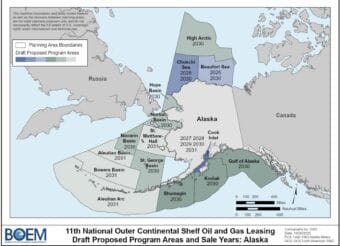
The Trump administration has announced plans to hold six oil and gas lease sales in Cook Inlet over the next six years, starting next March.
The plan “ensures Alaskans benefit from new jobs, stronger local economies and long-term investment in their communities,” the Interior Department said in an emailed statement.
Southcentral Alaska depends on natural gas from Cook Inlet for heat and electricity generation, but industry has shown only mild interest in the area in recent years.
It takes more than a lease sale to boost production, said Larry Persily, a former Kenai Peninsula Borough official for oil and gas matters.
“ That’s the first step. But there’s not really a shortage of opportunities in Cook Inlet. There’s more a shortage of capital and interest,” he said. “So I guess the first test we’ll see is who bids in March of 2026.”
Hilcorp is the primary producer of Cook Inlet gas. It has been the only bidder in the last two federal offerings. The company has warned that it may not be able to supply enough gas by 2027 to meet Southcentral’s demand.
Persily said the newly announced lease schedule doesn’t solve the near-term problem.
“Because by the time you have a lease sale and you get permits and you explore and you find something to turn to production, it’s probably not going to come in time,” he said. “So dealing with the Southcentral gas shortage is going to have to come from existing leases” or outside the region.
The offshore oil and gas leasing plan announced this week was mandated by Congress in the reconciliation bill it passed in July.
Santiago “Diego” Martinez’s work station as sushi chef for Sushi Motto. Martinez was arrested by ICE officials outside the restaurant on Aug. 11, 2025. (Wesley Early/Alaska Public Media)
An immigrant seeking asylum in Anchorage was arrested outside the restaurant where he worked and detained by federal Immigration and Customs Enforcement officials earlier this month.
ICE officials said they detained Santiago “Diego” Martinez, 30, for having a drunken driving conviction. However, his attorney said ICE admitted they made a mistake – Martinez does not have a criminal conviction – but he remained in custody as of Monday.
It was the morning of Aug. 11 that Jennifer Choi got a call from Martinez’s girlfriend, who said he needed help. Choi went behind her restaurant, Sushi Motto, and saw ICE officers detaining Martinez.
“So when I go, Diego was in the car,” Choi said. “And then I said, ‘OK, what’s going on?’ They say he don’t have a green card. I tell them, he has a green card. He has a green card. I tell them, like two, three times, but they said, ‘We have to take him.'”
Martinez had worked for Choi for more than five years as a sushi chef. She said he was a great employee.
“He has a good heart,” Choi said. “He helped, even though he’s a sushi chef, he helped in the kitchen, dishwash, whatever needed help. He did everything. He never complained.”
Martinez is a Mexican national who was in the country illegally, ICE spokeswoman Christine Cuttita said in an email. ICE officials first encountered Martinez in 2019 when he entered the country and was arrested by airport police, Cuttita said. His case was dismissed by a judge in 2022 for “prosecutorial discretion.”
Margaret Stock, Martinez’s attorney, said Martinez is an Indigenous person from Mexico and was seeking asylum in the United States. The charges for his initial immigration arrest were dismissed, because the judge ruled he had a valid asylum case, Stock said.
“He does have a very good reason not to return,” Stock said. “I mean, people in the family have been killed and murdered.”
It’s not uncommon for asylum cases to take years to resolve, she said.
Cuttita with ICE wrote that Martinez, “jeopardized any legal privilege to remain in the United States when he was arrested by the Anchorage Police Department on Nov. 12, 2024, for driving under the influence.”
But the charges were thrown out, Stock said, and Martinez doesn’t have a drunken driving conviction on his record.
“I talked to the ICE people, and they were operating on misinformation that he had a DWI conviction, which he doesn’t have,” Stock said. “But they claim that was the reason, on the telephone to me, that they were arresting him, was that he had a DWI conviction.”
Stock said the ICE officials told her they made a mistake arresting Martinez, since he doesn’t have a drunken driving conviction, but they still won’t release him.
“They told me that once they grab somebody, they’re not allowed to release him anymore,” Stock said. “And they say that this is a new rule that has been made up by the DHS leadership, that people who are pending asylum, they can just grab them anytime and put them in detention.”
Cuttita said that convictions and arrests can both jeopardize someone’s immigration status. But Stock said the Department of Homeland Security isn’t following the law.
“I think it’s illegal and it’s un-American,” Stock said. “It’s unconstitutional, and then on top of it, there’s obviously errors in the system. So how can we trust the Department of Homeland Security when they make these kinds of egregious errors all the time?”
For now, it remains unclear if Martinez will be deported.
Stock said she was able to meet with Martinez when he was being held at the Anchorage Correctional Complex, but the opportunities were limited.
“He was freezing cold and shivering while he was talking to me,” Stock said. “He said it’s freezing in there, and then he also told me that they would only let him make one phone call a day. They’ve denied me access to speak with him because they have special rules that attorneys aren’t allowed to go in there for huge chunks of the day. You know, they have hours that are off-limits to attorneys.”
Those rules, Stock said, contradict what ICE’s website says about the Anchorage Correctional Complex, that attorneys can access clients from 8 a.m. to 6 p.m. every day.
Martinez was transferred to a detention center in Tacoma, and Stock is there, too, working to get him released. But she said she was worried that the center will have similarly harsh conditions and the same lack of access as the Anchorage jail.
Meanwhile, Choi, Martinez’s boss, said she’s concerned about how his detention will impact her business and her employees.
“Everybody is getting sad, like, depressed, I think,” Choi said. “And, you know, some people, they don’t even want to work, even though they have a green card. You know, they’re just scared to work.”
Choi said she’s also pitching in to try to get Martinez back to Alaska.
Mike Bialy operates the Red Umbrella hotdog stand, two miles from the military base where Presidents Trump and Putin will meet. “I just hope everything goes smoothly,” he said. (Liz Ruskin/Alaska Public Media)
Mike Bialy operates a hotdog stand on Fourth Avenue in Anchorage, just two miles from Joint Base Elmendorf-Richardson, where President Donald Trump and Russian President Vladimir Putin plan to meet.
“I just hope everything goes smoothly, because I know a lot of the United States is kind of tense right now,” Bialy said, between customers. “And a lot of European countries, especially Ukraine, is really tense right now.”
Alaska has a long relationship with Russia, its across-the-strait neighbor. Alaska was once a Russian colony, served as a defensive bulwark for North America during the Cold War, and saw a period of warmer relations after the Soviet Union fell that has since cooled again.
While the Ukraine war is the main subject of the presidential meeting, many Alaskans wonder whether Putin will express Russia’s long-simmering sellers’ regret while he’s here. Czar Alexander II sold Alaska to the U.S. in 1867 for pennies an acre. The notion that Alaska should belong to Moscow is a theme among Russian patriots today. The Kremlin has not seriously proposed taking Alaska back, but some Alaskans are bracing for Putin to raise the issue, maybe as a joke, or to say that borders can be fluid to try to legitimize his seizure of Ukrainian territory.
Still, Lewis Baker thinks the meeting could be a boon for Anchorage.
Lewis Baker and his dog L.E. (pronounced “Ellie”). If the meeting leads to a peace accord, Anchorage “could be the new Versailles,” he says. (Liz Ruskin/Alaska Public Media)
It “puts us in the spotlight for a little bit,” he said, walking his brown retriever, L.E., down Fourth Avenue. “And if something good comes of it — which hopefully there will be — people would remember that.”
Anchorage, Baker said, might become a name associated with a peace deal or treaty, making Alaskans proud.
“It could be the new Versailles,” he said.
(Baker may be the first person to associate Anchorage, founded as a tent city in 1915, to the opulent French palace built in the 1600s where the Treaty of Versailles was signed.)
After the Ice Curtain of the Cold War melted, Alaskans could go to Russia and get to know their Russian neighbors. Civic and cultural organizations were established. Rick Mystrom was the mayor of Anchorage in the 1990s and traveled to Anchorage’s Russian sister city, Magadan. During a particularly tough winter, Mystrom helped organize coat drives for the community.
Rick Mystrom was mayor of Anchorage in the 1990s, when Alaska’s relationship with Russia’s Far East flourished. (Liz Ruskin/Alaska Public Media)
“We ended up sending three airplanes full of clothes and food to Magadan that year,” Mystrom recalled.
He said he still feels the spirit of those times.
“But my continued good feelings about the people of Russia doesn’t extend to Vladimir Putin,” he said.
Mystrom calls Putin a killer, citing the suspicious deaths of Kremlin opponents and critics, as well as the war on Ukraine.
“If I were mayor, I think I would have a hard time to give him a warm welcome to Anchorage,” Mystrom said. “I would be polite, but probably cold.”
Some in Anchorage plan to protest. Karen Colonell bought a dozen Ukrainian flags for the occasion and hopes Alaskans will show the world they stand against Russian aggression.
“We have some values that we need to uphold, and freedom is one of them,” she said.
Bill Gallanger questions the wisdom of waving the Ukrainian flag in Putin’s face. Gallanger grew up during hotter phases of the Cold War. He recalls doing duck-and-cover exercises in school.
“I don’t know why you’d want to be antagonistic to a leader of a nuclear country,” he said. “Seems like the normal thing is to be welcoming of a world leader that’s willing to come to America to discuss negotiations of great proportion, keeping us out of World War III.”
Retiree Bill Gallanger questions the wisdom of antagonizing the leader of a nuclear country. (Liz Ruskin/Alaska Public Media)
The White House has tamped down expectations for this meeting, calling it a “listening exercise.” And those who protest will have to do it from afar, since they won’t be allowed on the military base.
U.S. Sen. Dan Sullivan speaks at an aviation roundtable at Ted Stevens International Airport in Anchorage on Aug. 12, 2025. (Matt Faubion/Alaska Public Media)
Alaska is set to receive around $120 million from the federal government for improving aviation safety through new weather stations and updates to telecommunication systems.
That’s according to U.S. Sen. Dan Sullivan, who spoke at an aviation roundtable at Ted Stevens International Airport in Anchorage this week. Rep. Nick Begich and officials from the U.S. Department of Transportation and the Federal Aviation Administration attended the event as well.
“These are historic investments that our state needs,” Sullivan said. “We have the highest by far of any state in the country – 2.3 times higher – crash rates.”
The funding comes from the federal budget reconciliation bill, or the Big Beautiful Bill, which was signed by President Trump last month. The bill includes more than $12 billion for aviation improvements across the country. In Alaska, some of the improvements will also be paid for by an investment from the Federal Aviation Administration that was announced back in April.
The funding is only one step toward addressing the state’s longstanding challenges, but people in Alaska’s aviation industry say they’re encouraged.
“We’ve been fighting for years and advocating for weather reporting stations,” said Dan Knesek, the vice president of commercial operations at Anchorage-based Grant Aviation
More reliable flights for villages off-the-road system
Grant provides air service to communities across the state, delivers cargo and sends medevac planes. But Knesek said it is hard to make those flights between October and April.
Accurate weather information is crucial for pilots. When visibility is low, it helps them to decide whether they should fly. And carriers that fly relying on their instruments are required to have certified weather reports to take off.
But a lot of places in Alaska don’t have reliable – or any – weather reporting, which means that fewer planes make it in.
Knesek said there are times when flights can’t reach communities for a week.
“These communities are very dependent on our services,” he said. “They need to go to the doctor, or any of the basic services they need to fly to get.”
Alaska has about 160 aviation-specific weather stations. Adam White, with the Alaska Airmen’s Association, said that’s far from the density of weather stations in the lower 48. The Federal Aviation Administration is set to install an additional 174 weather observer systems for Alaska.
White said that still might not be enough, but any addition will help pilots and forecasters.
“We’ve got some parts of Alaska that there’s more than 100 miles to the nearest weather station in any direction. And that’s kind of crazy to think about,” White said. “So anything we can get is a huge increase in the information that we’ve got available to us.”
The FAA is now working with carriers and experts to prioritize places that need new stations most.
“We’re looking primarily at off-road system locations that (are) completely reliant on air service for the life and health and safety and well being of the community, and the typical weather patterns and the success rate of flights making it in and out of that community,” said White with the Airmen’s Association, one of the organizations advising on that process.
Questions remain about staffing and maintenance
Rick Thoman, a climate specialist at the University of Alaska Fairbanks, agrees that installing more weather stations is important for public safety and for weather and climate reporting. But he said it’s only one step.
“More stations are great, but they’ve got to work, and they got to report to the whole world reliably,” Thoman said.
Thoman said that on any given day, 10-15% of the aviation weather stations across Alaska are down or not fully reporting, He said the biggest issue is telecommunication infrastructure, which helps get information from the weather station out to the people who need it. Many Alaska villages still rely on copper wires for transmitting signals, and Thoman said sometimes people can’t even get parts to repair the antiquated systems.
The bill does include funding for improving telecommunications infrastructure.
At Tuesday’s conference, FAA administrator Bryan Bedford said the agency is still mapping out the details, but they are leaning toward updating stations to satellite technology and are now testing Starlink units.
Staffing to maintain the stations is another requirement for them to operate successfully – and to get certified, Thoman said.
“People have to go there to do the maintenance. Even if the FAA is contracting with local people, a human being has to go and do stuff,” Thoman said. “If money to support that is not included in that bill, then this is a big problem.”
Bedford said maintenance and staffing are not included in the bill. He said the agency still needs significantly more funding to improve aviation facilities and to look for workforce solutions, for example, through scholarships for technicians.
Close
Update notification options
Subscribe to notifications
Subscribe
Get notifications about news related to the topics you care about. You can unsubscribe anytime.