Federal Government

RFK Jr., on visit to Anchorage, casts doubt on mRNA vaccines

A man in a suit attends a press briefing
Secretary Robert F. Kennedy, Jr. spoke to reporters at Alaska Native Tribal Health Consortium on Aug. 5, 2025, the same day he canceled nearly $500 million for mRNA vaccine development. (Matt Faubion/Alaska Public Media)

U.S. Health and Human Services Secretary Robert F. Kennedy Jr. on Tuesday canceled projects worth nearly $500 million for vaccine development using mRNA technology. He defended that action while speaking at the Alaska Native Tribal Health Consortium.

“The mRNA vaccines, we know from COVID, don’t work against upper respiratory infections,” he told reporters. “They don’t work very well — Let me put it that way.”

Kennedy is a long-time skeptic of the scientific consensus on vaccines. Reports published in peer-reviewed journals have found COVID-19 vaccines, using mRNA technology, to be highly effective. Kennedy said mRNA vaccines might be useful for cancers and diseases other than respiratory infections.

Alaska’s U.S. senators flanked Kennedy as he spoke. Both voted to confirm him in February, though Sen. Lisa Murkowski said at the time she was concerned about his “selective interpretation of scientific studies.” She said Tuesday she didn’t agree with some of his actions, such as dismissing the entire Advisory Committee for Immunization Practices and installing new members, some with controversial views.

“I am a strong believer that vaccines save lives,” Murkowski said, “as I believe the secretary himself has stated.”

(From left) U.S. Sen. Dan Sullivan, U.S. Health Secretary Robert F. Kennedy, Jr. and U.S. Sen. Lisa Murkowski speak to reporters at the Alaska Native Tribal Health Consortium on Aug. 5, 2025. (Matt Faubion/Alaska Public Media)

Kennedy, as secretary, has sometimes spoken of vaccines as a crucial public health tool but also undermined their credibility.

He just happened to be in Anchorage on the day his agency announced he was canceling mRNA vaccine development contracts. It’s the season for cabinet secretaries to visit Alaska, and the secretaries of Homeland Security, Housing and Transportation are coming next week, Sen. Dan Sullivan explained.

“We have a lot of people — a lot of cabinet officials, sub-cabinet officials, admirals, generals — that we’re going to be hosting in Alaska in August,” he said. “It’s an exciting time.”

Unlike most cabinet members, Kennedy has visited Alaska many times. He came in years past to campaign for environmental causes. He also says he feels committed to carry on the work of his father and uncle, Sen. Ted Kennedy, to improve the lives of Indigenous people.

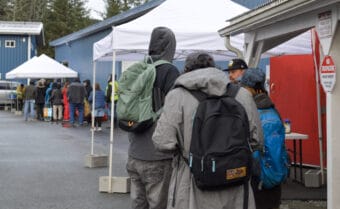
Outside the building, Susan Soule was among several dozen people who came to protest Secretary Kennedy.

“My sign says, ‘Respect the science. Vaccines save lives.’ That’s why I’m here,” she said. Kennedy, she said, “has not given any sign that he respects science. He’s killing people by what he’s doing to vaccines and the research.”

The medical campus where Kennedy spoke has for years championed vaccines to improve community wellness. In late 2020, the Alaska Native health care system led the rest of the state on COVID-19 vaccination.

Susan Soule was among the protesters outside the Alaska Native Tribal Health Consortium on Aug. 8, 2025. Health Secretary Robert F. Kennedy, Jr. “is killing people by what he’s doing to vaccines and the research,” she said. (Matt Faubion/Alaska Public Media)

Business leaders eye effect of future icebreakers on Arctic

The cutter Storis is the U.S. Coast Guard’s first polar icebreaker acquired in more than 25 years. To be homeported in Juneau, the icebreaker will expand U.S. operations presence in the Arctic. It’s expected to be commissioned in Juneau later this month. (Photo courtesy of the U.S. Coast Guard)

A large cash infusion to the U.S. Coast Guard’s budget and recent comments by President Donald Trump are stoking optimism that the country’s limited icebreaker fleet might soon greatly expand.

That’s according to shipbuilders, other businesspeople and some diplomats who spoke at the Arctic Encounter Symposium in Anchorage this week. Icebreakers are particularly important to Alaska, especially in the Bering Strait region where a narrow strip of water separates Alaska and Russia, a remote place where foreign vessels are often known to stray.

The United States has three polar-grade icebreakers capable of navigating the frigid waters of the Arctic Ocean, a waterbody that is rapidly warming due to climate change and seeing  new shipping routes opening in the process. The U.S.’s modest fleet compares to Russia’s hefty arsenal of some 40 icebreakers, including the world’s only nuclear-powered ones.

As sea ice melts and vessel traffic increases in Alaska’s northern waters and elsewhere in the Arctic, fear of oil spills, vessel collisions and national security threats from foreign adversaries is on the rise. Against this backdrop, the U.S. and two allies, Canada and Finland, are trying to boost the production of icebreakers capable of navigating and protecting the Arctic. Their goal is to build between 70 and 90 icebreakers within the next decade, according to published reports.

The trilateral cooperation effort is spelled out in a guidance document called ICE Pact, which stands for Icebreaker Collaboration Effort. This memorandum of understanding was signed at a NATO summit in Washington last year.

During a Thursday panel discussion at the Arctic conference, Paul Barrett of the Canadian shipbuilding company Davie noted that the Trump administration’s “One Big Beautiful Bill” builds off of ICE Pact in that it contains some $8 billion for the Coast Guard to expand its icebreaker fleet.

Trump has said he wants the U.S. to build or acquire 40 new icebreakers to close the gap with Russia and to counter the growing influence of both Russia, and more recently China, in the Arctic.

Barrett said his company is committed to helping make that happen. He outlined a $1 billion investment Davie is making to start building icebreakers at shipyards in Galveston and Port Arthur, cities in Texas.

“This is about really equipping the U.S. shipbuilding sector for the decades ahead,” said Barrett, the company’s chief communications officer. “Our analysis is that we can help the Americans to build these ships that they need and we can create many thousands of jobs, good jobs, in America.”

The massive spending and tax bill that Trump signed on July 4 contains $4.3 billion for the Coast Guard’s Polar Security Cutter program, to pay for three heavy icebreakers. There’s also $3.5 billion in the bill for three or more medium-grade icebreakers and about $800 million for light icebreakers.

The Coast Guard currently has two polar-grade icebreakers, and is getting a third, the Storis, which is scheduled to be commissioned in Juneau later this month. The Storis is the first polar icebreaker to be acquired by the Coast Guard in more than 25 years.

During a question-and-answer period at Thursday’s session, Dennis Young, who heads the Alaska Division of the International Longshore and Warehouse Union, asked why shipyards in Texas were chosen — as opposed to Alaska — for icebreaker construction.

Building a generational workforce of shipbuilders in Seward, Ketchikan or another Alaska port town would be a “tremendous asset for our communities,” Young said.

William Henagan, U.S. strategy lead for Davie, said many factors played into the decision but an important one was that Texas has a much larger existing workforce of skilled shipbuilders.

“From my experience down in Galveston, they do a lot of fabrication work, so they’re already building steel for the existing contracts,” Henagan said.

That said, Davie is “open for business” in Alaska and elsewhere.

“Paul and I are up here looking for opportunities and ways to collaborate with Alaska shipyards,” he said.

Henagan noted that icebreakers are “50-year assets” that require a lot of ongoing maintenance. So even if the ships are built in Texas, there might be plenty of work for Alaska to capture once the icebreakers start operating in the Arctic.

There’s no doubt that Alaska and the U.S. need more icebreakers for security reasons, said former Alaska Lt. Gov. Mead Treadwell, a panelist. But he said the country needs to focus on the commercial aspects of the Arctic Ocean and step up its role in capturing rapidly emerging global commerce opportunities.

“Let’s move forward with the concept of a marine seaway in the Arctic and figure out what the U.S. role is in helping convene the players to make that happen,” said Treadwell, a businessperson and former chair of the U.S. Arctic Research Commission. 

There’s talk that the U.S. secretary of transportation may visit Alaska this summer.

“Let’s all talk to him about it,” Treadwell said. “The fact is, we did this with Canada with the Saint Lawrence.”

He was referring to the Great Lakes St. Lawrence Seaway System, built as a binational partnership between the U.S. and Canada. Administered by both countries, the seaway allows vessels to travel from the Atlantic Ocean to the Great Lakes.

During Friday’s session on ICE Pact, Ambassador David Balton, who served as U.S. deputy assistant secretary for oceans and fisheries during the Biden administration, said while there’s clearly a need for more U.S. icebreakers, he’s skeptical about the effectiveness of the trilateral partnership.

“Relations between the United States and Canada at the moment are not great,” Balton said.

The 35% U.S. tariffs on Canadian goods that went into effect on Friday have a chilling effect and have disrupted one of the largest and most successful trading relationships in the world, he said.

And it’s not just tariffs that are straining bilateral relations.

“Let’s not forget that President Trump has spoken multiple times about how Canada should be part of the United States, and it hasn’t gone down very well with our Canadian friends,” Balton said.

Arctic shipping represents a “paltry fraction” of oceangoing global trade, he noted, and Balton said he’s doubtful that’s going to radically change anytime soon.

Even under the most aggressive climate change models, the Arctic Ocean remains ice-covered for most of the year.

There’s little existing land-based infrastructure to support large-scale Arctic shipping. Balton said it’s not clear to him that major shipping companies are going to retrofit their fleets to handle Arctic conditions for just a portion of the year, especially in a forbidding ocean that is poorly charted.

“There’s also unknown environmental consequences to large-scale Arctic shipping that we might want to stop and think about before embracing this brave new world that you’re imagining,” Balton said.

Losses mount for timber companies in Alaska amid China’s import ban

Logs being moved from the road system to water on Kupreanof Island near Petersburg in 2013.
Logs being moved from the road system to water on Kupreanof Island near Petersburg in 2013. (Joe Viechnicki/KFSK)

The Trump administration’s tumultuous relationship with China is proving to be a major issue for some companies in Alaska’s forest products industry. That includes in Haines, where a timber sale that was supposed to kick off this spring has stalled amid China’s ban on U.S. log imports.

China announced the ban in March, citing concerns over pests like bark and longhorn beetles in U.S. shipments. The move came the same day that China imposed retaliatory tariffs on certain U.S. agricultural products amid President Donald Trump’s global trade war.

The decision has had sweeping effects on companies that harvest logs in Alaska and ship them overseas.

“We’re severely impacted by it. There’s no doubt about that,” said Eric Nichols of Alcan Timber, a Ketchikan-based company. Nichols also serves as vice president of the Alaska Forest Association, a Southeast nonprofit.

Nichols said about half of his company’s volume typically would go to China. As a result of the halt on imports, he said, the company has had to shut down at least one of its operations and make a range of other changes.

Those include shipping to other markets, including Washington, South Korea and Vancouver, British Columbia. Alcan has also shifted its focus away from harvesting areas that are best suited for the Chinese market.

Those changes have come at a steep cost.

“We’re at pretty big losses on going to other markets, just because of the transportation differential from what we’re used to,” Nichols said.

In Haines, meanwhile, Oregon-based company NWFP Inc. had been planning to move forward with a sale in May that’s been under contract since 2021. The so-called Baby Brown sale would be the area’s first major timber sale since the 1970’s.

But the company could not move forward with the sale this spring due to the loss of the Chinese market, Haines State Forester Greg Palmieri said in an email. He added that the company is seeking other markets for the sale, both within the U.S. and overseas.

“I expect that as soon as they have the ability to market the timber, operations will move forward with the sale currently remaining under contract,” Palmieri wrote Tuesday afternoon. “They are continuing the processes to obtain the required permits from State and Federal agencies to move the logs to markets as originally planned.”

The trade disputes have also hit Canadian lumber company Transpac Group. The company in March largely shut down its site on Afognak Island, just north of Kodiak, citing the ban and failed efforts to divert its product to other markets.

“We’ve been trying very hard since the announcement,” Transpac CEO Charles Kim said in an interview at the time. “And it has all failed.”

A spokesperson confirmed this week that the situation hasn’t shifted in the time since.

Nichols, of Alcan, says his company will have to weigh similar decisions if nothing changes.

“We have to make decisions, you know, a little bit like Afognak, whether we’re going to stay in business or not,” Nichols said. “The question is how long can we hold these logs before we have to sell them and generate the losses they’re going to generate here.”

Murkowski votes against controversial Trump nominee for appeals court

a woman in the u.s. capitol
Sen. Lisa Murkowski at the U.S. Capitol on Oct. 31, 2023. (Liz Ruskin/Alaska Public Media)

Sen. Lisa Murkowski was one of only two Republicans to vote against confirming senior Justice Department attorney Emil Bove to be an appellate judge on the East Coast.

Still, Republicans confirmed him Tuesday night, by a vote of 50 to 49.

Murkowski cited the accounts of whistleblowers to explain why she was unwilling to confirm Bove to a lifetime appointment on the Third Circuit Court of Appeals.

“When somebody who is going to be placed on on the bench as at the Circuit Court level, basically tells other attorneys that you should disregard the law —That, to me, is disqualifying,” Murkowski said in an interview Tuesday afternoon. “Just plain and simple, disqualifying.”

She and Sen. Susan Collins of Maine joined all Democrats in voting against Bove.

Murkowski’s vote shows that she’s still sometimes willing to disappoint Trump and fellow Republicans, even as progressives remain mad at her for helping Republicans pass Trump’s big tax and policy bill a month ago.

Sen. Dan Sullivan was one of the 50 yes votes.

Six retired Alaska state judges penned an op-ed last week, urging Sullivan to reject Bove’s nomination.

“In recent times, highly regarded and long-experienced attorneys at the DOJ have resigned, publicly stating that Bove demanded that they act unethically in their handling of high-profile cases,” the retired judges wrote.

Sullivan did not respond to an interview request Tuesday.

Other Republican senators emerged from their weekly policy lunch saying they’re committed to doing what it takes to get around Democratic objections and more swiftly confirm Trump’s nominees. Some said they had coalesced around a plan to let Trump bypass the Senate and install nominees while senators are on their August recess.

Murkowski said she’s not on board with any plan that evades the Senate’s authority to confirm nominees.

“It is our responsibility. It is part of our constitutional assignment, on this whole role of advise and consent,” she said.

The White House is pushing the Senate to approve Trump’s nominations faster, but Murkowski said the number of confirmations is on par with the past two presidencies at this stage.

School leaders in Alaska express relief as Trump administration releases frozen funds

an Unalaska City School District sign
The Unalaska City School District sign. (Maggie Nelson/KUCB)

The Trump administration will release millions in federal education funding for Alaska that had been frozen since June 30. Alaska schools will now receive over $46 million that they included in their budgets for the upcoming school year. The money supports programs for migrant education, professional development for teachers, adult English learner services, as well as before-and-after-school programs.

Kimberly Hanisch is the Unalaska City School District Superintendent. Earlier this month, she was preparing to cut staff after learning that over half of their funding from the federal programs was frozen.

“Without those programs, it is just impossible to meet all students’ needs,” Hanisch said. “So, much relief for our students and for our staff to know that we have those opportunities back.”

Districts learned on June 30 that the money would not be released, just a day before it was to be sent out to states. About 60% of Unalaska students qualify as English Language Learners. Hanisch is glad the funds will now be available, but said the process has been chaotic.

“The quickness of it just seems to be part of the chaos that seems to be embedded in everything related to education funding right now,” Hanisch said. “It’s good that they unfroze it, but it’s just unsettling that we’re never really sure what’s going to happen next.”

Sen. Lisa Murkowski signed onto a letter with nine other U.S. senators asking Office of Management and Budget Director Russell Vought to release the $6.8 billion in federal money for schools and adult learning programs.

In a Friday press release, Murkowski called the funding thaw a win.

“Local communities have the best understanding of the unique needs of their students and how best to serve them,” Murkowski wrote. “But the anxiety, disruption, and extra work to figure out how to serve students without this funding should never have been necessary.”

A coalition of schools and advocacy groups filed a lawsuit over the frozen money earlier this week. The Anchorage School District — one of three Alaska districts named in the suit — said they had to lay off five employees due to the federal and state funding cuts to their already-approved budget for the upcoming school year.

Districts are still dealing with the impacts of Gov. Mike Dunleavy’s line-item veto of state formula funding. Legislators are set to convene a special legislative session Aug. 2 to discuss education funding and reforms. They will have five days once they begin to vote on an override of Dunleavy’s vetoes, but Dunleavy has asked several lawmakers to skip the first part of the session.

Trump’s EPA reaffirms Biden-era Pebble Mine veto

The proposed site of the Pebble Mine.
The proposed site of the Pebble Mine. (Jason Sear/KDLG)

The Environmental Protection Agency is sticking with its veto of the proposed Pebble Mine project in southwest Alaska.

Northern Dynasty, the parent company behind the Pebble project, is still suing to get the veto overturned. A document filed in that lawsuit early this month said the company and the EPA were in settlement talks, and that the Trump administration said it was open to reconsidering the Biden-era veto on the controversial mining project.

But on July 17, attorneys in the case filed another document to update the judge. It says that negotiations between the company and the EPA did not reach a resolution, and that the Trump administration will continue to back the veto.

The proposed site for the copper and gold mine is upriver from Bristol Bay, home to the world’s largest sockeye salmon fishery. The mining project is unpopular in the region, where many people believe the open-pit mine would put the salmon run at risk.

Karla Jensen is an environmental specialist from Pedro Bay. Her village is close to the proposed mining site. She says that after the veto of the project in 2023, many of the mine’s opponents felt relieved but remained wary.

“It reminded me of a cancer,” Jensen said. “Some people were like, ‘We don’t have to worry about that… I don’t have cancer anymore.’ But you always have that nagging in the back of your mind that it can always come back.”

The Pebble Limited Partnership is now asking the court to rule on whether the veto is lawful.

Site notifications
Update notification options
Subscribe to notifications