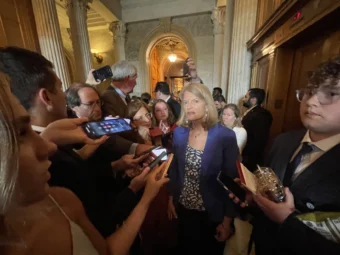
U.S. senators visited Pituffik Space Base on a three-day trip to Greenland that ended Feb. 9, 2026. From right: Maggie Hassan, D-N.H., Angus King, I-Maine, Gary Peters, D-Mich., and Lisa Murkowski, R-Alaska. They met with U.S. Space Force Col. Shawn Lee, left, the base commander. (Matt Felling/U.S. Senate)
Sen. Lisa Murkowski said in Greenland Monday that she feels terrible for the anxiety her country inflicted on the Danish territory.
“In just a few sentences and words, trust that has been built since World War II has been eroded and degraded,” she told reporters in Nuuk. “We need to work to rebuild that trust.”
Murkowski was the sole Republican among four senators who took the trip to try to repair the relationship with Greenland after President Trump’s repeated threats to acquire the island.
The trip was part of her initiative to bolster what she calls a trans-Arctic alliance. She was part of another congressional trip to Denmark a few weeks ago.
The Greenland crisis seemed to abate last month, when Trump backed off threats to take the Danish territory by military force. But the visiting senators were asked if they could guarantee the president wouldn’t change his mind.
“The answer is no,” said Sen. Angus King, I-Maine, who led the delegation. “We can only exert our role as a separate and co-equal branch of government. But we can’t guarantee what the president may or may not do tomorrow, let alone two months from now.”
Murkowski said Congress will stand up for Greenland, if necessary.
“But I will also speak to the fact that there are some members of my party who don’t want to be seen as engaging in anything that might be viewed as contrary to President Trump’s initiative or desire, and so who may not be speaking out publicly,” she said.
In private conversations, she said, Republican colleagues have assured her they won’t allow Trump to seize or control Greenland.
“I’m going to encourage them that they need to be more vocal in reinforcing that, because this should not be a partisan issue,” she said. “Respect for the sovereignty of another nation, respect for our NATO allies — that should not be Democrat (or) Republican. It should be just pro-democracy”
Herbert Glacier on Nov. 27, 2025. (Photo by Alix Soliman/KTOO)
After proposing to build a new cabin near Juneau’s Herbert Glacier, the U.S. Forest Service released a draft decision last month abandoning it.
The cabin site was initially selected due to public interest. It would have been built within a mining claim block across the river from the proposed New Amalga gold mine owned by Grande Portage Resources, Ltd. The Forest Service approved exploratory drilling at New Amalga in April.
But Paul Robbins, a public affairs officer for Tongass National Forest, said the agency’s decision to cancel the cabin is unrelated to mining interests and is instead due to the challenging location and limited staff capacity. This comes after the agency lost a third of its staff in Alaska last year.
“The proposed cabin site’s elevation, distance from the trail, design requirements and the need to move materials through difficult terrain all add to the complexity of that cabin project,” Robbins said.
He said the agency’s landscape architects and engineers could be overwhelmed with work if they moved forward with building the cabin.
But some residents in Juneau submitted public comments saying they don’t believe those reasons are genuine.
“Cancelling the project seems to be influenced by mining interest across the river which would inherently be hard to make compatible,” wrote Riley Moser, a Juneau resident. “It appears that the Forest Service is bending to corporate interests instead of listening to the needs and concerns of the public.”
Staff from the Alaska Miners Association and Grande Portage submitted comments to the agency before the draft decision, saying that building a cabin near the proposed mine could lead to disputes over how the land is used.
“Selection of a site to be used for recreational lodging, which can be easily placed anywhere, within an area of active mineral exploration could unnecessarily invite land use conflicts that do not and should not exist, and could incite litigation and appeals for years,” wrote Deantha Skibinksi, executive director of the Alaska Miners Association.
Kyle Mehalek, a technical specialist at Grande Portage, wrote that “it would be incredibly challenging, likely impossible, to protect the proposed cabin from potential visual and noise impacts with the same effectiveness as the existing trail.”
The cabin would have been part of the Alaska Cabins Project, the Forest Service’s biggest public-use cabin expansion plan in 50 years, which plans to bring around 25 new cabins to the Chugach and Tongass National Forests, including four in Juneau at Mendenhall Campground, Montana Meadows, Treadwell Ditch Trail and Dupont Beach.
Robbins said cancelling this cabin won’t affect the other proposed cabins. He said the Forest Service plans to reroute part of Herbert Glacier Trail and build a scenic overlook there instead.
Although there is a lot of public support for building a cabin near Herbert Glacier, Robbins said the agency is unlikely to change course.
“Only because our decision was based on the complexity and capacity, not on whether or not the site was popular,” he said. “We know the site is popular, that’s why we wanted to initially build a cabin there.”
Aaron Peterson at his confirmation hearing in the U.S. Senate Judiciary Committee on Nov. 19, 2025. (Screenshot from U.S. Senate video)
WASHINGTON — The U.S. Senate on Wednesday confirmed Aaron C. Peterson of Anchorage to be a federal District Court judge in Alaska.
The vote was 58 to 39, with seven Democrats voting yes.
Peterson is in his mid-40s and was born in Anchorage. He’s an Air Force veteran and has worked at the state Department of Law since 2012. Earlier, he clerked in the Alaska Superior Court, for now-retired Superior Court Judge Michael Spaan.
“Judge Spaan approached his work diligently, with humility and always respecting every litigant that appeared before him,” Peterson said at his Senate confirmation hearing last year. “I took so much away from that clerkship, and I’ve carried those lessons with me every day since.”
Peterson, once he’s sworn in, will be the first judge to go through an advisory committee Sen. Dan Sullivan established to help select candidates for Alaska’s federal court.
He’ll be Alaska’s first new federal judge since U.S. District Court Judge Joshua Kindred resigned amid allegations of impropriety with law clerks and attorneys. Like Peterson, Kindred had the support of both U.S. senators and was nominated by President Trump.
Peterson’s swearing-in will bring the number of judges on Alaska’s U.S. District Court to two. The court still has one vacancy.
U.S. Sen. Dan Sullivan stands with acting Coast Guard Commandant Adm. Kevin Lunday during the after the commissioning ceremony for the Coast Guard icebreaker Storis on Sunday, Aug. 10, 2025, in Juneau, Alaska. (Photo by James Brooks/Alaska Beacon)
A $300 million project to build a new Coast Guard base in Juneau for the icebreaker Storis likely will not be complete until at least 2029, the service’s top admiral said in a U.S. Senate hearing last week.
The Commandant of the Coast Guard, Adm. Kevin Lunday, testified Thursday in front of the U.S. Senate’s subcommittee on Coast Guard, Maritime, and Fisheries, chaired by Sen. Dan Sullivan, R-Alaska.
During the hearing, Sullivan pushed Lunday on his timeline for work in Alaska. Congress approved almost $25 billion earlier this year for new Coast Guard construction, including hundreds of millions for work in Alaska.
In August, the Coast Guard commissioned the icebreaker Storis, a converted oilfield services ship, at a ceremony in Juneau. The Storis will be based in Juneau, the Coast Guard has said, but not until new facilities are built.
“Are we on time, on schedule?” Sullivan asked.
“We’re moving quickly to be able to execute that funding and have that pier and infrastructure there ready by 2029,” Lunday said.
The Coast Guard had previously said its target was 2028.
“They’ve talked about 2028 before with regard to Juneau and the Storis,” Sullivan said in a phone call with reporters afterward. “He did mention 2029, but part of my job is to make sure we have the money, make sure they make the decisions early, and impress them in oversight hearings like this, to get them to keep their timelines if they put them out there, but also try to move them closer in.”
Lunday was only recently confirmed to his position after President Donald Trump controversially fired Adm. Linda Fagan after the start of his term.
Sullivan said it’s only natural for a new appointee to play it safe.
“I think the default position is to be a little conservative on the timelines,” Sullivan said.
Sullivan also pressed Lunday on his plans for a series of new icebreakers the Coast Guard intends to build in coming years.
Sullivan has been campaigning to have several medium icebreakers based in Alaska in addition to the Storis. Lunday was evasive when Sullivan asked him when he would make a decision and whether he would choose Alaska.
“As (my team) develop options, one of the first ones that I want them to present among a range of options for consideration … is for homeporting of up to four icebreakers in Alaska,” Lunday said. “Although we are still pending a decision, that’s clear guidance I’ve given to the team.”
Afterward, Sullivan said he tried to pin Lunday down on the issue because he sees it as important.
“I love the Coast Guard, but I have had real issues with how slow they are,” he said.
While Lunday didn’t make a firm commitment, Sullivan said he viewed the day as “progress.” Sullivan said he wants to see the ships in Alaska because basing them here has an economic benefit that he termed “a virtuous cycle” — the ships create demand for local shipyard work and stores to sell things to the Coast Guard, members of the Coast Guard and their families.
Housing any new arrivals remains an unsolved issue, he noted. Communities throughout Alaska are experiencing critical shortages of housing and child care.
“In almost every community, housing is an issue, and it’s an issue throughout the whole state,” he said.
“This is where we need to get the state, the cities, the boroughs also, to come to the table and say, ‘Hey, we have land here that we can provide. … We have financing that we can help incentivize housing,’” Sullivan said.
He said the Coast Guard is contributing financially for housing, but that he has encouraged elected officials to look for ways to ease the issue.
Eric Phillip, the boardwalk foreman for Kongiganak, Alaska, surveys infrastructure damage caused by Typhoon Halong, Oct. 18, 2025. (Alaska National Guard photo by Staff Sgt. Joseph Moon)
The Trump administration has denied Alaska’s request for full reimbursement for disaster relief efforts immediately following last October’s devastating Western Alaska storms, despite the Dunleavy administration’s claim that the federal disaster declaration meant the state would be fully reimbursed.
Gov. Mike Dunleavy arrives in Bethel after visiting the storm-damaged villages of Kipnuk and Kwigillingok on Oct. 17, 2025. (Photo by Eric Stone/Alaska Public Media)
That leaves the state on the hook for millions of dollars for disaster recovery, however the full amount is still unknown.
The state’s request for federal support for 100% of disaster relief efforts in the first 90 days after the storms hit was denied on Dec. 20, according to a spokesperson for the Alaska Division of Homeland Security and Emergency Management on Thursday.
The state appealed the denial on Jan. 15, and asked for a 90% federal cost reimbursement, but has not yet gotten a response from the Federal Emergency Management Agency.
“We have not heard back from FEMA on approval or denial and there is no timeframe requirement,” said Jeremy Zidek, public information officer for the division, by email.
A spokesperson for Dunleavy’s office did not respond to a list of questions, but confirmed the appeal on Friday. “An appeal has been filed and the administration will await the federal government’s decision,” said Jeff Turner, Dunleavy’s communications director.
In the meantime, the federal government is reimbursing Alaska’s disaster recovery efforts at roughly 75%, leaving the state to cover 25% of its costs, with some exceptions for certain relief programs, Zidek said.
Following the West Coast storm disaster in October, Dunleavy quickly declared a state disaster emergency. On Oct. 22, his office announced that the Trump administration approved the state’s request for a federal disaster declaration, and the state’s full costs would be covered immediately following the storms.
“President Trump was deeply concerned with the wellbeing of Alaskans who lost their homes and livelihoods to this historic storm,” Dunleavy said in a statement along with the announcement. “I want to thank him and his administration for approving the disaster declaration because now Alaskan families have local, state and federal support for rebuilding their lives in the months ahead.”
“The federal disaster declaration authorizes a 100 percent federal cost share for all categories of relief assistance for the next 90 days,” the statement said.
Dunleavy’s office did not respond to questions about his previous statement or whether his office had communication from the Trump administration about why the request was denied.
Alaska’s Republican U.S. congressional delegation applauded the federal disaster declaration and Trump’s support for the Western Alaska disaster response last year. All three members said through spokespeople Friday that they support the state’s appeal.
U.S. Sen. Lisa Murkowski has been actively engaged with FEMA and state officials throughout the disaster relief efforts, said her communications director, Joe Plesha, in a statement on Friday. “Alaska’s vast geography and many rural communities make disaster response more challenging and recovery efforts significantly more costly,” he said. “She supports the state’s appeal and will work to secure the maximum amount of federal support available to Alaskans who have suffered so much from this devastating storm.”
A spokesperson for U.S. Sen. Dan Sullivan, Amanda Coyne, said the senator has advocated for the 100% federal cost share, as well as organized a delegation of FEMA and other Trump administration officials to visit Western Alaska.
“Given the severity of the storm and its devastating impacts on communities in Western Alaska, Senator Sullivan believes an increased federal cost share is warranted,” Coyne said. “He will continue strongly advocating with FEMA and other senior officials in the Trump Administration for an increased federal cost share as the state’s appeal goes through the process.”
A spokesperson for Alaska’s lone U.S. Representative, Nick Begich III, said on Friday that he supports the appeal and will continue to advocate for those impacted by Typhoon Halong at the Congressional level. “Our office is in communication with the Administration to ensure recovery efforts in Western Alaska remain a priority,” spokesperson Silver Prout wrote.
Western Alaska storm recovery is ongoing
The Western Alaska storms and particularly ex-Typhoon Halong brought record-breaking winds and flooding — damaging thousands of structures, roads, boardwalks, airports and other critical infrastructure. It prompted the state’s largest mass evacuation of residents from their homes to other villages, Bethel and Anchorage.
Evacuees of Kipnuk and Kwigillingok wait to board an evacuation flight from Bethel to Anchorage on Oct. 15, 2025 (Photo by Corinne Smith/Alaska Beacon)
While some Western Alaska residents are continuing to rebuild through the winter, other residents who evacuated to Anchorage are living in temporary housing. As of Thursday, the Alaska Division of Homeland Security and Emergency Management reports that 471 residents are still sheltering in hotels in Anchorage.
The state is administering public assistance programs, which reimburse costs of repairing public infrastructure and utilities, as well as provide individual disaster assistance, in partnership with other agencies, including FEMA.
FEMA has awarded $31.2 million in individual assistance to date, Zidek said.
More than 2,000 residents have been awarded state individual assistance, and 1,794 households have registered for federal assistance from FEMA.
Those applications for state and federal assistance are still open until Feb. 20.
State disaster relief funding under debate
The state’s disaster relief funding is a point of ongoing debate among lawmakers and the governor, as they kick off discussion of Dunleavy’s proposed $7.75 million budget and its $1.5 billion deficit.
Last year, legislators approved $23.3 million in state disaster relief funds, but Dunleavy vetoed $10.3 million of that sum last summer, leaving $13 million in the budget. In November, following the federal government shutdown, Dunleavy announced a state disaster to help provide food aid, transferring $10 million to the state’s disaster relief funding from the Department of Environmental Conservation’s Village Safe Water and Wastewater Infrastructure program.
This year, the governor has requested an additional $40 million in the state’s supplemental budget, which is a routine ask for additional money to pay the state’s bills for the previous year.
Sen. Bert Stedman, R-Sitka, a co-chair of the Senate Finance Committee, didn’t mince words about the governor’s back and forth with disaster spending. “Ill-advised and foolish,” he said. “It makes no sense what he did to me, frankly, and it’s embarrassing for him, his veto.”
But Stedman said he hopes the state’s federal appeal is approved, and expects legislators to pass the governor’s request for the additional $40 million. “Obviously, 100% is better than 90 and 90 is better than 75,” Stedman said of the federal cost share. “So that’s pretty much a given there. But we will fund the disaster request as the governor puts it on the table, through next week’s amendments.”
Sen. Jesse Kiehl, D-Juneau, also a member of the Senate Finance Committee, commended the governor for his record on disaster response, and echoed hope for the appeal to move forward. “There’s no question in my mind that this is exactly what the federal disaster relief programs exist for. So I think the governor’s request was the right thing, and if it came back at less than full funding from the feds, that’s the wrong call,” Kiehl said.
Kiehl described the state’s fiscal picture, with rising costs and ongoing debates on how to raise more revenues, as “bleak.” “So there isn’t cash just sitting around for disaster assistance,” he said. “We have to step up for western Alaska financially. That’s going to stink, but we have to do it, as far as I’m concerned.”
A typical cost share between the federal government and a state for disaster relief efforts is a 75% federal and 25% state cost split.
“We have dozens of federal declared disasters we are currently working on that have the 75/25 cost share structure,” said Zidek, with agency. “Large disasters are occasionally given a modified cost share structure adjustment, but it is not guaranteed. When we have a large disaster, we ask for modification to reduce the amount of state funding needed because as managers of state funds it is the responsible thing to do.”
The U.S. Capitol building. (Photo by Liz Ruskin/Alaska Public Media)
WASHINGTON — The U.S. Senate on Friday passed a bill funding the departments of Defense, Health, Labor and Transportation, among others, with both Alaska senators voting yes.
Still, hours later, at 8 p.m. Alaska time, funding will lapse for those departments, comprising much of the government. The U.S. House still has to pass the bill, and House members don’t return to the Capitol until Monday.
The shutdown, or lapse in funding, could last just one weekday. That would be minimal compared to the 43-day shutdown in 2025, the longest in U.S. history.
Nonetheless, the Office of Management and Budget says it will follow its usual shutdown practices.
Unless they’re told otherwise, all federal employees who would normally report to work on Monday should still go, according to the OMB’s plans. It’s standard practice on the first weekday after a funding lapse for federal workers to be on duty to launch the orderly shutdown procedures.
Then, if the shutdown continues, agencies are expected to notify their employees if they are essential and have to come to work, or if they will be put on furlough.
This time, the impact on Alaskans will be more limited than the shutdown last fall, because Congress has already funded many departments for the rest of the fiscal year. Those include NOAA and the departments of Commerce, Interior, Justice and Veterans Affairs.
Democrats held up a funding bill for the Department of Homeland Security. They demanded reforms to curb the kind of harsh immigration enforcement tactics deployed in Minneapolis, where agents shot and killed two U.S. citizens.
Now, Congress and the White House have two weeks to reach an agreement on what those reforms will be. Both of Alaska’s senators say they support some type of reform.
Close
Update notification options
Subscribe to notifications
Subscribe
Get notifications about news related to the topics you care about. You can unsubscribe anytime.