Federal Government

Alaska holds migrants in ‘punitive conditions,’ violating ICE standards, lawyers say

A hearing room. Public section is full.
Rep. Andrew Gray called a hearing in Anchorage on June 20, 2025 on allegations that 41 ICE detainees transferred to the Anchorage Correctional Complex were subjected to pepper spray, denied access to their attorneys and subjected to long lockdowns. Attorney Sean Quirk (on screen) testified that he wasn’t allowed to call his client for days, contrary to federal law. (Matt Faubion/Alaska Public Media)

The Alaska Department of Corrections is holding dozens of immigration detainees in Anchorage under conditions that violate federal standards for humane treatment, a trio of lawyers told Alaska legislators at a hearing Friday.

Rep. Andrew Gray, D-Anchorage, called the hearing of the House Judiciary Committee. He said that the state has assumed a new role since June 8, when it agreed to take in 41 men from an Immigration and Customs Enforcement facility near Tacoma, Wash. The Department of Corrections regularly houses a few federal detainees picked up in Alaska, but for the first time ever, Gray said, it is holding people transferred from the Lower 48.

“We Alaskans would be on the hook for financial damages if we are sued and lose,” he said. “So it’s our duty as a committee to understand why these people are here, what we are doing with them, and what financial liabilities we Alaskans may be responsible for.”

Three immigration lawyers said the men were denied phone access to their attorneys and consulates, held in lockdown for long periods and, in one incident, subjected to pepper spray.

Immigration attorney Cindy Woods of the ACLU of Alaska said the men at the Anchorage Correctional Complex have legal rights as civil detainees and are just waiting for officials to decide if they can remain in the country.

“In fact, at least four of them have been granted immigration relief in the form of asylum, or withholding of removal by an immigration judge after a full hearing on the merits,” she said. “Yet all of these individuals are being held in punitive conditions.”

Testimony at the hearing suggests that Alaska prisons, set up to separate criminals from society, aren’t easily remade into facilities that can relieve overcrowding as the Trump administration ramps up migrant arrests and deportations.

Members of the public filled every available seat in the Anchorage Legislative Information Office. They sat quietly, other than occasional scoffing as Alaska Corrections Commissioner Jen Winkelman testified.

Winkelman said the detention was going well after a number of “bumps in the road” during the first few days. She cited one deployment of pepper spray, which she said was used to overcome a “verbal demonstration” and enforce a lockdown order.

Gray said he’d heard about that from several people, including relatives of the men.

“It seemed, from the story that I heard, that there was one detainee who was asking for permission to access his property so that he could get the contact information for his consulate representative,” Gray said. “And the result was that all the detainees were pepper sprayed. Is that your understanding of the event?”

Winkelman disagreed.

“Nobody was ever sprayed,” she said. “It was deployed in the area to get individuals to move to their individual cells and lock down.”

That didn’t sound right to Rep. Andy Josephson, D-Anchorage.

“I mean, the nature of pepper spray is to move and drift,” he said.

Gray said he’d heard that several men reported respiratory distress afterward and that they weren’t allowed to shower or change their clothes.

He cited federal standards, updated during the first Trump administration, saying that ICE detainees are entitled to daily changes of socks and underwear, access to all their belongings including paperwork, confidential phone calls with their attorneys, outdoor time and visitors — conditions that he or the attorneys said have not been consistently met.

At the start of the hearing, Winkelman sounded confident that the men were being properly treated. She said Corrections staff had medical information on each detainee and were able to supply them with telephone PIN codes.

“Our kitchen prepared bag lunches so the influx of detainees were immediately given food upon arrival,” she said.

She sounded less sure as she heard more from the legislators and the attorneys.

Winkelman repeatedly told legislators she was unaware of specific complaints and alleged violations of federal standards.

“I will commit to this committee to look into that,” she said. “This is the first I’ve heard of this.”

Josephson and Gray questioned why the state agreed to accept the ICE detainees, given the liability.

“All we’re doing is getting refunded for our costs,” Josephson said. “Why are we doing this at all?”

Winkelman said the state is trying to be a good partner to the federal agencies, including ICE.

Alaska Sens. Dan Sullivan, Lisa Murkowski offer support for Trump-ordered bombing of Iran

U.S. Sen. Dan Sullivan, R-Alaska, prepares to shake hands with one of his critics, state Rep. Andrew Gray, D-Anchorage, after the conclusion of his speech to the Alaska Legislature on Thursday, March 20, 2025. (Photo by James Brooks/Alaska Beacon)

Less than an hour after President Donald Trump announced that the United States had bombed three Iranian nuclear facilities, Alaska Republican Sen. Dan Sullivan said he supported the decision.

In a written statement posted on the social media site X, Sullivan said he commends the president.

“The terrorist leaders of Iran have, in essence, been at war with the United States for decades — targeting, wounding and killing thousands of American service members for years,” Sullivan wrote.

Sullivan, a former Marine Corps officer, has repeatedly called for aggressive actions against Iran, particularly amid Iran’s support of anti-American militias during the Iraq War. Five years ago, he supported Trump’s decision to assassinate an Iranian general in Iraq.

Sullivan and U.S. Sen. Lisa Murkowski, R-Alaska, previously supported Trump’s decision in 2018 to withdraw from a diplomatic agreement intended to prevent Iran from developing nuclear weapons.

International experts and Tulsi Gabbard, Director of National Intelligence under Trump, have said that no evidence has been produced showing that Iran is building a nuclear weapon.

Trump himself has said he does not believe Gabbard, and Sullivan, a member of the U.S. Senate Committee on Armed Services, spoke this week in that committee, implying that he would support military action in order to deter Iran from developing a nuclear weapon.

He reiterated that position after the Trump-ordered bombing.

“Making sure the world’s largest state sponsor of terrorism never gets a nuclear weapon is part of the work of reestablishing deterrence against Iran, which was lost during the appeasement of the Biden Administration. This is difficult work, but critical for our national security. I fully support the President and his national security team in these critical efforts,” he wrote.

Murkowski, Alaska’s senior U.S. senator, did not comment about the strike until hours later, after Trump had delivered a speech about the attack.
“President Trump’s decision to carry out focused strikes on Iran’s nuclear infrastructure makes clear that the international community will not tolerate a nuclear-armed Iran. I commend all those who executed this mission with precision and professionalism,” she wrote in a post on social media.
A Murkowski spokesperson said he expected a longer statement on Sunday.

Rep. Nick Begich III, R-Alaska, spoke about Iran during an interview Friday, one day before the Trump-ordered bombing.

During the interview, he said he had no special knowledge about what would happen in the coming weeks and months but viewed the situation as Iran’s to settle.

“I think the ball is at this moment in Iran’s court: Do they want to be a member of the international community or not? And what’s been made clearly, not just by the United States, but many of our friends and allies around the world, is that we cannot allow them to become a nuclear-armed nation,” Begich said.

“We don’t need another nation, particularly a nation like Iran, to gain the ability to attack with nuclear weapons. We’ve already seen they have hypersonics and are willing to use those. A nuclear-tipped hypersonic would be very difficult to intercept, and it creates an asymmetric capability in a nation that has made quote, “Death to Israel” and “Death to America,” official policy. And when you have a nation saber-rattling like that on a regular basis, actively pursuing a nuclear weapon, it’s a dangerous situation, not just for Israel, not just for the United States, but for the entire world,” he said.

Juneauites join nationwide ‘No Kings’ protest against Trump’s policies

More than 1,500 people gathered at Overstreet Park for a No Kings protest in Juneau on Saturday, June 14. 2025. (Photo by Yvonne Krumrey/KTOO)

On Saturday afternoon, downtown Juneau’s Overstreet Park was packed full of protesters. Tahku, the whale sculpture, towered over the crowd that gathered to partake in a No Kings protest — a nationwide protest against President Donald Trump’s recent policies and actions. 

The protests took place on the same day as a military parade in Washington to celebrate the Army’s 250th birthday. It coincided with Trump’s 79th birthday. Juneau’s protest was just one of thousands of protests held across cities in the U.S., including in many Alaska. 

More than 1,500 Juneauites joined hundreds of thousands of people across the country. Jorden Nigro emceed the event in Juneau on Saturday.

More than 1,500 people gathered at Overstreet Park for a No Kings protest in Juneau on Saturday, June 14. 2025. (Photo by Clarise Larson/KTOO)

“Today, on Donald Trump’s birthday, he is throwing himself a military parade,” she said as the crowd booed. “A draft dodger who continues to destroy what our service folks sign up to defend.”

She said many of the president’s recent policies and actions are attacks on democracy and human rights. 

More than 1,500 people gathered at Overstreet Park for a No Kings protest in Juneau on Saturday, June 14. 2025. (Photo by Yvonne Krumrey/KTOO)

“Ripping healthcare for millions of people is violence. Hunger is violence, poverty is violence, and disappearing people is violence,” she said. 

A handful of speakers were invited to talk to the crowd, including Nina Edwards, a master’s of public health student at the University of Alaska Anchorage and a member of the Alaska Native Sisterhood.

“Although we’re a small town in southeast Alaska, I’m alarmed at how deeply and personally we have felt the effects of national policy,” she said. 

She raised an alarm about recent policies seeking to cut back public health funding. Billions of federal dollars could be cut from Medicaid and other government benefits if Trump’s spending bill becomes law.

Nina Edwards gives a speech at a No Kings protest in Juneau on Saturday, June 14, 2025. (Photo by Clarise Larson/KTOO)

“One by one, important programs are being dismantled when right now, we need more services and not less,” she said. “It is heartbreaking to be told that programs promoting health for us all no longer align with American values.”

Seasoned protester Jean Shannon said she’s proud to live in a community that embraces activism. Juneau voters were split in the 2025 presidential election. While downtown and Douglas voters overwhelmingly leaned blue, five precincts from the Juneau International Airport to Mendenhall Valley went for Trump.

Protesters hold signs along Egan Drive for a No Kings protest in Juneau on Saturday, June 14, 2025. (Photo by Clarise Larson/KTOO)

“I’ve never been this scared for my life, and I protest against the Vietnam War,” she said. “After having lived through the 60s, I can see how momentum builds, and you can effect change when people stand up and just don’t lie down anymore.”

A live band sang an iteration of Bob Marley’s protest song ‘Get Up Stand Up.’ After the speeches, people marched to Egan Drive to continue the protest. 


House votes to claw back $1.1 billion from public media

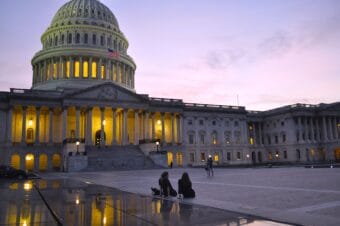
The U.S. Capitol building
The U.S. Capitol. (Liz Ruskin/Alaska Public Media)

The House of Representatives narrowly approved legislation Thursday to eliminate the next two years of federal funding for public media outlets.

It did so at the direct request of President Trump, who has accused NPR and PBS of bias against conservative viewpoints as part of his broader attacks on the mainstream media.

The measure passed largely along party lines, 214 to 212, with two key Republican lawmakers switching their votes from “no” to “yes” to push it over the finish line.

The legislation is the first request by the Trump administration for Congress to claw back money it already has approved through annual spending bills. The bill reflects a list of cuts totaling $9.4 billion that were requested by the Office of Management and Budget. The bulk of the cuts — $8.3 billion — are to foreign aid programs addressing global public health, international disaster assistance and hunger relief.

The remainder would slash $1.1 billion allocated to the Corporation for Public Broadcasting (CPB), which distributes nearly all of the funds to local television and radio stations, for the next two fiscal years. By law, that money is supposed to be approved in advance as part of an effort to insulate public broadcasting from political influence over fleeting issues. That spending had been approved by both Republican-led chambers of Congress and signed into law by Trump earlier this year.

CPB, which is privately incorporated in Washington, D.C., is suing the Trump administration over his efforts to exert control over its board. CPB, PBS and NPR put out separate statements decrying the vote. Executives from the two networks urged the Senate to put a stop to the legislation.

“Americans who rely on local, independent stations serving communities across America, especially in rural and underserved regions, will suffer the immediate consequences of this vote,” NPR Chief Executive and President Katherine Maher said in a statement. “If rescission passes and local stations go dark, millions of Americans will no longer have access to locally owned, independent, nonprofit media and will bear the risk of living in a news desert, missing their emergency alerts, and hearing silence where classical, jazz and local artists currently play.”

Similarly, Paula Kerger, PBS’s chief executive and president, said the fight to protect funding for public media does not end with Thursday’s vote. She said the services provided by public television “cannot be replaced by commercial media.”

“If these cuts are finalized by the Senate, it will have a devastating impact on PBS and local member stations, particularly smaller and rural stations that rely on federal funding for a larger portion of their budgets,” Kerger said. “Without PBS and local member stations, Americans will lose unique local programming and emergency services in times of crisis.”

A coalition of local public media officers, emergency readiness officials, Native American tribal representatives, educators and others had joined with listeners and viewers to lobby lawmakers against the bill.

Support for public media has, historically, been fairly bipartisan. But the idea of getting government out of the business of subsidizing public media has always struck a cord in more conservatives parts of the Republican party, and it has been increasingly resonant in recent years.

The Republican majority prevailed on Thursday with a paper-thin margin, however, relying on the flipped votes of Reps. Don Bacon of Nebraska and Nick LaLota of New York.

LaLota and Rep. Mike Lawler, both of whom represent the suburbs of New York City, have bucked party leadership over the separate issue of whether a new budget would return property tax deductions for pricey mortgages. LaLota could be seen on the floor conferring with House leaders just moments before reversing from “no” to “yes.” Lawler’s vote was among the last cast.

Heated partisan debate before the vote

When House Majority Leader Steve Scalise formally introduced the legislation last week, he said it “codifies President Trump’s cuts to wasteful foreign aid initiatives within the State Department and USAID, as well as woke public broadcasting, including NPR and PBS, at the Corporation for Public Broadcasting, which is a business the federal government shouldn’t even be in.”

Republicans attacked the programs they targeted for cuts in speeches Thursday before the vote. “Don’t spend money on stupid things and don’t subsidize biased media,” Ohio GOP Rep. Jim Jordan said.

Democrats defended public broadcasting as providing essential services. They cited the need for local information during natural disasters and balanced news coverage.

“NPR and PBS are targeted here today precisely because they are so good at delivering the truth,” Texas Democratic Rep. Lloyd Doggett said. He pointed to Trump’s social media attacks on the outlets, saying, “Trump doesn’t want a country of engaged, informed Americans. He prefers those who salute on command.”

House Minority Leader Hakeem Jeffries, who has accused Republicans of rubber stamping Trump’s agenda despite their own misgivings, held up a doll of Elmo, the Sesame Street character, on the House floor.

“The letter of the day is ‘C’. How appropriate because this bill is cruel, and it cuts children’s programs all across the country,” he said.

After the vote, Rep. Mark Amodei, a Nevada Republican who is co-chair of a bipartisan caucus supporting public broadcasting, condemned the outcome.

“Before we trigger major consequences for our local public broadcasting stations throughout the West and other rural areas, we need more discussion—rather than railroading folks over the East Coast’s editorials and indiscretions,” Amodei said in a statement. “I agree we must make meaningful cuts to shrink our federal deficit; however, I would be doing a disservice to the thousands of rural constituents in my district if I did not fight to keep their access to the rest of the world and news on the air.”

While a handful of Congressional Republicans have joined Amodei in supporting their local public radio and television stations, there is intense pressure on them to side with the president. Heritage Action, a grassroots conservative group, designated the vote on the rescissions bill as the first “key vote” included on their scorecard tracking lawmakers’ voting records this session of Congress.

Some of Trump’s supporters have been frustrated that Congress has not moved sooner to officially back the cuts recommended or put into motion already by the Department of Government Efficiency or DOGE, launched by Elon Musk. Musk initially vowed to cut $2 trillion from the federal budget, then scaled back to $1 trillion. The actual amount so far has been a small fraction of the trillion promised. But Musk’s imprint slimming down or gutting some federal agencies has already reverberated in fallout in the U.S. and around the world.

Musk’s recent departure from the administration and public feud with the president haven’t affected the plans of top GOP leaders on Capitol Hill to schedule votes to formally wipe out spending for the targeted agencies and programs. House Speaker Mike Johnson said Tuesday he expected additional votes on rescissions requests based on DOGE’s efforts.

After the heads of both NPR and PBS testified before a House oversight panel in March, the speaker argued in a statement on social media that NPR and PBS “have consistently and knowingly betrayed the public trust. Instead of fair and balanced reporting, they routinely ignore facts to advance a far left agenda.”

“The American people support the free press, but will not be forced to fund a biased political outlet with taxpayer funds,” Johnson said.

Conservative views on public media have changed

Two former Republican lawmakers say that the GOP sentiment toward public broadcasting has shifted over time — from frequent support to skepticism to open hostility.

“I always supported PBS on the rationale that ‘just because Barnes and Nobles sold books didn’t mean public libraries were no longer needed’,” former Oregon Sen. Gordon Smith, who served from 1997 to 2009, tells NPR. “But even in those days, I would admonish my friends in PBS to strive for better political balance. This, they haven’t done.”

Smith says he gave the same advice after later becoming chief of the National Association of Broadcasters, a trade group to which PBS and NPR do not belong. “Given the size of the public debt and PBS’s ability to find other financing and sell advertising, well, they’ve left themselves vulnerable,” Smith says.

Former U.S. Rep. Charles Bass came to office with former U.S. House Speaker Newt Gingrich’s big Republican wave. Bass went on to represent New Hampshire’s 2nd Congressional District for 14 years.

“The debate over whether to fund public television or public radio networks is more divisive than it was,” Bass says. “By that process, it is likely to be more imperiled.”

“To some extent it’s influenced by the perception that it’s more liberal than it actually is,” Bass says. “There is a bent to it, but it’s not as significant as the commercial networks — Fox and MSNBC on either end and CNN in the middle. They really are.”

Bass says public broadcasting stands apart for avoiding commercial priorities. But, he says, technological changes in how people consume media have raised valid questions about the need for federal subsidies.

He says that the shift in formats from music to all news and public affairs talk by many NPR member stations increased content that has proved controversial and attracted scrutiny by critics, especially on the right.

Yet he also says the lines have hardened within Republican ranks toward public broadcasting as cultural warfare has become increasingly important to the party faithful: first with Gingrich, then with the Tea Party, and now MAGA Republicans with Trump at the lead, each of which have sought to present public media as unworthy of taxpayer dollars.

“I would be pondering this seriously. I wouldn’t be a lock-step supporter or opponent of public radio or television funding,” Bass says. “That’s true even though I probably listen to [New Hampshire Public Radio] as a news source more than any other source of news.”

A bumpy history of public media funding

Congress created CPB, a private nonprofit entity, in 1967. President Lyndon B. Johnson signed the law making CPB the entity to oversee federal grants to more than 300 public television stations and more than 1,000 public radio stations.

In the early years, there were questions about the federal role for CPB. In 1969, Fred Rogers, the host of the popular children’s show “Mister Rogers’ Neighborhood,” testified about the benefit of continued federal funding. His defense of CPB was credited with changing the mind of a key senator, John Pastore, a Rhode Island Democrat who had pressed Rogers on the value of public television.

Rogers described themes in his half-hour program addressing children’s feelings and offering ways to handle them. He told the congressional panel, “I feel that if we in public television can only make it clear that feelings are mentionable and manageable we will have done a great service for mental health.”

Lawmakers from both parties frequently appear on their local public stations for interviews. They participate in debates hosted by local stations during House and Senate campaigns.

But for decades, Republicans in Congress have vowed to defund public media outlets. In 1994, then-House Speaker Newt Gingrich argued for zeroing out CPB’s budget. That didn’t advance, but in more recent years Republicans have included provisions in annual spending bills to strip all federal money for NPR and PBS. But these have failed to be included in final versions of government funding bills enacted by presidents of both parties.

In 2011, the GOP-controlled House approved a bill to bar NPR from receiving any additional federal funding, but that measure failed to advance in the Senate. Seven House Republicans voted against that bill, including then-Wisconsin Rep. Sean Duffy, who now serves as Trump’s transportation secretary.

More recently during years of divided government, GOP leaders had to rely on Democrats to approve must-pass funding bills to avoid shutdowns. The debate over the issue of federal funding for public media became more of a backburner issue. CPB received $535 million for 2025. The spending bill approved with bipartisan votes in the House and Senate and signed by Trump in March approved the same level for the next two years.

Just two months later, Trump issued an executive order to block funding for NPR and PBS. And this first effort by the Office of Management and Budget to ask Congress to rescind federal money lumped in public media with foreign aid — two areas the GOP base frequently holds up as priorities Washington needs to scale back or eliminate altogether.

Concern for rural areas

Earlier in the week, Amodei and Democratic Rep. Dan Goldman of New York released a joint statement urging the Trump administration to “reconsider” clawing back money for CPB.

The two pro-public broadcasting lawmakers touted public media’s news coverage and its role in communicating during emergencies, and pointed out that rural areas are “particularly vulnerable” if funding is cut.

“Public broadcasting represents less than 0.01% of the federal budget, yet its impact reaches every congressional district,” the two noted. “Cutting this funding will not meaningfully reduce the deficit, but it will dismantle a trusted source of information for millions of Americans.”

Goldman told NPR that Trump’s role in pushing this issue is “100%” making this a tough vote for GOP lawmakers to break with the president. “I think if they looked at the merits of it they would recognize it’s essential funding — and public media, independent journalism plays an essential role,” Goldman said.

He argued that Trump objects because “independent media that exposes facts that may look unfavorable to him is therefore somehow biased, but the First Amendment protects freedom of the press specifically because the press is an essential form of accountability in our democracy.”

Some Republicans have defended their own local public television and radio stations and expressed a willingness to work with Democrats to avoid cuts that would force them to scale back coverage or staffing.

Alabama GOP Rep. Robert Aderholt, pressed by Colorado Democratic Rep. Joe Neguse in a hearing on the bill on Tuesday, said Alabama Public Television “has not been subject to these woke policies that some of these other states have,” and suggested he could join a bipartisan effort to continue grants to local stations.

But Aderholt noted “NPR is in a different category” and said most GOP lawmakers have had concerns about the outlet for some time.

Even so, most of the cuts will fall on the local stations, which receive by far the lion’s share of the funds. Some of that money makes it back to PBS and NPR in the form of fees to run the networks’ programs on the air.

Public television and radio stations have mounted a grassroots lobbying effort to urge lawmakers to oppose the package. The Protect My Public Media campaign says more than 2 million messages have been sent to House and Senate offices. “This support is driven by the deep connections Americans have to their local public media stations and the essential services stations provide to their communities.”

The rescissions package now moves to the Senate. Under the rules, it needs a simple majority to pass and must be approved within 45 days of the president sending the request to Capitol Hill. That means if the Senate — where Republicans also have a slim majority — fails to pass the bill by mid-July, the administration would be required to release the $9.4 billion in funding for the foreign aid programs and CPB. Senate Majority Leader John Thune has indicated the Senate would take up the rescissions request soon.

Disclosure: This story was reported and written by NPR Congressional Correspondent Deirdre Walsh and Media Correspondent David Folkenflik.  It was edited by Deputy Business Editor Emily Kopp, Managing Editor Vickie Walton-James and Managing Editor Gerry Holmes. Under NPR’s protocol for reporting on itself, no corporate official or news executive reviewed this story before it was posted publicly.

Who has beef with the Republican mega-bill? Alaska’s solar industry, among others.

Josh Craft, an Alaska energy consultant, was in Washinton, D.C. on June 11, 2025 to advocate for renewable energy tax credits. He waited with Caitlin McLennan, who helped organize the visit, in the office of Congressman Nick Begich. (Liz Ruskin/Alaska Public Media)

WASHINGTON — The U.S. Capitol complex is crawling with citizen advocates these days, mobilized by one part or another of the “One Big Beautiful Bill” pending in the Congress.

A cluster of anti-hunger champions took a breather Wednesday afternoon in a stairwell of the Cannon House Office building.

“We have 500 advocates on the Hill today, from almost every state in the nation, and we have 200 Hill meetings,” said Cheri Andes, an organizer for Bread for the World, from Massachusetts.

Proposed cuts to SNAP and Medicaid have captured most of the attention since the reconciliation bill emerged in the House in May, but in its more than 1,000 pages are sections that have all kinds of interest groups knocking on congressional doors. They’re asking lawmakers to block the bill, or blunt some of its provisions.

Alaskans are walking the marbled halls, too. Chase Christie, development director for Anchorage-based company called Alaska Solar, flew to Washington to defend renewable energy tax credits that the House-passed bill slates for extinction. Josh Craft, an energy consultant and project manager from Wasilla, was on the same mission.

man in a checked shirt. Behind him a sign reads "Experts in the Field."
Chase Christie is development director of Alaska solar. He was at the U.S. Capitol June 11, 2025 to advocate for tax credits that have helped advance the renewable energy industry. (Liz Ruskin/Alaska Public Media)

Wednesday they went to Alaska Congressman Nick Begich’s office. Begich, a freshman Republican, voted for the reconciliation bill, and with it the cancellation of renewable energy credits that have boosted Christie and Craft’s industry.

Christie honed his message for the freshman Republican.

“Solar and renewables in general are unnecessarily politicized in this country,” he said, enroute to his appointment with a Begich staffer. “Nobody from our contingent is saying ‘solar only.’ We’re saying ‘solar and.’ Fill in the blank: Natural gas, oil, whatever. We’re part of the energy solution for this country.”

At stake are several kinds of tax credits. Some help homeowners install solar panels, heat pumps and the like. Thousands of Alaskans have claimed them. Other credits give utilities incentives to install large-scale solar or wind generation. And, utilities could sell their credits to investors.

Craft says together they’ve made for an effective financing tool.

“You can’t go to a bank and ask them for $500 million to do a wind project because they don’t have the underwriting capability. The banks don’t have the programs in place,” Craft said. “So the investment firms are the ones that have stepped up and provided the capital for local folks to go out and build these projects … because they get the credits.”

Eliminating the clean energy producer and investment tax credits would save about $250 billion over 10 years. The Congressional Budget Office estimates they’ve increased private investment in the renewables industry by about 30%.

Another Alaskan on Capitol Hill, advocating against specifics in the reconciliation bill, is Laurie Wolf. She’s president of the Foraker Group, a non-profit that supports other Alaska non-profits. Wolf is focused on tax provisions in the bill that would tend to suppress charitable contributions and philanthropy.

“Specifically, calling out areas that would deeply impact Alaska’s nonprofits and the people that we serve,” she said.

As she talks to the congressional delegation, Wolf said she can’t overlook the proposed cuts to Medicaid.

“Every rural (and) every urban health care system in Alaska relies on that, the equation of Medicaid,” she said. “And you can’t take that equation out and expect there to be health care for all Alaskans.”

Republican leaders in Congress had hoped to pass the reconciliation bill by July 4. But Republican senators have been slow to reach agreement among themselves about the bill, which is projected to add $3 trillion to the deficit.

On National Trails Day, the future of trail work in Juneau looks brighter

Trail Mix Inc Director Meghan Tabacek holds a Pulaski as she demonstrates safe tool usage to volunteers. She's standing on the bed of a pickup truck, wearing a red halibut jacket and lemon earrings.
Trail Mix Inc Director Meghan Tabacek holds a Pulaski as she demonstrates safe tool usage to volunteers on June 8, 2025. (Photo by Yvonne Krumrey/KTOO)

On the first Saturday in June — National Trails Day — Juneau’s trail maintenance nonprofit gives volunteers a chance to pick up a shovel and help with trails.

Trail Mix Inc Director Meghan Tabacek stood in the back of a pickup truck, holding up tools for volunteers to see. 

“We have the shovel, the tried and true,” she said. “Not a lot of concerns with the shovel.”

She gave volunteers advice on how avoid the shovel’s few dangers.

“My one concern is, I highly recommend holding the shovel both hands on it like this,” she said, demonstrating proper form to avoid injury.

Volunteers file up the trail with rakes, hoes, and mattocks in hand to pack muddy spots with gravel.

The volunteers came out because they care about Juneau’s trails – and lately their work has felt more vital than ever. This spring, federal funding uncertainty meant that trail work on some of those beloved trails could have been deferred. Now, the situation is more hopeful: trail workers have their jobs back, and funding may still come. 

It was Rachel Disney’s first time volunteering with Trail Mix. Instead of a hand tool, she pushed a motorized wheelbarrow full of gravel.

“Being able to get out and hike and be in the woods was my main reason for staying in Alaska when I got here,” she said. “So I want to be able to make sure that people can continue being out in the woods here.”

Disney said the future of Juneau’s trails means a lot to her. 

But that future has been uncertain. After the Trump administration canceled federal grants and fired federal workers— including dozens of U.S. Forest Services employees based in Juneau—Trail Mix leadership decided to reduce its scope in case its federal funding was canceled.

Two women Ami Reifenstein and Maggie McMillan hold tools on a trail on a forested path.
Trail Mix Inc. board members Ami Reifenstein and Maggie McMillan volunteering on the Spaulding Meadow trail on National Trails Day. June 8, 2025. (Photo by Yvonne Krumrey/KTOO)

With that in mind, the organization pivoted to fundraising, and planned to work only on city-owned projects — not Juneau’s heavily-used Forest Service trails.

At the time, job cuts halved Juneau’s Forest Service trail work crew.

Donors stepped in, and Trail Mix raised just over $54,000 to put towards previously scheduled work on two heavily trafficked Forest Service trails and other projects. Tabacek said people often submit complaints about the condition of Peterson Lake and the Amalga Trail that reaches the Eagle Glacier cabin, so the group had planned the work before federal cuts came down.

“The work was already planned,” Tabacek said. “We were already hoping to do it. And so it was really great the community stepped up so we could do it.”

Tabacek planned to use the money to hire fired off Forest Service trail crew, but when she went to extend the offers, she found they had been rehired by the federal government.

“They have one full trail crew of all returning staff,” she said. “Which was really great for them, just because returning people have a lot of experience.”

And Tabacek says it looks like the majority of their expected federal funding will be honored after all. The Forest Service has not confirmed the staffing levels in Juneau. 

Trail Mix Inc. volunteer Henry Lloyd and two others shovel gravel out of a red motorized wheelbarrow onto the Spaulding Meadows trail on National Trails Day.
Trail Mix Inc. volunteer Henry Lloyd (center) shovels gravel out onto the Spaulding Meadows trail on National Trails Day. June 8, 2025. (Photo by Yvonne Krumrey/KTOO)

But she said, RIFs—or Reduction in Force efforts—still loom for the Forest Service employees. Now, federal rulings are blocking them, but Trail Mix is reserving some of the fundraised money to be able to hire two Juneau trail workers who may lose their jobs in future cuts.

“There is still kind of the omnipresent threat looming over the heads of federal workers that they might lose their job,” Tabacek said.

If there are no more cuts to trail jobs in Juneau, then the money set aside will go towards trails people want to see improve, she said. 

Trail Mix crews are currently working on a reroute trail to Mt. Jumbo, also called Sayéik, and the Thunder Mountain Bike Park.

Site notifications
Update notification options
Subscribe to notifications