Federal Government

Legislators argue cuts in GOP megabill would mean ‘chaos’ for Alaska

Rep. Nellie Jimmie, D-Tooksook Bay, speaks with House Speaker Bryce Edgmon, I-Dillingham, during a floor session on Monday, March 10, 2025.
Alaska House Speaker Bryce Edgmon, I-Dillingham, speaks with Rep. Nellie Jimmie, D-Tooksook Bay, during a floor session on Monday, March 10, 2025.

Some key Alaska state legislators are pushing back on the Republican budget package known as the “big, beautiful bill.”

With U.S. Senate votes coming soon, state Senate Majority Leader Cathy Giessel, R-Anchorage, said she and House Speaker Bryce Edgmon, I-Dillingham, thought it was time to ring the alarm bells.

“Bryce and I … have been astonished and dismayed at what we’re seeing Congress looking at doing to our Medicaid program,” Giessel said in a phone interview Friday.

In a New York Times opinion piece Friday, the pair of legislative leaders argued the tax- and spending-cuts package would “throw state budgets into chaos” for rural states like Alaska.

Roughly one in three Alaskans has Medicaid coverage. Edgmon, who represents Bristol Bay and other rural Southwest Alaska communities, said the program props up communities throughout rural Alaska.

“It’s so interwoven as a whole into our entire economy out here — everything from air taxis to restaurants to transportation to certainly health care itself,” Edgmon said in a phone interview from Dillingham.

The New York Times piece he co-authored with Giessel is headlined “Alaska Cannot Survive This Bill.”

Changes to Medicaid and the federal food aid program known as SNAP could push some families into bankruptcy and leave others without enough food on the table, Edgmon said. He and Giessel wrote that cuts to SNAP could force village grocery stores to close.

“The SNAP program, I’d characterize as one of the sleeper programs in Alaska, because it does provide a lot of benefits to people that sort of escapes … the average person’s comprehension of how important it is,” Edgmon said.

SNAP, the Supplemental Nutrition Assistance Program, pays for food for roughly 70,000 low-income Alaskans. All of the money for that food currently comes from the federal government, though the state shares half of the cost of administering the program.

The House-passed version of the One Big Beautiful Bill Act would, for the first time, require states to pay part of the cost of benefits.

A Senate proposal would push up Alaska’s SNAP costs by roughly $50 million, according to data Giessel shared from the state Division of Public Assistance.

The status of that provision in the Senate bill is in flux. It was recently stripped out of the bill under the rules the Senate is using to avoid a filibuster, but Republican leaders say they plan to push it back in as the bill approaches procedural votes, amendments and a final Senate vote, a process that could start as soon as Saturday.

Giessel says the changes couldn’t come at a worse time for Alaska’s already-stressed state budget. Lawmakers approved an austere spending plan this year as low oil prices sent them scrambling.

“It’s going to be hard to find that money,” she said. “How much more are we going to cut from the Department of Transportation? How much more are we going to cut from the Department of Corrections? How much more are we going to have to reduce our commitment to education?”

The impact of Medicaid changes on the state budget is less clear. The House-passed version of the bill would reduce federal spending on Alaskans’ health care by roughly $200 million per year and leave tens of thousands of Alaskans without health coverage, according to the Kaiser Family Foundation and health care groups.

Giessel argues that would force some costs indirectly onto state and local employees’ health insurance, since more uninsured Alaskans would forgo primary care and instead show up at emergency rooms — federal law requires them to treat everyone, even if they can’t pay.

Defenders of the tax and spending cuts package, though, say opponents vastly overstate the impacts on Alaska’s budget.

Much of the projected loss in Medicaid spending is linked to a proposed work requirement for adults without children. But the most recent Senate draft has exemptions for Alaska Native people covered by the Indian Health Service, people with serious mental health conditions, including substance abuse, people living in areas where the unemployment rate is above 8%, pregnant and postpartum mothers, and people receiving major medical care outside their home community.

The state’s chief Medicaid administrator, Department of Health Deputy Commissioner Emily Ricci, said those broad exemptions mean it’s tough to anticipate just how many Alaskans might lose Medicaid coverage.

“Many national estimates don’t reflect Alaska’s unique circumstances or the exemptions in the bill that apply here, so they may overstate the impact on our state,” she said in a statement. “The bill is not complete, the Department is closely tracking as it develops.”

House Minority Leader Mia Costello, an Anchorage Republican, said in a statement that the bill “protects our most vulnerable while ensuring that benefits are targeted and sustainable.”

“It is narrowly focused on the subset of adults who are fully able to work but choose not to,” she said.

Gov. Mike Dunleavy, in a statement on social media, pointed to a broad range of energy-related provisions in recent Senate drafts that would ease drilling on federal land and direct more oil and gas tax revenue to the state, and another that would provide $300 million to homeport an icebreaker in Juneau.

Costello said the bill, which also extends and expands tax cuts passed in 2017, would give the state’s economy a boost.

“To claim Alaskans can’t ‘survive’ a federal budget bill that is due to unleash so many aspects of our economy while maintaining benefits to our most vulnerable is misguided,” she said.

But Giessel, who is a family practice nurse practitioner, questioned whether Alaskans would truly benefit from the bill’s carve-outs.

“What does it take to get an exemption? It takes someone applying for that exemption,” she said. “I can tell you that people applying right now, even for Medicaid benefits, are waiting months.”

Another Republican legislative leader, Senate Minority Leader Mike Shower of Wasilla accused Giessel and Edgmon of fearmongering and questioned the pair’s commitment to reining in costs in the state budget.

“The leadership in the Alaska Legislature refuses to entertain anything along the lines of a balanced and realistic fiscal policy. Instead, it’s how to protect government, no discussion of protecting and encouraging the private sector, and how we are going to tax Alaskans to pay for a state government that — by their own tacit admission in the (opinion piece) — we can’t really afford,” Shower said in a statement.

As of Friday afternoon, Senate leadership has yet to unveil the final text of the bill, even as they plan to vote as soon as this weekend. Edgmon says that makes it difficult to assess what it would mean for the state in any appreciable level of detail.

The bill is likely to span hundreds of pages, and Edgmon says the race to pass the fast-changing bill by the president’s July 4 deadline makes it hard to anticipate the consequences.

“I don’t think anybody, even ourselves as long term legislators, have a full understanding of what those impacts could be as they trickle down the entire economy,” he said.

The Congressional Budget Office, which analyzes the impact of federal legislation, said last month that the House’s version of the megabill would on average, accounting for both the tax and benefit cuts, increase the resources available to the average American. But the highest-income households would come away with more — while those in the bottom 10% would be worse off.

Edgmon and Giessel closed their opinion piece with a warning.

“Alaska is one of the most amazing places in our country,” they wrote. “Congress is risking our way of life to give money to the rich.”

Juneau residents rally for Medicaid as Congress nears megabill vote

Kris Cheng waves at passing cars with other protesters at a protest outside Senator Dan Sullivan’s office on June 27, 2025. (Photo by Jamie Diep/KTOO)

Dozens of Juneau residents gathered outside U.S. Sen. Dan Sullivan’s office Friday to implore him to consider Alaskans’ reliance on Medicaid. 

The U.S. Senate is expected to vote soon on President Donald Trump’s megabill, which would limit Medicaid eligibility.

Kris Cheng holds a poster with photos of her son Henry, who relies on Medicaid after a traumatic brain injury. June 27, 2025. (Photo by Jamie Diep/KTOO)

For many protestors, the threats to health care coverage were deeply personal. That’s the case for Kris Cheng, who held a homemade poster covered with photos of a boy, one where he is in a hospital. 

“It’s about my son and the fact that he’s on Medicaid after a severe traumatic brain injury,” she said. “And the fact that I’m scared it’s gonna be taken away.” 

Her son Henry is 23, and due to an accident nine years ago, he needs specialized care that he has to travel to Seattle for. Medicaid helps cover those visits, and without it, the costs would fall on their family.

“And without that, he can’t be independent,” Cheng said. “He needs these injections that he gets. He needs the specialized care for brain injury down there. When he doesn’t get it, he’s more susceptible to falls, which ends up costing everybody more money.” 

Cheng’s poster had the words “not a fraud” and “not a scammer” interlayed with the photos of Henry. She said that’s in response to messaging she’s heard from politicians about Medicaid recipients.  

“My son is not a waste, he’s not a fraud, he’s not an abuse of anything,” Cheng said. More than 200,000 Alaskans are covered by Medicaid and the equivalent program for children. The megabill, if passed, could make it harder for those recipients to continue receiving care, and some may lose insurance completely.

Advocates worry ‘big, beautiful’ GOP bill would push Alaskans off Medicaid

Anchorage residents held a protest outside of Representative Nick Begich’s office Wednesday afternoon, urging to help protect Medicaid. May 21, 2025. (Matt Faubion/Alaska Public Media)

If you ask the chief advocate for Alaska’s hospitals and nursing homes, Jared Kosin, there are plenty of ways to improve health care in the state. He said reducing the number of people with health insurance isn’t one of them.

This is terrible health care policy,” said Kosin, who heads the Alaska Hospital and Healthcare Association. “The predominant issue with it is it’s premised on achieving a savings target, that’s what they’re after, to fund these tax cuts.”

The Republican megabill making its way through Congress would make significant changes to benefits programs like Medicaid and SNAP, which would affect Alaskans across the state. The so-called “big, beautiful bill” with tax and spending cuts is changing fast, and it’ll likely keep changing right up until the bill passes.

The Congressional Budget Office, Congress’s official scorekeeper, estimates that the version of the bill that passed the House would push 16 million Americans off of government-funded or -subsidized health insurance. Divide that by Alaska’s population, and you get somewhere in the neighborhood of 30 to 40 thousand Alaskans at risk of losing insurance, either from Medicaid, which the state calls DenaliCare, or the federal health insurance marketplace.

That doesn’t mean those Alaskans won’t need health care.

But Kosin said they won’t get it until it becomes urgent. Hospital emergency rooms have to see everyone, even those who can’t pay. That would push up the cost of healthcare for everybody else, he said.

“What you can expect from that is there’d probably be a pretty significant cost shift over to private insurance, and so you’d see an increase in premiums for everyone else to offset these massive losses,” Kosin said.

Kosin said the drop in the number of insured people, especially in low-income rural areas with many Medicaid patients, would force hospitals to cut back on services or even close their doors.

The bill House Republicans passed includes new work requirements for Medicaid. That means that every six months, you have to prove to the state, which administers the program, that you have a job and that you’re working at least 80 hours a month. Or that you’re exempt.

Right now, though, the state is already struggling to keep up with the paperwork it’s tasked with and has a well-documented backlog.

Billy Stapleton Jr. is a state benefits processor and union representative who went to Washington to push back on the bill, and said new paperwork requirements would make things worse.

“That would cripple us because Medicaid is renewed once a year,” he said. “Now we have to focus on one case and put eyes and hands on it twice a year.”

The Alaska Division of Public Assistance is already way behind. He said he’s currently, in June, processing applications for the Supplemental Nutrition Assistance Program, or SNAP, that have been pending since November.

The House version of the bill has provisions that would require Alaska to pay tens of millions of dollars for the SNAP program. And whether the state could afford to pick up the tab is unclear, said state House Finance Committee co-chair Andy Josephson, an Anchorage Democrat.

“Will the Legislature, writ large, and the governor support back filling those items? I don’t know. That’s an open question,” he said.

Another open question is whether the SNAP provisions make it into the final bill at all. And that’s a lot of what Alaska’s Senate delegation is saying right now: The bill is in flux.

A spokesperson for Republican Sen. Dan Sullivan said he’s working hard to ensure the final bill doesn’t reduce Alaskans’ access to Medicaid or SNAP benefits.

She said Sullivan generally supports work requirements for Medicaid and doesn’t see them as a cut. But, she said Sullivan has pushed for a variety of “exemptions and carve-outs to protect vulnerable Alaskans.”

“He will continue to work during implementation to ensure that paperwork and administrative burdens do not prevent people from accessing the critical safety net programs they rely on,” Sullivan’s communications director, Amanda Coyne, said by email.

The bill exempts most Alaska Native people, people in high-unemployment areas, parents, veterans, pregnant women and people with mental health conditions, including substance abuse issues.

At the same time, opponents say that just applying the exemptions would be challenging for the state and the applicants.

But another thing to note: the Senate’s working copy of the bill allows the federal government to exempt states like Alaska from implementing the work requirement through 2028, as long as the state makes a good faith effort to upgrade its systems to handle the new paperwork requirements. But there are no guarantees the state would get that exemption.

A spokesperson for Republican Sen. Lisa Murkowski said she continues to have concerns about the bill and its impact on Alaskans who depend on Medicaid and SNAP.

“The landscape is rapidly evolving and discussions are ongoing,” spokesperson Joe Plesha said in a statement.

It’s unclear when the Senate will take up amendments and start voting on the bill. But President Donald Trump is pushing for the final bill to be passed by the Fourth of July.

Public land sales struck from federal reconciliation bill, but some might make it back in

Residents of Prince of Wales Island gather on a remote beach at Port Protection on June 21, 2025, to urge lawmakers to keep public lands in public hands. (Photo courtesy of Colin Arisman)

Listen to this story:

A mandate to sell millions of acres of public land was struck from the Republican budget reconciliation bill that’s moving through the U.S. Senate this week. That’s after the Senate parliamentarian ruled on Monday that the public land sales didn’t clearly affect the budget. But some parcels of land might make it back into the bill. 

Two days before the parliamentarian’s ruling, dozens of people gathered on a remote beach on Prince of Wales Island, taking a picture with a large wooden board painted with three red words: NOT FOR SALE. Then they sent the photo to lawmakers.

“When we were holding that sign, I think we all felt upset,” Elsa Sebastian said. “This was happening for reasons that we didn’t understand.”

Sebastian lives in a small community near Port Protection. It’s a remote area surrounded by the flora and fauna of the Tongass National Forest — and she said that’s why people live here.

“It’s our way of life,” she said. “It’s being able to continue to hunt and fish and play and explore and, like, find ourselves in these places.”

Sebastian said the lack of public engagement from lawmakers felt like a betrayal of trust, and privatizing parts of the Tongass would significantly affect rural communities like hers.

“We need ultimate transparency when it comes to decisions around our public lands,” she said. “And that’s not what we got this time around.”

U.S. Sen. Mike Lee, R-Utah,  added the proposal to the mega bill that would have required the U.S. Forest Service and Bureau of Land Management to sell off roughly two to three million acres of land across 11 western states. 

National parks, monuments and other protected lands were excluded, but roughly 82 million acres in Alaska could have been eligible for those sales, including sections of the Tongass and Chugach National Forests and parts of the Interior. 

U.S. Sen. Lisa Murkowski, R-Alaska,  told the Anchorage Daily News last week that public land sales would help Alaska develop affordable housing. But much of the identified public lands are not suited for housing development. 

The Senate parliamentarian decided that the mandate breaks a rule ensuring that reconciliation bills like this one focus on fiscal issues rather than unrelated policy changes and ordered the section’s removal.

Lee is reportedly revising the public land sale proposal to try to include BLM lands within five miles of town borders. According to The Hill, that would include a sale of somewhere between 600,000 and 1.2 million acres of BLM land nationwide. The new proposal is expected to exclude National forest lands, so the Tongass and Chugach National Forests might not be affected.

Joe Plesha, Murkowski’s communications director, said the language is currently evolving, but it’s now about selling public lands purely for housing and local needs associated with housing. He said there might also be provisions for a review process. 

“Eligible BLM lands could be made available to build housing for communities after a significant process that involves nominations, consultation, review and first right of refusal for local governments,” Plesha said in a statement to KTOO. 

The Forest Service and BLM declined to comment on pending legislation, and the U.S. Department of Agriculture, which manages the Forest Service, did not respond. 

Kate Glover is a Juneau-based attorney at Earthjustice, an environmental law firm. She said the Forest Service and BLM already have the authority to sell or exchange land under current laws.

“But in those cases, the agencies have to take a look at the public interest and decide whether it makes sense to sell the land or not,” Glover said.

She said what’s different about a mandate is that it would require sales whether or not they are in the public interest.

Also, Glover said that selling steep and rugged public lands won’t solve Alaska’s affordable housing problem because many of those areas are not connected to existing infrastructure. 

“It’s more likely that that’s going to allow for building new mansions and second homes for people from out of state,” she said. 

The Wilderness Society published a map showing swaths of land that could qualify for sales under the original bill, fueling public outcry on social media. Josh Hicks is the organization’s director of conservation campaigns in Denver, Colorado. He said the controversial idea to sell off public lands is widely unpopular. 

“We’re seeing people from across the political spectrum in opposition to this proposal,” Hicks said. “A lot of folks in the sporting community who go and hunt and fish in our public lands absolutely are rising up.”

Some Republican representatives from Colorado, Idaho and Montana spoke out against the sell-off. Alaska Congressman Nick Begich III, who voted for the bill when it passed through the House, did not respond to a request for comment. Sen. Dan Sullivan, who has indicated support for public land sales in Alaska, also did not respond. 

Amendments to the bill have not yet been made public, and it’s unclear whether revised public land sales will be approved by the parliamentarian. Senate Republicans are aiming to vote on the bill by July 4. 

U.S. Senate approves bill with funding for some rural Alaska schools and towns

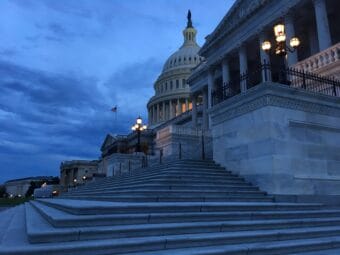
The U.S. Capitol in Washington, D.C., on Thursday, April 18, 2024. (Photo by Jennifer Shutt/States Newsroom)

The U.S. Senate voted unanimously on June 18 to resume the federal Secure Rural Schools program, which sent millions of dollars to small Alaska schools each year until Congress failed to reauthorize it in 2023.

Congress passed the Secure Rural Schools and Community Self-Determination Act in 2000, which launched the program as a way to help logging towns cope with the loss of revenue caused by a slowdown in logging on nearby federal land.

In 2023, it directed more than $250 million to communities nationwide and over $12.6 million to Alaska towns.

But in 2024, a reauthorization bill stalled in the House of Representatives, and the program ended. In the wake of that failure, some rural schools in Alaska, particularly in Southeast Alaska, have suffered significant budget cuts.

This spring, the Alaska Legislature voted by a 56-4 margin to approve a resolution that calls on Congress to renew the program.

Sen. Lisa Murkowski, R-Alaska, cosponsored a reauthorization bill, and the Senate approved it last week.

“If you’re a city manager building a budget or a school administrator looking at new hires, you need financial certainty. That’s why renewing the Secure Rural Schools program before funding lapses has been one of my top priorities in this Congress, and today was a crucial step in that process,” Murkowski said in a written statement. “I hope my colleagues in the House will quickly pass this legislation to provide stability for Alaska’s schools and local governments.”

Trump administration announces plans to rescind Roadless Rule once again

The Tongass National Forest is the largest temperate rainforest in the country. With exceptions, the Clinton-era Roadless Rule restricted road building and industrial activity in around 55% of the national forest. Advocates for its repeal said it posed unnecessary hurdles to development projects, like logging, mining, and renewable energy. (Erin McKinstry/KCAW)

The U.S. Department of Agriculture announced plans to rescind the Roadless Rule yesterday, aligning with President Donald Trump’s executive order earlier this year to end a ban on constructing roads in undeveloped areas of the Tongass National Forest in order to stimulate more logging in the region.

The Roadless Rule has flip-flopped multiple times since it was established to protect undeveloped lands in 2001. It was rolled back during Trump’s first term before being reinstated by former President Joe Biden. 

Mike Jones is the Tribal President for the Organized Village of Kasaan on Prince of Wales Island, an area of the Tongass that has been logged heavily. 

“It’s the largest temperate rainforest in the world … it’s the northern lung of the planet,” Jones said of the Tongass.

He said new roads and additional logging would degrade the landscape and harm salmon streams that people rely on. 

Rolling back the Roadless Rule in Alaska hasn’t been popular in the past. When the U.S. Forest Service considered exempting the state from the federal Roadless Rule back in 2019, more than 144,000 people submitted public comments and most were opposed to opening up the Tongass to new roads. 

U.S. Senators Lisa Murkowski and Dan Sullivan both welcomed the rollback. 

“Repeal will not lead to environmental harm, but it will help open needed opportunities for renewable energy, forestry, mining, tourism, and more in areas that are almost completely under federal control,” Murkowski said in a statement today.

Kate Glover is an attorney at Earthjustice, an environmental law firm that has challenged past rescissions of the Roadless Rule on behalf of tribes, conservation nonprofits and tourism and fishing groups. 

“It’s disappointing to see the administration doing something that’s so clearly contrary to what the public is asking for and is contrary to the public interest,” Glover said. 

More than 9.2 million acres of the Tongass are inventoried as roadless areas under the rule. Nearly 330,000 acres of the 16.7 million-acre forest are considered suitable for logging, according to the U.S. Forest Service’s latest 2016 management plan. That plan is currently going through a revision

The USDA did not respond to a request for comment. Viking Lumber and Alcan Timber, the largest logging companies operating in the Tongass, also did not respond.

Site notifications
Update notification options
Subscribe to notifications