Federal Government

Feds ask court to dismiss timber industry lawsuit that aims to increase Tongass old-growth logging

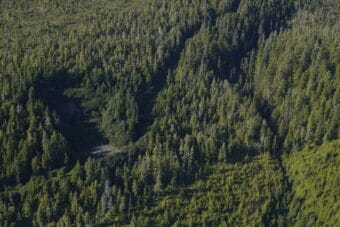
The Tongass National Forest covers more than 80% of the land in Southeast Alaska. (Photo by Katie Anastas/KTOO)

Listen to this story:

The largest timber companies operating in Southeast Alaska want the Tongass National Forest to sell them more old-growth timber, and they’re suing the federal government to get it. The Department of Justice asked the court to throw the case out in May.

The Alaska Forest Association along with two of their members, Viking Lumber and Alcan Timber, filed the lawsuit in March, alleging that the U.S. Department of Agriculture failed to fulfill a promise to supply the companies with enough timber to meet market demand. But the government filed a motion to dismiss the case, writing that it didn’t make such a promise.

The case comes after President Trump issued two executive orders aimed at expanding logging in the Tongass this March, and follows decades of legal disputes over Tongass timber. 

Frank Garrison is an attorney with Pacific Legal Foundation representing the timber industry. He said the industry has faced a 30-year decline, and that Viking and Alcan are struggling. 

“They’re on the brink of collapse,” he said. 

He said the companies rely almost completely on old-growth timber offered by the Tongass National Forest.

The government argues in the motion that it is only required to “seek to” provide enough timber to meet market demand while balancing other forest uses and ensuring their sustainability — as written in the 1990 Tongass Timber Reform Act. The law eliminated an old requirement for the Tongass to supply 4.5 billion board feet of timber per decade. The DOJ argues that the agency is not legally required to provide a specific amount of timber to companies.

The DOJ also writes in the motion that the timber sale objectives in the 2016 Tongass National Forest Management Plan are aspirational goals, not binding commitments that can be challenged in court. Furthermore, the government asserts that plaintiffs don’t point to a specific agency action or rule that has been violated. 

But Garrison said that the management plan gave timber companies an expectation that they would have roughly 15 years to transition their businesses from old-growth to new growth trees, and provided estimated amounts of old-growth timber that they could expect to buy. 

“The timber industry, including our clients, relied on the management plan when they were figuring out how they were going to run their business for the next decade,” Garrison said.

When the Forest Service announced the Southeast Alaska Sustainability Strategy in 2021, which proposed to end old-growth logging, Garrison said the agency abandoned its commitment to a slow transition.

The Forest Service has not met its annual target for timber sales in Alaska since 2014, according to a U.S. Government Accountability Office report published last year. Demand for forest products from the Tongass between 2015 and 2030 is estimated to range from roughly 41 to 76 million board feet per year, according to a Forest Service study published in 2016, the most recent market analysis. Between 2020 and 2023, the Forest Service offered sales for a total of 14 million board feet.

Garrison said he hopes that two recent Supreme Court decisions will tip the lawsuit in the industry’s favor. The first is DHS v. Regents, a 2019 case that set a precedent that federal agencies must consider whether those benefiting from a policy rely significantly on its continuation before upending it.

The second case is Loper Bright Enterprises v. Raimondo, which overruled a legal doctrine called Chevron deference last year. The doctrine directed courts to defer to federal agency interpretations of ambiguous laws. Now, the courts must use their independent judgment to interpret laws that agencies administer. It’s unclear whether these new precedents on agency discretion will factor into this case.

Nonprofit environmental law firm Earthjustice is representing a group that seeks to intervene in the case. It includes the Organized Village of Kasaan, the Organized Village of Kake, a boat tour company called The Boat Company, Alaska Longline Fishermen’s Association, Natural Resources Defense Council, Southeast Alaska Conservation Council, and The Wilderness Society.

Earthjustice Attorney Kate Glover agrees with the DOJ that the case should be thrown out because the industry hasn’t challenged a specific agency action. She said that timber companies are looking for a wholesale policy change.

“The timber industry plaintiffs are asking the court essentially to order the region to take a step backwards — to go back to a long-gone era of large timber sales, large clear cuts, where we make that the priority for the use of old-growth forests,” Glover said.

Joel Jackson is president of the Organized Village of Kake, a tribe based on Kupreanof Island. He said the forest’s health is vital to support an abundance of salmon, deer and moose. Since heavy logging moved out, he said the tribe’s food security has improved. Jackson does not want to see old-growth logging scale back up. Instead, he wants the old-growth to be preserved for future generations to experience it as he has. 

“It’s like walking into one of the most beautiful cathedrals you could ever walk into anywhere in the world,” Jackson said of the forest.

The tourism industry brings significantly more money into Southeast Alaska than the timber industry. Jackson said the two are at odds because visitors come to see one of the last protected temperate rainforests in the world, not clear-cut logging in the mountains. 

Maggie Rabb is the Executive Director of the Southeast Alaska Conservation Council, one of the environmental groups trying to intervene in the case. She said that the timber industry’s demands are out of line with what most Southeast Alaskans want for the Tongass.

“They want nuanced, science-based, responsive management. And that does not look like one logging company telling the Forest Service how much they need, and letting that drive decisions about how we manage our forests,” Rabb said.

The Tongass National Forest is undergoing a revision to its management plan, which will update timber sale objectives. The new plan is expected to be completed in 2028. 

The USDA, DOJ and Forest Service declined to comment. The timber industry must file a response to the DOJ’s motion to dismiss the case by June 24. 

Clarification: This story has been updated to include the name of the boat tour company seeking to intervene in the case. 

Federal cuts could end key library services for rural Alaskans

Flowers bloom outside of the Cooper Landing Community Library on Saturday, Aug. 31, 2024 in Cooper Landing, Alaska. (Photo by Ashlyn O’Hara)

At the Moose Pass Public Library, kids were playing in a room lined with bookshelves. Children’s toys lay scattered across the floor. This is a typical day for the library, which has become a hub for the Kenai Peninsula community of about 80 people.

It’s one of the roughly 70 libraries in Alaska that participate in a lending program, called the 800# Interlibrary Loan & Reference Backup Service, that primarily serves rural communities. The service stopped taking requests on May 7.

“A lot of people are like, well, that’s, you know — it’s a big inconvenience,” said Moose Pass Public Library Director Dani Koschak.

Nearly 100 interlibrary loan requests have been filed at the library since last summer. They included children’s science fiction novels like “The Wild Robot,” vehicle repair manuals and an Alaska climbing guide.

“Not everyone can just buy what they want, either, so that’s why they rely on libraries,” Koschak said.

The program gave rural residents access to books that smaller, far-flung libraries don’t have the budget or space for. If a request couldn’t be satisfied in-state, the title would get pulled from a library in the Lower 48.

But the service could be eliminated entirely if funding for the Institute of Museum and Library Services isn’t approved by the end of June. The institute is an independent federal agency that was targeted for cuts through a Trump administration executive order in March entitled “Continuing the Reduction of the Federal Bureaucracy.”

Already, some of the state’s tribal libraries have had to scale back operating hours because of the order. And Alaska isn’t the only state where Trump’s funding cuts have affected library services.

The Institute of Museum and Library Services could not be reached for comment via email.

The Moose Pass Public Library, on the Kenai Peninsula, is a hub for the community of about 80 people. It’s one of the roughly 70 libraries in Alaska that participate in the state's 800# Interlibrary Loan & Reference Backup Service.
The Moose Pass Public Library, on the Kenai Peninsula, is a hub for the community of about 80 people. It’s one of the roughly 70 libraries in Alaska that participate in the state’s 800# Interlibrary Loan & Reference Backup Service. (Photo by Hunter Morrison/KDLL)

Sandy Knipmeyer, who runs the rural interlibrary loan service at the Anchorage Public Library, says losing it will be worst for people who live in villages with few library options.

“There is nothing in the state that will step in to provide that,” Knipmeyer said.

Virginia Morgan is library director of the Cooper Landing Community Library, a Kenai Peninsula library housed in a small log cabin without running water. Her library serves about 200 people.

“I don’t think we’ve even started to comprehend how we’re going to adapt,” Morgan said. “We are still sort of, like, a little bit shell-shocked at what’s happening.”

Janette Cadieux, a patron of the Cooper Landing library, has used the interlibrary loan service several times. She once requested a style manual for a research paper she wrote. She says the title wasn’t available in Cooper Landing.

“If I lived in a large town, I would just go to that big library and get the book, and I would take my laptop in, and day after day, I’d just go in and use that manual and get it done,” Cadieux said. “But that’s not really feasible in a little community like Cooper Landing.”

The Cooper Landing Community Library, on the Kenai Peninsula, is housed in a small log cabin with no running water. The library serves about 200 people.
The Cooper Landing Community Library, on the Kenai Peninsula, is housed in a small log cabin with no running water. The library serves about 200 people. (Photo by Hunter Morrison/KDLL)

Cadieux says her research paper wouldn’t have been published in an academic journal without the style manual being sent to Cooper Landing through the loan program.

Trump’s executive order could also end the Alaska Library Extension, a service that mails books and DVDs to Alaskans who don’t have a library in their community. It also provides virtual reference services.

The program is funded entirely by the Institute of Museum and Library Services. If federal funding isn’t approved, it will end after June, too.

“Right now, in the absence of funding, there is no alternative,” said Catherine Melville, director of the Juneau Public Libraries. That’s where the program operates.

“There are a lot of areas in Alaska that are off the beaten track and isolated, and this program really provided a connection to the outside world,” Melville said.

Last year, nearly 90 communities without libraries used the Alaska Library Extension. Melville says it’s sad to even consider living without the program.

Koschak, the Moose Pass library director, said she hopes the cuts won’t stop people from using rural libraries’ remaining services.

“We do the best that we can,” she said. “But ultimately there will just be more disappointment.”

A federal judge recently ordered the Trump administration to restore Institute of Museum and Library Services funding to 21 states that filed a lawsuit over the executive order. Alaska is not one of those states.


Correction: This story has been updated to correct the spelling of the Director of Juneau Public Libraries, Catherine Melville.

There’s an event nearly every day of Juneau’s Pride month

People gather around a shelter at Sandy Beach for a Pride picnic on May 11. The picnic is an annual event that Juneau's LGBTQ+ alliance group SEAGLA sponsors.
People gather around a shelter at Sandy Beach for a Pride picnic on May 11. The picnic is an annual event that Juneau’s LGBTQ+ alliance group SEAGLA sponsors. (Photo by Lyndsey Brollini/KTOO)

June is Pride month and Juneau’s LGBTQ+ Pride month calendar is packed this year — more so than in recent memory. One organizer says she wants to create chances for people to connect with their community amid attacks by the Trump administration.

Summer Christiansen leads SEAGLA, Juneau’s LGBTQ+ nonprofit. She says, unless otherwise noted, all events are open to LGBTQ+ identifying people and allies. 

“My hope is that if we can have events like these, you know, and we can all come together as one,” she said. “We’ll see how important that community is, and we can use that energy to do bigger and better things.”

President Trump signed multiple executive orders targeting transgender people at the beginning of his second term. Many LGBTQ+ Alaskans say they are afraid of what limits on gender-affirming care will mean for them and their loved ones. 

This month’s events include things like weekly crafting opportunities, dog park parties, and outdoor gatherings.

Christiansen says she wants these events to offer a chance for Juneau’s queer community to have fun and spend time away from the news cycle.

“That way, we as a queer community can feel the sense of belonging, the sense that we’re safe in Juneau,” she said. SEAGLA’s event calendar for June has something scheduled almost every day. The calendar also includes events put on by other Juneau mental health and community nonprofits, like an ocean dip, and the annual Juneau drag performance showcase GLITZ.

Murkowski says pushing health care, disaster costs to states is trouble for Alaska

U.S. Senator Lisa Murkowski, R-Alaska, speaks with reporters at the Juneau International Airport on Wednesday August 16th, 2023 (Mikko Wilson/KTOO)

Hundreds of people came to Haines last weekend for the Great Alaska Craft Beer and Home Brew Festival — including Sen. Lisa Murkowski.

Friday evening, as people streamed into town, she gave a wide-ranging interview that touched on issues from school funding to canceled FEMA grants and Haines’ troubled Lutak Dock project.

Murkowski said she is particularly concerned about looming cuts to Medicaid. The U.S. House of Representatives passed a tax and spending bill on Thursday that would pay for sweeping tax cuts in part by reducing federal spending on Medicaid, among other programs.

The bill would do so by imposing strict work requirements and requiring states to verify some recipients’ eligibility more often. Both changes would increase costs for states. Murkowski said that’s a concerning trajectory in Alaska, which is heavily reliant on the insurance program and already wrestling with a strained budget.

“If what ends up happening is more costs are pushed to the state, the state can’t absorb it, those individuals will be dropped,” she said. “If they’re dropped, then it doesn’t make them any less sick. It just means that they’re going to defer their care until they have to go to the emergency room. And then we all pay for it.”

Alaska Congressman Nick Begich, a fellow Republican, voted for the bill. He told reporters last week that the legislation is “great” for Alaska because it would keep taxes low and “drives more accountability” for social safety net programs.

Murkowski was more optimistic about the trajectory of Secure Rural Schools. That’s a U.S. Forest Service program that provides funding for schools, roads and other municipal services, including in Southeast Alaska.

Congress failed to renew the funding earlier this year, leaving major holes in school district budgets. Just one example: the Chatham School District, which is home to the Klukwan School. The Chilkat Valley News reported in March that the district saw a $245,000 cut in Secure Rural Schools funding.

Murkowski said the budget bill could provide some relief, at least in the near-term.

“The House just passed this budget reconciliation over there. It does include an extension. It’s just a one year extension, which is not what we want. We need it to be longer,” she said. “But it recognizes that it’s a priority.”

Murkowski said it’s likely the Senate will move in the same direction. That’s the case, she said, given support from both the chair and ranking member of the Senate Finance Committee – which plays a major role in the budget reconciliation process.

The senator said she has also been tracking the Trump administration’s effort to downsize the federal government and what that means for Haines, Skagway and Klukwan.

That includes the $20 million grant the Federal Emergency Management Agency awarded to Skagway – and then cancelled. That money was meant to help mitigate rockslides above a cruise ship dock. Murkowski also mentioned cuts to the Institute of Museum and Library Services, which resulted in the Klukwan library losing the vast majority of its funding.

“We’re seeing the immediate impact of that. Klukwan library, the hours, dramatically cut and with no real relief in sight,” Murkowski said.

But Murkowski also spoke about FEMA more broadly. The Trump administration has ordered state and local governments to take more responsibility for natural disasters. But Murkowski said that won’t work in Alaska, which is plagued by a long list of catastrophes and often has to fend for itself when one does hit.

“When you’re here in Alaska, you’re a long way from your neighbor, and so we don’t really have the ability for the mutual aid that you do in other states,” Murkowski said. “So, to say, ‘state of Alaska, you’re just going to have to absorb all this yourself,’ that’s a really heavy lift.”

“I’m not convinced that that is the answer here, to just push everything to the state,” she added.

Murkowski also weighed in on a major infrastructure project in Haines known as the Lutak Dock. The dock is the entry point for most of the borough’s cargo, but it’s been crumbling for years, and along the way it’s become a major source of controversy.

The borough received a $20 million federal grant to repair the dock back in 2021.

But the project has stalled over disagreements about the dock design and legal disputes with the contractor. Murkowski says the situation isn’t ideal for the community or federal funding partners.

“We want our federal partners to look at the community and say, OK, they know what’s going on. We’re here to help. We’re all going to make this happen. And so the greater certainty and clarity that they have, it’s just easier for them,” Murkowski said.

“You don’t want them to think that you’re not ready, because it’s really easy to go on to the next one,” she added.

Alaska’s Drue Pearce and Kara Moriarity join Interior to work on ‘unleashing’ state’s energy

Kara Moriarity, left, and Drue Pearce have taken new Alaska-focused jobs at the U.S. Interior Department. (Photo by Liz Ruskin/Alaska Public Media)

WASHINGTON — Drue Pearce, a former president of the Alaska Senate, has taken a new job in the U.S. Interior Department.

I’m counselor to the assistant secretary in the Land and Minerals hallway,” she said in an interview from her new office.

“Hallway” is not actually part of her title, but it does describe how the Interior Department’s D.C. headquarters is organized. The assistant secretary Pearce will work under is charged with implementing the Trump administration’s orders to unleash Alaska’s energy potential.

Pearce has worked for decades in this arena, as a federal appointee during the George W. Bush administration and the first Trump presidency, and most recently as a consultant and lobbyist at the firm Holland & Hart.

She calls some issues she’ll be working on, like opening the Arctic National Wildlife Refuge to oil development, old friends.

“I think I had my first ANWR briefing when I was first elected, but not yet sworn in, all the way back in 1984,” she said. “And we’re still at it.”

The Interior Department has also hired Kara Moriarity, president of the Alaska Oil and Gas Association. Her exact title hasn’t been announced, and she didn’t respond to an interview request Friday. Moriarity has worked for the industry trade association for 20 years.

News that Moriarty will have an important role in managing federal land in Alaska sparked criticism from the Sierra Club. The environmental group issued a statement saying an oil and gas lobbyist should not be in charge of treasured landscapes.

The Interior Department manages more than 200 million acres in Alaska, some of it in national parks and wildlife refuges.

Begich says GOP bill is ‘great’ for Alaska, despite cuts to Medicaid and SNAP

Congressman Nick Begich in his Washington, D.C. office, a few hours after the House passed the budget reconciliation bill. (Photo by LIz Ruskin/Alaska Public Media)

WASHINGTON — Without a single vote to spare, the U.S. House passed a mega-bill early Thursday that’s chock-full of Republican priorities.

Alaska Congressman Nick Begich, like nearly all Republicans, voted for it.

“This is a great bill for Alaska,” he said in his Washington, D.C. office, a few hours after the vote. “It preserves the 2017 Tax Cuts and Jobs Act, so it keeps taxes low for working Americans, working Alaskans. It also drives some accountability in some of the government programs that are safety-net programs.”

As he spoke, protesters in Alaska were preparing to bring a hospital bed covered in funeral flowers to his Anchorage office as a “symbol of public grief.” They and other critics say the bill is devastating for the social safety net.

Nationally, the bill cuts almost $100 billion a year from Medicaid, a public health insurance program, and SNAP, sometimes called food stamps. Instead, it shifts some of the costs to the states.

If it becomes law, the reconciliation bill would, for the first time, require states to pay a percentage of SNAP benefits, based on each state’s rate of payment error.

That would hit particularly hard in Alaska, which has the highest error rate in the country, stemming from a huge backlog in cases it struggled to clear. Alaska could be on the hook for 25% of SNAP benefits, or $63 million. Also, the bill would cut in half the amount the federal government pays the states to administer SNAP, a loss of nearly $6 million for Alaska.

“We’re struggling right now, and this would just be a bigger hit,” said Rep. Genevieve Mina, D-Anchorage, who chairs the state House Committee on Health and Social Services. “I still receive constituent emails, and emails from people in other districts, that they’ve been waiting months for their Medicaid and for their SNAP. So it’s this cascading impact.”

About one in 10 Alaskans receive SNAP benefits to help them buy food. The program injects some $250 million a year into Alaska’s economy, through grocery purchases.

Begich said he supports measures to ensure Alaska and other states abide by the rules of the safety-net program. Alaska’s cost share of SNAP could drop from 25% to 5% if it improves its error rate, he said, and it has a year to work on that.

“A number of other states have gotten it right, and I think that we need to look to other states for how we go about ensuring that the people that are receiving the benefit are properly vetted,” he said.

State House Rep. Zack Fields, D-Anchorage, said there’s no quick way to fix the trouble Alaska has had administering the federal programs, which he attributes to job vacancies, low salaries and benefits.

“This is such a profound challenge,” Fields said. “It’s absolutely not something we can solve by the time these proposed mandates and the budget reconciliation proposals would come down on us.”

The bill adds work requirements to Medicaid. Health researchers say requiring beneficiaries to document they work at least 80 hours a month could cause as many as 14,000 Alaskans to lose their health care coverage, even though many work already or would be exempt.

The bill includes a huge array of Republican priorities, such as more domestic energy production.

Begich lauded a section promoting oil development in the Arctic National Wildlife Refuge, including a provision that says 90% of the revenue would go to the State of Alaska, starting in 2035. In addition to requiring more lease sales, Begich said it would provide regulatory certainty.

“We worked with many of the folks who would likely be bidders to ensure that they believe that they could bid high and robustly on these lease sales, so that we can get some production in these areas,” he said.

In last-minute changes, House leaders removed two sections of the bill aimed at encouraging development in the National Petroleum Reserve-Alaska and construction of the Ambler road to aid mining.

The reconciliation bill goes next to the Senate, where it can pass with just Republican votes. But several Republicans have said they don’t like it

Sen. Lisa Murkowski has said she won’t vote for a bill that would make big cuts to health care coverage. She said a bill that does that indirectly, by requiring states to contribute more than they can, isn’t good either.

“If you shift these costs, and they are substantial enough, you will possibly, quite possibly, have the state in the position of then just dropping those individuals from the rolls,” she said.

She said she was still studying the bill to see if Alaska can administer the safety-net programs with the new requirements.

Site notifications
Update notification options
Subscribe to notifications