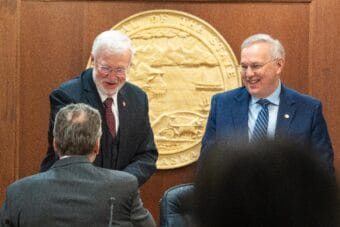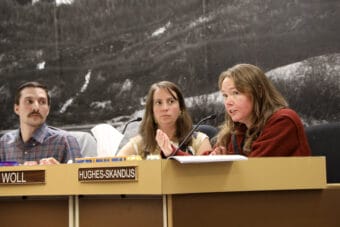
Legislators watch during an vote seeking to override Gov. Mike Dunleavy’s veto of a bill that would have expanded Alaska’s corporate income taxes to capture more revenue from Outside businesses. (Eric Stone | Alaska Public Media)
Alaska lawmakers failed Thursday to override Gov. Mike Dunleavy’s veto of a bill that backers said would have modernized Alaska’s corporate income tax system.
The override failed 35-25. It would have required a 45-vote majority to become law.
Senate Bill 113 would have expanded the state’s corporate income tax to capture revenue from so-called “highly digitized businesses” that sell to Alaskans over the internet but may not have a physical presence in the state. Some of the money raised by the tax change would have gone toward reading programs in public schools.
After the vote, House Speaker Bryce Edgmon, a Dillingham independent, said the debate over the bill illustrated how difficult it would be for lawmakers to agree on ways to raise new revenue as the state deals with a fiscal crunch.
“I’d also say it’s a preview of the debate that we’re going to undergo on a fiscal plan,” he said.
Some Republicans who voted against the override said they were concerned that the bill could increase costs for Alaskans, including Big Lake Republican Rep. Kevin McCabe.
“It’s disingenuous to think that we are not going to pay for this tax one way or the other,” he said.
Supporters of the bill rejected McCabe’s characterization, saying that the bill would simply give Alaska a share of similar taxes companies already pay in other states.
Sen. Bill Wielechowski, an Anchorage Democrat who championed the bill last year, said the idea that the bill would raise consumer costs was “wildly inaccurate.”
“In fact, there’s been research on this,” he said. “The National Bureau of Economic Research did a working paper titled Corporate Taxes and Retail Prices, and found null — zero — effects on prices for firms subject to a single sales factor.”
Gov. Mike Dunleavy said Wednesday that he planned to introduce a temporary sales tax as part of a larger fiscal plan. Wielechowski said the corporate income tax change was a better option.
“How dare we go to Alaskans and say, ‘We want to tax you. We want to take your dividend,’ before we’re going to tax collect revenue from tech billionaires,” he said. “Really? Is that where we’re going with this?”
Some lawmakers who voted against overriding the bill said they supported the law in concept, including Fairbanks Republican Rep. Will Stapp, who voted for the bill when it passed in May.
But he said the complexity of the tax change— and the fact that the bill would take effect immediately if the veto was overridden — gave him pause.
“(If) you vote to override this bill, Mr. Speaker, you’re going to create a new type of corporate tax structure for people that there’s no regulatory guidance on how to pay,” Stapp said. “I would argue we probably shouldn’t do that.”
Wielechowski said he was confident the state would have been able to put out regulations before taxes would be due in 2027.
Even so, Stapp said he planned to introduce a new version of the bill this session addressing that and several more technical objections he raised on the floor.
“There are a lot of questions with the bill that we should probably know the answer to,” he said.
Gov. Mike Dunleavy is set to deliver the annual State of the State address to the Alaska Legislature in Juneau Thursday at 7 p.m.
Starting at 6:30 p.m., KTOO Managing Editor Lisa Phu will host a discussion with Alaska Legislative Digest Publisher Tim Bradner, KNBA News Producer Rhonda McBride, and Alaska Public Media State Government Reporter Eric Stone to provide some context for the speech.
Watch live Gavel Alaska coverage of the discussion and Dunleavy’s speech on KTOO 360TV or listen to your local public radio station.
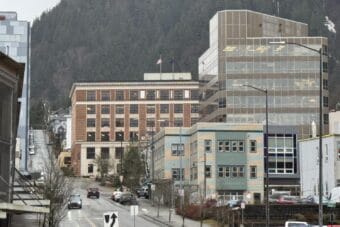
People walk past City Hall in downtown Juneau on Thursday, Jan. 22, 2026. (Photo by Clarise Larson/KTOO)
The Juneau Assembly is bracing for a tough budget season in the coming months.
That’s because during last fall’s municipal election, Juneau voters approved municipal tax cuts that created a multimillion-dollar recurring hole in the city’s budget.
The city’s next fiscal year begins on July 1 of this year. Starting then — and every fiscal year moving forward — the city will face an estimated $10 to $12 million in revenue loss in its general fund. That’s due to the tax exemption on food and utilities and a cap on the city’s property tax rate that voters passed. It’s now up to the Juneau Assembly to figure out how to mend that gap.
Earlier this week, the city released a survey asking residents to help inform the Assembly as it decides in the coming months how to move forward with the budget. Christine Woll is on the Juneau Assembly and is its finance committee chair. During KTOO’s Juneau Afternoon show on Tuesday, she said the survey is meant to be tough.
“We want people to be a little bit in our shoes in terms of having to make hard decisions about priorities,” she said.
The survey asks residents to pick what city programs and services are most important to fund and to pick what services to reduce funding for. The list includes programs like libraries and museums, trails and parks, and homeless services.
This is a graph of the City and Borough of Juneau’s general fund operating expenditures. (City and Borough of Juneau)
The survey also asks what values they want the Assembly to prioritize, like whether to keep taxes low, continue to support local business year-round, or fund affordable housing projects.
The survey broadly lists programs, services and values. That’s by design, said Phil Huebschen, an engagement specialist with the city’s communications department. He said the survey is meant to simplify the complexities and nuances of the city’s $478 million budget so it is digestible for everyday residents.
“We’re trying to reposition all of this really complex data and information as really simple values information that people can understand,” he said.
The survey also includes some budgets that the Assembly doesn’t necessarily have direct control over, like the airport and hospital, which have their own boards and operate like businesses. But, Huebschen said, the information is meant to guide the Assembly as they make decisions during the budget cycle.
“We’re hoping that they’ll have a compass, so to speak, of what kind of areas in terms of city services, the broad public of Juneau kind of values the most, and where they’re willing to make trade-offs,” he said.
Assembly member Woll explained that budgetary cuts aren’t the only way to mend the deficit. There are other options too, like increasing revenue using bonds, increasing sales taxes or user fees. The survey asks respondents what option they’d be comfortable seeing implemented.
“There are lots of different ways to address revenue reductions. You can figure out other ways to increase revenue,” Woll said.
Along with the survey, the city plans to host three community workshops and two Assembly listening sessions on the budget. The first workshop is at the Filipino Community Hall on Feb. 18, the second at the Valley Library on Feb. 24, and the third at the Douglas Library on March 3. Each workshop starts at 5:30 p.m. The city hasn’t posted details on the listening sessions yet.
The survey is open until mid-February and respondents are eligible for several prizes, like an annual city bus pass or a two-night stay at Hilda Dam Cabin.
The city manager will release the draft city budget in March. The Assembly must finalize its budget before July 1.
Students end their school day in Aniak. Theirs is one of nine schools in the Kuspuk School District, which is a plaintiff in a lawsuit filed against the state Tuesday alleging years of inadequate education funding. (Photo by Emily Schwing)
Two Alaska school districts filed a lawsuit Tuesday in Anchorage Superior Court against the state, its governor and its education commissioner over what they say is a long-running failure to adequately fund public education.
In the complaint, the Kuspuk School District and the Fairbanks North Star Borough School District argue “the state is failing to meet its constitutional obligation” both to provide Alaska students “a sound basic education and meaningful opportunity for proficiency” in vital subjects, and “to fund schools and school districts at a level that is adequate to provide students with a sound basic education.”
The plaintiffs are seeking a declaratory judgment that the state is violating the Alaska Constitution by failing to sufficiently fund public education. They say the state is violating the plaintiffs’ and students’ rights to substantive due process. They’re also seeking an injunction directing the state to fulfill its constitutional obligations, and requesting a court-ordered adequacy study to determine what it costs to educate students.
“Alaska, we don’t believe, has ever done an adequacy study to really understand what it would take to allow Alaska students a fair opportunity to learn the skills they need to participate and contribute to society,” said Matt Singer, a trial attorney representing the plaintiffs. ”If you don’t know what something is going to cost, then you can’t have a conversation with the Legislature about how to fund it,” he said.
The lawsuit points to low proficiency assessment scores, reductions in teaching staff and the elimination of fine arts, career technical and vocational education programs as direct impacts due to years of chronic underfunding. It also cites dangerous conditions inside school buildings.
“The last eight years, we’ve experienced a governor that has put forward a zero dollar budget going into budgeting,” said Kuspuk School District Superintendent Madeline Aguillard. “That’s almost a decade of just starting at nothing and when you have to claw your way to even less than minimal funding, that takes a toll,” said Aguillard.
A spokesperson with the governor’s office deferred to the state Department of Law.
“The responsible path is legislation — not litigation,” Department of Law spokesperson Sam Curtis wrote in an email Tuesday night, noting that “we have not been served with this lawsuit and have not yet had an opportunity to review the claims.”
The education clause in Alaska’s constitution does not specify a dollar amount for education. Instead, wrote Curtis, the constitution “vests the power of the purse squarely in the Legislature and the Governor. The legislative session began today. That is where education policy and funding decisions are meant to be debated and resolved.”
Superintendent Madeline Aguillard oversees nine rural public schools in Western Alaska’s Kuspuk School District. (Photo by Emily Schwing)
It’s not a coincidence the suit was filed on the same day legislators convened in Juneau for this year’s legislative session, according to Fairbanks North Star Borough School District Superintendent Luke Meinert. “I think it sends the message that the work on education funding is not done,” said Meinert. “We’re calling on this year’s Legislature to continue to work on that issue. They have the power to do so. Nobody else does,” said Meinert.
Education Commissioner Deena Bishop did not respond to a request for comment as of Tuesday evening. When she was superintendent of the Anchorage School District, Bishop consistently advocated for increased state funding for public schools through a change to the state’s education funding formula. But Bishop changed her stance when she became education commissioner under Dunleavy, arguing that the state’s budget is strained and that she preferred a more targeted approach to increasing school funding, like providing more money for tutors.
In the past, Bishop has said her department is not responsible for allocating funds for education. “The levers that I can pull aren’t levers for funding,” Bishop said in a 2024 interview. “I don’t create the money. The Legislature creates that, but we can certainly support policy that would help support schools as their needs come up,” she said.
Caroline Storm, executive director of Alaska’s Coalition for Education Equity, a nonprofit organization that is helping finance the lawsuit, said that “legal action is not the only way, but it raises the public awareness.” Storm said years of advocacy from her organization and others simply “hasn’t moved the needle enough” in Alaska to pay for wide-ranging needs from curriculum to building maintenance.
Storm said the lack of financial support for public education should be central to this year’s election cycle. “In my mind I don’t frame that as using politics, but ensuring something that is in our constitution,” said Storm.
According to Article VII of Alaska’s constitution, “the legislature shall by general law establish and maintain a system of public schools open to all children of the State.” For years, the complaint alleges, the state has failed to do so.
“This does not come as a surprise to me,” state Sen. Löki Tobin, an Anchorage Democrat who chairs the Senate Education Committee, said Tuesday. “In this conversation around adequate school funding, our local school boards have been bleeding,” she said.
“They have come to Juneau, they have talked to our commissioner, they have elevated the desperate need that they are under to have adequate state funding. We know that the state support for schools has been slowly diminishing,” said Tobin, who is also a member of a task force formed at the end of last year’s legislative session to address education funding, among other issues.
Alaska’s public schools receive funding from two state budgets. Capital funds pay for building maintenance, upgrades and construction. Money for operations, often referred to as the Base Student Allocation, or BSA, buys things like textbooks and pays for teachers’ salaries. According to the complaint, Alaska allocated $5,800 per student in 2015. Over a decade, the number had risen only 2.2%, totaling $5,960 in 2025.
“The state is failing in all regards,” said Singer. “In order to provide a basic sound education, you need a lot of different things,” he said. “One of the things is a safe school building with a roof and heater. Another thing you need is a competent teacher standing in front of a classroom educating young people.”
After years of relatively flat state funding for schools amid rising operational costs, Alaska lawmakers during the 2025 legislative session passed a $700 increase to the BSA, then gained enough support to override Gov. Mike Dunleavy’s veto of the bipartisan education bill — and later overrode his veto of $50 million in education funding from the budget.
While advocates celebrated the funding increase, many education leaders have said it still falls short of what school districts need to effectively operate, and the plaintiffs in the lawsuit filed Tuesday said the increase in the BSA was “woefully insufficient to keep pace with inflation, which had eroded purchasing power by 37% in the preceding decade.” After last year’s protracted battle over school funding, and with state revenues projected to be lower than expected, it’s unclear whether there’s enough traction in the Legislature to pass another increase this year.
There are more than 50 school districts in Alaska, and most are located within cities or organized boroughs, which have access to local tax revenue to help fund education.
Nineteen districts are nearly entirely reliant on the state for funds, because they serve rural, unincorporated communities where money from local taxes is simply not available to help pay for schools. Dozens of those school buildings are owned by the state education department, including in the Kuspuk School District, which straddles the middle stretch of the Kuskokwim River and covers an area roughly the size of Maryland in Western Alaska.
State assessment data on student performance within the Kuspuk School District “are dire,” according to the complaint. The numbers show 90% of the district’s 330 students during the 2024-25 school year were not proficient in English language arts, math or science. Aguillard said chronic underfunding from the state is having an outsized impact on districts like hers, where the student population is predominantly Indigenous.
Bats sometimes fly through the hallway and classrooms in Sleetmute. The building’s roof had a leak for nearly two decades before state funds finally became available for repairs. (Photo by Emily Schwing)
Those students aren’t only struggling with classwork. For years, Aguillard said her district has had to pull funds from its operational budget to keep buildings open. Over the last two years, an investigation by KYUK Public Media, NPR and ProPublica uncovered a public health and safety crisis inside many of Alaska’s public schools and in particular, in rural schools that serve predominantly Indigenous student populations. In one school, bats occasionally fly through classrooms and the hallway. At a school above the Arctic Circle, maintenance staff struggled for years with a persistent toxic chemical leak from the heating system, and in several cases across the state, failing plumbing means kids have to leave school to go to the bathroom.
Dozens of studies cited by the U.S. Environmental Protection Agency highlight negative impacts on student performance as a result of poor maintenance and conditions inside schools. The investigation found black mold inside several Alaska schools. Exposure can increase the risk of asthma and is linked to higher rates of absenteeism. According to the agency, leaking roofs and problems with heating and ventilation can also impact academic performance.
The situation isn’t unique to rural school districts, however. In an interview, Meinert described at length the tangible impacts a $5 million budget deficit has had in the Fairbanks North Star Borough School District, one of the three largest in the state.
“The state does have a responsibility to provide safe and adequate facilities for our students not only in rural Alaska but also in urban Alaska,” said Meinert. In the last five years, seven schools in his district have been forced to close due to a budget shortfall. Meinert said the district opted to outsource its custodial jobs and eliminate more than 70 positions. Since 2019, Meinert said, his district has terminated more than 300 teaching positions districtwide, which means class sizes have swelled to more than double what the National Center for Education Statistics reported for the state five years ago.
Meinert contends that a lack of state financial support within his district is also disproportionately impacting the minority student population. State assessments show that more than 76% of Indigenous and economically disadvantaged students in the district are not proficient in English language arts.
Aguillard has also been scrambling with maintenance staff over the last two weeks. This winter, communities across the state experienced a prolonged and extreme cold snap in December and January. Eight of the Kuspuk district’s nine buildings could not open in time for students to return from the holiday break because there was no running water, heat or electricity. The majority of the buildings in the district are owned by Alaska’s education department.
”It’s unsettling,” Aguillard said. “Our buildings should not be shutting down so easily. It’s really just evidence of the decline of the capacity of those buildings,” she said.
Kuskokwim River salmon drying on a rack at a fish camp near Napaskiak, 2016. (Rhonda McBride)
As the deadline for public comment approaches, the Alaska Federation of Natives is pulling out all the stops to block a national sport hunting and fishing group’s push to reform the federal subsistence board.
This comes after Safari Club International successfully petitioned the U.S. Interior and Agriculture Departments to review federal subsistence management policies.
AFN held a webinar Tuesday afternoon to give Native hunters and fishers an update on the status of subsistence management in Alaska and explain why it believes the Safari Club proposals pose a serious threat to the Native subsistence way of life.
Attorney Jaelene Kookesh, a longtime legal counsel for the Sealaska native corporation, was one of the presenters. She currently is senior legal counsel at the Van Ness Feldman firm. Kookesh says many Alaska Natives were elated last week, when the U.S. Supreme Court decided not to take up the State of Alaska’s challenge of federal subsistence protections under the Alaska National Interest Lands Conservation Act, or ANILCA. But Kookesh says, the battle goes on.
“It’s like you can celebrate for not even for a day, maybe, but then you can say, ‘Okay, we won that, but now we have to comment on this scoping at Department of the Interior,” Kookesh said. “And Safari Club also has draft legislation that they’re pushing at Congress. to amend ANILCA. So, we’re getting hit at every arm of government, so we can’t rest, even with the win at the Supreme Court.”
Kookesh says she worries most about the Safari Club’s campaign to limit the federal subsistence board to state and federal agency heads, a move that would undo recent efforts to diversify the board.
“So you had five federal agency representatives, who obviously are not subsistence users. And so, we worked very hard to have three tribally nominated members for the Federal Subsistence Board, with real concrete knowledge of these practices. And this just happened within the past year,” Kookesh said.
The Safari Club also wants to change the make-up of the Rural Advisory Councils to give sport hunters and fishers a voice in the process, as well as require federal wildlife managers to defer to the state’s regulatory decisions.
Regina Lennox, Safari Club International’s senior legal counsel, says it is seeking these changes to make ANILCA work as Congress intended.
“I don’t think anything that we have sought in any way diminishes the potential representation of Alaska Native voices anywhere,” Lennox said.
“We’re working on behalf of hunters within the state, subsistence and non-subsistence alike, just to ensure that the federal agencies don’t overreach,” she said. “Over 60% of Alaska is federal land, and so if you have agencies that are doing the wrong thing and, stepping on the toes of the state and closing down hunting opportunity, that’s a lot of acreage that’s potentially at risk.”
The Safari Club says one of its top priorities is to protect the resources, which benefits all hunters. It claims the federal government has ignored state data in some of its management decisions to the detriment of wildlife.
AFN and other Native groups say the federal government has done a better job than the state in balancing ANILCA’s rural subsistence priority with conservation.
Kookesh says AFN’s webinar will be a good Subsistence 101 on the decades-long fight to protect subsistence.
“It’s been a battle going on for many years, but it kind of goes quiet every once in a while, and then it comes back up again,” Kookesh said. “So right now, we’re heavy in the fight again. So, hopefully, we can take some steps forward and not some steps back.”
The deadline for public comment is February 13. AFN’s Jan. 20 webinar is posted on AFN’s website.
Gov. Mike Dunleavy gestures while speaking to reporters during a meeting of his 15 department commissioners on Wednesday, Jan. 21, 2026. (Eric Stone | Alaska Public Media)
Gov. Mike Dunleavy says he’ll soon propose a statewide sales tax as part of his larger plan to stabilize the state’s finances.
“There will be a temporary, seasonal sales tax concept put forth for discussion with the Legislature,” Dunleavy said during a cabinet meeting livestreamed on his Facebook page Wednesday in which he and the state’s 15 department commissioners outlined their accomplishments over the past seven years.
Dunleavy said a fiscal plan — along with moves to advance a natural gas pipeline from the North Slope — are his top two priorities for the legislative session that began Tuesday.
Dunleavy has been tight-lipped about the specifics of his plan. The political news site the Alaska Landmine reported Tuesday it would include a seasonal sales tax, a limit on government spending, changes to oil taxes and a new formula for the Permanent Fund dividend. Dunleavy’s communications director, Jeff Turner, declined to confirm the Landmine report and said by email, “the bills are still being finished.”
During Wednesday’s meeting, Dunleavy said he would start rolling out his fiscal plan next week. A required ten-year plan released alongside his budget in December identified some $1.6 billion in unspecified new annual revenues starting in July 2027. Dunleavy said he expects the plan to raise revenues “pretty close to that mark.”
“The proposal and the fiscal plan has multiple components,” he said. “It’s a road map to inject stability, especially over the next five years, when revenue is not quite what will be in the years out.”
Dunleavy emphasized that most of the measures he’d propose would serve as a temporary, half-decade bridge. After five years, Dunleavy said he expects state revenues to rebound thanks to increased oil production, growth in the Permanent Fund and the possible natural gas pipeline.
Lawmakers have said they’ll consider Dunleavy’s proposals, but it’s unclear if a sales tax and other components of Dunleavy’s plan will have enough support to pass the state House and Senate.