A computer-generated mockup of the new Tustumena replacement vessel, which will be bigger, carry more people and vehicles as well as be more efficient. (Alaska Marine Highway System)
After years of delays, the build contract to replace the Alaska Marine Highway System’s ferry Tustumena is out to bid. The state’s project notice calls for the new mainliner ferry to be completed by the beginning of 2029 with an estimated price tag of more than $300 million.
The new ferry will be a more efficient, diesel-electric vessel with capacity for 250 passengers and 58 cars at a time.
“It is really delightful, even just to talk about. You can probably hear the smile on my face,” Louise Stutes said.
State Representative Stutes, a Republican from Kodiak, is a longtime advocate of the Alaska ferry system. Especially the more than 60-year-old Tustumena, which regularly sails from Homer to Kodiak Island communities.
Captain John Mayer (left) of the M/V Tustumena presented Rep. Louise Stutes (right) a hand painted piece of the Tustumena’s hull for her longtime support of the Alaska Marine Highway System in August of 2024. (Brian Venua/KMXT)
She commended Craig Tornga, the head of the state ferry system, for getting the Tustumena replacement project to this point.
“And there are several shipyards that are interested in it as opposed to the first time it went out where no shipyards were interested,” she said.
“So, they kind of had to reassess it, redesign a few things and we’re good to go,” Stutes said.
Tornga went back to the drawing board on the ferry’s design and overhauled the contract over the last several years. Tornga has previously said that one of the hurdles that delayed the project so long was a requirement that 70% of the money spent on the Tustumena replacement has to go to American companies.
Sen. Lisa Murkowski was surrounded by reporters outside the U.S. Senate chamber last year. (Liz Ruskin/Alaska Public Media)
WASHINGTON — Sen. Lisa Murkowski said Secretary of Homeland Security Kristi Noem should be held accountable over a fierce immigration crackdown that has killed two citizens in Minneapolis and that she should resign.
“She has — through her words, and I think in her actions — she’s taken a direction that has not been helpful to the situation, and I don’t think that it helps the country,” Murkowski told reporters.
She said Noem has an obligation to maintain control of what the agencies in her jurisdiction are doing. Instead, Murkowski said, Noem has inflamed tensions. She noted that almost immediately after Border Patrol agents shot and killed nurse Alex Pretti, Noem claimed, without evidence, that Pretti was a “domestic terrorist.”
Murkowski spoke to reporters on her way to a Senate vote as lawmakers returned to the Capitol from a week away. She called it a good sign that the administration has removed top Border Patrol official Gregory Bovino from Minneapolis. But, she said, accountability rests with Noem.
Reporters pressed her on whether Noem should resign.
“I voted for her,” Murkowski said, referring to Noem’s Senate confirmation. “I think the President needs to look at who he has in place as a secretary of Homeland Security. I would not support her again, and I think it probably is time for her to step down.”
Murkowski was among the first Republicans in Congress to openly criticize the tactics of the immigration enforcement operation after agents killed Pretti. The group of GOP critics remains small.
But minutes before Murkowski spoke, Sen. Thom Tillis, R-N.C., also castigated Noem. He said the enforcement operations need to focus on the serious criminals President Trump promised to target and not pursue nonviolent people.
“I think that what she’s done in Minnesota should be disqualifying. She should be out of a job,” Tillis said of Noem. “And I mean, really, it’s just amateurish. It’s terrible. It’s making the president look bad on policies that he won on.”
Tillis is retiring from the Senate after his term ends in a year. He’s become one of the more outspoken Republicans in Congress when it comes to criticizing and voting against the Trump administration.
Unlike Murkowski and Tillis, Sen. Dan Sullivan, R-Alaska, didn’t issue a social statement or a press release this weekend to condemn Pretti’s death or call for reform.
His office provided a statement to reporters on request. Sen. Sullivan “strongly supports our law enforcement and their ability to do their jobs,” it says, while calling any loss of life tragic. It also says he hopes that “the temperature in Minnesota on both sides can be lowered.”
On his way to the Senate chamber to vote Tuesday, Sullivan held his phone to his ear as he walked through a crowd of reporters, fending off approaches.
Juneau Assembly member and Eaglecrest Ski Area board liaison Neil Steininger speaks during a meeting at City Hall on Monday, Jan. 26, 2025. (Photo by Clarise Larson/KTOO)
The Juneau Assembly has stalled on deciding whether to disempower the Eaglecrest Ski Area’s board of directors until a joint meeting in March.
Earlier this month, Mayor Beth Weldon proposed an ordinance to reduce the status of the city-owned ski area’s board from an empowered board to an advisory board. She cited the recent leadership turnover at the mountain and ongoing financial challenges.
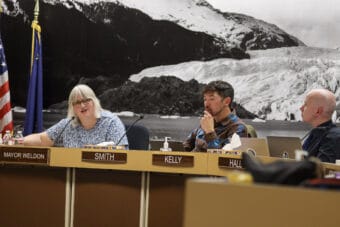
At a committee of the whole meeting Monday night, Weldon further explained her reasoning for the proposed ordinance to the Juneau Assembly and the roughly 20 members of the public in the audience.
“I’m literally trying to save Eaglecrest, and I think with the empowered board making the decisions, I don’t see the status quo changing,” she said.
Right now, as an empowered board, Eaglecrest has its own set of laws, rules and responsibilities. But, if it became an advisory board, members could only make recommendations to the Assembly. It would lose the authority to establish policies or make decisions without Assembly approval.
At the meeting, Weldon argued the ski area needs more oversight, given the high amount of funding the city has funneled toward it in recent years, specifically on a new gondola project.
“If we are investing large amounts of money on things such as the chair lifts or maybe even the gondola, we want to have more of a say in how that money is spent, and currently, we don’t,” she said.
In the coming years, the ski area is slated to run into a multimillion-dollar deficit. The deficit is a part of a plan to repair some broken and aging infrastructure while boosting pay to employees and preparing to operate year-round.
Its expansion into summer operations relies heavily on the success of the gondola, which the ski area hopes to get up and running by the summer of 2028. However, many city leaders are worried the timeline — and cost — of the project will run far over what the board projected.
The Assembly agreed to hold off on any decision-making until it holds a joint meeting with the Eaglecrest board on March 4. Assembly member and Eaglecrest Ski Area board liaison Neil Steininger said he thinks that’s the best option.
“I think we owe it to everybody in the community to have a joint meeting with the Eaglecrest board to actually hash this out,” he said.
The Assembly will then vote on whether to move the ordinance forward during a committee meeting on March 16.
Gov. Mike Dunleavy speaks to reporters during a news conference on May 19, 2025. (Eric Stone/Alaska Public Media)
Gov. Mike Dunleavy introduced a series of bills on Friday and Monday that he says would stabilize the state’s finances. The most prominent pieces of Dunleavy’s plan are a statewide sales tax and a new formula for Permanent Fund dividends.
“I want to stop our fights over the PFD and the Permanent Fund, and I want to minimize arguments over how much we’re going to spend each year and how we’re going to control the growth of government,” Dunleavy said in his State of the State speech on Thursday, before the bills were unveiled.
The governor did not take questions on the plan on Monday. His press office declined requests to interview members of his administration and did not respond to questions sent by email Monday afternoon.
Debates over the state budget have routinely dominated legislative sessions in Juneau in recent years. Alaska has not followed a formula in state law specifying the amount of the dividend since 2015, after a crash in oil prices sharply reduced the amount of money flowing into state coffers.
The new dividend formula would split the state’s annual Permanent Fund drawdown 50-50 between state services and dividends. If the 50-50 formula were in effect this year, next year’s PFD would cost the state roughly $2 billion and provide each eligible Alaskan with about $3,200.
A constitutional amendment requires a two-thirds majority in both the House and Senate. If lawmakers approve, voters would be asked to ratify it.
Dunleavy also proposes a variety of tax changes, most of them temporary. As a whole, they’d raise more than $900 million in annual revenue from mid-2027 through mid-2032 as the measures begin to phase out.
“Alaska has prosperous years ahead,” the governor wrote in a letter sent alongside the tax bill. “Starting in (mid-2032), Alaska is projected to see higher revenue due to expected increases in pipeline throughput and the Alaska LNG Project.”
The sales tax, proposed Monday in Senate Bill 227, would be set at 4% from April through September and 2% for the remainder of the year. As written, the sales tax would expire in 2034. That would provide the majority of the revenue from the tax package, between $735 million and $815 million each year.
“All who benefit from Alaska’s public services — residents, workers and visitors — will share in supporting those services,” Dunleavy wrote.
The bill would also seek to extract additional revenue from the North Slope’s oil and gas industry by raising the minimum tax companies must pay on each barrel of oil for as many as five years. The tax would end sooner if North Slope oil production increases to 650,000 barrels a day, roughly 40% more than current volumes.
It also includes elements of a bill the governor vetoed last year that seek to bring in more revenue via corporate income taxes from out-of-state companies that sell to Alaskans. It would eliminate the state’s corporate income tax in 2031.
A separate piece of the plan, laid out in House Bill 274 and Senate Bill 222, would require legislators to periodically vote on whether to continue various government programs, known as a “sunset review.”
Another element of Dunleavy’s plan would set a stricter limit for the growth of government spending in state law, reducing the allowable increase in state spending from 5% to 1% . A sunset review and a spending limit have been priorities for some of Dunleavy’s Republican allies in the state House and Senate.
The tax bill would not take effect unless the constitutional amendment, spending limit and sunset review bill each pass.
Anchorage Democratic Sen. Bill Wielechowski expressed reservations about the plan on Monday. He said he’d rather the state lean more heavily on the oil industry and Outside tech billionaires to raise revenue.
But Wielechowski said Dunleavy’s proposal will get “serious consideration” in the Senate.
“I’m glad the governor put something out. I think it’s the basis for discussion,” he said. “It’s hard to pass any of these major bills without the governor actively engaged, and this shows that he’s actively engaged.”
The new statewide sales tax would mean big changes for local governments, many of which already collect a sales tax.
The head of the Alaska Municipal League, Nils Andreassen, said on a video call Monday that Alaska’s local governments broadly support a plan to stabilize the state’s budget. But a statewide sales tax could have a variety of “unintended consequences,” especially for communities that already have a local sales tax, he said.
“The addition of a state-level (tax) is definitely a burden that some communities will feel more than others,” he said. “There will be calls from those residents to lower not the state’s rate, but the local (rate), which will diminish revenues at the local level.”
Dunleavy’s plan would also do away with so-called “tax caps” that limit sales taxes in some communities and set a statewide list of sales tax exemptions, Andreassen said. For example, it would likely override a local ballot measure in Juneau exempting most groceries and utilities from sales taxes.
Medical care, rent, groceries purchased with federal SNAP or WIC benefits, jet fuel, insurance premiums and business purchases would be among items exempt from sales tax under Dunleavy’s proposal.
It’s too soon to say if the governor’s plans will pass the Senate this year, Wielechowski said. Leaders in the House said earlier this month they’re not optimistic Dunleavy’s plans will pass this year, his last as governor.
Editor’s note: This story has been updated with additional information about the revenue the tax package would raise.
Secretary of Defense Pete Hegseth on April 9, 2025. (Senior Airman Madelyn Keech/U.S. Air Force Senior Airman Madelyn Keech | Department of Defense)
The federal government is reviewing a business program that brings contracting opportunities to Alaska Native corporations and tribes.
U.S. Secretary of Defense Pete Hegseth said in a video posted on X Jan. 16 that his department will review the 8(a) Business Development Program. The program falls under the federal Small Business Administration and supports businesses owned by socially disadvantaged individuals or tribal entities, including Alaska Native corporations.
Hegseth said in the video that the program promotes diversity, equity, and inclusion framework and race-based contracting.
“We are taking a sledgehammer to the oldest DEI program in the federal government,” Hegseth said. “Our goal is to spend your money to build our defense industrial base with businesses, large and small, that share our mission.”
Quinton Carroll, the executive director of the Native American Contractors Association, originally from Utqiaġvik, said that Native participation in the program is not a diversity, equity and inclusion initiative.
“It is grounded in the unique political and legal status of tribal nations under U.S. law and fulfills longstanding federal trust and treaty obligations to tribes, Alaska Native Corporations and Native Hawaiian Organizations,” Carroll said.
Tribal participation in the program
Alaska Native Corporations rely heavily on federal contracts, which they often secure through the 8(a) program.
In 2021, corporations received more than $11 billion from federal contracts, which were their primary source of revenue, according to data from the Federal Reserve Bank of Minneapolis. More than a half of that revenue came through the 8(a) program, and the majority of those contracts were with the Department of Defense, according to that research.
Christopher Slottee, an attorney who works with Alaska Native villages, regional corporations and tribal governments, said that makes the Pentagon’s review of the program “a significant concern” for tribes and corporations.
“They often rely on those contracts to generate the revenue that lets them provide the benefits to their shareholders and tribal members,” he said.
Slottee said that tribal entities are subject to the same standards, reviews and compliance requirements as everyone else, but they do have a few advantages in the program.
Slottee said tribal entities, unlike individuals, don’t have to prove their social disadvantage. They can also have multiple companies in the program, while individuals can only have one. Plus, tribal entities have significantly higher limits for certain awards, he said.
Slottee said a government agency also might want to contract with an Alaska Native organization because they often have more experience than some of the traditional small businesses. And there are treaty obligations to fulfill, he added.
“There is a general, government-wide encouragement for agencies to contract with entities owned by tribes and ANCs, as part of the government’s responsibility to Alaska Natives and Native Americans,” he said.
The DoD review of the program
Hegseth ordered a line-by-line review of 8(a) contracts that are over $20 million in value. He said in a memorandum to the Pentagon leadership that the department would get rid of contracts that don’t make the country’s military more lethal.
“We have no room in our budget for wasteful DEI contracts that don’t help us win wars,” he said in the social media video.
Carroll, with the Native American Contractors Association, said that Native federal contractors have been partners of the Department of Defense, working to strengthen readiness and the military industrial base.
Hegseth also said the department would make sure that the businesses with contracts were actually doing the work. He claimed that small businesses often receive a contract, take a fee and then pass the job on to a larger firm that’s not eligible for the program.
Carroll said Native contractors support the elimination of fraud and waste within the program.
“It is critical that oversight efforts preserve a program that has proven its value — strengthening national security, reinforcing the defense industrial base, and supporting economic growth in Native and surrounding communities,” Carroll said.
President Trump signed an executive order in April directing the rewriting of federal contracting regulations. Slottee, the attorney, said the revision has been completed, but it’s not clear yet how the changes will affect tribal entities.
He said that there is more focus now on the use of larger contracts, which can be harder for smaller corporations and tribes to access.
“It’s going to take a little bit for folks to actually see the kind of on-the-ground downstream impact, but we definitely anticipate seeing that in the course of 2026,” Slottee said.
Earlier this month, the Small Business Administration issued an announcement that, among other things, described a massive reduction in how many applications were approved for the program.
“The Trump SBA accepted just 65 new 8(a) firms into the program last year – compared to over 2,100 who were accepted during the Biden Administration,” it said.
Slottee said that the many Native-owned businesses felt that reduction.
“There is a concern that ANCs and tribes will have to start looking for alternatives,” he said. “If the SBA is not going to be approving new 8(a) applications, even though they should be under the rule established by Congress, that’s going to be a downstream impact on ANCs and tribes.”
Adam Crum speaks to reporters on Oct. 4, 2022 at the Alaska Scientific Crime Detection Lab in Anchorage while serving as health commissioner. (Wesley Early | Alaska Public Media)
Former Alaska Revenue Commissioner Adam Crum deviated from state policy and failed to perform the necessary due diligence before committing millions in state savings to a private equity fund, according to an outside review ordered by Gov. Mike Dunleavy after Crum’s decision came to light last summer.
In its report, the D.C.-based law firm WilmerHale said its investigation had raised “significant concerns” about whether Crum met his fiduciary duties under state law. Investigators also found Crum engaged outside lawyers to represent the state in the investment without obtaining the approval of the attorney general “in apparent contravention” of state law, according to the report.
“Mr. Crum’s process for selecting the DigitalBridge fund and the two other private funds in which he intended to invest did not involve rigorous due diligence, and Mr. Crum did not follow Department of Revenue protocols designed to assist him in meeting his fiduciary duties in connection with the investment,” the report states.
The state ultimately invested some $50 million from its primary rainy-day fund, the Constitutional Budget Reserve, with the private equity firm DigitalBridge. The investigation found that Crum intended to invest $75 million with the firm.
The investment came to light shortly after Crum left office to run for governor. The state ultimately sold the investment to an Israeli insurance company and lost roughly $859,000, according to a letter sent to the state House and Senate’s finance committees. A portion of the $50 million sent to DigitalBridge that was not invested yielded $325,000 in interest, offsetting a portion the loss, according to the letter.
“Clearly, this was an unsuitable investment for the (Constitutional Budget Reserve). No question about it,” said Sitka Republican Sen. Bert Stedman. “The ex-commissioner broke his fiduciary duty to execute it.”
Shortly after the legislative session began in Juneau this month, Stedman introduced a bill that would bar the state from doing business with DigitalBridge.
The report, which cost the state an additional $350,000, found no evidence of criminal wrongdoing or self-dealing. And it said Crum had the authority as revenue commissioner to commit money to the private equity fund. But that’s only if he had done the requisite due diligence, and the report says there’s reason to believe he didn’t.
In a phone interview, Crum said he tried his best to keep everything above board. The private equity investment was an effort to simultaneously boost the returns of the savings account and spur investment in Alaska, and he kept in touch with the Department of Law and the governor’s office about the investment, he said.
“I actually had multiple communications with (the Department of) Law, even with Treasury staff, trying to actually figure out what — I would send emails and ask the questions that say, have we met all of the legal duties in order to actually fulfill this?” Crum said.
But according to the investigation, he chose not to inform the governor’s budget office, the legislative auditor, or members of the Legislature as state policy requires. He wrote on a checklist outlining the policy for so-called “non-routine investments” — created after a state investment misadventure in 2015 — that “Treasury must not abdicate its statutory authority.”
Crum also failed to inquire with the Department of Law whether the investment met his fiduciary obligations under state law, according to the investigation.
Crum casts the issues the investigation raises as “procedural.” Details, he said, were not his mandate as revenue commissioner.
“It’s not about being technically proficient on all that stuff. It’s knowing the overall concepts,” he said. “Making sure that you actually are the expert on the actual delivery of that thing — no, that is not the case. That’s why you have staff. Otherwise, why do you have staff?”
The report included four recommendations aimed at avoiding similar issues in the future. As it was released, Gov. Mike Dunleavy issued an administrative order implementing many of the recommendations by placing additional checks on the revenue commissioner’s authority to invest in unconventional assets.
In the order, Dunleavy said the changes were intended to “enhance the transparency of investment decisions.”
Close
Update notification options
Subscribe to notifications
Subscribe
Get notifications about news related to the topics you care about. You can unsubscribe anytime.