Government

Juneau Animal Rescue’s long-sought new shelter secures location from Assembly

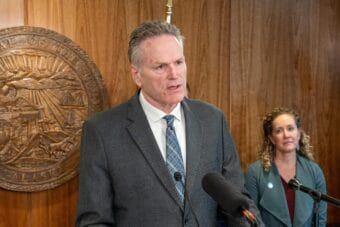
Rick Driscoll, Juneau Animal Rescue’s executive director, holds a puppy at the shelter on Thursday, Jan. 18, 2024. (Photo by Clarise Larson/KTOO)

Juneau Animal Rescue has finally secured a location for its proposed new animal shelter.

On Monday night, the Juneau Assembly unanimously approved leasing a parcel of city property in the Mendenhall Valley to Juneau Animal Rescue to serve as the site of a larger facility for rescued animals. 

Rick Driscoll, the shelter’s executive director, said the approval is a major milestone for making the new shelter a reality.  

“This was kind of the big step,” he said. “We couldn’t really launch a capital campaign without having land that we can say we’re going to build it on. Everything has led up to this point.”

The nonprofit organization has been fundraising to construct a newer, updated facility for the last few years. The current shelter off Glacier Highway was built in 1984 and needs extensive repairs. The shelter also often finds itself at or near capacity for housing dogs and cats. 

Driscoll said the Assembly’s approval means the animal rescue can begin narrowing in on a design for the facility and figure out how much they need to fundraise to make it happen. 

The proposed new facility would have a better ventilation system to help prevent the spread of diseases, and more space for cats, dogs, and smaller animals like rodents and reptiles. The shelter is also interested in creating walking trails in the surrounding area for dogs.  

Driscoll said a long-term goal is to make the site a campus for all things animals by collaborating with other organizations in Juneau.

“Whether that’s working with the Capital City Kennel Club, or working with Parks and Recreation on a dog park, or working with Trail Mix to perhaps do some kind of cool trails out there — the sky’s the limit,” he said. 

Under the approved lease agreement, the shelter will pay $10 a year for the 35-year lease. The annual market value for the land is $3,000 a month. Driscoll said the organization will share more about the design and fundraising needs for the new shelter as soon as possible. 

Disaster aid deadlines extended into 2026 for those affected by Western Alaska storms

Alaska Organized Militia members, assigned to Task Force Bethel, survey Nightmute, Alaska, while conduct post-storm recovery efforts for Operation Halong Response at Oct. 27, 2025. (Courtesy photo by the Alaska National Guard)

The State of Alaska and the Federal Emergency Management Agency have extended their deadlines to apply for individual disaster assistance for those impacted by storms in Western Alaska, including Typhoon Halong.

How to apply for State of Alaska or FEMA individual assistance:

  • Online
  • Call the Alaska Call Center at 1-866-342-1699
  • Or visit an assistance hub set up in Bethel through Dec. 19.

State and federal officials are continuing to encourage residents to register for both state and federal assistance programs to maximize their potential benefits. The new deadline for applications is February 20, 2026.

“We know that there may be more people out there, and we want to give them this opportunity to register,” said Jeremy Zidek, a spokesperson for the Alaska Division of Homeland Security and Emergency Management.

Zidek urged residents to apply for both assistance programs if they have experienced any level of storm damage. He said registrations can be updated once they have been filed.

“We always say that if people are unsure about their damages or unsure if they want to apply, to just go ahead and apply,” he said. “They can always amend their application at a later date. But after those deadlines, it becomes very difficult for us to register people, so we really urge anyone that had damage, even if it was a little bit of damage, to apply and go through the process.”

The state has received 1,920 aid applications and FEMA has received 1,630 applications for assistance as of Dec. 10. The programs provide relief for damage to homes, damage to essential personal property and medical, dental or funeral needs directly related to the disaster. State disaster aid also includes assistance for damage to subsistence camps. The Small Business Administration is also providing low-interest loans, including up to $100,000 for repairs to subsistence camps.

The state and FEMA have distributed over $41 million in disaster assistance as of Nov. 25, and have visited 43 communities.

An estimated 1,160 residents evacuated from Western Alaska following Typhoon Halong, with dozens of communities sustaining damage across the region.

Since the evacuations, 678 residents have been staying in hotels in Anchorage. The first group of families began moving into longer term housing last week, according to a state update. The state’s emergency management division is working with local property owners and non-profit partners to locate apartments and housing units throughout Anchorage for long-term housing for storm displaced residents.

Officials also set a Dec. 15 deadline for owners to claim pets. Over 200 dogs were evacuated from Western Alaska after the storms, and 21 dogs remain unclaimed. Pet owners who have not yet claimed their dogs  can search for them at a website created by volunteers.

Federal disaster areas include:

    • The Northwest Arctic Borough
    • Lower Yukon Regional Education Attendance Area
  • Lower Kuskokwim Regional Education Attendance Area

State of Alaska disaster areas include:

  • North Slope Borough Northwest Arctic Borough
  • Yupiit Regional Education Attendance Area
  • Lower Kuskokwim Regional Education Attendance Area
  • Bering Straits Regional Education Attendance Area
  • Lower Yukon Regional Education Attendance Area
  • Kashunamiut Regional Education Attendance Area
  • Pribilof Islands Regional Education Attendance Area
Pollution response teams from U.S. Coast Guard Sector Western Alaska and U.S. Arctic conduct post-storm assessments in Kipnuk, Alaska, Oct. 22, 2025, after the community was impacted by severe flooding from Typhoon Halong. Personnel deployed to affected areas to identify pollution concerns and work with state, federal, and industry partners to conduct clean-up operations. (U.S. Coast Guard photo by Petty Officer 1st Class Shannon Kearney)

After veto overrides, Alaska Gov. Dunleavy drops push for major education reform

Gov. Mike Dunleavy speaks to reporters ahead of his annual holiday open house on Tuesday, Dec. 10, 2024 in Juneau.
Gov. Mike Dunleavy speaks to reporters ahead of his annual holiday open house on Tuesday, Dec. 10, 2024 in Juneau. (Eric Stone/Alaska Public Media)

Gov. Mike Dunleavy is dropping a longtime priority ahead of next year’s legislative session.

At his annual holiday open house on Dec. 9, the Republican governor told reporters he isn’t planning to revive his push to reform the state’s schools.

“I’ve always said this, for year after year after year, that once the issue of money is settled, nobody wants to talk about policy,” Dunleavy said. “So, unfortunately for us, I think we’re going to skip over that this year — not from my perspective, but I don’t think the Legislature enough for the people in the Legislature really have a desire to fix the outcomes.”

Improving the state’s public schools was the top issue in the last two legislative sessions. Dunleavy vetoed a series of bills seeking to boost public school funding, saying they didn’t do enough to improve student performance. He instead called for a variety of reforms that he said would help Alaska’s low test scores, in part by boosting charter schools and correspondence homeschool.

But lawmakers overcame Dunleavy’s vetoes to break the stalemate earlier this year.

Sitka independent Rep. Rebecca Himschoot co-chairs the state House Education Committee. She said lawmakers will continue to look at ways to boost students’ test scores — even with budgets expected to be tight this year.

“We need to ensure the best value for the dollar. Obviously, accountability is very important,” Himschoot said. “At the same time, we need to make sure that our kids have opportunities. And if we look to other states, there’s a lot going on in other states that we could be doing here in Alaska.”

She said she’d also like to see a smaller boost to public school funding this year to keep up with inflation.

Rep. Andi Story, a Juneau Democrat who also co-chairs the House Education Committee, said she wants lawmakers to override Dunleavy’s veto of a corporate tax bill tied to education funding.

“Those dollars are scheduled to go for reading intervention and career-tech, and that would just, to me, be a game changer,” Story said.

Backers pitched the tax bill as a way to extract more state money from Outside tech companies who sell to Alaskans. Dunleavy said he couldn’t support it without a larger fiscal plan.

The Senate Education Committee chair, Democratic Anchorage Sen. Loki Tobin, said she planned to introduce a constitutional amendment that would “codify the right for every child in Alaska to learn about Indigenous peoples and cultures.”

“With the largest Indigenous population in the United States, it is high time Alaska guarantee a robust public education rooted in Indigenous knowledge,” she said via email.

Dunleavy said he hoped lawmakers would pass a bill that would launch a pilot program for schools run by Alaska Native tribes. But Dunleavy told reporters his main goals for his final year are largely in other areas, including a forthcoming fiscal plan and preparation for a possible North Slope gas pipeline.

Lawmakers reconvene in Juneau on Jan. 20.

Report documents racial disparities in pandemic death rates in Alaska

A patient receives the COVID-19 vaccine.
A patient receives the COVID-19 vaccine. (Steven Cornfield/Unsplash)

About one in 500 Alaskans died of COVID-19 between 2020 and 2023. That’s according to an epidemiology bulletin the Alaska Department of Health released Dec. 9, which says there were substantial racial disparities in rates of COVID-19 hospitalization and mortality in the state.

Early in the pandemic, for instance, age-adjusted mortality rates in the state were about 3.6 times higher for Asian and Pacific Islander people compared to white people, according to the bulletin. The disparity during that period – from June 2020 to January 2021 – was greatest among American Indian and Alaska Native people, whose age-adjusted mortality rate was 5.5 times higher than that of white people.

“It matters because … at the end of the day, what we would like to get to is that there are no disparities based on race for the various disease processes and vulnerabilities that people may have,” said Jacoline Bergstrom, the executive director of health services for Tanana Chiefs Conference (TCC), a nonprofit tribal organization based in Fairbanks that aims to advance the health and social service needs of its 42 members, 37 of which are federally-recognized tribes.

Bergstrom read the state bulletin and said the results didn’t come as a surprise, since officials were tracking data during the pandemic. Other studies have also observed similar disparities nationally. But she said the report’s comprehensive look back at COVID-19 in Alaska makes it a useful resource.

“Because when we were in it, we were in it, right? And we were tracking real-time,” Bergstrom said.

The 33-page document splits the pandemic into seven distinct eras and reviews multiple topics, including the disparities, but also the spread of the virus, the state’s response, the efficacy of vaccines and gaps in pandemic preparedness.

The magnitude of the racial disparities for hospitalization and mortality rates in Alaska fluctuated in the different phases of COVID-19 analyzed in the bulletin. But it says that the disproportionate impacts “continued for the entirety of the pandemic in Alaska,” and concluded by saying more research is needed to grasp the underlying social and structural issues.

Bergstrom also said the causes behind the disparities are numerous and complex, but she said limited access to running water in some parts of Alaska is one example. That’s because it impacts people’s ability to take preventative measures, like hand-washing, she said.

According to the Alaska Division of Water, more than 3,300 homes in Alaska don’t have modern plumbing, and a study during the pandemic linked limited water resources with increased risk for COVID-19 in Alaska villages. Bergstrom said the new report offers more evidence that improving those resources would be a boon to public health.

“Just seeing this data … it’s another really important factor where we can show – and say, ‘Hey, we need to get water and sanitation to our rural communities,’ because we know, we’ve seen some of the impacts during the COVID-19 pandemic,” she said.

Through Megan Darrow, a state department of health spokesperson, the state section of epidemiology declined an interview request about the bulletin, saying emailed questions would be routed to the appropriate “subject matter experts.”

In a written response to questions, health officials wrote that the disparities in Alaska COVID-19 amplified pre-existing inequities, and that contributing factors likely include housing conditions, limited access to timely or speciality healthcare, and higher prevalence of underlying medical conditions associated with severe COVID-19.

The response also said that “[r]educing disparities in a future pandemic will require both long-term structural investments and strengthened public health systems,” including culturally grounded outreach, expanded access to care, modernized disease surveillance systems, as well as a clinical a public health workforce “capable of sustaining prolonged, high-intensity responses.”

Alaska Native veterans and heirs race to apply for Native allotments

Anthony "Bone" Lekanof in Biên Hòa, Vietnam, 1969
Photo of Anthony “Bone” Lekanof (Courtesy of Michael Livingston)

For those who haven’t filed for their Native allotments, Alaska Native veterans don’t have much time to claim 160 acres of federal land. The window for applications closes permanently on Dec. 29.

ANCSA ended 1906 Native allotment program

The land grants were part of a government program created over a hundred years ago, to promote homesteads and private property ownership. But the 1906 Native allotment program shut down in 1971, after Congress passed the Alaska Native Claims Settlement Act passed.

But in the years leading up to the land claims act, Natives scrambled to file for their land allotments. But during that time, a lot of Native Vietnam veterans missed out, because they were stationed overseas. Many were engaged in combat.

The Alaska Congressional delegation eventually succeeded in passing legislation to fix this. In 2019, President Trump signed a bill into law that opened a five-year window for Natives vets to claim their allotments. But despite the special exemption to apply for the land, it isn’t easy to do. There are still many hurdles.

Application process is “onerous”

“It’s one thing to make laws,” said Jim LaBelle, an Inupiaq Vietnam veteran. “But it’s quite another thing when the bureaucracy kicks in and starts developing these onerous processes that were never really anticipated.”

Jim and Kermit LaBelle at the Mount Edgecumbe boarding school in Sitka. (Photo courtesy of Jim LaBelle)

LaBelle’s challenges began before the war when he and his younger brother, Kermit, were in boarding school. He says they were unable to qualify for their allotments, because they were far from home and couldn’t prove they worked the land they hoped to receive.

(Photos courtesy of Jim LaBelle)

Then both brothers went to fight in the Vietnam War, and Kermit was killed in action at the age of 18.

After the war, LaBelle had about given up on efforts to claim his land but tried again. A few years ago, the government finally accepted his application.

Veterans unhappy with federal land available

“It took a little doing, but I managed,” he said. “And I can’t say I was very happy with the lands that I got.”

LaBelle wound up with land near the Interior Alaska community of Tok, far away from his Inupiaq homelands.

“It’s an area I’m not familiar with but was available at the time,” LaBelle said. “The way I look at the map, I’d have to have a helicopter to fly in.”

LaBelle is now focused on getting his late brother Kermit’s allotment. To do that, he needed a death certificate.

“I have to prove that he was killed in Viet Nam. I also have to prove that he had a CIB, Certificate of Indian Blood,” LaBelle said. Michael Livingston has volunteered to help vets like Jim LaBelle apply.

Michael Livingston, an Alaska Native veteran’s advocate, has volunteered to help vets like Jim LaBelle apply.

It’s not a user-friendly process,” he said. “Out of the 2000-some veterans that are eligible, only about 500 of them have applied, so that’s only about 25 percent.”

Native vet allotment applications remain low

As of mid-December, the Bureau of Land Management’s website said it had received 519 applications – but fewer than 44 have been accepted.

Livingston believes the limited land available to veterans has discouraged them from applying but says age is probably the biggest barrier. He says most of the veterans he’s worked with are now in their 70’s and 80’s. Many are in poor health and don’t have the computer and internet skills it takes to navigate the bureaucracy, so they’ve given up.

Livingston says it also takes a lot of persistence, which he is willing to supply.

“So far, I’ve helped about 50 Alaska Native veterans apply for about 160 acres of land,” he said. “And that adds up to over 8,000 acres that potentially is going to return to the hands of Alaska Natives. So, in that sense, it’s been pretty rewarding.”

Livingston encourages Native vets to file before the Dec. 29 deadline, even if their application is incomplete. He says if veterans need help, it’s OK for them to email him at the following address: michaelpocatelloATgmail.com.

Sen. Dan Sullivan offers staff assistance

Alaska U.S. Senator Dan Sullivan also says vets shouldn’t worry about filing a complete form, that it’s more important to meet the deadline.

“Get your application in, we can work with you,” Sullivan said. “We can help. If it needs to be updated, we can do that.”

Sulllivan says staffers in his Alaska offices are prepared to assist. For now, he is racing against the clock to get a bill passed to extend the program.

“I just wish we could get my colleagues to see that this is not a big ask,” the Republican senator said. “Believe it or not, the bill is a two-word change. It’s from five years to ten years.”

Screen grab from Sen. Dan Sullivan’s Senate floor testimony on Nov. 19, 2025. In making a case to extend the deadline for Alaska Native Veterans to apply for Native allotments, he complained that attempts by Democrats to block his bill were part of an ongoing pattern to lock up Alaska federal land. (U.S. Senate)

In his advocacy for the extension, Sullivan reminds his colleagues that Alaska Natives veterans have some of the highest rates of service of any ethnic group in the nation.

“You’ll go to a small Native community and ask how many veterans there are,” Sullivan said, “and like, almost all the men in the town hall you’re doing, raise their hand.”

Although Sullivan has attempted to make new lands available for veterans to claim, his current bill, S785 and its companion House bill, HR410, does not include new land. It simply extends the application period to December 2030.

Sullivan says his bill has Republican support – and he’s worked with Democrats to attach his legislation to other bills that include things they want. But the senator believes they continue to block his extension, because they think it’s a backdoor attempt to usher in more development, which he says is not true.

“They’ve just been very reluctant to get more people land and access to federal lands in Alaska,” said Sullivan, who remains hopeful he’ll be able to win an extension in time.

“But just to be safe, get your application in before the end of the year,” he said.

Congress approves reauthorization of Secure Rural Schools funding

Secure Rural Schools payments go to municipalities with large amounts of untaxed federal land — including those near the Tongass National Forest and the Chugach National Forest. (Sydney Dauphinais/KRBD)

Congress approved critical funding for rural schools Tuesday night with the Secure Rural Schools Reauthorization Act.

More than $12 million is set aside for Alaskan communities affected by the decline of the timber industry. That money goes to districts with large amounts of untaxed federal land, and is distributed in annual payments to rural boroughs and school districts — including those near the Tongass National Forest in Southeast and the Chugach near Prince William Sound.

“We had a big success,” said Rep. Jeremy Bynum (R-Ketchikan). “The legislature spoke with a unified voice that Secure Rural Schools needed to be reauthorized.”

Bynum sponsored a resolution earlier this year to renew and permanently reinstate the program. He said when the funding lapsed the past two years, those smaller rural communities felt the impact.

“We absolutely noticed that not having that funding available put an immediate pressure on, how do we backfill that funding?” he said.

In Ketchikan, the annual payments go to the borough and typically end up being between $1 million to $1.5 million. In smaller communities, like Wrangell, those payments end up being a big portion of their school budget.

The Secure Rural Schools Act initially passed in 2000 in response to the decline of the timber industry. But that funding lapsed at the end of the 2023 fiscal year. With overwhelming bipartisan support, the U.S. House of Representatives voted to reauthorize that program through September of 2026, including two years worth of back-pay.

Bynum says he knows this reauthorization isn’t a permanent fix, and that it will take work to find other ways to fill that gap and be less reliant on Secure Rural Schools funds.

“What I don’t want to have happen is I don’t want to end up in a situation where we let it lapse again, and then we’re really kind of scrambling to figure out how to effectively do the backfill for for our school funding,” he said.

Bynum says there has been discussion of filling that financial gap with longer-term logging contracts, but he doesn’t believe that will be close to enough. He says those logging contracts aren’t long enough to see forest industries revitalized.

The federal payment amounts are decided by how much money each community would have made in the height of the logging industry.

For rural municipalities that have counted on this funding for over 20 years, losing it has been a big financial blow.

In Ketchikan, Secure Rural Schools money goes directly into the Local Education Fund, a borough-managed account that funds schools and is primarily paid for with property taxes. There’s a $2 million floor for the Local Education Fund that, without a supermajority vote from the assembly, the borough’s required to stay above.

Charlanne Thomas, the finance director for the Ketchikan Gateway Borough, said that without the Secure Rural Schools money, the account went below the $2 million floor.

She says without those payments, they might have to pull from the borough’s general fund.

“So if we end up in a shortage in the Local Education Fund, it could result in property taxes being raised to make up the difference or supplementing it from the general fund, which could affect the sales tax needing to be increased,” Thomas said. “So it kind of has a domino effect. If one is shorted, it would definitely affect the other fund.”

The Secure Rural Schools Reauthorization Act now heads to the president’s desk. It is unclear when that will happen. Once it is signed into law, payments are expected to be distributed within 45 days.

Site notifications
Update notification options
Subscribe to notifications