Government

Alaska Gov. Dunleavy says he’ll propose a property tax break for planned gas pipeline

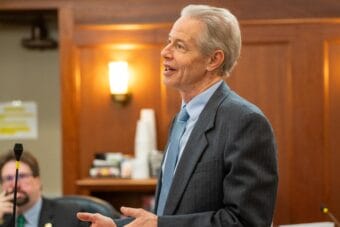
Gov. Mike Dunleavy speaks to reporters during a news conference on Feb. 7, 2024. (Eric Stone/Alaska Public Media)

Gov. Mike Dunleavy is eyeing a property tax break for the long-planned Alaska LNG project. The Republican governor said he plans to propose a two-mill property tax for the 800-mile natural gas pipeline and associated infrastructure, a 90% lower rate than the state typically charges in property tax for oil and gas infrastructure.

Dunleavy described his plans in an interview with the Anchorage Daily News. The Republican governor’s spokesperson confirmed the governor’s plans but declined to make Dunleavy or another member of the administration available for an interview.

The state shares a portion of the property tax revenue it collects with local governments, and some local leaders are raising concerns about Dunleavy’s proposal.

“We can’t subsidize that project,” said Kenai Peninsula Borough Mayor Peter Micciche. “We at least have to cover our costs.”

Micciche said he expected the project would be a boon for the state and his region, bringing thousands of jobs to the Kenai Peninsula. But a low property tax rate for the project would essentially push some of the project’s cost onto local taxpayers, he said.

“We’re going to have impacts on our schools. We’re going to have impacts on emergency services, for sure,” he said. “We’re likely going to be the agencies they turn to for their emergency response plans, like all the other oil and gas facilities do.”

Plans for a North Slope gas pipeline and Southcentral export terminal have been in the works for decades but have taken new life in the second Trump administration. The state turned the project over to a private developer, Glenfarne, which has put out a steady stream of announcements about agreements with potential customers, investors and suppliers. But the project has plenty of skeptics, who argue the project last estimated to cost $44 billion would be too expensive to make financial sense.

A consulting firm contracted by the state Legislature to examine the project, GaffneyCline, told lawmakers last month they may need to make a variety of changes to help the pipeline become a reality, including to property taxes.

In a statement, Glenfarne spokeperson Tim Fitzpatrick said the developer had not seen the specifics of Dunleavy’s proposal and couldn’t offer an opinion.

Micciche said he’s open to tax breaks that would support a pipeline, but he said local governments need to be involved in determining what exactly those might be.

At least so far, he said, that hasn’t happened.

“There is a deal to be had here, but it has to be born from facts, real math, local impact data,” Micciche said. “It has to be transparently and fairly negotiated between all involved in good faith.”

In an email, Dunleavy’s spokesperson, Jeff Turner, said the bill hasn’t been drafted, so it was premature to say the proposal was developed without their input. He said the deal was better than nothing.

“Right now, the state collects no property tax at all because the LNG pipeline does not exist,” he wrote.

Fairbanks Rep. Maxine Dibert, a Democrat who co-chairs the state House Resources Committee, says she plans to discuss Dunleavy’s bill with local officials. But she says she plans to focus much of her attention on a separate bill that would require the project to include a smaller lateral pipeline to supply Fairbanks with gas to cut energy costs.

“For me, that is a line in the sand, that it needs to be guaranteed part of the project,” she said.

Republican Sen. Jesse Bjorkman, who represents the central Kenai Peninsula, says he’s on the fence about Dunleavy’s proposal. He said he’d like to learn more about the project’s finances to determine what’s necessary. But in any case, he said, it would make little sense to cut the project a break on property taxes after Glenfarne makes a final investment decision, or FID.

“If they’re gonna have an FID decision in January next month, then that cake is already baked, like the financials are already in place.

Glenfarne declined to say whether it would reach FID before the legislative session begins Jan. 20, but said it continues to work toward making the pipeline a reality. The company has previously said it expected a decision by the end of 2025.

“Glenfarne is rapidly progressing toward a final investment decision, as seen through our progress with numerous Asian commercial announcements and strategic partner agreements. We expect additional announcements in the next several weeks,” Fitzpatrick said. “Our overall project schedule, including completing the pipeline in 2028 and delivering first gas to Alaskans in 2029 is proceeding on schedule.”

Former state medical board member dies in house fire after arrest for child sexual abuse images

Flashing lights atop a law enforcement vehicle. (Valerie Lake/Alaska Public Media)

Alaska State Troopers said in a bulletin Monday that Dr. Ryan McDonough died in a weekend fire at his home in Wasilla.

At the time of the fire, McDonough — a cardiologist formerly with Mat-Su Regional Medical Center — was on $50,000 bail after being arrested on Dec. 11 and accused of owning child sexual abuse images.

The alleged crimes, and the bail posted by McDonough’s wife, were reported by the Anchorage Daily News on Friday, a day after the medical center fired him.

The fatal fire at McDonough’s home took place Saturday; McDonough was initially listed as missing after the fire, but firefighters found human remains at the site, and preliminary testing later identified McDonough’s body.

The cause of the fire remains under investigation, and the other people who lived at the home were unharmed.

Alaska Gov. Mike Dunleavy appointed McDonough to the state medical board in August. That month, he joined other members of the medical board in voting to impose restrictions on medical care for transgender youth in the state and to recommend that Alaska lawmakers end legal access to abortion in the late stages of pregnancy.

McDonough subsequently appeared to drop off the board; he attended its August and September meetings but was absent from its October and November ones, public records show.

Because of absences and unfilled seats, the board — which regulates doctors and other medical professionals in Alaska — has had problems finding a quorum needed to do business.

McDonough’s name was removed from the board’s roster in November. A spokesperson for Dunleavy told the Anchorage Daily News that the governor’s office found out about McDonough’s alleged crimes on Friday and was not aware of any investigations at the time of his appointment.

According to an affidavit submitted in Palmer courts by a Department of Homeland Security officer, the online file storage company Dropbox sent a tip to the National Center for Missing and Exploited Children on July 31.

That tip led to the investigation of a Dropbox account linked to McDonough that contained a video of a child being sexually abused. A second tip followed another video on Aug. 10.

The Anchorage Police Department, in charge of investigating tips like those received by the National Center, obtained a search warrant for McDonough’s Dropbox, GCI and Google accounts. Subsequent searches found additional suspect videos, and McDonough’s computer was seized during a search warrant on Dec. 11, shortly before his arrest.

The Alaska Beacon typically publishes copies of court affidavits but is not doing so in this case because of their graphic contents and because they describe acts of sexual violence against children.

McDonough’s next court appearance was scheduled for Jan. 31.

Finalists for new Juneau fire chief present their plans for the department

Capital City Fire/Rescue fire chief finalists Tom Hatley (left) and Sean Wisner (right) during presentations at City Hall in Juneau in December 2025. (Photos by Clarise Larson/KTOO)

Two finalists in the running for fire chief at Capital City Fire/Rescue got a chance to share their vision for the department during public presentations this week. Juneau’s city manager is expected to make a decision next week.

Finalist Sean Wisner, who presented on Monday, has been the fire chief for Alyeska Pipeline Fire & Rescue in Valdez since 2012. He’s spent more than 20 years serving in emergency services leadership roles. He founded a consulting firm that specializes in helping organizations be resilient and improve their performance.

“I’ve been in leadership positions in all sorts of complex, municipal, industrial, backcountry and critical infrastructure environments,” he said. “I think that gives me a unique perspective on a place like Juneau.”

Wisner said he’s had his eye on Juneau since he visited the capital city in 2022 to compete in the Ironman Alaska race.

The other finalist, Tom Hatley, presented on Tuesday. He served as the deputy chief for the Spokane Valley Fire Department in Washington until April of this year, when he left due to a family medical reason. He has more than 30 years of experience in fire service, holding positions like fire chief, assistant chief and fire marshal at multiple agencies in the Pacific Northwest. 

Hatley said he was drawn to the position because of the complexities of Juneau’s fire and emergency medical services. He pointed to the community’s lack of outside support, large service area and seasonal population surges. CCFR services 3,255 square miles.

“This unique operating environment is why CCFR must focus on prevention, system resilience, workforce sustainability and community-centered service delivery,” he said. 

Hatley said, as chief, he would focus on addressing staffing problems in the department, especially retaining the department’s current employees. The fire department has struggled with staffing shortages, which union officials say have led to burnout and driven people away from the department. 

The Juneau Career Firefighters Union is currently at an impasse in its negotiations over a new contract with the city.

Juneau’s Capital City Fire/Rescue Chief Rich Etheridge in downtown Juneau on Tuesday, Sept. 16, 2025. (Photo by Clarise Larson/KTOO)

“Retention must come before recruitment,” Hatley said. “Hiring new people is important, but keeping experienced, well-trained personnel is what maintains service quality and organizational stability.”

Wisner said his strategy for strengthening the department is focusing on staff mental health. He said he wants the department to be a place where employees feel empowered and supported when they need help. 

“Emotional intelligence and emotional literacy is one of the tools that we can use to get there, to create a better culture within the organization and to foster stronger mental health,” he said. 

Both finalists said they also want to increase transparency, leadership development and community engagement.

The new chief will replace outgoing Fire Chief Rich Etheridge, who announced his plans to retire in September. He has been at the helm of Capital City Fire/Rescue for more than 15 years.

The annual salary listed on the city’s website for the position is between $125,944 and $161,761.

Federal lawsuit could scrap Mendenhall Glacier Visitor Center improvement plan

The Mendenhall Glacier Visitor Center on Friday, Feb. 21, 2025. (Photo by Clarise Larson/KTOO)

Listen to this story:

A U.S. Forest Service plan to revamp the Mendenhall Glacier Visitor Center to accommodate more tourists could be upended by a lawsuit brought by a nearby homeowner. 

Katharine Miller has lived in the Dredge Lake area near the visitor center for about 22 years. 

“It’s my backyard,” she said. “I do spend quite a bit of time there.”

Last July, she sued the Forest Service, claiming the agency violated the National Environmental Policy Act, or NEPA, when it designed its visitor center improvement plan. The plan expands facilities and increases the cap on the number of visitors allowed to come through commercial tour operators. 

Miller’s lawsuit argued that the Forest Service planned the project to accommodate more tourism without considering other options, which it’s legally required to do. In September, a federal court agreed and ruled in her favor.

Now, she’s requesting that the U.S. District Court for Alaska throw out the improvement plan altogether. The Forest Service is asking the court to leave the plan in place, arguing there’s a serious possibility the agency would reach the same decision to deal with existing overcrowding, and that revisions can be made instead. 

But Miller said it matters how the federal government arrives at decisions.

“Federal agencies like the Forest Service manage resources on behalf of the U.S. public,” she said. “They’re public resources, and I think it’s important to hold agencies accountable to include us in that process in a realistic way.”

Miller said she had objected to the agency’s process before the plan was finalized, but felt ignored.

On top of increasing the number of visitors tour companies can bring to the area, the improvement plan includes building a new welcome center and five new cabins, improving the existing visitor center, paving more parking lots and expanding trails. According to the court decision, the improvements are based on an assumption that tourism will grow 2% per year and the agency’s position that it should strive to meet the demand. 

In its ruling, the U.S. District Court for Alaska found the agency’s options for improving the facilities were all narrowly focused on facilitating more tourism. None focused on restricting the number of visitors.

Miller said the Forest Service should have considered a wider range of options beyond supporting tourism growth. 

“Because this isn’t something that’s necessary, it’s something that you want to do,” she said in reference to the Forest Service. “So you need to explain, you know, why that’s better than figuring out a better carrying capacity.”

The annual visitor capacity for the Mendenhall Glacier Visitor Center is a little more than half a million. The improvement plan allows for nearly double that — bringing the cap to 999,000 — with 87% allowed to be allocated to commercial use.

The U.S. Department of Justice’s brief on behalf of the Forest Service argues the agency can delay raising the capacity and revise parts of the plan that mention the 2% projected tourism growth. 

Despite citing significant congestion, the Forest Service doesn’t have a system for consistently tracking exactly how many people go to the visitor center each year, according to Paul Robbins, a spokesperson for the Tongass National Forest. He said a safe estimate is probably around 700,000 per year. He wrote in an email to KTOO that an estimated million or so people visit the wider Mendenhall Glacier Recreation Area annually.

According to a court file the Forest Service submitted, the area’s busiest days over the summer of 2025 ranged from 3,849 to 6,257 visitors.

Robbins declined to comment on the status of the improvement plan due to the ongoing lawsuit. He said agency staff plan to address deferred maintenance at the visitor center in the fall of 2026, work that was supposed to happen this year. It includes things like lighting, HVAC, flooring and painting. He said this maintenance is not part of the improvement project.

It’s unclear when the court will decide whether to throw out the improvement plan as Miller wants, or choose a different way to address the Forest Service’s violation. 

Alaska studies building a ferry terminal at Hyder to connect to the road system

Hyder is marked in red, located about 70 miles up the Portland Canal.

The state of Alaska is considering opening up a new ferry terminal in Southeast Alaska, connecting Alaska’s ferries to the Lower 48 road system without going through Canada.

The idea comes as Alaska continues to struggle with the closure of the ferry terminal at Prince Rupert, British Columbia. Now, the state is conducting a $250,000 study to see if a terminal on Alaska’s side of the border would be a good replacement.

For decades, the Alaska Marine Highway System relied on a terminal at Prince Rupert as its southern road connection. The state has leased the terminal from Canada since 2013, but it’s been closed for most of the past six years. There are numerous complications, like infrastructure challenges and disagreements with Canada over border control responsibilities. The dock needs over $20 million in repairs, and Alaska’s aging fleet isn’t certified for international travel anymore.

Jim Clark spoke about it at a regional development meeting in Ketchikan last year. He’s the former chief of staff for Governor Frank Murkowski, who worked on the ferry system for decades.

“If we can put a man on the moon, we ought to be able to solve the problem between here and 90 miles away at Prince Rupert,” Clark said.

Prince Rupert’s closed terminal has been a hot topic in many southern Southeast meetings. Some, like Robert Venables of the Southeast Conference, say they’re not ready to give up on Prince Rupert.

“It’s going to take everyone to lean into this thing,” Venables said. “It is problematic at the highest levels of bureaucracies to try to get back to Prince Rupert. But we’re going to give it our best, best push, and we’re going to keep pushing until it happens.”

The Prince Rupert connection isn’t completely off the table. But Alaska would need a federal waiver to bypass a requirement that steel materials for repairs be American-made. The state has requested this waiver in recent years without success. Canadian officials have opposed the requirement because the terminal is on Canadian soil.

And so, the state’s Department of Transportation has considered Hyder, Alaska — about 90 miles from Ketchikan — as an alternative.

“Fortunately, we have a lot of data for this site,” said Kirk Miller, an engineer with the state’s Department of Transportation, last year. “We’ve done engineering up and down this whole Causeway, the island, I’ve been working on their harbor and all these projects there for years. So, we have data, but not quite enough.”

This October, a new feasibility study began and is expected to be completed in mid-2026. The study is looking at all the details, like where a dock would go, the water depths, dredging, and environmental concerns.

It’s estimated the new terminal would cost about $30 million. It’s located about the same distance to Seattle as Prince Rupert – about 1,000 road miles. Prince Rupert is much larger than Hyder and has more amenities, but Hyder would be under Alaska’s control.

“I just want to really voice my support for Hyder,” said Bob Horchover, speaking in July as a member of the Alaska Marine Highway Operations Board, which makes recommendations to the state.

“In Hyder, we own the land, and most of the work is already done,” he said. “It’s a very adaptable situation. So, for me, there isn’t even a discussion.”

The state approved a 20-year ferry plan this year, based, in part, on a survey of over 2,500 Alaskans. Many respondents said restoring a road connection in Southeast was a priority.

Local governments agree. The Ketchikan Gateway Borough passed a resolution supporting a Hyder terminal if Prince Rupert doesn’t work out. Nearby Metlakatla feels the same. Mayor Albert Smith said that the lack of a Prince Rupert connection has hurt his town’s economy.

“With fishing, the rail system is real close to Rupert, so we could use the ferry to transport fish, and then it’s connected right to the 48s,” Smith said. “It’s a more efficient way than other ways of shipping.”

At least one Alaska lawmaker is on board: Republican Representative Jeremy Bynum of Ketchikan.

“I’m going to be a fierce fighter here on the legislative side and make sure we can get the funding in place that we need,” he said.

Whether Alaska rebuilds the Prince Rupert connection or builds a new terminal at Hyder, officials say either option would take five to eight years to complete the necessary infrastructure work.

Alaska Senate Republicans pick Tok Sen. Mike Cronk as new minority leader

Tok Republican Sen. Mike Cronk speaks during a news conference on January 21, 2025.
Tok Republican Sen. Mike Cronk speaks during a news conference on January 21, 2025. (Eric Stone/Alaska Public Media)

Tok Republican Sen. Mike Cronk is the state Senate’s new minority leader. The six-member minority caucus in the state Legislature’s upper chamber announced Tuesday its members had elected Cronk to replace former Wasilla Republican Sen. Mike Shower, who resigned to run for lieutenant governor earlier this year.

Cronk is a former schoolteacher and construction worker who first joined the state House in 2021. Last year, he won a seat in the Senate representing a massive swath of Interior Alaska that includes Glennallen, Tok, southeast Fairbanks, Delta Junction and much of the Yukon River.

In a phone interview, Cronk said he was looking forward to working on a fiscal plan that Gov. Mike Dunleavy plans to unveil next month.

“Obviously, we are in the minority, but I’m hopeful to, you know, work with the majority, to — can we get some of these things solved?” Cronk said.

The caucus includes six of the 11 Republican members in the Senate. Five others caucus with Democrats in a bipartisan majority that controls the chamber.

Fairbanks Republican Sen. Robb Myers will remain minority whip, the caucus’s the second-in-command.

Cronk will lead a caucus with two new members after Gov. Mike Dunleavy picked two House Republicans, now-Sens. Cathy Tilton and George Rauscher, to replace Shower and former Sen. Shelley Hughes, who is running for governor. Cronk said he would keep his seat on the Senate Finance Committee, but he said the caucus is still finalizing other senators’ committee assignments.

Cronk’s elevation to minority leader follows a leadership shakeup in the House’s minority caucus. That means both minority caucuses will have new leaders when lawmakers return to Juneau next month.

Site notifications
Update notification options
Subscribe to notifications