Incumbent Juneau Assembly member Ella Adkison (left) and Greg Smith (middle), and new member Nano Brooks (right) and give their oath to the city attorney at a meeting on Monday, Oct. 28, 2025. (Photo by Clarise Larson/KTOO)
The Juneau Assembly appointed two returning members and one new member during its annual reorganization meeting Monday night.
New member Nano Brooks and incumbents Ella Adkison and Greg Smith gave their oath to the city attorney and will now each serve a three-year term.
There were three seats up for grabs on the Juneau Assembly in this year’s municipal election, but only one race was contested. Brooks unsuccessfully ran for Assembly twice before finally securing a spot this election. He ousted two-term incumbent Wade Bryson from his District 2 seat by nearly 400 votes. This will be Brooks’ first time serving in public office.
Bryson did not attend the meeting.
Assembly members Greg Smith and Ella Adkison ran uncontested for their seats. Smith will now serve his third and final three-year term on the Assembly, while Adkison will serve her first full term. She was originally elected to the Assembly in 2023 to fill the remaining two years in the term of a member who resigned.
At the meeting, Assembly members appointed Smith as deputy mayor. He served in the role during his previous term.
The Juneau School Board will also swear in three new members on Tuesday night.
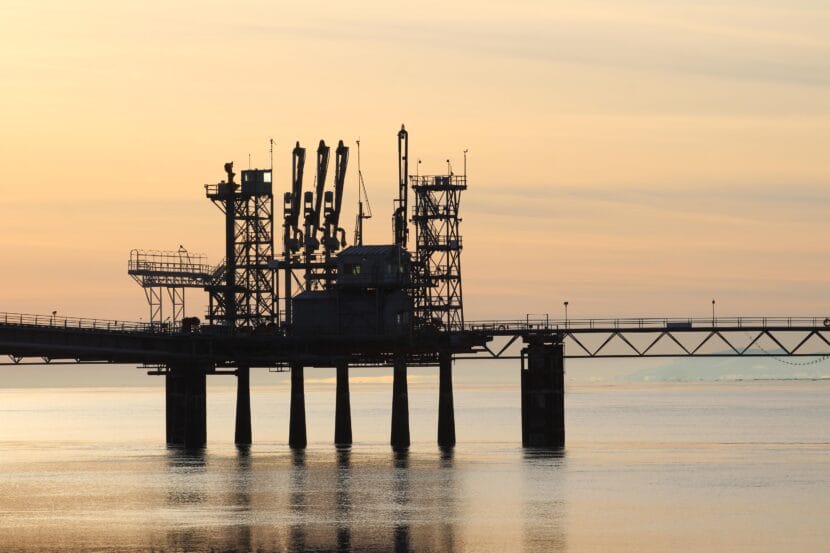
The sun sets behind Marathon Petroleum Corportation’s Kenai LNG Terminal on Thursday, Feb. 6, 2025 in Nikiski, Alaska. (Ashlyn O’Hara/KDLL)
The proposed Alaska natural gas pipeline project picked up another nonbinding agreement last week. This time, the letter of support comes from Tokyo Gas Company, one of Japan’s largest energy utilities. It’s the fifth acquired for the project since Glenfarne, a private energy asset developer, took over majority project ownership earlier this year.
If it’s built, the Alaska LNG Project will move natural gas from the North Slope through a roughly 800-mile pipeline to Nikiski to be liquefied and shipped overseas.
Adam Prestidge is the project president with Glenfarne. He told KDLL last month that preliminary agreements, though nonbinding, are a necessary first step toward agreements that are binding. But he says that can take a while.
“Typically, an LNG contract like this, can take, you know, 12, 18, 24 months to go from initial concept to being a binding agreement,” he said.
Glenfarne celebrated the preliminary Tokyo Gas agreement in a press release for pushing the project over the halfway mark of its LNG export capacity.
Glenfarne Communications Director Tim Fitzpatrick said the project’s annual capacity boils down to two separate numbers.
The first is the natural gas capacity of the pipeline, measured as a volume in billion cubic feet. The second is the liquid volume of natural gas for export, measured as a weight in million tons.
Fitzpatrick says the pipeline has an estimated capacity of 3.3 billion cubic feet of natural gas per day. Of that, 15.2%, or 500 million cubic feet, is earmarked for in-state use by Alaska residents as natural gas. According to a report commissioned by the Alaska Gasline Development Corporation, that’s roughly double what Alaskans in the Anchorage, Matanuska-Susitna and Kenai Peninsula regions actually use each year – between 180 and 200 million cubic feet.
The remaining project output will be converted to 20 million tons of liquefied natural gas for export, Fitzpatrick said. Of that, 11 million tons already have tentative customers through the handful of preliminary agreements reached this year.
Glenfarne estimates it needs binding commitments for five million more tons of liquified natural gas to fund the full $44 billion project.
This week, the head of the International Energy Agency predicted a forthcoming increase in liquefied natural gas supply could change global markets. Reuters reports the shift is creating a buyer’s market, pushing prices down for importers in places like Asia.
Glenfarne is eyeing the end of this year to decide whether to move forward with project development or not.
Correction: A previous version of this story incorrectly stated the annual natural gas capacity of the pipeline.
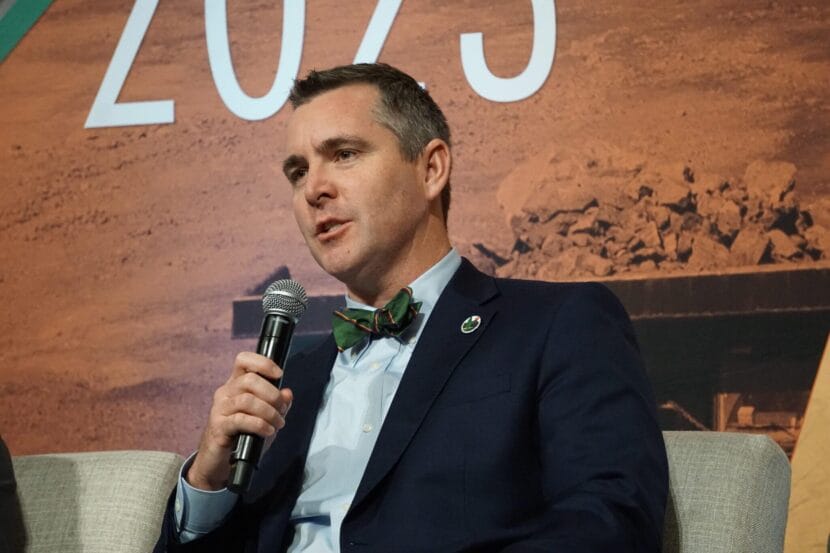
John Boyle, commissioner of the Alaska Department of Natural Resources, speaks on Nov. 15, 2023, at the Resource Development for Alaska annual conference in Anchorage. (Yereth Rosen/Alaska Beacon)
John Boyle, commissioner of the Alaska Department of Natural Resources, abruptly resigned his position on Friday.
Gov. Mike Dunleavy announced the appointment of his deputy, John Crowther, as acting head of the agency that regulates Alaska’s agriculture, mining, oil and gas.
The governor’s office declined Monday to answer questions about the resignation, which had not been previously announced.
Dunleavy is term-limited and will leave office in December 2026. Boyle’s departure follows those of Revenue Commissioner Adam Crum and Attorney General Treg Taylor.
The resignations of both of those men — who are now Republican candidates for governor in next year’s elections — were announced in advance, unlike Boyle’s departure.
Boyle could not be reached for comment on Monday.
The departing commissioner has extensive experience in the oil industry. Before joining Dunleavy’s cabinet in 2023, he was a lobbyist for BP and Oil Search.
Crowther, who will replace Boyle on an interim basis, has been with the Department of Natural Resources since 2012, the governor’s office said.
He previously worked as director of the governor’s Washington, D.C. office and served on the staff of the U.S. Senate’s Energy and Natural Resources Committee. He holds a law degree from Georgetown University.
“The Department of Natural Resources is at the forefront of protecting and developing Alaska’s precious land and waters. Mr. Crowther’s legal background and experience as a deputy commissioner make him a great choice to advance the responsible development, and maximum use, of Alaska’s natural resources consistent with the public interest as mandated by Alaska’s Constitution,” the governor said in a prepared statement released on Friday.
Correction: This story originally had the wrong byline.
KC Kregar yells at Assembly members and City officials as he is escorted by Juneau police during an Assembly meeting on Monday, Oct. 27, 2025. (Photo by Clarise Larson/KTOO)
A man was escorted out of the Juneau Assembly meeting on Monday night by police officers due to safety concerns.
KC Kregar was asked to leave the meeting because of his alleged repeated harassment of city officials and Assembly members, said City Attorney Emily Wright. He was previously arrested for trespassing after refusing to leave City Hall on Oct. 16. But on Monday he left willingly with officers and was not arrested.
“He was trespassed for a pattern of continuous harassment and threats towards staff,” Wright said.
Kregar originally showed up to the meeting at Centennial Hall in a ski mask and goggles. He took the mask off while speaking to the press, saying he came to the meeting to testify and expose wrongdoings and corruption by the city and Eaglecrest Ski Area.
“They’re trying to bury me,” he said to the press prior to his removal. “They should be put in jail for what they are hiding.”
Kregar said he’s a whistleblower and has information about safety violations related to the ski area.
The meeting was delayed an hour while police confronted Kregar. He shouted as he left.
“This is wrong. I committed no crime,” he said. “You’re hiding, you’re non-transparent.”
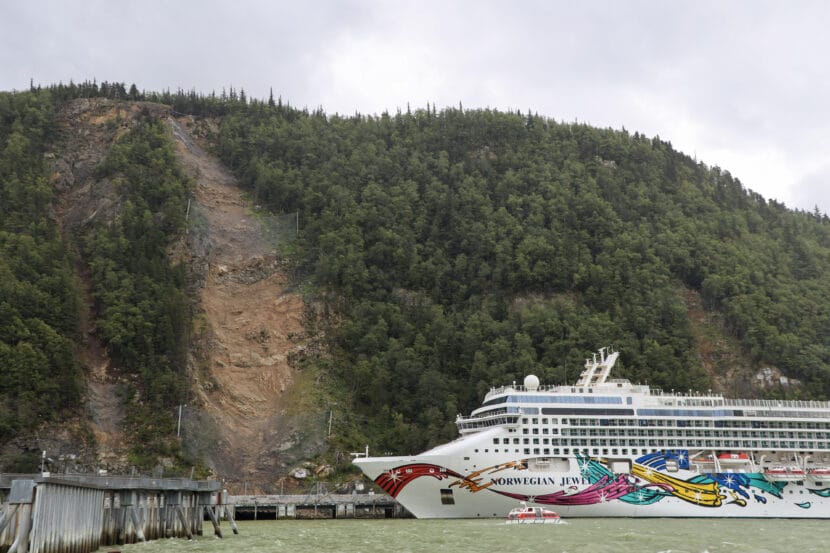
The Norwegian Jewel berths below the Railroad Dock in Skagway on Friday, Sept. 6, 2024. (Photo by Clarise Larson/KTOO)
A major rockslide has been threatening Skagway’s busiest cruise ship dock in recent years. Numerous industry experts were in town recently to present options for long-term mitigation. None of the choices were easy or cheap.
A rockslide above Railroad Dock in 2022 prompted a study by the geological firm Shannon & Wilson. That report stated the firm’s opinion that “the slide mass will eventually fail and the consequences of such failure will be catastrophic in nature with significant risks to life and property.”
Since then, the municipality has been doing routine scaling work, which is basically removing loose rock. Crews installed additional fencing and netting and instruments to measure ground movement. During tourist season, they send someone up the mountain each morning to take photographs. But, these are all admittedly short-term solutions.
“Nobody wants the big failure to happen and then not be ready for it,” said Kyle Brennan, project manager for Shannon & Wilson.
Brennan said the mountain needs long-term mitigation.
“We’re able to keep track of what’s happening up there. And right now, we have safe operation of the facility at the bottom,” he said. “But it’s time to move forward and take care of this larger hazard with these unstable rock masses at the top of the slope. Because predicting when that failure will eventually happen … is very difficult. And so right now, we have time. To be proactive about these things and take care of them is in the best interest of the community and everybody else.”
Shannon & Wilson presented four options. Option one concedes that the rock is too difficult to move and will therefore remain in place. The dock and everything below would be moved to a safer distance. Option two is excavating the unstable rock and sending it down the slope, where it is collected and hauled off-site. Option three leaves the rock mass in place and attempts to stabilize it. Brennan says this would be a “case study.” Option four would excavate the rock mass and move it up the slope, leaving it on the mountain.
The team wholeheartedly prefers option two.
“We’re looking at modifications to the dock,” Brennan said. “But for the most part, it’s just simply excavation and removal and letting gravity move the rock for part of it, and then picking it up and putting it somewhere else. This seems to be like our lowest risk option right now.”
The municipality was awarded a nearly $20 million grant for the project from the Federal Emergency Management Agency. But a majority of that money dissipated with President Donald Trump’s administration, leaving only the funds for the design portion of the project.
However, the municipality chooses to move forward, and however they manage to pay for the multi-million-dollar project, Brennan said it’s not going to be easy.
“It’s a tender site,” he said. “It’s going to take a lot of TLC to get that rock down. And so we want to make sure we’re doing it in a purposeful manner that’s safe, that’ll achieve the goal without catastrophe. The last thing I want to do is stand up here in front of you guys in a couple years and try to explain why everything went sideways…”
Skagway resident Lynne Davison was one of many intently listening to the presentation.
“And so I hear you talking about these alternatives and when the decision is made,” she said. “But how and who? How is that decision going to be made?”
“The decision, the ultimate decision is not one that Shannon & Wilson and our design team will make independently of anybody else,” Brennan answered. “The city will be involved with that decision. And ultimately will likely be the ones to make that decision based on our input and based on all of your input.”
Brennan said there will be at least two more public meetings before the construction phase. If funding is procured, that could start in 2026 and would take place between tourist seasons.
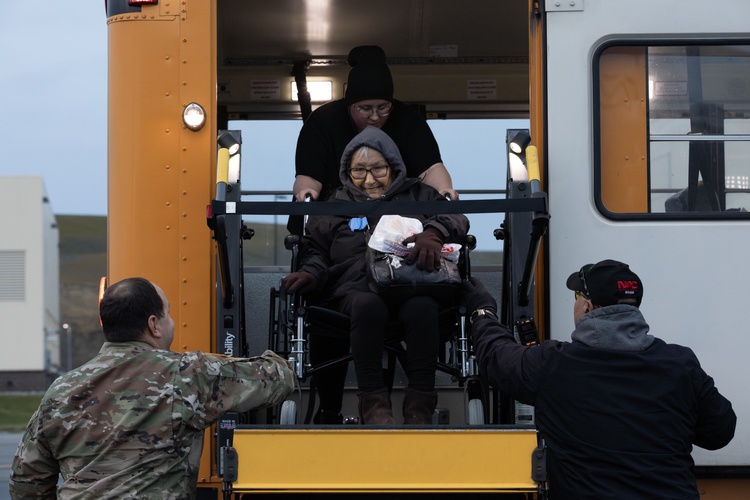
Alaska Air National Guard C-17 Globemaster III aircrew, assigned to the 176th Wing, arrive at Joint Base Elmendorf-Richardson, Alaska, with 62 evacuated residents from western Alaska, Oct. 17, 2025. (Alaska National Guard photo by Alejandro Peña)
The State of Alaska has begun distributing disaster relief payments, totaling over $217,000 as of Friday, to residents of western Alaska impacted by storm damage from ex-Typhoon Halong.
The state has received more than 940 applications for state individual assistance, according to a statement from the Alaska Division of Homeland Security and Emergency Management. Applications are open on the state’s website, through Dec. 9.
As many storm evacuees left or lost identification or essential documents, the Alaska Department of Motor Vehicles and the Department of Health have booths at emergency evacuation shelters in Anchorage to assist with replacements. The Association of Village Council Presidents is offering tribal IDs in the shelters. State caseworkers and a Yup’ik speaking public notary are helping with documentation, the state update said.
Residents must prove they are from the designated disaster area, and provide proof of identification and a mailing address where checks can be mailed.
As of Thursday night, there were 302 evacuees staying in emergency shelters in Anchorage, with 178 at the Egan Center and 124 at the Alaska Airlines Center.
The state’s assistance program provides financial assistance for storm damage to homes, vehicles, essential personal property and medical, dental or funeral needs directly related to the disaster. Applicants will be eligible for $21,250 in home repairs and another $21,250 for “other needs.”
The state’s individual assistance program also includes a housing assistance program that provides renters with up to three months and homeowners with 18 months of financial assistance, according to the state’s website.
Gov. Mike Dunleavy announced Friday that he amended the state’s disaster declaration to waive state fees associated with replacing documents, including licenses and registrations. It also waives late fees for state-administered loan and payment programs.”
Federal disaster assistance approved
On Wednesday, the Trump administration authorized a federal disaster declaration for the Western Alaska storm. The president said that he has authorized an immediate $25 million in federal aid for the state to cover costs as the recovery effort is underway.
Trump also approved the state’s request for federal assistance, including federal individual assistance, public assistance and the hazard mitigation grant program.
Residents can apply on the Federal Emergency Management Agency’s website at DisasterAssistance.gov or on the FEMA app. Applicants must file a claim and are required to go through a FEMA inspection to qualify.
The U.S. Small Business Administration is also offering low interest loans to small businesses, non-profits and individuals impacted by the storm, to help pay for losses not covered by insurance. Applications can be submitted on their federal website.
Financial donations pour in for Western Alaska communities
Individual and business donations have come pouring in for the families and communities devastated by ex-Typhoon Halong, including food, supplies, and financial assistance.
The state has a list of resources and links to assistance on its website.
The Western Alaska Disaster Relief Fund has raised $2.5 million to date, said Ashley Ellingson, director of communications with the Alaska Community Foundation, with mostly corporate donors pledging an additional $1.5 million more. She said an advisory committee of regional and state leaders meets at least weekly to consider requests and how to best allocate funding.
The Alaska Community Foundation has already distributed roughly $575,000 to five organizations: the Association of Village Council Presidents, the Maniilaq Association, the tribal councils of Kipnuk and Kwigillingok — the communities hardest-hit by the storm — and the Alaska Native Heritage Center. Ellingson said that is to ensure funding goes to immediate needs.
“Local organizations can distribute to individuals and families affected the most,” she said.
Correction: The application for state disaster assistance is open until Dec. 9, 2025.
Close
Update notification options
Subscribe to notifications
Subscribe
Get notifications about news related to the topics you care about. You can unsubscribe anytime.