Government

Juneau Assembly weighs cost of buyout for View Drive residents in flood zone

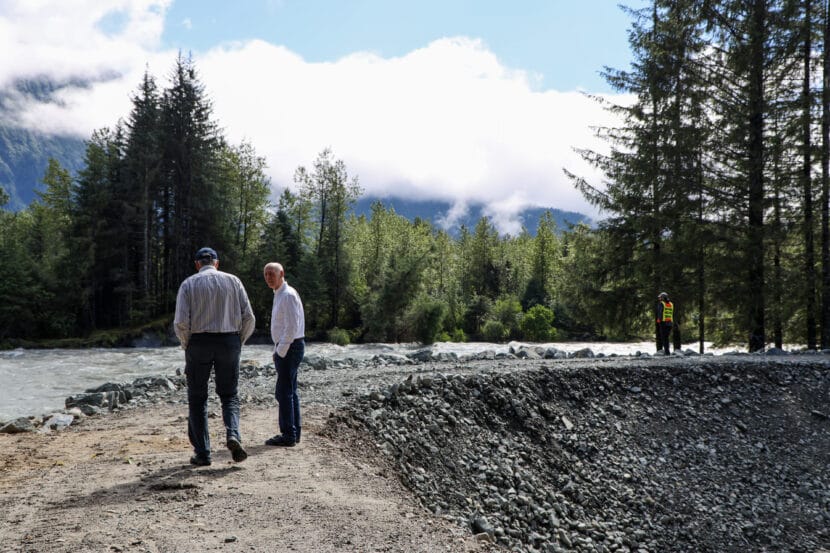
Don Habeger and Wayne Coogan walk on the top of a privately made berm that failed to protect Habeger’s home from flooding on View Drive in August 2025. (Photo by Clarise Larson/KTOO)

Listen to this story:

View Drive is the street hardest-hit by Juneau’s annual glacial outburst flood, and remains unprotected by the city’s temporary levee. The Juneau Assembly is hoping to avoid paying a portion of the cost for a federal program that would offer buyouts to those residents.

A federal buyout for View Drive would pay residents to leave, demolish their homes and transform the land into a park. But first, the city has to decide whether to sponsor it. At this point, it’s not clear if the Assembly will vote to do so. 

Mayor Beth Weldon was cautious at Thursday’s special Assembly meeting, where experts presented the city’s options.  

“I don’t think anybody’s ready to commit to anything tonight,” she said.

Brett Nelson is Alaska’s conservation engineer at the Natural Resources Conservation Service, or NRCS. The federal agency oversees a recovery buyout program. At the meeting, he explained that the City and Borough of Juneau would be responsible for 25% of the cost. 

If all 18 eligible properties participated, it would cost an estimated $25 million. That means the city would be on the hook for up to around $6 million. But he says it’s unlikely every household would take the deal.

The Assembly voted unanimously to request a waiver to pay. Nelson said it’s worth making the request, but he’s not sure it’s realistic that NRCS headquarters would approve it. 

“I’ll say this: it is not very often used,” Nelson said.

If the cost is not waived, the city could seek funding from other sources besides Juneau taxpayers, such as nonprofits. But there is one restriction on the city’s portion:

“The 25% cannot be from another federal source unless that other federal source comes with congressional language specifically indicating that it can be used as a match for federal dollars,” Nelson said.

He said it would take around a year to complete the process and that the agency would prefer to offer the buyout option to residents before the next flood, which is expected next summer. 

“This is an emergency program and we’d like to move as expeditiously as possible,” he said.

If the city does take on the project, NRCS will appraise the 18 homes on View Drive and then residents will choose whether to take the deal or stay. Nelson says there are two appraisal options: they can be done based on the value now, or as of the day before the 2024 flood — and the agency is leaning toward the latter.

That appraisal decision will apply to every eligible property and affect the overall price tag of the project, since homes are worth more before they’ve been damaged by repeated flooding. 

Engineers say that while a couple of properties on View Drive might benefit from a barrier, the whole street can’t be protected by the HESCO barriers that make up the temporary levee protecting most other Valley neighborhoods.

Mike Records is a hydraulic engineer at the Army Corps. He compared the hazard of putting HESCO barriers on View Drive to the danger of a mariner taking a dinghy across Lynn Canal during a storm. 

“View Drive basically sits on a moraine from the retreat of the Mendenhall Glacier, so that moraine is extremely porous,” Records said.

He said that means water would seep under a temporary levee and form a pool. That’s what happened to a property at the end of the street where residents decided to erect their own berm ahead of the flood this August.

“You’re building a reservoir — potential reservoir  — with homes in the middle and no way out,” Records said, referring to how View Drive is a dead-end street with a single entry and exit point.

He said he recognizes that it’s unfair not to protect View Drive residents who’ve faced flooding over and over, and that they’re in a “horrible situation.” But from an engineering perspective, he said the only way to protect households that decide to stay is to implement a long-term flood solution

Nelson says parcels that get bought out become restricted from development forever, so households that participate in the program couldn’t return to their former properties — even after a long-term solution is built. He says NRCS has already determined View Drive is eligible for a buyout and that federal funding would likely be available soon after the government shutdown ends, if the city decides to sponsor it.
Army Corps agrees to pay for HESCO barrier expansion, expedites long-term outburst flood solution

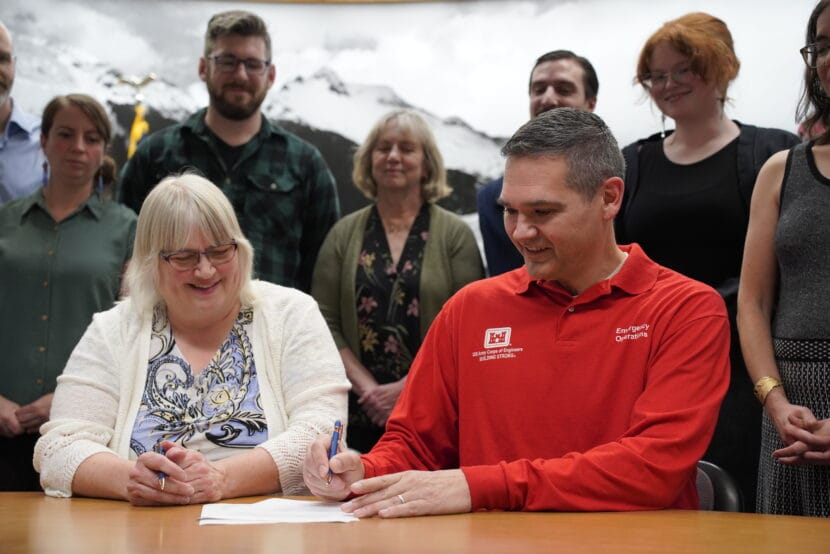
Mayor Beth Weldon and Daryl Downing, a program manager at the U.S. Army Corps of Engineers, sign the assistance agreement to enhance the temporary levee on Oct. 30, 2025. (Alix Soliman/KTOO)

Listen to this story:

The U.S. Army Corps of Engineers announced Thursday that it will pay the full cost to extend and repair Juneau’s temporary river levee meant to protect almost all Mendenhall Valley neighborhoods from glacial outburst floods in the near-term. And it will expedite its process to choose a long-term solution that will protect the entire Valley. 

The existing temporary levee is made of HESCO barriers — steel and mesh baskets filled with sand. It protected hundreds of homes from flooding by a slim margin during the record-breaking glacial outburst flood in August. At a special Juneau Assembly meeting Thursday, members signed an agreement accepting assistance from the Army Corps to enhance the temporary levee. 

After signing the agreement, Mayor Beth Weldon referenced a quip Assembly member Ella Adkison made moments before. 

“The Army Corps is going to do phase two and pay for it. So we truly appreciate the assistance, and as Miss Atkison says, there’s no take-backs,” Weldon said.

The agreement expands the levee both upstream and downstream, protecting many more homes and businesses along Mendenhall River. Phase 2 will go from Back Loop Bridge to just before Juneau International Airport. The city estimates the expansion will cost around $19 million to build. The agreement means the city will no longer have to debate controversial ways to pay for construction.

Daryl Downing, program manager at the Seattle District of the Army Corps, says the agency will cover HESCO design and installation, as well as armoring the banks. 

“What is not covered is going to be any sort of outreach the City and Borough of Juneau will need to do to secure rights of entry or any permitting requirements for these efforts,” Downing said. “Once the Corps installs these measures, they get turned over to the City and Borough of Juneau for operations and maintenance, and then removal as well.”

The Army Corps will also help repair the existing stretch of the flood barrier, which leaked and slumped during the flood this summer — sustaining about a million dollars in damage — and build it higher for the next flood. 

The agency aims to complete that work by July 15, 2026. For reference, the glacial outburst flood has struck during the first two weeks of August in each of the past three years. 

None of this funding will retroactively cover the cost to build Phase 1 of the levee — which is estimated at around $6 million. The Assembly passed a controversial funding scheme called a local improvement district, or LID, earlier this year to split 40% of the cost among more than 400 homeowners in the flood zone. 

At Thursday’s meeting, the Assembly voted not to close out the Phase 1 LID. The only Assembly member who objected was Nano Brooks. He asked if it would be possible to use some funds from the recently reappropriated $5 million that was pulled from the Capital Civic Center to reduce the residents’ portion. 

City Manager Katie Koester said that money could be used to care for future repairs and maintenance of the HESCO barriers. 

“In the end, it’s really your decision how much you want to use taxpayer dollars versus property owner dollars,” Koester said. 

Long-term solution in sight

The Army Corps made another major announcement Thursday.  It aims to finish its technical report, recommend a long-term flood solution, and design it by the end of May 2026. That’s several years faster than the process agency staff outlined at a public meeting in July.

John Rajek is the chief of the geotechnical and engineering services branch at the Alaska District of the Army Corps. 

“We plan on developing a preliminary design of the preferred flood control alternative, we’re going to prepare a planning-level cost estimate that’s going to help everybody understand the financial implications and basically help make informed decisions on the path forward,” Rajek said. “And then the third element is, we’re going to complete a draft environmental assessment of that alternative.”

Those options are a dam, a permanent levee, a bypass channel along the river, a tunnel to drain Suicide Basin or relocating buildings from the flood zone. 

Rajek says that in December, the Army Corps will hold a charette — a major planning meeting with federal and local agencies — to discuss the options and pick one.

Anonymous sources engaged in the agency’s process told KTOO that a tunnel through Bullard Mountain to drain Suicide Basin looks like the preferred option at this point, but Army Corps staff refused to comment. 

The Army Corps is seeking public comment on the long-term solution, which closes at the end of next month. The public affairs office requests comments to be submitted to public.affairs3@usace.army.mil.

Telephone Hill tenants must vacate homes by Saturday ahead of demolition plans

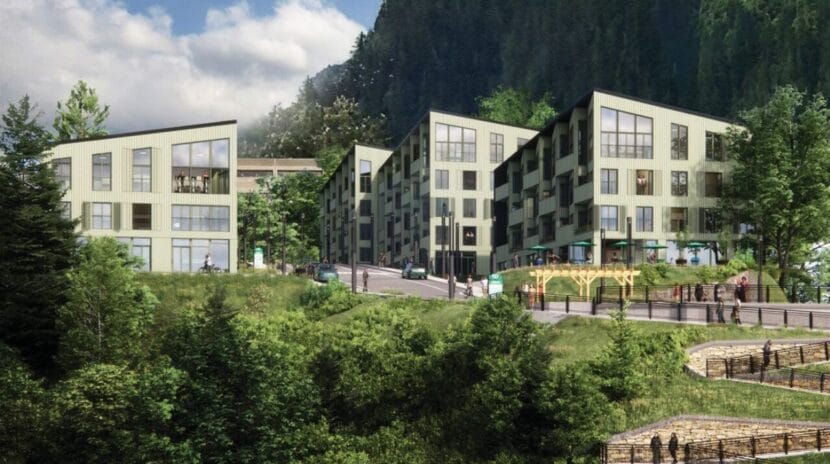
This is a preliminary concept drawing of what the Telephone Hill neighborhood redevelopment could look like. (Courtesy/City and Borough of Juneau)

Renters living in Juneau’s Telephone Hill neighborhood have until Saturday to vacate their homes before the city evicts them.  

That will clear the way for the city’s plan to demolish the houses in December and redevelop the area to build newer, denser housing there in response to the city’s housing crunch.

The evictions were originally slated for Oct. 1, but the city postponed them until this Saturday due to a legal hiccup. The evictions come after outcry by local advocates, who asked the city to halt them until it produces a clearer redevelopment plan. Right now, a developer has not signed on to the project. 

Advocates collected more than 800 signatures opposing the redevelopment plan ahead of the Juneau Assembly meeting on Monday. There, more than a dozen people testified in hopes of persuading members to reverse course and save the historic downtown neighborhood. However, no action was taken on the topic. 

The Juneau Assembly is slated to discuss the project and next steps for the redevelopment at a committee meeting on Monday at 6 p.m. The discussion will include the timeline for demolition and finding a developer, and will address several other questions about the project brought forth by advocates. 

State analysis of Cascade Point ferry terminal draws fire from advisory board, Haines mayor

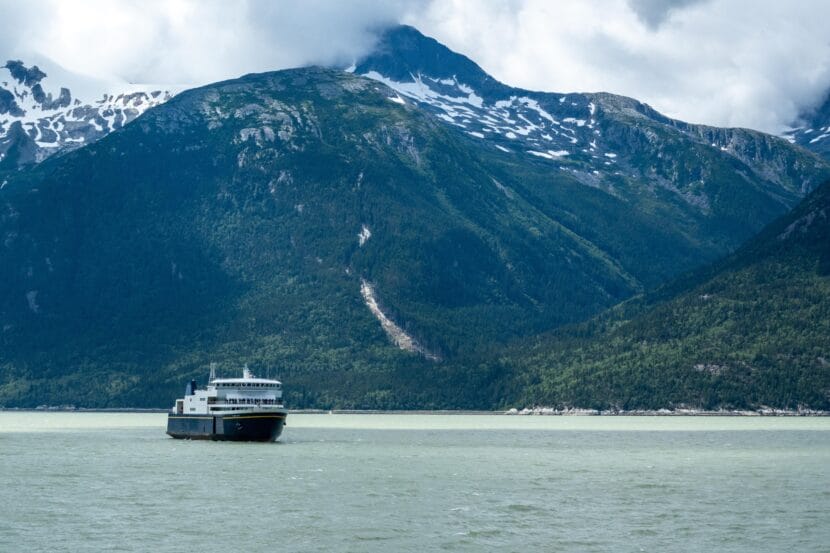
An Alaska state ferry in front of a steep mountain on a cloudy day
The Alaska Marine Highway System ferry Hubbard approaches the dock in Skagway on July 28, 2024. (Eric Stone/Alaska Public Media)

A state plan to build a new ferry terminal north of Juneau is hard to justify on its financial merits but could pose long-term benefits, including more flexible regional travel and a boost to the mining industry.

That’s the conclusion of an economic analysis released by the Alaska Department of Transportation in mid-October. It weighs the agency’s plan to shorten the ferry route between Juneau, Haines and Skagway by routing passengers through a new terminal located 40 miles outside the capital city.

For months, local officials and members of a key advisory board have called on the state to provide an economic analysis or feasibility study of how the project might help – or hurt – travelers. At least so far, they’re unimpressed with the resulting document.

“It’s not convincing me,” said Haines Mayor Tom Morphet. “And it’s certainly not, even in their own words, a slam dunk.”

Bob Horchover of the Alaska Marine Highway Oversight Board echoed that point during a meeting last week. He said the analysis, which was first reported by the Juneau Independent, read “like a timeshare brochure.”

“I don’t think it was realistic, and I’m not sure where they got some of their numbers,” he said.

Report calls proposed terminal “a strategic investment”

At issue is the so-called Cascade Point ferry terminal project. The state says it’s been working on the idea for several years. But DOT recently kickstarted the effort by signing a $28 million contract for the first phase of the project.

The site is located on land owned by Goldbelt, Inc., a Juneau-based Alaska Native Corporation. News of the initial contract was welcomed by Canadian mining company Grande Portage, which plans to develop an ore terminal at the site – in partnership with Goldbelt.

DOT, for its part, argues the project would reduce operating costs and ease passenger travel by moving the ferry terminal significantly closer to Haines and Skagway, shortening the ferry route.

The new economic analysis assesses those claims plus concerns raised by critics. It was written by a contractor, Ed King, who formerly served as chief economist and economic advisor for the state of Alaska.

On the whole, the report acknowledges that the project’s “extensive capital costs” are “difficult to justify based on savings alone.” Still, it paints a picture of the so-called Cascade Point ferry terminal as a project with more pros than cons – especially in the long term.

“In conclusion, although the Cascade Point Ferry Terminal presents challenges as an independent initiative,” the report reads, “it may prove valuable as a strategic investment that facilitates resource development and improves access to the Capital.”

A skeptical ferry board 

That framing drew sharp criticism from members of the Alaska Marine Highway Oversight Board during a meeting last week.

Board Chair Wanetta Ayers said it seems like the analysis aims to “build a case for Cascade Point,” as opposed to evaluating it against alternative options.

“I don’t believe it makes a strong case, certainly from a customer service standpoint, and very marginally from an economic standpoint, that the project is justifiable,” Ayers added in a follow-up interview.

That’s concerning, she said, given that dollars are already being allocated to it — and that there’s a long list of other ferry-related projects in desperate need of funding. The nearly 45-page report explores potential impacts from the terminal, which would shorten the ferry ride between Juneau, Haines and Skagway.

The analysis acknowledges that the terminal would create new infrastructure and maintenance responsibilities for the state. It also finds that “construction costs are unlikely to be recovered in a meaningful timeline without additional changes.”

Another con is that passengers would have to make up for the shorter ferry route by traveling 28 more miles outside Juneau. That would make regional travel more expensive, given extra gas, vehicle wear and tear, and ferry fares that would stay the same.

Goldbelt has committed to running a bus service to transport passengers between Cascade Point and Juneau. But uncertainty remains about the reliability and cost of that shuttle for those traveling without a vehicle – and about what the longer drive would mean for those who do bring a car.

“My guess – and obviously, I’m not an economist – is that for the average user, it’s not a clear cut win, to put it most lightly,” said Morphet, the Haines mayor. “And certainly, to a lot of people, I think would be a loss” of access.

DOT spokesperson Danielle Tessen did not directly address those concerns during an interview Wednesday morning. She said shortening the ferry route ultimately comes down to saving money for the chronically underfunded ferry system.

“That is what we’re focused on, is creating these shortened ferry distances, because that’s how we’re able to continue reducing the cost of operations,” Tessen said.

Cascade Point “not an on-its-own project,” DOT says 

The analysis concludes that the new terminal would reduce planet-warming emissions and operating costs. Shorter ferry runs would result in “modest reliability gains” and an estimated 5% bump in ridership, it says.

But the real value comes from other long-term factors.

“Cascade Point, and this terminal, it’s not an on-its-own project,” said Tessen, of DOT. “And what I mean by that is, there is a bigger plan.”

That bigger plan has two main prongs. The first is another DOT effort, known as the Chilkat Connector Feasibility Study, which has also faced fierce opposition in the Upper Lynn Canal.

The agency is assessing what it would take to build a road aimed at easing travel between Skagway, Haines and Juneau. Cascade Point, the analysis notes, would be a “foundational” component of that effort.

The second prong is regional economic development by way of mining. The analysis says the new terminal would serve as a major boon for Grande Portage Resources’ proposed New Amalga Gold Project, which would likely use Cascade Point as its logistical base.

Morphet took issue with that logic.

“It’s kind of based on this trickle-down view of the economy, that if there’s commercial or industrial development at Cascade Point, there’s a greater benefit to the public,” he said.

“But is there a greater benefit to the traveling public?” he added. “That’s what this question is about: transportation.”

Horchover, the operations board member, echoed that point.

“I don’t know exactly what the motivation is, but it sure isn’t for the good of the Alaska Marine Highway service,” he said. “That’s my two cents.”

The board has previously raised concerns that the Cascade Point planning process deviated from the ferry system’s long-range planning process. During last week’s meeting, the board voted to write a so-called “corrective action” letter to the agency and state legislature saying as much.

The state announced on Wednesday that it is soliciting public comment on phase one of the project through Nov. 28.

Wasilla Sen. Mike Shower says he’ll resign to campaign for lieutenant governor

Man speaking in legislative chamber
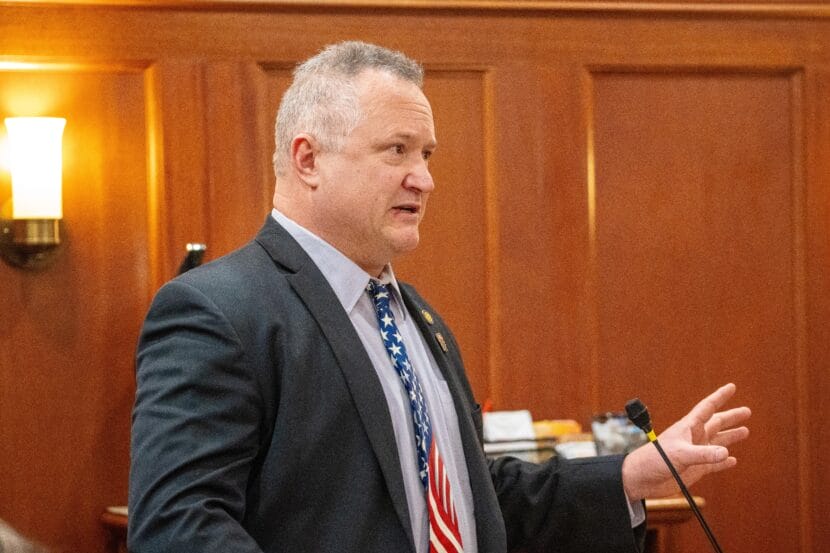
Sen. Mike Shower, R-Wasilla, speaks in the Alaska Senate on March 25, 2024. (Eric Stone/Alaska Public Media)

Alaska Senate Minority Leader Mike Shower plans to resign to focus on his campaign for lieutenant governor alongside gubernatorial candidate Bernadette Wilson.

In an interview, Shower said he was concerned his duties as a legislator would create roadblocks in the campaign. For instance, state law prohibits sitting lawmakers from fundraising during legislative sessions.

“Going to the Legislature and being sequestered for four months in Juneau, and then maybe a special session or two next year, would limit my ability to fundraise and campaign,” he said. “You can violate the law if you’re not careful, right? You can really make a mistake there.”

The Wasilla Republican represents a large chunk of the Matanuska-Susitna Borough and some other communities, including Talkeetna, Willow, Sutton and Valdez. He leads the all-Republican minority that makes up about a third of the state Senate. He’s been in the Senate since 2018.

Once Shower’s resignation takes effect on Nov. 3, Gov. Mike Dunleavy will have 30 days to appoint a new Republican to serve until the 2026 election.

Shower declined to say who Dunleavy should appoint to replace him, and the governor’s office didn’t immediately respond to questions on the subject. But he said he’d like it to be someone who shares his conservative views.

“What I think is important is that that person represents the values of my district,” he said. “My district is very conservative. It’s one of the most conservative, politically, in the state.”

Since Shower is a Republican, state law requires Dunleavy to appoint a Republican to replace him. The appointment is subject to confirmation by other Senate Republicans.

Sutton Republican Rep. George Rauscher has registered as a candidate for Shower’s seat. Big Lake Republican Rep. Kevin McCabe, who also lives in Shower’s district, has also filed campaign paperwork that would allow him to run for Shower’s seat, as has former Alaska Wildlife Troopers head Doug Massie.

Debate over Alaska’s ranked choice voting continues at Juneau Chamber of Commerce luncheon

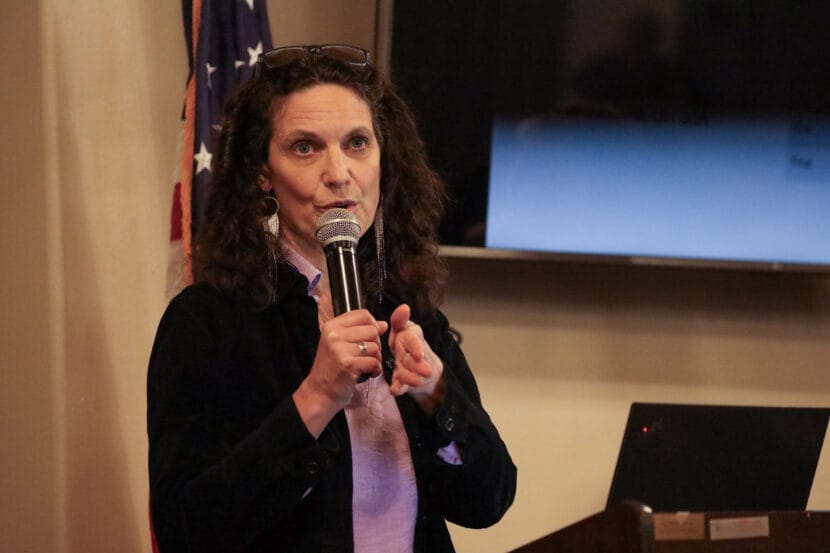
Rebecca Braun speaks in favor of ranked-choice voting at a Juneau Chamber of Commerce Luncheon on Thursday, Oct. 30, 2025. (Photo by Clarise Larson/KTOO)

Though Alaskans approved ranked choice voting nearly five years ago, the debate about whether it actually benefits voters persists. At a Juneau Chamber of Commerce Luncheon on Thursday, two speakers shared what they think of the system. 

Alaska uses a ranked choice voting system for statewide elections. Voters approved it in 2020 and used it for the first time in 2022, though there have been attempts to repeal it. The system allows voters to rank candidates by preference. 

Rebecca Braun is on the board of Alaskans for Better Elections and spoke in favor of the system. Braun argued that ranked choice voting encourages voter participation and reduces political polarization.

“It might not be perfect, but I think that it’s better,” she said. “I don’t think there’s any voting system that like has no distortions. Mathematicians study this, and there’s almost nothing where you have 100% perfect outcomes. But this seems like to me a better system.”

Alaska is one of only two states that use ranked choice voting. Ten Republican-led states have banned it. Murray Walsh spoke against the system at the forum. He’s a retired land use consultant and is a part of a statewide campaign to repeal ranked choice voting.

Walsh argued it makes voting unnecessarily complicated and unfairly gives Democrats an advantage. The Alaska Republican Party has consistently opposed ranked choice voting. 

“Anytime you take something that people do understand and make it more complicated so that they don’t understand it, and then you’re alienating the voter,” he said. 

According to data from the state’s Division of Elections, Juneau voters appear to support ranked choice voting. The capital city overwhelmingly voted against an effort to repeal the statewide system last year, which only very narrowly failed statewide

Though the discussion on Thursday centered around ranked choice voting in state elections, the City and Borough of Juneau could soon be the first major Alaska city to adopt the system. Larger cities in the U.S. like New York, San Francisco and Minneapolis already use ranked choice voting in local elections.

Earlier this summer, Juneau Assembly member Ella Adkison proposed an ordinance to adopt the system locally. She said the change will help build community consensus. The Assembly chose to delay voting on the ordinance until after this fall’s local election. Members are expected to take the topic back up in the coming weeks. 

Correction: A previous version of this story used the wrong title for Rebecca Braun. 

Site notifications
Update notification options
Subscribe to notifications