Government

Northwest Arctic continues recovery efforts 3 weeks after major flooding

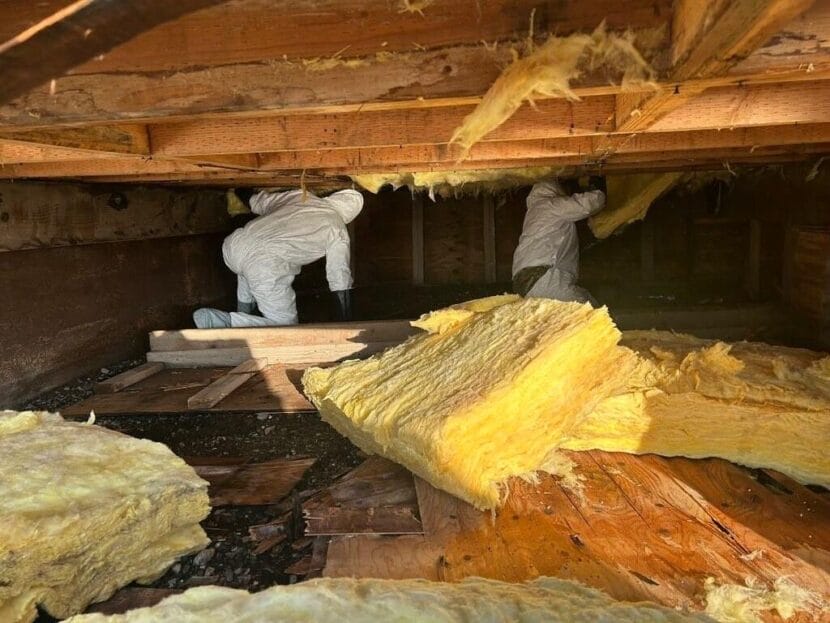
Alaska Organized Militia members remove debris while supporting storm recovery operations at Kotzebue, Alaska, Oct. 15, 2025.
Alaska Organized Militia members remove debris while supporting storm recovery operations at Kotzebue, Alaska, Oct. 15, 2025. (Photo courtesy of the Alaska National Guard)

It’s been nearly three weeks since a storm caused major flooding and erosion damage in Kotzebue and other Northwest Arctic communities. That was before the remnants of Typhoon Halong made their way through the region.

After assessing the damage in multiple communities, officials said the region is moving quickly to make repairs as winter sets in.

Kelly Hamilton is the emergency manager for the Northwest Arctic Borough. He says more than 150 homes in Kotzebue have already been assessed for damage after the Oct. 8 flood and the remnants of Typhoon Halong a few days later.

The region saw similar flooding last year, too. Hamilton said many of the homes that needed repairs last year will have to go through the same process again, tearing out and replacing damaged flooring and insulation.

This year, he said the borough had a better game plan to start that work immediately.

“If at all possible, help the residents de-water, dehumidify, dry out their house, and then help them to the extent the borough can and get things buttoned up for winter,” Hamilton said.

Gov. Dunleavy declared a disaster for the region on Oct. 9, which was later amended to include damage from ex-Typhoon Halong. But Hamilton said it’s a tight timeline to get relief.

Temperatures in Kotzebue are already in the low teens and 20s this week, making repairs more challenging.

“The residents need a dry place to live, and winter is on the way,” Hamilton said. Otherwise, they’re just living on an ice block.”

According to Hamilton, a coordinated response between the borough and multiple local, state and even national agencies — including Maniilaq, NANA and the City of Kotzebue— helped assess the damage.

Hamilton said the borough’s Village Public Safety Program also helped, but now about a dozen of the borough’s VPSOs are deployed in the Yukon-Kuskokwim Delta to help with emergency response efforts there.

Damage in Kivalina and Deering

Kotzebue wasn’t the only community in the Northwest Arctic to experience damage.

In the community of Kivalina, over 280 residents sheltered at the school during the night of the Oct. 8 storm. Several returned home to flood damage.

The Alaska Organized Militia, including Alaska National Guard members, deployed eight people to Kivalina for repairs and assessments, according to Jeremy Zidek, a public information officer with the Alaska Division of Homeland Security.

Emergency officials said Kivalina also received help from the nearby Red Dog Mine, which was able to transport water, non-perishable food items and diapers to the community via helicopter. Many Kivalina residents have already applied to the state’s individual assistance program for financial help.

Zidek said the community of Deering had erosion near their health clinic.

Erosion in Kotzebue

Zidek also said emergency officials are working with Alaska Native Tribal Health Consortium on Kotzebue’s sewage lagoon, which had just undergone repairs.

“Those repairs were just completed about a week before the storm from last year’s storm,” Zidek said.

Representatives from the Alaska Department of Transportation and Public Facilities said there was significant slope erosion in Kotzebue, especially along Ted Stevens Way. The road is closed because of the severity of the erosion, and repairs are ongoing.

“We’re working on the repairs between the bridges, and we’re working as fast as we can,” said Angelica Stabs, a public information officer with the division. “We just saw a lot of erosion.”

Kotzebue resident Matt Bergan said his home experienced damage from the flooding. He spoke at a recent Kotzebue City Council meeting. Bergan said he thinks there should be more of an effort for long-term planning.

“It seems like there’s plenty of money to respond to emergencies and fix things like we’re doing now, but it seems harder to get the money for preventive measures before disasters happen,” Bergan said.

Residents have until Dec. 9 to apply for state individual assistance and can apply for federal individual assitance until Dec. 22.

State of Alaska Individual Assistance (IA) – Deadline is December 9, 2025
To register for State of Alaska Individual Assistance:
Call 1-844-445-7131, Monday – Friday, 8 a.m. – 4 p.m.
Or apply online https://ready.alaska.gov/Recovery/IA

FEMA Individual Assistance (IA) – Deadline is December 22, 2025
To register for FEMA Individual Assistance:
Call the FEMA dedicated Alaska Center at (866) 342-1699
Or apply online at https://disasterassistance.gov
 
Red Cross Assistance
To Register for assistance through the American Red Cross:
Call 1-800-RED-CROSS
From food to financing, Alaska Native organizations feel the shutdown’s pinch

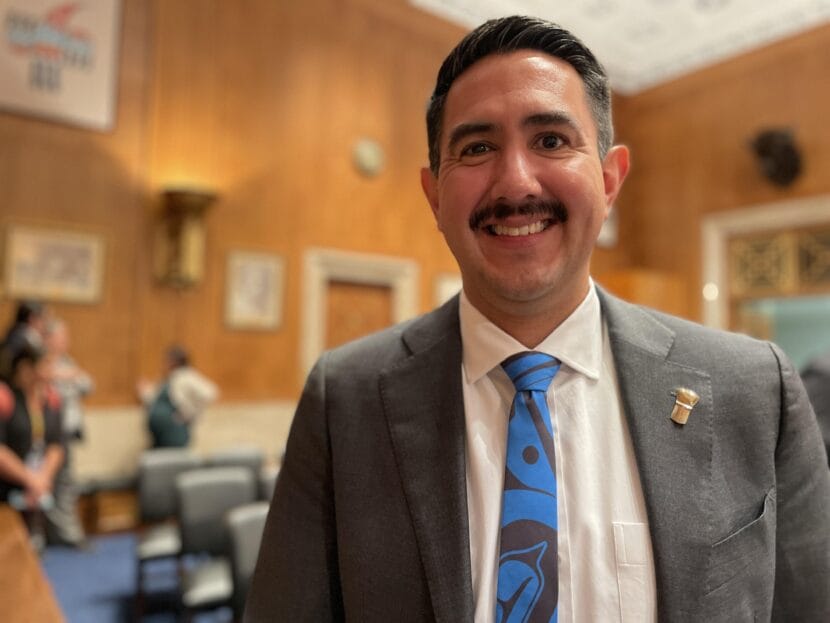
AFN President Ben Mallott testified to the Senate Indian Affairs Committee Oct. 29, 2025 about the impact of the goverment shutdown on Alaska Native communities.
AFN President Ben Mallott testified to the Senate Indian Affairs Committee Oct. 29, 2025 about the impact of the goverment shutdown on Alaska Native communities. (Liz Ruskin/Alaska Public Media)

WASHINGTON — The government shutdown is creating a lot of uncertainty and disruption for Alaska Native communities, and for tribal organizations that administer federal programs.

These include SNAP, for food assistance, and the Low Income Home Energy Assistance Program, which subsidizes energy bills.

Ben Mallott, president of the Alaska Federation of Natives, said the prospect that both of those programs would run out of money, just as winter begins, puts some Alaskans in a life-threatening bind.

“Without LIHEAP, without SNAP, our communities, our tribal citizens will have to decide between fuel and food,” he testified to the Senate Indian Affairs Committee Wednesday.

During the pandemic, the Federal Subsistence Board allowed emergency hunting to improve food security. Now, with the government shutdown, Mallott said the Subsistence Board can’t even meet to consider it.

Since the second Trump administration began, advocates for Native American and Alaska Native people have stressed that programs that help them aren’t D.E.I. initiatives but the result of promises, treaties and laws. Now, between the administration’s cuts to government services and the shutdown, they say the government is dodging its responsibilities.

Hearing witnesses said tribal Head Start programs will run low on money if the shutdown extends into November, and that many agency experts tribes normally turn to have lost their jobs.

Pete Upton testified about the Trump administration’s plan to abolish a fund at the Treasury Department called the Community Development Financial Institutions Fund. Upton runs the Native CDFI Network, whose Alaska members include the Cook Inlet Lending Center. He said tribal communities are often in banking deserts.

“Native CDFIs are typically the only financial institutions serving these communities, providing access to capital, credit and financial education where no alternative exists,” he said.

Early in the shutdown, the Treasury Department fired the entire staff of the CDFI Fund. With no one at the federal office to certify the CDFIs, Upton said it’s hard for the community finance organizations to attract private-sector and philanthropic investment.

Certification is “a stamp for investors to say that ‘you are investable,'” Upton said. With it, “we bring in private capital at a rate of eight to one.”

Sen. Lisa Murkowski, chair of the Indian Affairs Committee, said tribes face enormous uncertainty as the stalemate in Congress nears the one-month mark.

“We can’t figure out the path forward right now on our spending bills, although I am a little bit more optimistic on that today,” she said.

She didn’t elaborate but said earlier this week that senators are engaged in productive talks.

Trump plans to nominate state fish and game attorney for Alaska federal judgeship

Alaska attorney Aaron Peterson, seen here in a February 2024 photo, is expected to be nominated by President Trump to one of two vacancies on Alaska's federal court bench.
Alaska attorney Aaron Peterson, seen here in a February 2024 photo, is expected to be nominated by President Trump to one of two vacancies on Alaska’s federal court bench. (Alaska Division of Forestry)

President Donald Trump plans to nominate Aaron Peterson, an attorney with the Alaska Department of Law’s natural resources division, for one of two open federal judgeships on the bench of the U.S. District Court for the District of Alaska.

The president’s plans were confirmed by the news organization Reuters, which published a copy of a questionnaire Peterson submitted to the U.S. Senate’s judiciary committee.

Trump himself has not formally announced Peterson’s nomination, but state and federal officials confirmed the president’s plans with the Beacon.

Reuters reported that Trump is preparing to nominate two federal judges in other states as well as Peterson.

A message left on Peterson’s work phone was not returned Tuesday afternoon.

According to a copy of Peterson’s questionnaire, a member of Gov. Mike Dunleavy’s federal transition team encouraged him to apply to a committee formed by Sen. Dan Sullivan, R-Alaska, to vet possible candidates for the federal judiciary.

According to state voter records, Peterson is a Republican. He identified himself in the questionnaire as a member of the Federalist Society, whose members generally follow Republican legal principles and support President Donald Trump.

Records published by the Federal Elections Commission and the Alaska Public Offices Commission do not list any political contributions by Peterson.

Attorney General-designee Stephen Cox served on the Sullivan committee. By email, he called Peterson an “outstanding choice.”

“He’s demonstrated a remarkable ability to navigate complex issues with fairness and integrity, including during his representation of the Board of Fisheries. His extensive understanding of both civil and criminal law, honed through his experience as a prosecutor, makes him uniquely qualified for this position. Alaska needs judges who are equipped to handle the complex cases before them and the realities of our state, and I am confident that Aaron will be an excellent addition to the bench,” Cox wrote.

Alaska has three federal judgeships but only one sitting federal judge. Judge Timothy Burgess retired at the end of 2021, and Judge Joshua Kindred resigned in disgrace in 2024 amid a sexual scandal.

Since then, Alaska’s two U.S. senators have been divided about who to pick as replacements and how to pick those replacements. Under longstanding Senate tradition, judge picks normally advance only with the assent of both home state senators.

As a result of the senators’ disagreements and Sullivan’s decision to not attempt to fill a vacancy under President Joe Biden, the judgeship vacated by Burgess is now the fifth-oldest vacancy among 50 in the federal court system.

Sullivan has not disclosed the names of judicial candidates that he examined through a special committee designed to serve as an alternative to the Alaska Bar Association’s traditional review process.

Sen. Lisa Murkowski, R-Alaska, disclosed the names of applicants she received and solicited opinions from the Bar Association. Peterson’s application was not among those initially received by Murkowski.

Through a spokesperson, Murkowski said she learned about Peterson’s nomination from the White House.

“After speaking extensively with him last week about his many qualifications, I informed the White House that I would support his nomination. Alaska’s District Court has had two vacancies for far too long, and I hope the White House will soon announce a second qualified nominee whom I can support to fill out the bench,” Murkowski said.

According to Peterson’s questionnaire, he met with Murkowski on Oct. 23, seven months after being interviewed by Sullivan and four months after his initial interview by the White House Counsel’s Office. Since September, according to the questionnaire, he has been in regular contact with White House and Department of Justice officials.

By email, Sullivan said Peterson has “extensive legal experience.”

“Throughout his career, which includes military service, Aaron has demonstrated a commitment to the rule of law and federalism. He also understands the principle that the job of a federal judge is to interpret the law, not to make policy,” Sullivan said. “I’d like to thank each of the members of the Alaska Federal Judiciary Council, who worked with me to fully vet a number of well-qualified Alaska nominees, including Aaron. The council’s diligent work and input are invaluable in ensuring Alaskans are represented by jurists and citizens of the highest caliber. I also want to thank President Trump and his team for working closely with my office on identifying outstanding judges who will serve Alaska and our country well.”

According to the information Peterson submitted to the U.S. Senate’s judiciary committee, he was born in Anchorage in 1981 and served in the U.S. Air Force from 2000 to 2003 before attending the University of Alaska Anchorage, graduating in 2007. He attended Gonzaga University School of Law and graduated in 2010.

After graduation, he returned to Alaska, serving first as a clerk to Justice Michael Spaan of the Alaska Supreme Court, then as a prosecutor with the Municipality of Anchorage.

The Alaska Bar Association’s directory says he was admitted to the state bar on Nov. 16, 2010.

Peterson worked in the Anchorage District Attorney’s office starting in 2012, including on violent felonies, such as murder and sexual assault. He moved to the Department of Law’s office of special prosecutions in 2015 before beginning work with the Department of Law’s natural resources section in 2019.

Since joining that section, he’s prosecuted high-profile criminal cases, including a 2018 incident in which two Matanuska-Susitna Borough men illegally killed a black bear and her two squealing cubs within their den.

More recently, Peterson has represented the state in an ongoing case that challenges the state’s current two-tier system of subsistence fishing management. He also represented the state in a lawsuit that challenged salmon fishery management in Cook Inlet.

“If confirmed,” Peterson said in his questionnaire, “I will recuse myself from any case where I have ever played a role. Further, I will evaluate any potential conflict or issue that could give rise to the appearance of a conflict, on a case-by-case basis and determine appropriate action, including recusal where necessary.”

Alaska cities and school districts scramble to close budget gaps after state cuts bond debt payments

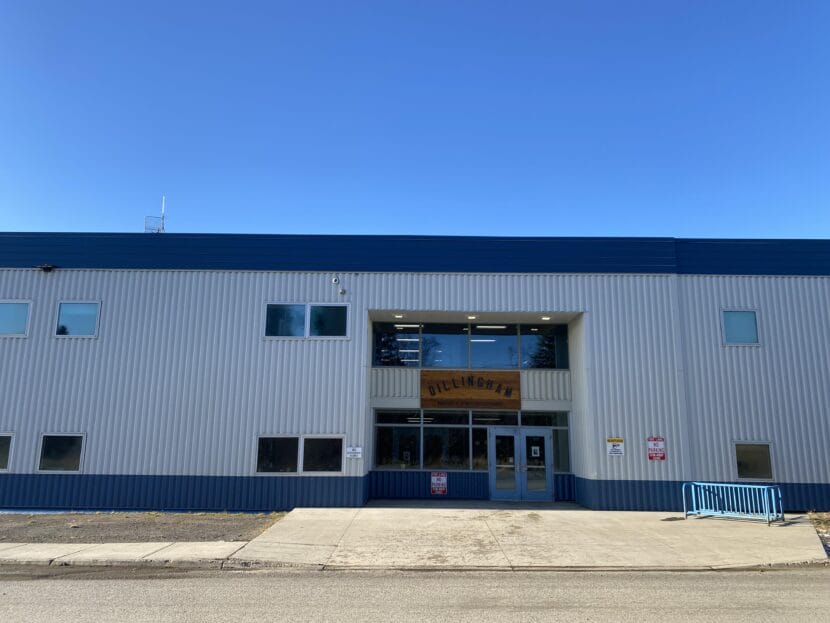
Dillingham City School District Middle/High School building.
Dillingham City School District Middle/High School building. (Margaret Sutherland/KDLG)

The City of Dillingham and the Lake and Peninsula Borough government are two of 17 Alaska municipalities and school districts that are trying to close budget shortfalls after the state cut its payments for school construction and renovation projects by roughly 25-30% this year.

The payments are part of the state’s School Bond Debt Reimbursement Program, which started in the 1970s. Local governments borrowed money to pay for new or improved school facilities, and the state committed to help repay the debt over time.

The proposed reduction to the bond reimbursement program originated in the Senate Finance Committee last session. Bristol Bay Representative and House Speaker Bryce Edgmon says the Legislature had to cut costs for several projects to balance the budget and avoid dipping into the state’s savings account, the Constitutional Budget Reserve.

The cost for the state to fully fund projects under the program would have been roughly $47 million a year. The reduction cut roughly $12 million of that.

“When you start looking at the finances of a small, first-class community like the city of Dillingham, that reduction is quite meaningful to their bottom line,” Edgmon said. “I would also point out it signifies how tight the budget really is getting down in Juneau, with costs increasing at every turn.”

‘A huge chunk of money’ from Dillingham’s budget

In 2015, the Alaska Legislature paused funding of new projects for 10 years, a moratorium that expired on July 1. But the state kept paying for pre-moratorium debt, like for a $15 million bond Dillingham voters approved in 2008 to pay for repairs to Dillingham school facilities.

“The state said, ‘Listen, we’ll help support you, you go out and get the bond. We are going to reimburse you for 70% of that bond,'” said Anita Fuller, finance director for the City of Dillingham.

Fuller said that in normal years, the city paid the remaining 30%, primarily with local tax revenue. But this year, the state cut its help with the debt by $231,000, roughly 30% of its commitment to Dillingham’s schools.

“That’s a huge chunk of money because that’s $231,000 that we just lost,” Fuller said. “Somebody’s paying that school bond. If the state’s not, then that means we are.”

All 17 districts and municipalities in the program face the same roughly 30% cut. In the Lake and Peninsula Borough, district officials say that amounts to a roughly $250,000 cut — about 8.5% of the borough’s total education budget for the year.

Lake and Peninsula Borough officials say they will have to shift money from other commitments or drain their reserves to close the gap.

Meanwhile, Dillingham’s city council introduced a revised budget at a special meeting earlier this month to make up for the lost funding.

Various departments are facing cuts, though Fuller says they can’t all be attributed to the loss in bond reimbursement because there were other budget changes to account for.

But she says the cut pulls from the finite amount of money available for all departments.

“All of that money comes from our general fund,” Fuller said. “So money that was going in there to help us with the library or the senior center or the school, all that comes from our general fund.”

Other changes to the budget include a $200,000 increase to the estimated FY26 income tax revenue and a $111,000 annual lease-to-own payment for a new grader.

Fuller said the librarian and senior center director positions were consolidated into one position, and the two full-time staff members at the senior center have been reduced to part-time.

After the moratorium, questions about the program remain

This isn’t the first time lawmakers have shorted the reimbursement program. In 2019, the governor cut the program and left districts to shoulder the majority of the debt payment from 2020 through 2022. Then, in 2023, they back-paid districts and municipalities for those three years.

Edgmon says that it is possible that will happen with this reduction as well. He says funding next year and possible retroactive payments depend on state revenue, especially the price of oil. Alaska’s oil prices are currently lower than what lawmakers budgeted for.

“That makes me a little nervous in terms of what our budget situation is going to look like next year,” said Edgmon. “My hope is next year we can come back and fully fund the bond debt reimbursement program and really maintain our commitment to municipalities and school districts.”

The reduction in funding coincides with the expiration of the 10-year moratorium on the program. Organizations have been calling for the state to lift the moratorium and reopen the bond debt reimbursement program for years.

“There’s this pent-up need for money to build school infrastructure or repair school infrastructure that hasn’t been addressed since the moratorium,” said Carole Triem, government affairs manager for the Alaska Municipal League.

On the other hand, Triem said the fluctuation in state funding makes the program risky for communities.

“It’s hard for them to say, ‘I feel confident that if we go out and bond for a new school building or fixing a school building, that the state will honor its obligation to repay that debt,'” she said.

But Triem said the need may be great enough for districts to take that risk.

Juneau Assembly approves pay hikes to city manager, attorney

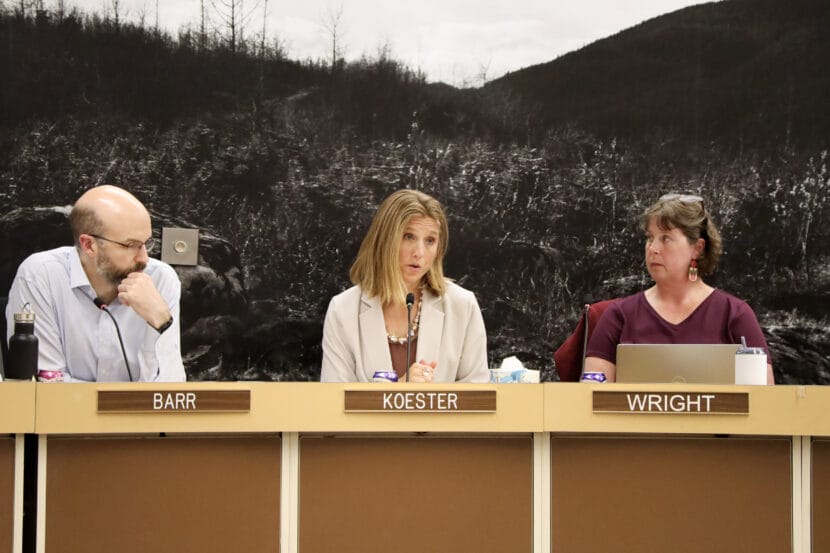
Deputy City Manager Robert Barr, City Manager Katie Koester and City Attorney Emily Wright during a Juneau Assembly committee meeting on Monday, Aug. 4, 2025. (Photo by Clarise Larson/KTOO)

The Juneau Assembly approved merit and cost-of-living pay bumps to Juneau’s city manager and city attorney Monday night. 

The increases were discussed during an executive session that was not open to the public during the Assembly meeting. Members unanimously approved the increases publicly afterward.

The increase is retroactive to Sept. 8. 

City Attorney Emily Wright received a 3% cost-of-living increase and a 7.75% merit increase to match the former city attorney, bringing her salary to just under $208,665. The city will pay Wright retroactively to Aug. 25.

According to city data, Koester is the city’s highest-paid salaried employee. She’s followed by Deputy City Manager Robert Barr and Port Director Carl Uchytil, who all make above $200,000 as of September.

However, according to data from 2024, Koester isn’t the highest-paid employee when it comes to actual earnings. She was outpaced in actual earnings by four Juneau Police Department officers, who are eligible for overtime pay. 

The manager’s and attorney’s pay boosts come as some city employees are working without a contract. The city is also bracing itself for a looming budget shortfall following the outcome of this year’s local ballot measures. 

The unions representing most police and Capital City Fire/Rescue staff are at an impasse in their wage negotiations with the city. Union officials say Juneau’s wages aren’t competitive with those of other departments and agencies in the state.

Juneau will pay for part of temporary levee expansion using funds meant for Capital Civic Center

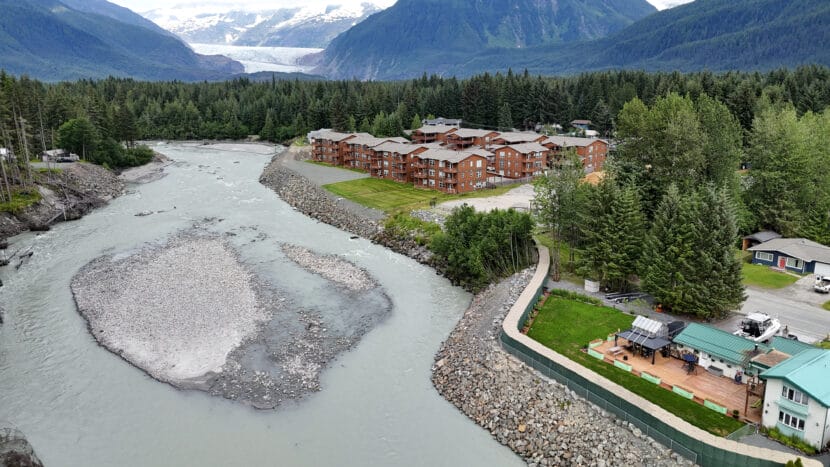
HESCO flood barriers line the Mendenhall River on Tuesday, July 22, 2025. The barriers end before reaching an apartment building that dangled over the river due to erosion during a flood in 2023 (Photo by Clarise Larson, Mikko Wilson/KTOO)

Juneau plans to expand its temporary levee along the Mendenhall River, in part by using money originally intended for a new arts and culture center. 

An ordinance passed unanimously at Monday’s Assembly meeting will allow the city to help protect more homes and businesses from annual glacial outburst flooding by pulling $5 million from the proposed Capital Civic Center. 

The current levee is made of HESCO barriers — steel and mesh baskets filled with sand. It protected hundreds of homes from flooding by a slim margin during the record-breaking glacial outburst flood in August. 

Deputy City Manager Robert Barr said at the meeting that $4 million of the reallocation will go toward Phase 2 of the levee project. 

“These funds would contribute toward ongoing overall protection costs like site preparation, armoring, environmental installation and legal for HESCO barrier installation along (parts of) the Mendenhall River that do not currently have barriers,” Barr said. 

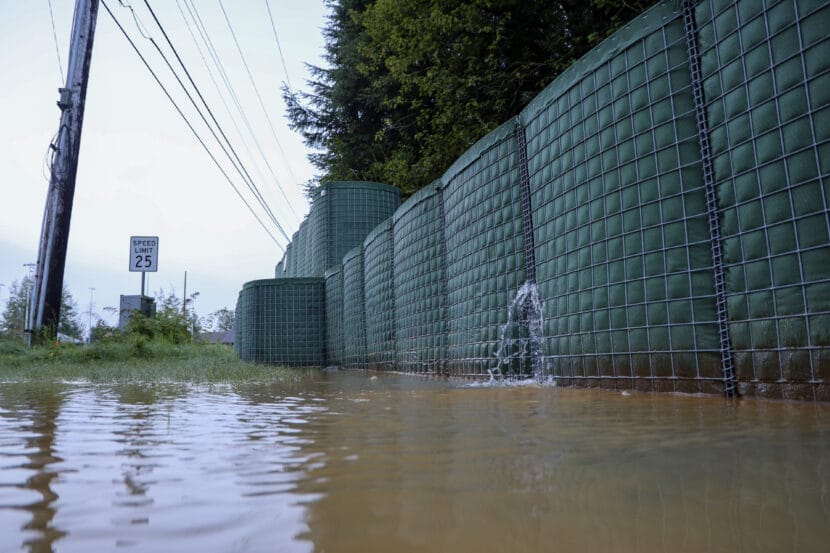
Water seeps between HESCO barriers installed along the Mendenhall River on Wednesday morning, Aug. 13, 2025. (Photo by Clarise Larson/KTOO)

Phase 2 would expand the levee both upstream and downstream, so it would stretch from Back Loop Bridge to just before Juneau International Airport. The city estimates the expansion would cost around $19 million to build. 

The other $1 million pulled from the Capital Civic Center will be used to repair and maintain the existing stretch of HESCO barriers, which leaked, slumped and lost sand during the flood. 

The Capital Civic Center is a proposed project that would replace the current Juneau Arts & Culture Center. Juneau voters rejected a ballot proposition to fund the new civic center in 2019, but the city appropriated funds to a slightly altered version of the project anyway. 

Barr said those funds were meant to be a match for a federal or state grant, which hasn’t materialized. He said that money was originally allocated from the hotel bed tax fund and the general fund.

The Assembly will discuss how to fund the rest of the HESCO barrier expansion at a special assembly meeting on Thursday.

Site notifications
Update notification options
Subscribe to notifications