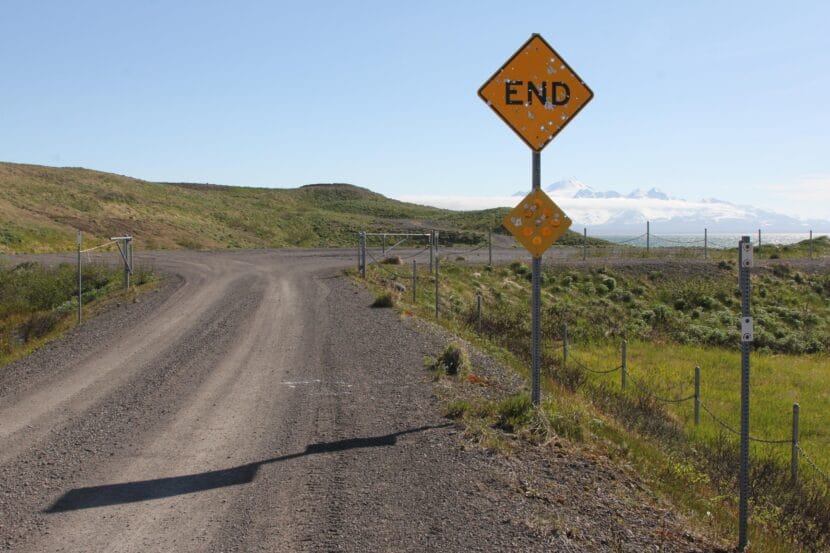
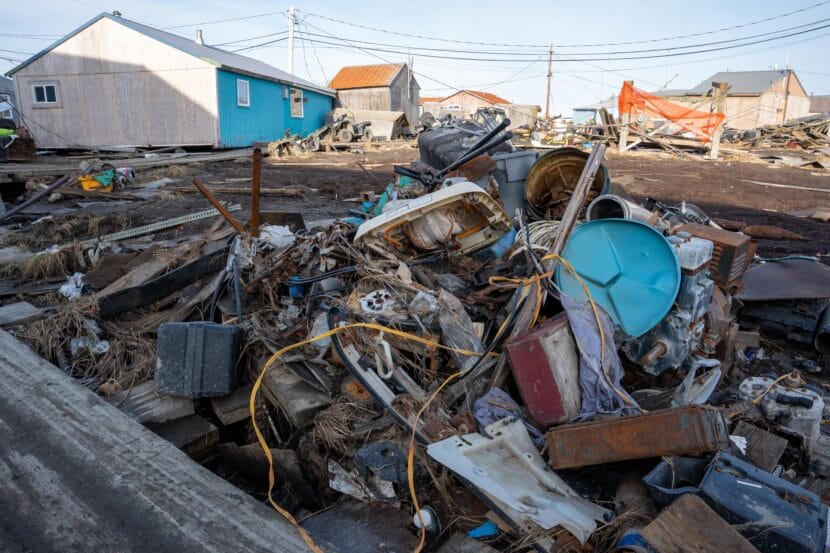
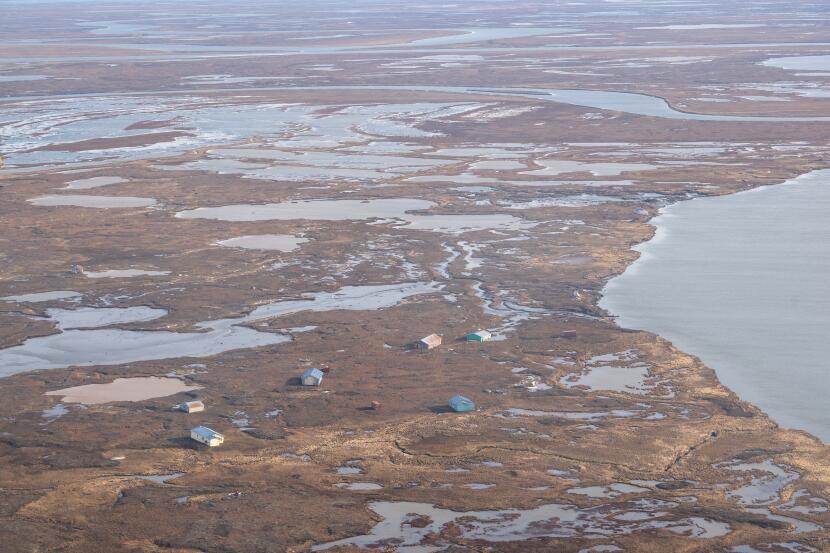
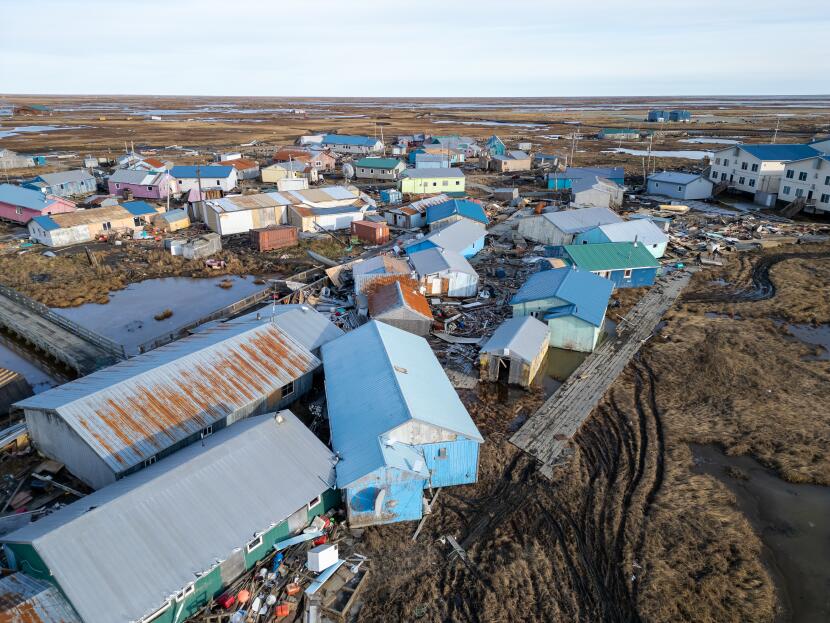
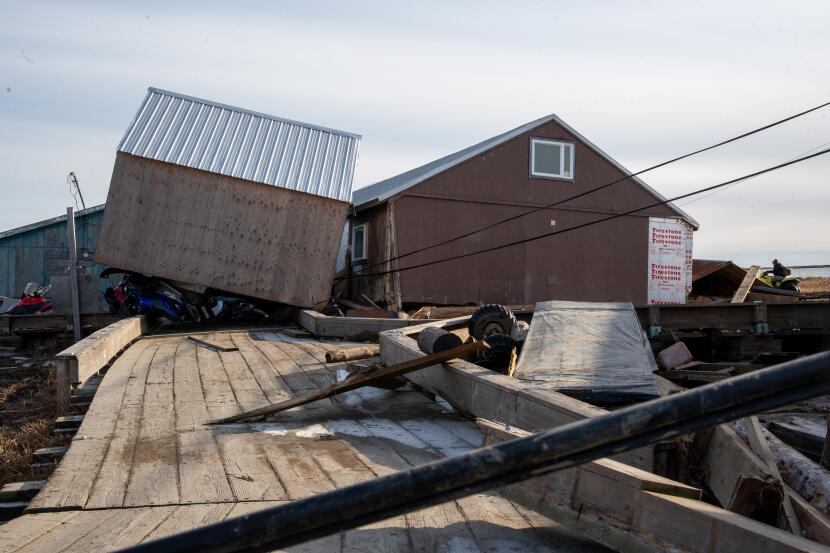
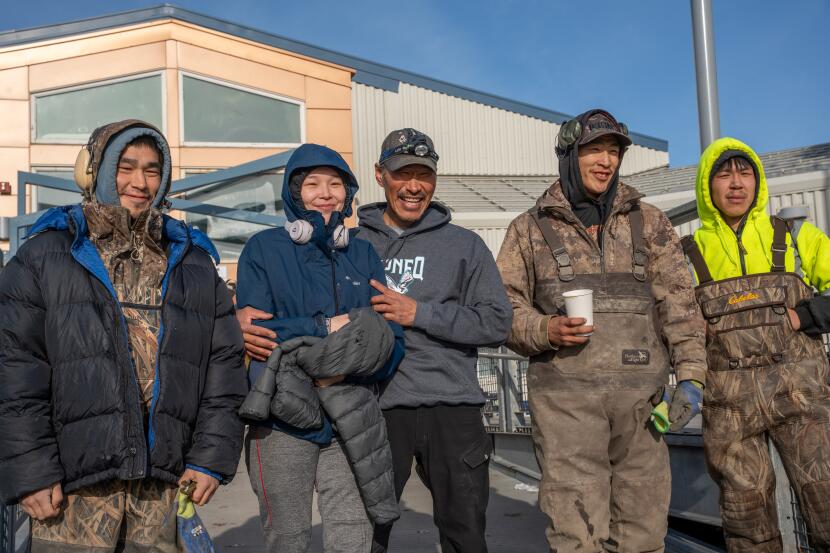
The end of the road leading out of King Cove. June 2024 (Theo Greenly/KSDP)
Department of the Interior Secretary Doug Burgum announced a land exchange agreement Thursday with King Cove’s Native corporation, making way for the controversial construction of what many consider to be a lifesaving stretch of road.
It’s not the first time an agreement like this has been approved for the road, which would connect two eastern Aleutian communities. But according to local leaders, there’s one important difference this time around.
“Having the land exchange agreement already signed, and the ownership of the land now a done deal, that’s never happened before, so that’s big,” said longtime King Cove City Administrator Gary Hennigh in a phone interview Thursday afternoon.
King Cove sits near the western tip of the Alaska Peninsula. It’s a small fishing community that is only accessible by air or water, weather permitting, and its short gravel airstrip is difficult to fly into.
But with the addition of about 11 miles of road, residents could access a neighboring all-weather airport in Cold Bay. King Cove community leaders have fought for that road for decades, arguing that it would provide lifesaving access to emergency medical care.
The problem, though, is that the road would pass through the Izembek National Wildlife Refuge. Environmental groups and several Alaska tribes have said that land shouldn’t be developed in order to protect wildlife.
In 2018, the Trump Administration approved a land swap, which was later revoked by the Biden administration. But Hennigh said this is the first time the land has actually switched hands.
Alaska’s congressional delegation celebrated the agreement at an Alaska Day ceremony Thursday in Washington D.C.
At a press conference after the event, Republican Sen. Lisa Murkowski said the property conveyance, including the patent and the deed to the land, would be recorded Thursday afternoon.
She applauded King Cove’s perseverance.
“They are weary,” Murkowski said. “They are tired of kind of this ‘up and down, and back and forth, and maybe or maybe not.’ They want the certainty that’s going to come with this very small connector road.”
Murkowski said the U.S. Fish and Wildlife Service is swapping 490 acres of federal land for the road. The King Cove Corp. — the local Alaska Native village corporation — will hand over acreage in return.
Some western Alaska tribes have opposed the road, saying it threatens important subsistence species. And federal biologists have acknowledged the road would impact the habitat of Pacific black brant and emperor geese.
Murkowski said she recognizes the significance of those resources and that requirements are in place to ensure the animal populations remain strong.
“Nobody’s talking about a multi-lane paved road, moving lots of big trucks back and forth,” she said. “It is still an 11-mile, one-lane gravel, non-commercial-use road.”
The congressional delegation said in a statement that the swap will ultimately “result in the net expansion of the Izembek refuge, clearly adding to its conservation and subsistence values. Under the agreement, Interior will receive or maintain roughly 14 times more land than it gives up.”
Hennigh said there’s still a lot to be done, with things like permitting, public commentary periods and funding to secure. After years of seeing progress toward a road fall back, he said he’s optimistic but cautious.
“We also are not so naive to think that there won’t be some lawsuits along the way,” he said.
Hennigh hopes to see construction begin by 2027.
The Alaska Desk’s Theo Greenly contributed reporting.
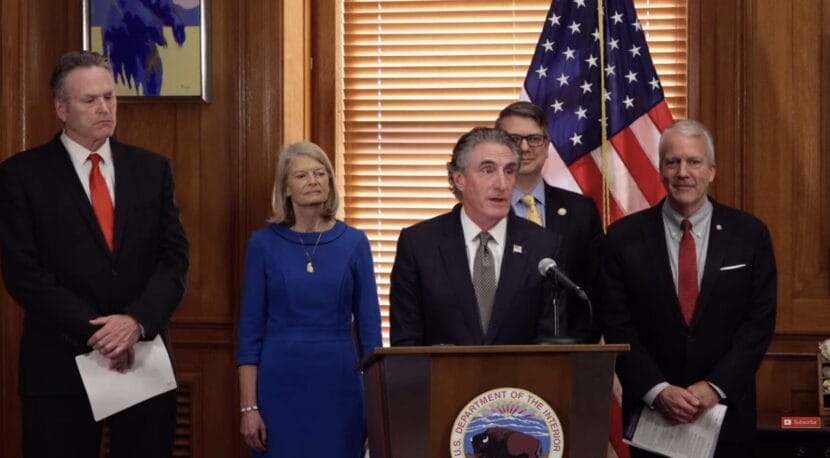
US Department of Interior Sec. Doug Burgum at a news conference with Gov. Mike Dunleavy, Alaska’s congressional delegation US Sen. Lisa Murkowski, Rep. Nick Begich, and Sen. Dan Sullivan, announcing several actions advancing resource development projects in Alaska on Oct. 23, 2025 (Screenshot)
The federal government is proceeding with efforts to expand drilling in the Arctic National Wildlife Refuge, mining in northwest Alaska, and construction of a road between King Cove and Cold Bay on the Alaska Peninsula, US Interior Secretary Doug Burgum announced Thursday.
At an event in Washington, D.C. that was dubbed “Alaska Day” by the federal department, Burgum signed a series of documents pertaining to all three projects as well as an ongoing effort by the federal government to give land to the families of Alaska Native Vietnam War veterans.
“This is our first, this won’t be our last, Alaska Day. We have a lot more things to accomplish, a lot more things to celebrate going forward,” said Burgum, flanked by Gov. Mike Dunleavy and all three members of the state’s congressional delegation.
“I told the president, it’s like Christmas every morning,” said Dunleavy. “I wake up, I go to look at what’s under the proverbial Christmas tree to see what’s happening. And here’s another example of more presents for not just Alaska, but for this country.”
Tribal and environmental groups opposed to the three development projects saw Thursday’s action differently, with Defenders of Wildlife, a national group, dubbing the event “Alaska Sellout Day.”
“Today’s announcements are the latest step in Donald Trump’s plan to sell out our wildest landscape and natural heritage to corporate polluters,” said Dan Ritzman, director of conservation for the Sierra Club.
What was done on Thursday
Burgum signed previously announced permits for the 211-mile Ambler Road, which is intended to connect the Dalton Highway with a series of potential mine sites in the Brooks Range of northern Alaska.
He also signed a record of decision for the federal government’s oil and gas drilling program in the coastal plain of the Arctic National Wildlife Refuge of northeast Alaska.
That re-establishes a program that had been in place during the first term of President Donald Trump but which was subsequently reversed by President Joe Biden.
Burgum also reversed the Biden administration’s decision to suspend oil and gas leases issued by the federal government in 2020 to the Alaska Industrial Development and Export Authority.
Barring further litigation, that move clears the way for AIDEA — Alaska’s state-owned development bank — to begin seismic surveys that could reveal the amount of oil available within parts of the Arctic refuge’s coastal plain.
While the Ambler and ANWR actions effectively took the projects back to where they stood in 2020, the King Cove road is now closer to construction at any point in its decades-long development process.
Envisioned as a gravel road between King Cove and an all-weather airport at Cold Bay, the road would pass through the Izembek National Wildlife Refuge, a nationally important bird sanctuary.
Eleven miles of new road are needed to link existing roads to the two towns, but those 11 miles would pass through a wilderness area.
On Thursday, Burgum signed documents that complete a land exchange between King Cove Corp., the local Alaska Native corporation, and the federal government. King Cove Corp. gives up about 31,200 acres to expand the refuge, and in return, it receives the 490 acres of refuge land needed to complete the road.
In a move with more limited statewide impact, Burgum signed paperwork awarding three Alaska Native Vietnam War veterans with 160-acre plots of land under a federal allotment program. As of March, 453 veterans and their families had requested plots authorized under legislation authored by Alaska Sens. Lisa Murkowski and Dan Sullivan.
For King Cove, a medevac-avoiding road moves forward
King Cove’s airport is frequently closed by bad weather, and since 2014, there have been more than 100 Coast Guard medevacs from the community because regular air ambulance service was unavailable.
Murkowski, who has previously vowed to complete the road, noted that this is the third time that the federal government has embarked on a land exchange for the road, with the prior two attempts blocked and reversed by litigation.
“We’ve reached a point with the King Cove exchange that we haven’t yet before, and that’s actually the official patent being issued to KCC, so we’re one step further. I think that’s important,” she said.
The road, though supported by local residents, is opposed by some Yukon-Kuskokwim river delta tribal leaders and subsistence bird hunters who fear its effects on wildlife.
“Surely, the people of King Cove can see the value of leaving the habitat for so many species intact would be far more valuable than any road could be,” said Angutekaraq Estelle Thomson, Traditional Council President of the Native Village of Paimiut, one of several communities that have supported lawsuits seeking to prevent road construction.
Rebecca Noblin, an attorney with the Center for Biological Diversity who has fought the road on behalf of several area villages, said Thursday that “we have significant questions about the legality of the exchange. We, along with the Native Villages of Hooper Bay and Paimiut, expect to bring those issues to court soon. Road construction will also require additional permits, including an Army Corps 404 permit and Endangered Species Act consultation, so this is far from a done deal.”
With Ambler and ANWR, a triumph of economics over environment
On the first day of his second term in office, Trump issued an executive order seeking to encourage oil and gas development, mining and logging in Alaska.
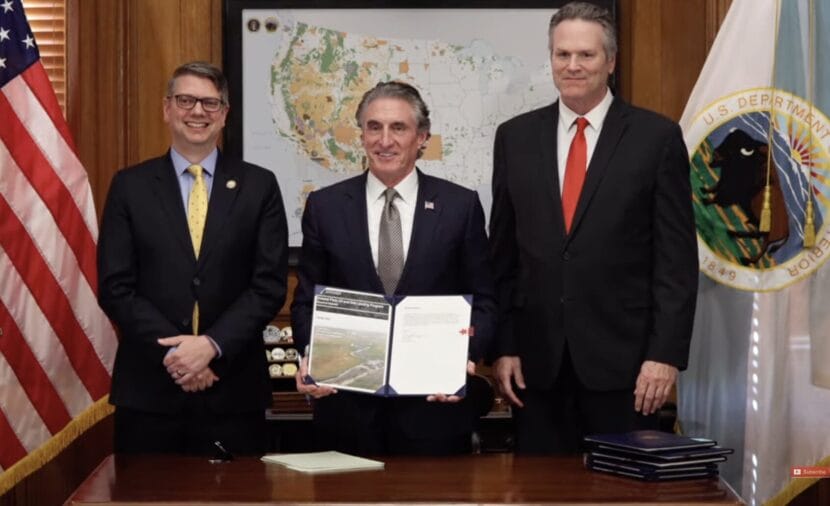
US Rep. Nick Begich, R-Alaska, US Dept. of Interior Sec. Doug Burgum, and Alaska Gov. Mike Dunleavy pose for a photo at a news conference announcing advancements to several resource projects, including oil drilling in the Arctic National Wildlife Refuge on Oct. 23, 2025 (Screenshot)
Elected officials said they see Thursday’s actions in line with that decision.
Alaska Republican Rep. Nick Begich said projects like the Ambler Road and ANWR drilling matter because they create jobs.
“We need the jobs. We need high-paying, good jobs, and these resource industry jobs fit that bill completely. And so whether it’s mining, timber, oil and gas development or other resources, these are necessary for the functioning of Alaska’s economy,” he said.
The coastal plain of the Arctic National Wildlife Refuge is believed to contain billions of barrels of recoverable oil that could be sold on global markets.
Sullivan noted that previous North Slope oil development has been good for the region’s residents.
“The life expectancy, mostly of the Native people in our state, has increased in the North Slope and the Northwest Arctic Borough and by dramatic numbers … and a lot of that is due to the benefits that come from responsible resource development: jobs, revenues, water and sewer, gymnasiums, health clinics. So it’s a real life and death issue,” he said.
The predominantly Alaska Native town of Kaktovik is located on Barter Island, within the refuge.
“Developing ANWR’s Coastal Plain is vital for Kaktovik’s future,” said the town’s mayor, Nathan Gordon Jr., in a written statement. “Taxation of development infrastructure in our region funds essential services across the North Slope, including water and sewer systems to clinics, roads, and first responders. Today’s actions by the federal government create the conditions for these services to remain available and for continued progress for our communities.”
To date, no oil companies have shown interest in drilling within the refuge, leaving only Alaska’s state-owned development bank, which won leases in a 2020 sale, to work there.
So far, no actual work has taken place because of repeated lawsuits seeking to overturn the sale.
The bank, which has filed several lawsuits over federal restrictions on drilling within the refuge, did not respond to a request for comment on Thursday.
Several legal challenges to the 2020 ANWR plan of development — which was restored Thursday — are still pending in federal court.
Some of those challenges revolve around the possible effects that ANWR development and the burning of those fossil fuels will have on climate change.
Thursday’s announcement came just a week after the remnants of Typhoon Halong devastated coastal communities in southwestern Alaska. Experts say that storm was worsened by climate change.
Murkowski said she does not shy away “from the fact that the impact of that typhoon was made more fierce and more destructive because it was able to travel over a large body of what is now warmer, open ocean with lack of ice. I get that, and I call it climate change.”
At the same time, people worldwide are continuing to consume fossil fuels. Murkowski said that for her, the choice is straightforward: Will they get those fossil fuels from Alaska or some place with worse environmental standards?
“I’d much rather be producing in Alaska, than just across the Bering Strait there, over in Russia, where I don’t think that they respect the same level of environmental standards and safeguards,” she said. “So is it complicated? Yes. But am I proud of how Alaska has led in terms of meeting environmental standards that are amongst the highest in the world? I am.”
What comes next for Ambler, King Cove and ANWR?
All three development projects boosted by the federal government on Thursday are a long way from construction, both supporters and detractors say.
In all three cases, proponents need to obtain additional federal permits and will have to cope with lawsuits brought by opponents.
The environmental law firm Earthjustice has repeatedly been involved in lawsuits against the federal government over the issue of arctic refuge drilling.
“Interior has re-adopted the maximally destructive plan from President Trump’s first term,” said Earthjustice attorney Erik Grafe, by email on Thursday. “That plan was unlawful in 2020 and is still unlawful today. The bedrock environmental laws that protect the Arctic Refuge’s irreplaceable natural resources remain despite Congress passing reconciliation bills on leasing in the refuge.”
The Gwich’in Steering Committee, represented by attorneys from Trustees for Alaska, is among the organizations that have repeatedly sued to block drilling in ANWR.
The committee is concerned about the effect that refuge development would have on local caribou herds used by subsistence hunters. In a statement, the committee’s executive director, Kristen Moreland, implied that further litigation will come.
“This action by the Trump administration is a direct attack on the Gwich’in, who have for decades been a voice for the caribou and stood against the destruction of the Arctic Refuge. A leasing program that would open the entire Coastal Plain completely ignores the impacts that oil and gas development would have on the land, on wildlife, and on our communities,” she said.
“We condemn these efforts by the Trump administration to exploit the calving grounds of the Porcupine Caribou herd for short-term gain, and we know that we are not alone. We will continue to raise our voices and fight for the protection of this sacred land and for our way of life.”
Alaska Army National Guard Staff Sgt. Steven Gildersleeve, right, an HH-60M Black Hawk critical care flight paramedic, assigned to the 207th Aviation Troop Command, surveys Nightmute, Alaska, with local resident Harvey Dock during Operation Halong Response, Oct. 17, 2025. (Alaska National Guard photo by Staff Sgt. Joseph Moon)
President Donald Trump granted the State of Alaska’s request for a federal disaster declaration on Wednesday, unlocking federal disaster aid to support the ongoing relief and recovery effort in the aftermath of ex-Typhoon Halong throughout Western Alaska.
Gov. Mike Dunleavy formally submitted the request on Oct. 16, and applauded the announcement on social media on Wednesday.
“This declaration will be instrumental for ongoing response and recovery efforts. I want to thank President Trump and his administration for the continued support of Alaska and providing help for Alaska during this time of need,” Dunleavy said on Facebook. “Thank you President Trump!”
The declaration authorizes a 100 percent cost share for relief assistance for the next 90 days, through January, according to a statement from the governor’s office. The Federal Emergency Management Agency (FEMA) will coordinate with the Alaska Division of Homeland Security and Emergency Management on all recovery operations and programs. Representatives with the governor’s office and Alaska Division of Homeland Security and Emergency Management said they did not yet have a copy of the declaration on Wednesday.
Trump said he also authorized an immediate $25 million in relief funding, to cover costs as the state continues to conduct damage assessments.
“I am approving $25 Million Dollars to help Alaska recover from the major typhoon they experienced earlier this month,” Trump wrote on the social media site Truth Social. “It is my Honor to deliver for the Great State of Alaska, which I won BIG in 2016, 2020, and 2024 — ALASKA, I WILL NEVER LET YOU DOWN!”
The Alaska congressional delegation also thanked the president in a joint statement, noting their letter urging the president to respond and grant the disaster declaration.
“I raised Alaska’s disaster declaration directly with President Trump yesterday at the White House and thank him for quickly approving it to ensure impacted western communities have federal support in the wake of Typhoon Halong,” wrote US Sen. Lisa Senator Murkowski, R-Alaska. “I also appreciate FEMA’s expedited review of this request, which is one of the quickest federal responses in recent years.”
“To all Alaskans impacted,” Murkowski added. “Please know that your congressional delegation, state, and nation stand united and will continue to coordinate recovery efforts as you move forward.”
Sen. Dan Sullivan, R-Alaska, praised Trump’s move and said he would be visiting storm-impacted villages on Saturday.
“I plan on being in Western Alaska this weekend with top FEMA and DHS officials, and my team and I will continue working closely with the Trump administration and our state, local, and tribal partners to make sure these incredible Alaskans get the help they need to recover and return to their communities,” Sullivan said.
Begich has not announced plans to visit the region. He also praised Trump and the announcement. “Our focus as a delegation remains on ensuring every Alaskan family impacted by this storm receives the resources and support needed throughout the long process of rebuilding their lives,” he said.
The disaster declaration request covered the Northwest Arctic Borough, Lower Yukon Regional Education Attendance Area and the Lower Kukokwim Regional Attendance Area, places hit by the remnants of Typhoon Halong.
More than 1,500 residents were displaced by the storm that killed one woman and left two missing in Kwigillingok.
The storm recovery effort is in full swing. Local residents are working on clean up, while regional tribal partners and dozens of state agencies, non-profit and relief organizations provide support to the region, particularly the hardest hit area of the Yukon-Kuskokwim Delta. State and tribal agencies are flying aid into those residents who remain in the coastal villages, like immediate food, water and fuel, while crews continue to work on debris removal, fuel spills, infrastructure assessment and repair to water, power, and sewer systems, roads and boardwalks. Crews are working throughout communities to repair homes where possible, so that local residents can return before winter sets in.
There is no cost estimate for the storm damage at this time, according to Jeremy Zidek, a spokesperson for the state Division of Homeland Security and Emergency Management, because agencies are working to restore services simultaneously.
The program provides financial assistance for storm damage to homes, vehicles, essential personal property, medical, dental or funeral needs directly related to the disaster. Applicants will be eligible for $21,250 in home repairs and another $21,250 for “other needs.”
The president has not yet authorized federal individual assistance — $42,500 for home repairs and $42,500 for other items — but state officials say there will likely be more information from the Trump administration in the coming days.
Debris sits in a pile in Kipnuk, Alaska on Oct. 19, 2025, a week after the remnants of Typhoon Halong brought catastrophic flooding and hurricane-force winds to the village. (Eric Stone/Alaska Public Media)
It’s Sunday in Kipnuk.
And like a lot of folks on Sundays, Tony Paul is headed to the hardware store.
“We’re making progress every day, seems like,” he said.
Unlike a lot of folks, he needs a boat to get there.
“It floated away,” he said, gesturing upriver. “There’s a couple stores down past that way, a bunch of houses.”
A week earlier, on Sunday, Oct. 12, Kipnuk endured the worst storm anyone can remember. It’s one of dozens of communities in Western Alaska working to restore essential infrastructure and repair damaged homes after the remnants of Typhoon Halong devastated coastal communities.
According to preliminary damage assessments, Kipnuk fared the worst.
The few residents who remain are determined to rebuild — but the task ahead is immense, and the future is unclear.
Homes and other buildings that floated off their foundations in Kipnuk, Alaska rest on tundra miles upriver on Oct. 19, 2025, a week after the remnants of Typhoon Halong brought record flooding and high winds to the Western Alaska village. (Eric Stone/Alaska Public Media)
In this village, four miles from the Bering Sea on the east bank of the Kugkaktlik River, Halong’s high winds and storm surge left a catastrophe. Halong’s hurricane-force winds pushed seawater more than six and a half feet above the normal high tide line.
Water poured into houses. It lifted homes off their foundations and deposited some of them miles away. It toppled four-wheelers and snowmachines, and left freezers full of food for the winter without power.
The state Department of Transportation estimates that 90% of the structures in the community were destroyed. Most of Kipnuk’s residents evacuated on military helicopters in the days after the storm.
Now, Kipnuk is in ruins. Piles of debris are everywhere.
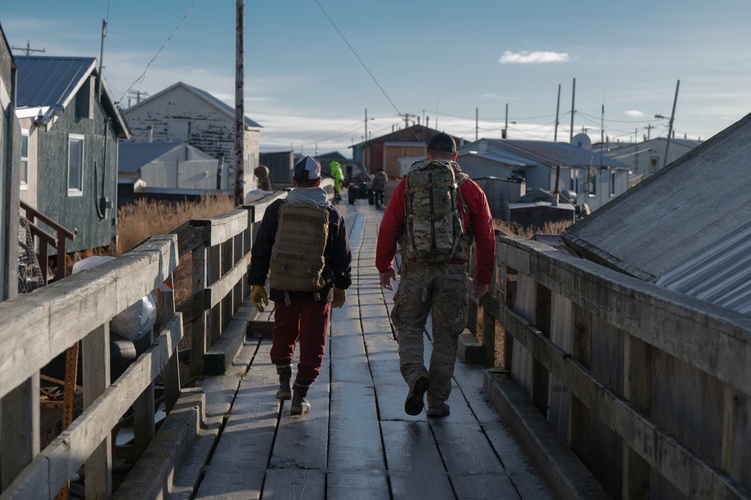
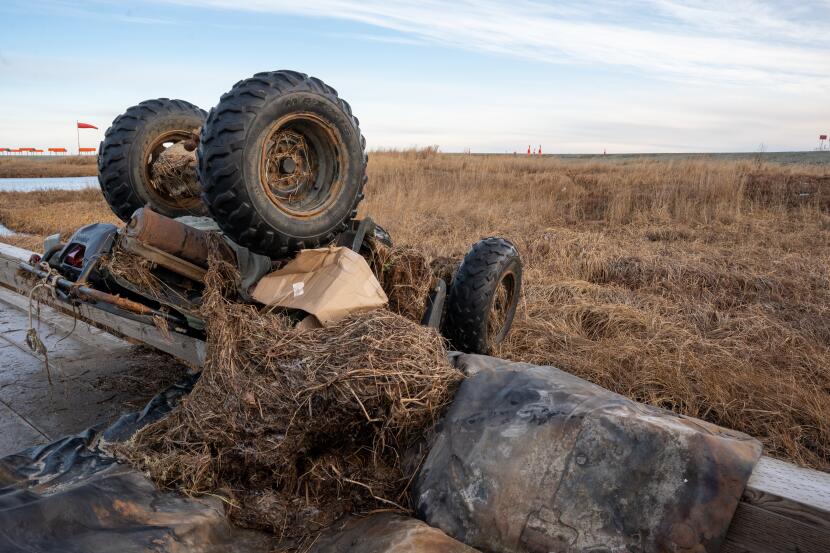
Houses and other buildings sit jumbled and surrounded by debris in Kipnuk on Sunday, Oct. 19, a week after the remnants of Typhoon Halong brought record flooding and high winds. (Eric Stone/Alaska Public Media)A building sits on a boardwalk among other debris on Oct. 19, 2025 in Kipnuk, Alaska, a week after the worst storm on record. (Eric Stone/Alaska Public Media)An all-terrain vehicle sits overturned on a boardwalk in Kipnuk on Sunday, Oct. 19, a week after the remnants of Typhoon Halong washed ashore. (Eric Stone/Alaska Public Media)
Anna Kashatok was with her boyfriend, his family and her two kids when the storm hit.
“We floated away pretty far,” she said. “A mile or two.”
They escaped from a window and trudged to the community’s school. She recalled seeing the destruction for the first time.
“So heartbreaking, devastating,” she said. “Kipnuk’s not Kipnuk anymore.”
Kashatok was only back in town for a couple days, retrieving some belongings and important documents from her parents’ house. It also floated away with them inside. She evacuated to the hub community of Bethel with her boyfriend, parents, and two children.
Only a handful of people remain in this village that just a week ago was home to 700.
In spite of the widespread destruction, the school remains a place of refuge. It escaped major flood damage. It’s elevated on pilings with a dedicated backup generator.
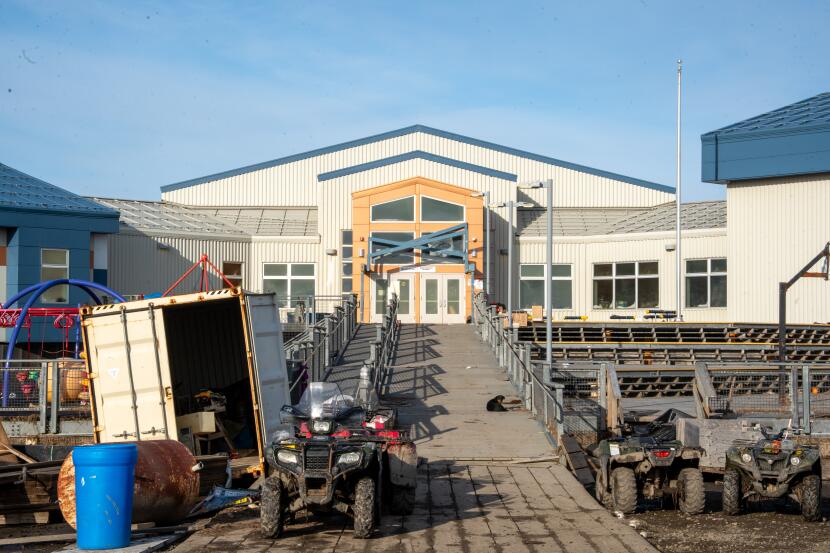
All-terrain vehicles and a dog sit outside the Chief Paul Memorial School in Kipnuk, Alaska on Oct. 19, 2025. (Eric Stone/Alaska Public Media)
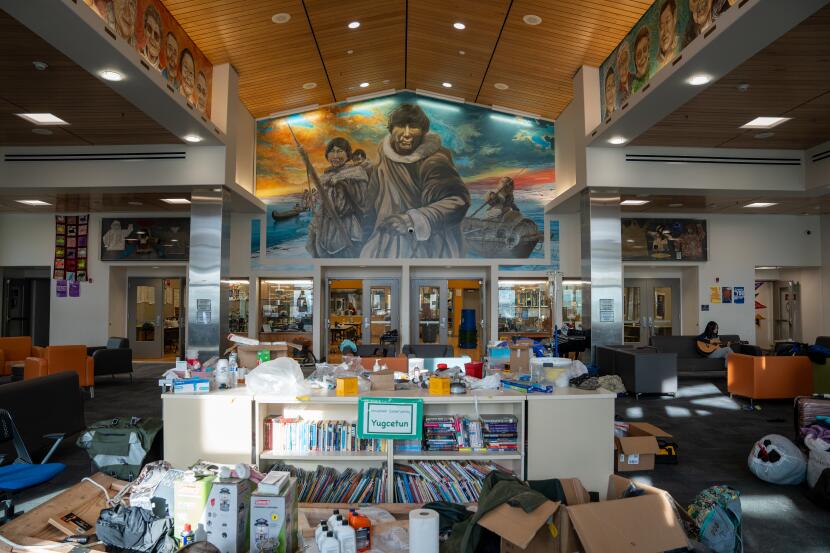
Supplies sit in the lobby of the Chief Paul Memorial School in Kipnuk, Alaska on Oct. 19, 2025, a week after the remnants of Typhoon Halong devastated the community. (Eric Stone/Alaska Public Media)
James Paul III sat at a table in the cafeteria, speaking with a local Yup’ik teacher.
“It happened so fast. Everything changed, like in a day,” he said. “The rest of their lives are changed in one day.”
The school remains, but the kids are gone. Many evacuated to Anchorage. Others are with friends and family in Bethel, surrounding villages or other communities around the state.
So for now, the Chief Paul Memorial School is a hub for the recovery effort. Packaged food lines the walls. Cafeteria workers prepare hot meals — chili was on the menu for dinner.
The state Department of Transportation told Paul some heavy equipment was on the way, he said, things like small excavators, skid-steers and all-terrain vehicles. That would help crews working to connect the school and a water treatment plant to power, he said.
“That’s our main objective right now,” he said.
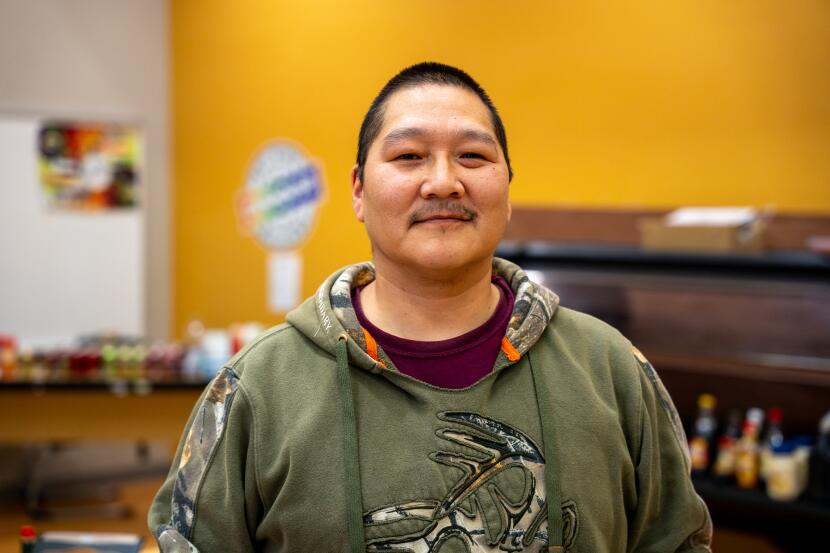
James Paul III poses for a photo in the cafeteria of Kipnuk’s Chief Paul Memorial School on Oct. 19, 2025. Paul is one of a handful of residents racing to rebuild Kipnuk after the remnants of Typhoon Halong struck a week earlier. (Eric Stone/Alaska Public Media)
But time is running short. Winter is well on its way. Bits of frost lined ponds on the tundra. That, and an oily sheen.
State emergency officials say they believe the fresh water supply is contaminated. A stiff breeze brought some relief Sunday from what residents said had been a lingering stench of fuel and sewage.
A big question looms ahead: Can evacuees return before winter — or at all?
“The way that their houses are right now, I don’t think they want to come back, especially people whose houses were pulled off their foundation,” Paul said.
There are a few dozen homes built on pilings that survived the storm and are still livable. They number 40 or 50, Paul estimated.
Paul wants to stay in Kipnuk if he can, he said. He’s spent most of his life here.
“Kipnuk means family, (it) means values, traditions. It’s my culture. I grew up here, and my dad taught me to hunt and live off the land here,” he said. “I do know some about city life, but I’d rather be here.”
From left to right, Tony Paul, Anna Kashatok, Benjamin Kugtsun, Logan Paul and Joshua Dock stand outside the Chief Paul Memorial School in Kipnuk, Alaska on Oct. 19, 2025. (Eric Stone/Alaska Public Media)
Outside the school, standing with a group of young men working to restore basic services to the community, Benjamin Kugtsun was unequivocal.
“We’re going to stay here in the winter,” he said. “We can survive. How did our ancestors survive? Without nothing. But they did.”
But when — or whether — large numbers can return is unclear. Gov. Mike Dunleavy, in a request to the federal government, said some evacuees from villages across the vast, low-lying Yukon-Kuskokwim Delta might not be able to return for 18 months.
For now, Kugtsun and his crew are taking it one day at a time. One task at a time. One boat ride to the hardware store at a time.
But he’d like to see more residents return to help out.
“With teamwork, it can happen,” he said. “We got hope.”
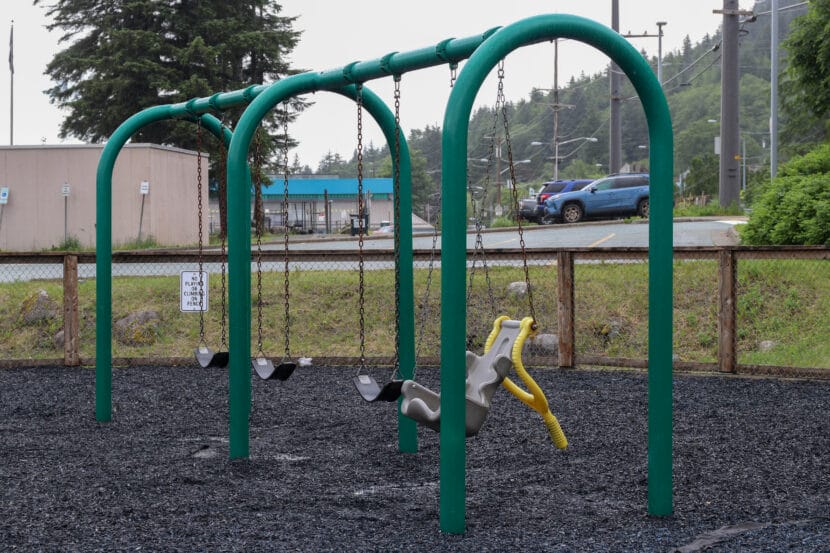
A swing set at Harborview Elementary School on July 9, 2025. (Photo by Jamie Diep/KTOO)
Listen here:
The Alaska Office of Children’s Services has struggled with staffing for years, from high vacancies and turnover to high caseloads. And data shows caseworker demographics also don’t line up with the state’s, or the system’s children.
According to the 2023 progress report on the state’s child welfare system, 8.7% of caseworkers are Alaska Native or American Indian, and more than 71.9% are white. As for supervisors, all but 2 of the agency’s 13 supervisors are white. The agency is turning to training and partnering with tribes to address the gap.
Indigenous children have been overrepresented in Alaska’s child welfare system for years. State population estimates from last year show that 23.8% people under the age of 18 are Alaska Native or American Indian. But data from the Office of Children’s Services shows they consistently make up around two-thirds of the children who are in out-of-home care such as a foster home. It’s been as high as 69% in the past.
Mary Johnson is the senior director of family services at the Central Council of the Tlingit and Haida Indian Tribes of Alaska, and worked as a caseworker for a tribal organization earlier in her career. She said the racial disparity concerns her.
“How do we connect with this, these 69% of our families?” she said. “If they are from one population, it would make sense that we would want to identify people to work with the population who are like them.”
Kate Paskievitch is a public information officer with the Alaska Department of Family and Community Services, which runs OCS. In an email, she wrote that “OCS does not view this as a ‘concern’ in the sense of a problem to be fixed, but it does guide our efforts to provide culturally responsive care.”
She wrote that care includes partnering with local tribes in the state on cases, prioritizing hiring local staff in the communities they serve, and providing ongoing training on cultural responsiveness.
Tlingit and Haida is one of the tribes that partners with the state on cases that apply to the Indian Child Welfare Act, or ICWA. That federal law lays out minimum requirements when taking on a case involving Indigenous children. The state must try to place children with their family members or in their local communities first.
Johnson herself is Yup’ik. She said it’s important to have tribal representation when working on these child welfare cases.
“It makes sense that if you’re not able to recruit and hire Alaska Native people, at least partner with tribes, at least have tribal partners be a part of the decision making process when making decisions about how our children and families are being cared for and treated,” she said.
Johnson said the tribe largely employs Alaska Native people in its family services office. She said it’s important to have Alaska Native people working on cases, either as a caseworker or as a tribal partner.
“I do think in the field of child welfare, when it’s something so serious and so personal, that the people making the decisions for the group of people that are involved really should have knowledge on how this other group exists in this world, right, and how we parent,” she said.
Trevor Storrs is the president of Alaska Children’s Trust, a nonprofit that advocates and works toward ending child abuse and neglect in the state. He said hiring people whose racial demographics line up with the people they serve is important, but it’s hard to focus on that when the entire system is strained.
“They’re doing really important work, and their hearts are out to protect kids, but they’re also challenged,” he said. “There have been audits. They have high caseloads. They can’t keep staff. There’s just all these challenges.”
Storrs said training on cultural responsiveness is part of social work programs, which is why he said it’s important for the state to hire credentialed workers. That also isn’t always happening.
An audit performed this year on OCS shows many people hired do not have a degree in social work. The state even hired case workers with only a high school diploma.
Storrs said the state should be looking for ways to improve the system as a whole. He said he wants to see a focus on supporting children and families and preventing the problems that lead to OCS intervening.
“It’s less kids that are not going to school, less kids and families addicted to substances, and for us and for OCS, it would be less cases of child abuse and neglect,” he said.
Research from Casey Family Programs shows some children benefit from the system, but they often leave state custody with lasting negative effects on their education, mental health and employment.
A change to the system might be on the horizon. A federal class action lawsuit against the state aiming to reform the system is awaiting a judge’s decision.
An employee restocks food at Foodland IGA in downtown Juneau on Tuesday, April 29, 2025. (Photo by Clarise Larson/KTOO)
If the federal government shutdown continues, more than 66,000 Alaskans will lose federal food aid within weeks, the state of Alaska is warning.
On Monday, the Division of Public Assistance within the Alaska Department of Health said that the federal government “has directed states to stop the issuance of Supplemental Nutrition Assistance Program (SNAP) benefits for the month of November due to insufficient federal funds. This means that Alaskans may not receive SNAP benefits for November, even if they are authorized to receive them.”
The division estimates that 66,471 Alaskans would be eligible for benefits under the program.
In its written statement, the division said that it tried to pay for the program with state money “and determined that a state subsidy was not mechanically possible under the federal payment system.”
Similar warning messages went out from other states across the country starting Friday. In Kentucky, where one in eight residents receives food aid, Gov. Andy Beshear said the pending cut makes this “a scary and stressful time.”
Altogether across the country, more than 42 million Americans rely on the food stamp program, which the federal government funds and individual states administer.
Sixty votes in the U.S. Senate are needed to advance a House-passed stopgap funding bill. That would require the support of some Senate Democrats, but they oppose its passage unless lawmakers also agree to extend subsidies for health insurance purchased through the federal marketplace.
Existing subsidies are scheduled to expire at the end of the year, sending prices soaring.
Thus far, Republicans have been unwilling to agree to the Democratic demand, and Senate Republicans also have been unwilling to change the Senate’s filibuster rule. Doing so would allow them to advance the stopgap funding bill with 50 votes instead of 60.
Close
Update notification options
Subscribe to notifications
Subscribe
Get notifications about news related to the topics you care about. You can unsubscribe anytime.