Evacuees from Tuntutuliak arrive in Bethel on Friday, Oct. 17, 2025. (Eric Stone/Alaska Public Media)
Gov. Mike Dunleavy requested Thursday that President Donald Trump declare a federal disaster after remnants of Typhoon Halong brought high winds and record-breaking floods to coastal villages in Western Alaska.
“This incident is of such magnitude and severity that an effective response exceeds state and local capabilities, necessitating supplementary federal assistance to save lives, to protect property, public health, and safety, and mitigate the threat of further disaster,” Dunleavy wrote in a letter to the Federal Emergency Management Agency.
Dunleavy and members of his cabinet were scheduled to visit Kipnuk and Kwigillingok on Friday.
The disaster declaration would unlock federal resources to respond to the Lower Kuskokwim and Lower Yukon regions in Western Alaska, in addition to the Northwest Arctic Borough. The Association of Village Council Presidents, a consortium of tribal governments in the Yukon-Kuskokwim Delta, urged a federal disaster declaration in a letter to the White House on Tuesday.
Loading…
Previously, officials coordinating the state’s response in the immediate aftermath of the storm said federal resources were not necessary. But with damage widespread, leaving evacuees unsure when they’ll be able to return home, Dunleavy said the state’s resources may not suffice.
“Due to the time, space, distance, geography, and weather in the affected areas, it is likely that many survivors will be unable to return to their communities this winter,” Dunleavy wrote. “Agencies are prioritizing rapid repairs to all lifelines where possible, but it is likely that some damaged communities will not be viable to support winter occupancy, in America’s harshest climate in the U.S. Arctic.”
“The people of Western Alaska are once again facing the onset of winter and the immense challenge of rebuilding in the aftermath of another coastal storm,” they wrote. “Quick federal action will help ensure that families remain safe, critical services are restored, and communities are stabilized before winter arrives.”
Trump was expected to sign the declaration Friday afternoon.
This is a developing story. Check back for updates.
Alaska Public Media’s Liz Ruskin contributed reporting.
Close up of a gavel. (Photo by Skip Gray/360 North)
Gov. Mike Dunleavy’s decision to appoint a suspended attorney to a public seat on the state’s judge-nominating board does not violate the Alaska Constitution, an Anchorage Superior Court judge ruled Wednesday.
An appeal to the Alaska Supreme Court is expected, but for the moment, it clears the way for John Wood to serve on the Alaska Judicial Council, which nominates candidates to the governor for judicial vacancies.
“The Alaska Constitution gives the governor clear authority to appoint members to the Judicial Council — a power central to the executive’s role in our system of checks and balances. Yesterday’s decision reaffirms that authority,” said Attorney General-designee Stephen Cox in a written statement. “The court agreed with the State on every material issue, recognizing that the governor’s appointment of John Wood was both lawful and appropriate, and that Mr. Wood is fully qualified to serve. This is a complete victory for the governor’s constitutional authority — and an important win for the separation of powers and for all Alaskans who want fair, balanced representation on the Judicial Council. With his decades of public service and sound judgment, Mr. Wood will be an asset to the council’s work right away.”
Alaskans For Fair Courts and Juneau resident Eric Forrer had alleged in separate lawsuits that picking Wood violated the Alaska Constitution. In a pair of expedited complaints, they claimed Wood’s suspended bar license made him ineligible to serve on the Judicial Council because the writers of the Alaska Constitution intended laymen, not trained lawyers, to sit in public seats.
Judge Yvonne Lamoureux disagreed with that interpretation of the constitution, declaring that Wood is not an attorney.
His license was suspended in 2000 because of a dispute over bar dues and he has not practiced law since.
“Mr. Wood is not authorized to engage in the practice of law, and has no intention of practicing law again,” Lamoureux wrote. “While Mr. Wood was an attorney 25 years ago, he is not an attorney today.”
Based upon the plain meaning of the constitutional clause establishing three non-attorney seats on the Judicial Council, and the intent of the framers of the Alaska Constitution, Lamoureux wrote, “the court concludes that Mr. Wood is eligible to serve as a non-attorney member on the council.”
The two plaintiffs had also challenged Wood’s eligibility to serve because the Alaska Constitution forbids a member of the Judicial Council from holding a “position of profit under the state,” and Wood holds a consulting contract with the Dunleavy administration. Other members of the Judicial Council also have had contracts with the state.
In 1968, the Alaska Supreme Court ruled that “position of profit” means acting as an employee in “salaried nontemporary employment” and does not cover consulting contracts.
Lamoureux, citing that case, ruled against the plaintiffs.
She also sided with the state and against the plaintiffs in one final argument that revolved around the timing of Wood’s appointment. His predecessor’s term on the Judicial Council had expired during the spring legislative session, but Dunleavy did not appoint Wood until after the session ended. The plaintiffs argued that because of that timing, Wood could not serve until confirmed by the Legislature.
Again, Lamoureux referred to the plain language of the constitution and rejected the argument.
“The text does not reflect that the governor can only fill a vacancy which arose or first happened during the recess (after the Legislature adjourns),” she wrote.
“There is no language in the constitution limiting the ability of an appointee to begin serving upon appointment, and the legislature has expressly allowed those appointed to ‘exercise the functions, have the powers, and be charged with the duties prescribed by law for the appointed positions or membership’ pending confirmation or rejection by the legislature,” Lamoureux said.
Neither Donna Goldsmith, co-chair of Alaskans for Fair Courts, nor Jim Reeves, the group’s attorney, could be reached for comment on Thursday.
Attorney Joe Geldhof, who represented Forrer, said by phone that he was “surprised, bordering on shocked” by Lamoureux’s decision because it was pretty clear to him that the context of the constitutional framers’ discussion around public members and attorney members went beyond its plain meaning.
Someone who has been trained in law cannot act as a layman, even when no longer an attorney, Geldhof said.
“The judge’s decision here, it creates a huge potential for political intrigue and mischief, and it’s just inconsistent with the ordinary language in the constitution and the common understanding of what a lawyer was when the citizens ratified the constitution,” he said.
While he expects to appeal, “it’ll be interesting in the meantime,” he said. “It’s going to cause chaos with the judicial council.”
Chad Millen has lunch with his daughters at the IBEW building on Thursday, October 16, 2025. (Photo by Alix Soliman/KTOO)
Volunteers in Juneau are offering free lunches for federal employees who were furloughed when the government shut down on Oct. 1. So far, more volunteers than furloughed workers have attended.
On Thursday afternoon, half a dozen volunteers laid out sandwich fixings, bags of chips, muffins and homemade pumpkin bread at the International Brotherhood of Electrical Workers building downtown.
Chad Millen prepared a turkey and cheese sandwich and sat down at a foldout table with his two young daughters. He was furloughed from NOAA Fisheries, where he works as an IT specialist on a system that tracks commercial fishing catches.
Millen said he saw the shutdown coming.
“It’s like the game of chicken, and you’ve got the two cars driving towards each other,” he said, referring to the two political parties in a gridlock. “They’re both acting crazy, expecting the other side to yield, and we’re passengers in the car, and so that’s what it feels like, is, you know, it’s not really about you, but you’re in the middle of it.”
Millen said his division at NOAA recently joined the National Federation of Federal Employees, or NFFE. Coming to lunch is a good opportunity to learn more about the labor union.
Millen was one of just two furloughed workers who attended lunch Thursday.
Eric Antrim is the recording secretary for NFFE Local 251 and one of the free lunch volunteers. He was furloughed from the U.S. Forest Service, where he manages bridge inspections across the Tongass and Chugach National Forests. He said his last paycheck came on Oct. 10.
“We’ve got a lot of members that are paycheck to paycheck,” Antrim said. “This next paycheck that we’re going to miss, I think that’s when, you know, maybe a baloney sandwich starts to sound a little bit better than it did last Monday.”
Antrim said they hosted one other lunch so far this year, last Monday, but only a few furloughed workers came.
NFFE Local 251 represents nearly 500 U.S. Forest Service employees across Alaska. Antrim said that 330 of its members are furloughed, according to data he obtained from human resources.
He said the volunteers plan to keep providing lunch and a space to gather for federal workers on Mondays and Thursdays until the shutdown ends.
Correction: Eric Antrim manages bridge inspections across both national forests in Alaska, not just the Tongass.
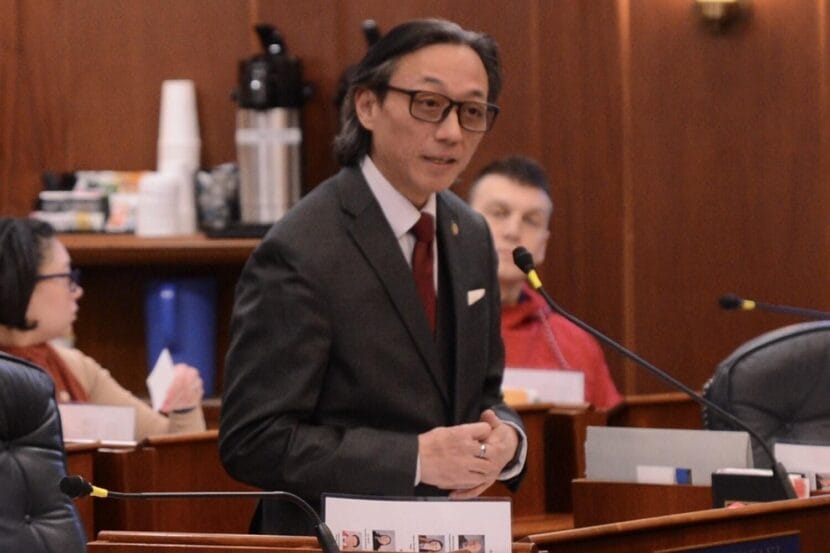
Sen. Scott Kawasaki, D-Fairbanks, speaks Friday, Feb. 7, 2025, on the floor of the Alaska Senate. (James Brooks/Alaska Beacon)
Democratic Fairbanks Sen. Scott Kawasaki violated ethics law by holding constituent events too close to the 2024 state primary, a panel of the Alaska Legislature concluded in a report published Friday.
The report was published by the Senate subcommittee of the Legislature’s Select Committee on Legislative Ethics, which recommended no penalty.
Under the Legislative Ethics Act, a legislator in a campaign cannot use state funds “to print or distribute a political mass mailing to individuals eligible to vote for the candidate” if the mailing takes place during a period that begins 60 days before the primary election and ends one day after the general election.
According to the report, Kawasaki e-mailed constituents a newsletter, distributed informational flyers and held a “Picnic in the Park” event to observe the opening of his office in Fairbanks.
Kawasaki, who defeated Republican Leslie Hajdukovich in the November general election, faced only Hajdukovich in the primary, making the race uncontested. In Alaska, the top four vote-getters advance from the primary election to the general election. Kawasaki and Hajdukovich were the only two registered candidates.
Kawasaki was first elected to the Alaska State House of Representatives in 2007, and to the Senate in 2019. He ran for re-election in 2024 to represent Senate District P.
Reached by phone on Friday, Kawasaki said that “it’s just sort of disappointing to have this be said and politicized, and then it becomes a potential issue in the future campaign.”
“It was a technical violation,” he said, “and I think it was unfairly weaponized against us just because of who we were running against.”
The log storage facility would be located in Haines’ Lutak Inlet, pictured above in August 2025. (Avery Ellfeldt/KHNS)
A company under contract for a major timber sale in Haines is trying again to secure a permit to store harvested logs in Lutak Inlet, a key piece of its proposed operation.
As part of that process, the company conducted a required survey this spring that says the storage site is appropriate and would not affect sensitive marine habitat.
But some community members remain unconvinced. The area Fish and Game Advisory Committee submitted a comment letter on Friday that says the intertidal area of the inlet is a “sensitive habitat” for species including salmon, eulachon, or hooligan, and crab.
The committee argues the permit should not be granted absent more information about potential repercussions.
“These species provide an essential source of food security as well as cultural continuity for local residents who rely on the Inlet for subsistence harvests,” the committee wrote. “Any degradation of these habitats would directly impact the community’s ability to access traditional and sustainable food resources.”
Oregon-based Northwest Forest Products Inc. won a contract years ago to carry out the Chilkat Valley’s largest timber sale in decades, known as Baby Brown.
The timber harvest hasn’t begun. But last spring, the company’s local operator, NSEA Inc., applied for a five-year permit for log storage with the Alaska Department of Natural Resources.
Then, the agency pulled the application after realizing it skipped a crucial step: requiring a survey of the sea floor.
“We don’t have a ton of log transfer facilities anymore. So I believe that kind of just slipped through the cracks,” said natural resource manager Tony Keith. “And that was our bad, so that’s why we did pull it.”
NSEA conducted the survey in April. That entailed using a device with underwater GPS, video and mapping software to examine current ocean floor conditions.
The survey report, which was submitted with the new permit application, concludes that the site is “suitable” for the facility. And it says no sensitive or critical habitat was documented.
Then NSEA re-applied for the permit in late September. The application proposes a log transfer facility and storage area on a 12-acre site about four miles out of town, off Lutak Road. The facility would be used to transfer logs into the inlet, near the shore, where they would be stored until they’re loaded onto ships.
The survey report explains that those ships will head overseas to the export log market “because there are no in-state purchasers for logs in the northern part of southeast Alaska.”
The company has indicated it plans to begin logging the timber sale in the spring of 2026 and wrap it up before the end of 2028.
Area management biologist Nicole Zeiser said the proposed facility would directly interfere with local fishing.
“Especially with the mooring buoys that may be installed. I’m not sure how many or exact location, but that would significantly reduce access for both subsistence and commercial gillnet fishermen, but crab fishermen as well,” she said.
State Forester Greg Palmieri previously told KHNS the storage site would be about 1,700 feet long. The new permit application says it would take up about 2,500 feet parallel to the shore. In an email on Friday, he said log rafts have been used in the Lutak Inlet historically – and that facility use can easily be managed to avoid fishing impacts.
NSEA President Polly Johannsen did not respond to a request for comment.
The public has until Oct. 13 to comment on the permit application. Comments can be submitted to muriel.walatka@alaska.go.
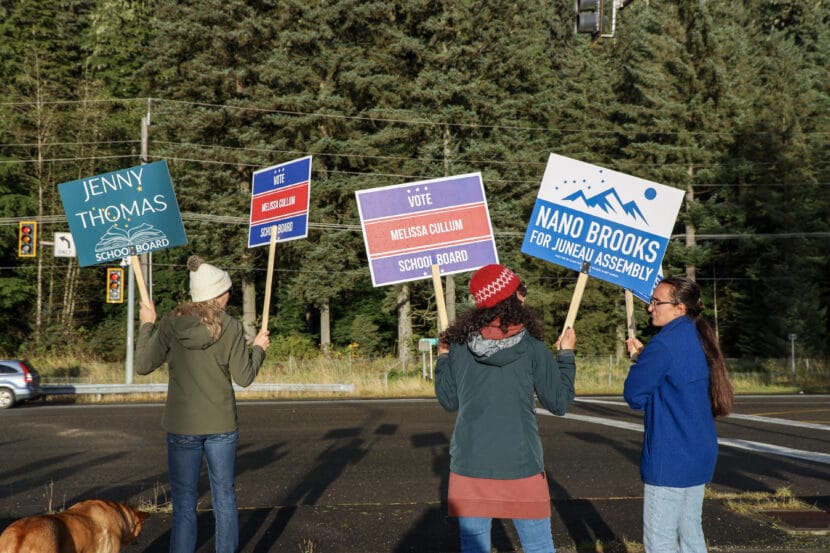
Candidates and residents wave election signs in the Mendenhall Valley on Election Day on Tuesday, Oct. 7, 2025. (Photo by Clarise Larson/KTOO)
The outcome of Juneau’s municipal election is beginning to take shape as preliminary results continue to roll in. The city clerk’s office released another batch of results that include ballots cast on Election Day on Friday evening.
The results paint a similar picture compared to the first round results shared earlier this week.More voters appear to be in favor of Propositions 1 and 2, but oppose Proposition 3.
Proposition 1 seeks to cap the rate the city uses to determine how much residents pay in property taxes each year. “Yes” votes narrowly outpace “no” votes by less than 200 votes.
Proposition 2 would exempt essential food and residential utilities from local sales tax. Nearly 70% of voters are in favor of it passing so far.
Proposition 3 would implement a new seasonal sales tax system next year to take advantage of cruise tourists. “No” votes lead by more than 1,500 votes.
District 2 Juneau Assembly candidate Nano Brooks continues to grow his lead over incumbent Wade Bryson for his seat. Brooks now leads by more than 400 votes.
Steve Whitney, Melissa Cullum and Jenny Thomas are now leading in the race for the three open seats on the Juneau Board of Education. Thomas surpasses Jeremy “JJJ” Johnson by 127 votes after trailing behind in previous results.
Write-in candidate and current board president Deedie Sorensen continues to trail behind all other candidates.
Voter turnout as of Friday’s results was just over 35%. The results shared are subject to change and more preliminary results will be shared in the coming weeks. The city will certify results on Oct. 21.
Close
Update notification options
Subscribe to notifications
Subscribe
Get notifications about news related to the topics you care about. You can unsubscribe anytime.