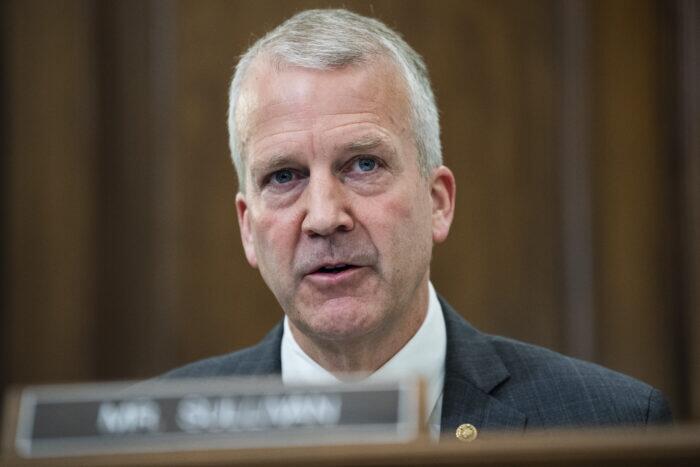
Sen. Dan Sullivan (R-AK) speaks during a hearing of the Senate Commerce, Science, and Transportation Committee in the Russell Senate Office Building on January 26, 2021 in Washington, DC. (Tom Williams | Pool/Getty Images)
The FBI searched the cellphone records of Republican Alaska Sen. Dan Sullivan and seven other U.S. senators and a member of the U.S. House as part of its investigation into the Jan. 6, 2021 insurrection at the U.S. Capitol, a newly released document shows.
The call logs cover several days during and around the insurrection, when rioters stormed the Capitol in an attempt to support then-incumbent President Donald Trump, who falsely claimed to have won reelection in 2020.
The logs do not show that the FBI obtained phone call recordings, only that an investigating agent was interested in who the senators were talking to, when they talked, how long they talked, and where the callers were. The document, released this week by the U.S. Senate Judiciary Committee, does not say why those senators were identified in particular and it does not say whether any investigative leads resulted from the records.
Sullivan himself is not under investigation.
According to a news release from the committee, the FBI sought and obtained data about the senators’ phone use in the days before, on and after the Jan. 6 insurrection, from Jan. 4 through Jan. 7, 2021.
The U.S. Department of Justice indicted Trump in 2023 for allegedly conspiring to overturn the results of the 2020 presidential election, but the special prosecutor in charge of the investigation abandoned that case after Trump was re-elected in 2024. Department policy says that sitting presidents cannot face criminal prosecution, and after the 2021 insurrection, the U.S. Supreme Court issued a decision limiting a president’s liability for conduct while in office.
Asked whether Sullivan had any contact with people who participated in or organized the riot at the U.S. Capitol, Devyn Shea, a spokesperson for Sullivan, said, “absolutely not.”
In a written statement, Sullivan called the FBI investigation “an absolute outrage.”
“We’ve just learned the Biden FBI was engaged in what appears to be an unprecedented fishing expedition against at least nine sitting Republican members of Congress — none of whom were under any type of investigation — surveilling our personal cell phone calls with family members, staff and colleagues. This is a new low in the political weaponization of the Justice Department,” Sullivan’s statement said.
The other seven senators were Cynthia Lummis (R-Wyo.), Lindsey Graham (R-S.C.), Josh Hawley (R-Mo.), Tommy Tuberville (R-Ala.), Ron Johnson (R-Wis.), Marsha Blackburn (R-Tenn.), and Bill Hagerty (R-Tenn.). Rep. Mike Kelly (R-Pa.) was also on the FBI list.
Some senators, including Hawley and Tuberville, voted to object to the certification of the electoral results of the 2020 election.
Sullivan voted to support the certification of the election, and in a statement the day after the Jan. 6 violence at the Capitol, he called the event “sad” and “dispiriting.”
All have been supporters of Trump and his policies; in office, Sullivan has been a reliable vote for the president and his agenda.
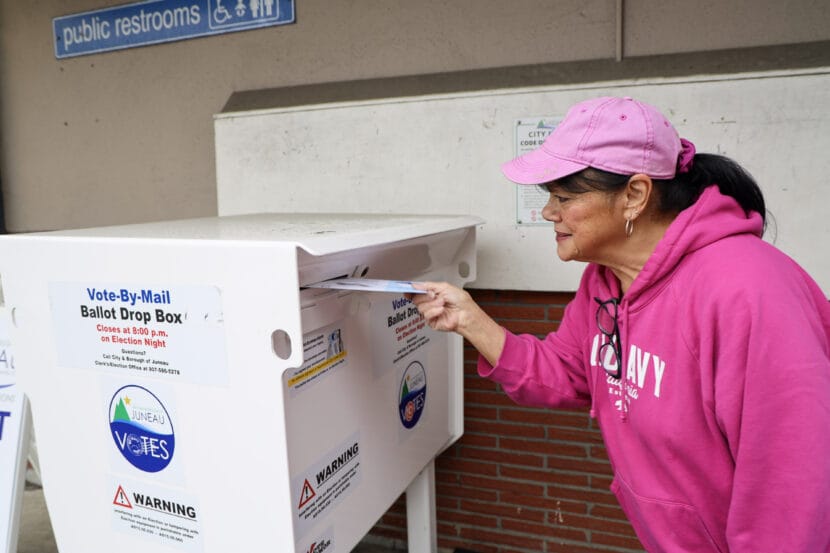
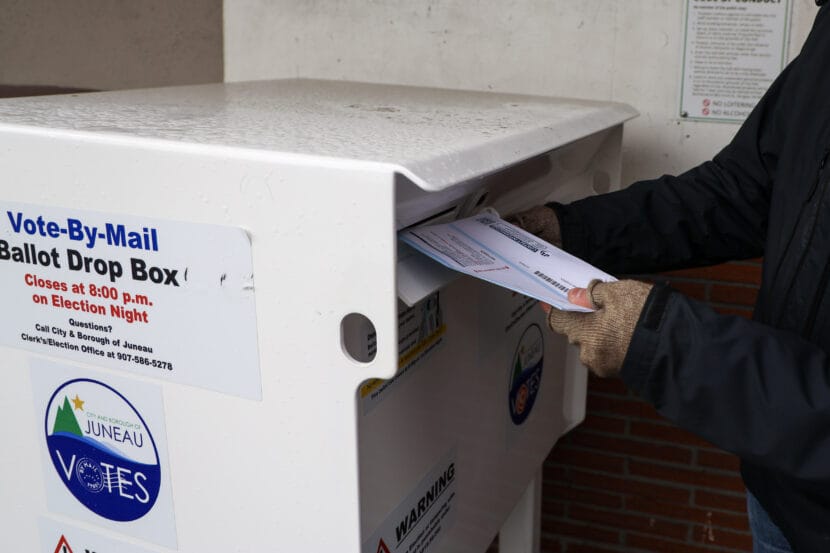
Elizabeth Ibias drops her ballot off in the City Hall ballot drop box on Election Day on Tuesday, Oct. 7, 2025. (Photo by Clarise Larson/KTOO)
Tuesday is municipal Election Day in Juneau, and voters will decide on three Assembly seats, three school board seats and three key local tax measures. Residents cast their ballots at vote centers and ballot drop boxes open across town.
Election workers emptied out the ballot box outside City Hall on Tuesday morning as Jev Shelton went to cast his ballot.
Shelton said he doesn’t think any of the propositions should pass, but took particular issue with Proposition 1. That measure seeks to cap the rate the city uses to determine how much residents pay in property taxes each year.
“It just leads to a major step backward in this community, which is losing population, losing influence, and is needing to make itself a bit healthy and a bit more attractive than it’s doing,” he said. “That was not the way to do it.”
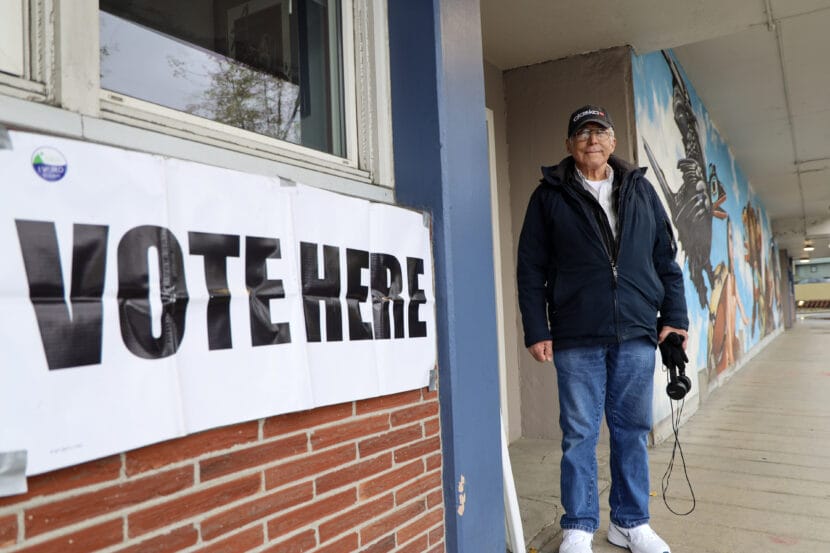
Another resident outside City Hall, Lawrence Siverly, said he wasn’t familiar with the candidates up for election. He came to vote on the ballot measures. He said he voted yes on Proposition 1 because his son is a homeowner here, and yes on Proposition 2, which would exempt essential food and residential utilities from local sales tax.
Lawrence Siverly smiles after casting his municipal ballot at City Hall on Election Day on Tuesday, Oct. 7, 2025. (Photo by Clarise Larson/KTOO)
“Since I’m a senior, I already have benefits for food, but I think that should be available for everybody that lives here,” he said.
But Siverly says he voted no on Proposition 3, which would implement a new seasonal sales tax system in Juneau next year. Proponents say the change would take advantage of the 1.7 million cruise passengers that come to town each summer, while giving year-round residents a break during the winter. Opponents say the system won’t actually save residents money in the long run. Siverly says he voted against it because he doesn’t want to pay a higher rate in the summer.
Brian Fox walked outside the Mendenhall Valley Public Library after voting in person. Fox didn’t share how he voted, but said he wants to make things more livable in Juneau.
“I know that the cost of living here, and I’m acquainted with it very well, having lived here and in Fairbanks previously,” he said. “The cost of many things is sky high, some of it a little out of proportion.”
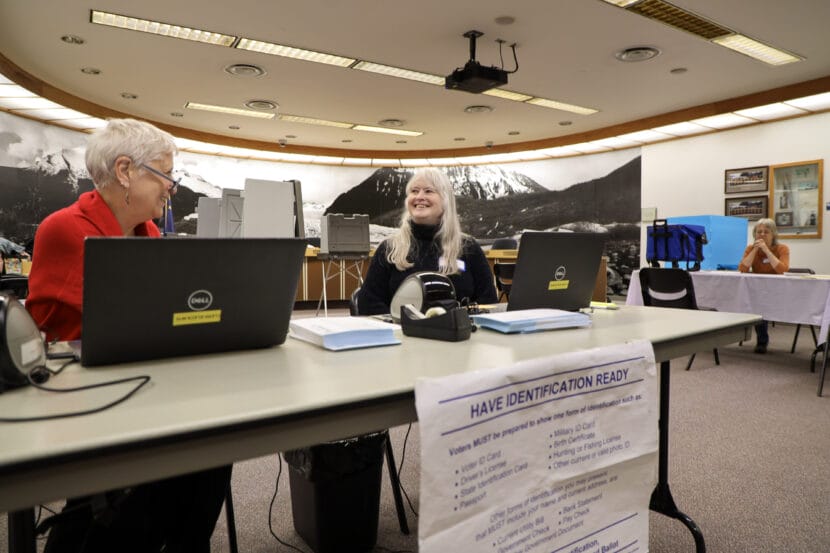
Election workers wait for voters at the City Hall on Election Day on Tuesday, Oct. 7, 2025. (Photo by Clarise Larson/KTOO)
Back at City Hall, LaRae Jones is the volunteer supervisor for the election this year. Next to a stack of “I Voted Today!” stickers featuring the Alaska state flag, she fills up a candy basket.
Jones said this is the last evening people can vote.
“People are wonderful, we love to have them come vote in person,” she said. “I just encourage everyone to vote.”
The preliminary results of the election will be released Tuesday night after ballot boxes and vote centers close at 8 p.m. The initial results will only include ballots that were mailed in or dropped off before Election Day. Official results won’t be certified by election officials until Oct. 21.
KTOO reporters Alix Soliman, Jamie Diep and Yvonne Krumrey contributed to this report.
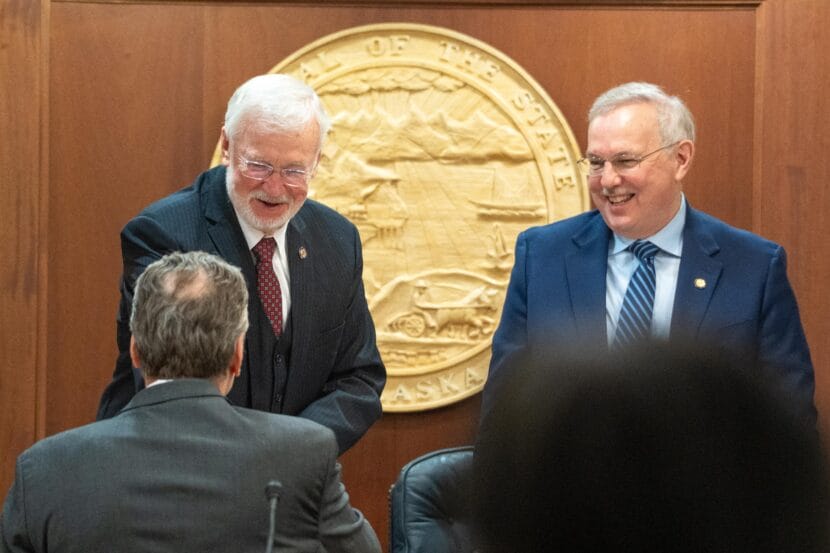
Senate President Gary Stevens, R-Kodiak, greets Gov. Mike Dunleavy while standing alongside House Speaker Bryce Edgmon, I-Dillingham, in the House chamber at the Alaska State Capitol in Juneau on Jan. 28, 2025. (Eric Stone/Alaska Public Media)
Top state lawmakers say they’re investigating why $50 million from the state’s primary savings account was invested in an outside private equity fund.
Former Revenue Commissioner Adam Crum committed to investing $50 million in state dollars in the fund shortly before his resignation took effect, according to his successor. The political website Alaska Landmine first reported the news and identified the outside fund as DigitalBridge, a digital infrastructure investment firm. Crum, who is running for governor, did not respond to a request for comment on Monday.
Senate President Gary Stevens, a Kodiak Republican, said in an interview that he and House Speaker Bryce Edgmon, a Dillingham independent, learned about the investment on a call with Gov. Mike Dunleavy on Sept. 30. They’ve asked the legislative auditor to look into it, he said.
“We’re not accusing anybody of anything. We’re trying to find the truth right now,” he said. “We’re in an investigative stage right now, as is the governor. I mean, he was very forthright in talking to us about this.”
Stevens and Edgmon issued a joint statement on Friday saying state officials should not make similar “high-risk investments” in the future without involving the Legislature.
“Regardless of whether the action was technically permissible under statute, decisions of this magnitude must not occur outside the view of the Legislature or the public,” the pair wrote.
Dunleavy’s office and the Department of Revenue did not respond to a series of questions seeking more information on the investment and whether it’s consistent with the state’s investment policies.
The money for the investment comes from the state’s main rainy-day fund, the roughly $3 billion Constitutional Budget Reserve. Unlike the Permanent Fund, the reserve is typically invested in safe, cash-equivalent assets that are easy to sell quickly, like short-term U.S. Treasury bills. Lawmakers have repeatedly drawn from the account in recent years to fill gaps in the state budget.
But private equity investments tend to be far less liquid — and Stevens said that undermines the purpose of the savings account.
“We’re concerned (about) what we’ve heard, whether it’s a proper investment, whether we are tying up monies that we shouldn’t be tying up,” Stevens said. “We just have limited savings these days, and we need to be very careful about protecting those savings.”
Stevens says he expects lawmakers will hold hearings on the issue.
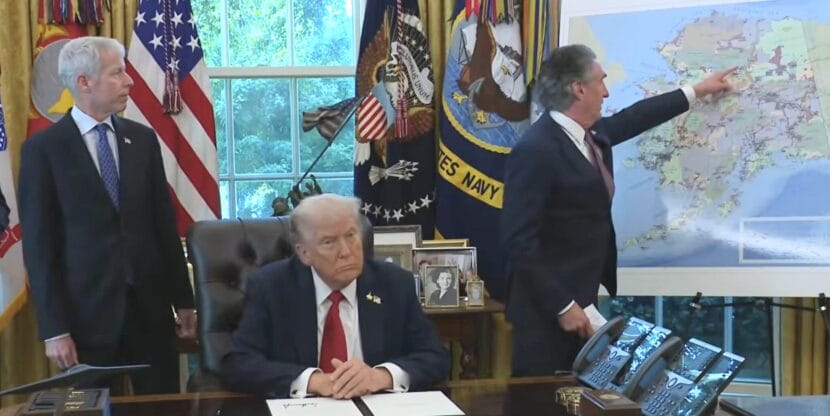
In this screenshot from a White House news conference, Interior Secretary Doug Burgum points to a map of Alaska on Monday, Oct. 6, 2025, as he announces the Trump administration’s decision to reverse a Biden administration action that canceled a right-of-way permit for the Ambler Road. (Screenshot)
The action removes a major hurdle for the project, but developers would still need to overcome lawsuits and opposition from environmental and tribal groups. They would also need approval from NANA and Doyon Ltd., two Alaska Native regional corporations who own land in the road’s path.
Ambler Road, planned by the state of Alaska’s development bank and supported by state officials and Alaska’s congressional delegation, would link the Dalton Highway with a mineral-rich region of northwest Alaska, providing access to the mining of rare minerals needed for batteries and high-technology manufacturing.
“It’s an economic gold mine, so to speak. I signed this years ago, and Biden un-signed it for me,” Trump told reporters on Monday at the White House.
Last year, the U.S. Bureau of Land Management concluded that the road would have a litany of negative impacts, and the Biden administration issued a record of decision saying that the best route for the project was no route at all.
The Alaska Industrial Development and Export Authority, Alaska’s state-owned investment bank and the road’s developer, sued the Biden administration, seeking a reversal.
U.S. Interior Secretary Doug Burgum, speaking at the White House on Monday, said the state of Alaska requested an appeal of that decision, and that under federal law, President Trump has the executive authority to make decisions on land use.
The appeal in question was filed by AIDEA under Section 1106 of the Alaska National Interest Lands Conservation Act of 1980.
“This opens up a wealth of resources,” Burgum said, adding that the federal government will also take partial ownership of Trilogy Metals, one of several firms exploring for minerals in northwest Alaska.
As currently planned, the road would consist of a gravel strip stretching from the Dalton Highway almost to Kotzebue. It is envisioned as a toll road, with no public access, and the cost of construction would be paid for via fees levied on users, similar to the way the AIDEA-funded DeLong Mountain Transportation System provides a port for lead and zinc exported from the Red Dog Mine in northwest Alaska.
In a special late-September meeting, AIDEA’s board voted to authorize limited negotiations with landowners in the road’s path.
The road is expected to cross more than 10 miles of land owned by Doyon Ltd., the regional Alaska Native corporation for Interior Alaska.
To date, that corporation hasn’t expressed official support or opposition for the road. Sarah Obed, senior vice president of external affairs for Doyon, said by email that Monday’s announcement was “not a surprise to Doyon” because of a different executive order signed earlier this year.
NANA Regional Corp. owns more than 20 miles of land in the path of the road. In a written statement, NANA President and CEO John Lincoln said the company “appreciates the Trump Administration and Governor Dunleavy’s support for economic development in Alaska and their work towards stabilizing the federal permitting process” but he declined to express support for the road.
Lincoln said that still stands: “Our position on the Ambler Access Project has not changed and will only be reconsidered if and when our established criteria are satisfied, in consultation with shareholders, local communities, and other stakeholders.”
Trump’s action on Monday restores a federal right-of-way grant issued in 2021, at the end of the first Trump administration. It also requires federal agencies to issue clean-water permits and other approvals needed for the road.
A lawsuit challenging the 2021 right-of-way grant remains open in U.S. District Court in Anchorage. Attorney Bridget Psarianos with the non-profit law firm Trustees for Alaska is one of the attorneys challenging that right-of-way.
By phone, she said she hasn’t ever seen a president use the authority that Trump did on Monday.
“He’s wielding this presidential power like a cudgel, including to overturn decisions that his own agencies have made and provided good reasons for,” she said.
Several dozen communities and Alaska Native tribes in Interior Alaska have opposed the road to date.
“I think it’s also just important to remember that there’s widespread opposition to this road in Alaska and by local communities, and the reason the alums said no to this was because they found that there would be significant impacts to subsistence and to communities and their health along the road corridor,” Psarianos said.
Athan Manuel, director of the environmental non-profit Sierra Club’s Lands Protection Program, offered similar thoughts in a written statement. “This order ignores those voices in favor of corporate polluters. The Ambler Road will lead to significant harm to fragile Alaskan landscapes and the local communities and wildlife that rely on them,” he said.
Most of the road’s path is on land owned or controlled by the state of Alaska; an easement allowing the road remains under consideration by the Alaska Department of Natural Resources, but approval is expected.
In a statement published after Trump’s announcement on Monday, Gov. Mike Dunleavy thanked the president for his action, saying, “this decision will unleash development opportunities, create new jobs for Alaskans and secure access to strategic minerals.”
Similarly, all three members of Alaska’s congressional delegation expressed support for Trump’s decision.
“By advancing this access, we are creating new opportunities for Alaskans while strengthening America’s supply chain and reducing dependence on foreign adversaries for our critical mineral needs,” said U.S. Rep. Nick Begich, R-Alaska. “I applaud the President’s decision to support this appeal, and I look forward to working with the Administration, state leaders, and Alaska Native communities to ensure this project moves forward in a way that benefits all Alaskans.”
U.S. Republican Sens. Lisa Murkowski and Dan Sullivan also thanked the president for his action.
“The President’s re-approval will unlock a world-class mining district, deliver quality-of-life benefits for communities in the region, and help grow Alaska’s economy. It will also improve our national security by strengthening our mineral security and enabling us to produce more of our most important resources here at home,” Murkowski said.
Sullivan said, “I’m glad to see another critically important project for our state’s economy and working families being put back on track.”
There are a handful of ways you can vote in the by-mail election. The city has ballot drop boxes in different locations all across town. Voters can also mail their ballots back or go to a vote center.
This year’s ballot features three propositions, four candidates running for three open seats on the Assembly and four candidates running for three seats on the school board. One write-in candidate for school board is not featured on the ballot.
Deputy City Clerk Andi Hirsh said as of Saturday, about 4,600 ballots had been returned.
“Democracy only works when people participate,” Hirsh said. “This is your chance to really have a say in what our community looks like, and I think it’s really important for every person to be part of that.”
The ballot drop boxes are open until 8 p.m. Tuesday. They are located at City Hall, the AEL&P office in Lemon Creek, Douglas Library, the Mendenhall Valley Public Library and Statter Harbor boat launch.
Ballots sent in by mail need to be postmarked on or before Election Day and a first-class stamp is required. Vote centers at City Hall and the Valley Library will be open from 7 a.m. to 8 p.m. on Tuesday for in-person voting.
Hirsh said the vote centers can get busy on Election Day and people might experience a wait time.
“We do tend to get both a lunch rush and an after work rush,” she said. “So, there tends to be a bit of a line.”
Ballots turned in on Election Day aren’t counted in the unofficial results released that night. They’ll be added to later unofficial result updates. Final results will be certified on Oct. 21.
Olerud’s Market in Haines, pictured above in 2022. (Corinne Smith/KHNS)
Haines might soon join communities across Southeast Alaska that have tweaked their tax policies to shift the local tax burden off year-round residents and onto tourists.
Voters this week will consider a ballot measure that would increase sales tax during the summer, when visitors flock to town, and reduce the rate in winter. Sweetening the deal is a provision that would exempt groceries from sales tax entirely during the winter months.
“Over the course of a year the visitors and seasonal residents will pay more and year-round residents (depending on who they are and what they buy when) should pay less or the same as they do now,” Haines Borough Finance Director Jila Stuart said in an email on Thursday.
Local sales tax in Haines is currently set at 5.5%. If the measure passes, it would boost the rate to 7% between April and the end of September. The rate would fall to 4.5% for the rest of the year – excluding groceries, which would not be subject to sales tax at all in winter.
The goal is to raise funds for two key purposes: school funding and road improvements.
“I think it’s an agreeable enough deal, in so much as folks will get 5.5% off groceries all winter long, and they’ll get 1% off everything else,” Haines Mayor Tom Morphet said in an interview this week.
Morphet has been a major proponent of the provision, which is modeled after versions adopted in communities across Southeast. Among them are Craig, Pelican, Seldovia, Ketchikan, Sitka and Skagway – Haines’ closest neighbor.
Each seasonal sales tax looks slightly different. But the goal generally speaking is to take advantage of the busy summer season to generate local tax revenue.
Consumers in Skagway for instance, currently pay a 5% sales tax in the summer and 3% in the winter. But that could soon change. On the Skagway ballot this year is a measure that would boost summer sales tax by another 2%. In exchange, the borough would waive local utility fees.
Morphet has done a handful of public presentations about the tax. He said he has heard some concerns, including extra administrative costs for businesses, and that the tax could discourage people from shopping in Haines.
All told, the tax is expected to generate about $280 thousand dollars – which amounts to a 6% boost to local sales tax revenue, according to the borough.
Morphet acknowledged that 6% is an “incremental” figure. But he emphasized it’s still a crucial sum given that the borough is grappling with a $1 million budget deficit that he says has to be made up somewhere.
The deficit is due in part to federal funding cuts and a senior tax exemption passed by voters last year. But it also resulted from the borough needing to kick in more than half a million dollars more for the school this year compared to last, to make up for insufficient state funding.
That’s a challenge facing communities across Alaska.
“Communities are responding by adopting a seasonal sales tax,” Morphet said. “In Craig, the seasonal sales tax goes entirely to the school. And you know, until we have a new governor, our hands are going to be tied.”
If passed, the Haines borough expects that year-round residents would spend roughly the same amount in sales tax that they currently do.
Someone who spends $30,000 per year on taxable goods and services – $7,000 of which is groceries – would spend about $80 less on tax under the new structure, according to a borough fact sheet.
That could look different depending on the person. The math might not pencil out as well for someone who spends a lot on gasoline in the summer, for instance, as opposed to groceries.
Close
Update notification options
Subscribe to notifications
Subscribe
Get notifications about news related to the topics you care about. You can unsubscribe anytime.