Government

Cut off from their jobs at home, Alaska typhoon evacuees have alternative income options

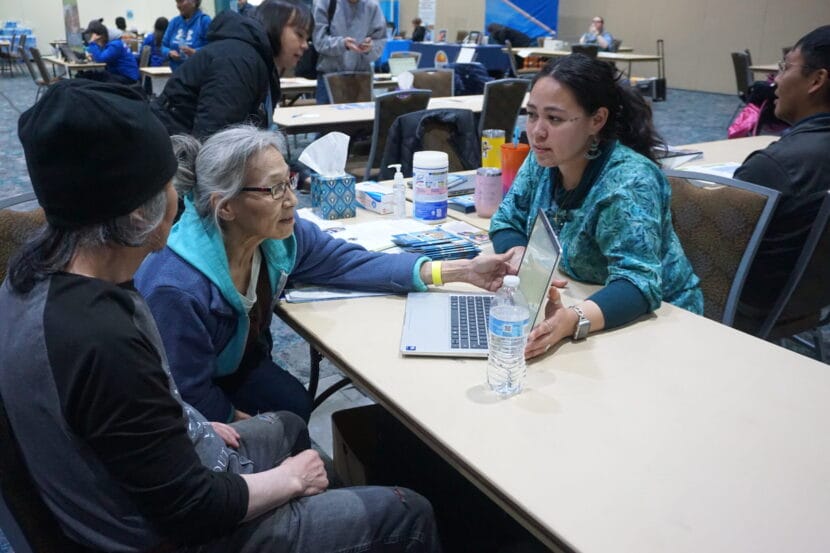
Regina Qussauyaq Therchik, manager of workforce and shareholder development at Calista Corporation, shows information on a laptop on Oct. 29, 2025, to Stephanie and Carl Anaver of Kipnuk. Therchik was among the Calista representatives participating in a workshop at the William A. Egan Center in Anchorage that connected evacuated Yukon-Kuskokwim residents with temporary employment and job-training opportunities. The Anavers have been staying in Wasilla with a relative since being evacuated from their home region. The Egan Center has been serving as a temporary shelter and assistance hub for the hundreds of Yukon-Kuskokwim residents flown to Anchorage after their villages were devasted by the remants of Typhoon Halong. (Photo by Yereth Rosen/Alaska Beacon)

For wage-earning Alaskans who were displaced by the remnants of Typhoon Halong, a powerful storm that lashed the western coast of the state earlier this month, qualifying for one special type of federal assistance could be a cinch.

The U.S. Department of Labor’s Disaster Unemployment Assistance program provides financial benefits to people who cannot perform their normal jobs because of disaster interference. One qualification for the benefits — $153 to $370 per week for up to 27 weeks, according to the Alaska Department of Labor and Workforce Development — is an inability to reach normal worksites.

Among the hundreds of Yukon-Kuskokwim region residents who were evacuated by military flights to Anchorage, nearly 500 miles to the east of their home villages, those that held wage-earning jobs in their home villages easily meet that requirement.

Beyond that weekly benefit, many evacuees will need to earn income over what might be a prolonged period away from home. To meet that need, companies and government agencies are seeking to place evacuees in temporary jobs and training programs.

At the forefront of those efforts is Calista Corporation, the Alaska Native corporation for the Yukon-Kuskokwim region. It has a series of programs underway to help displaced residents find work and training.

Cleanup and recovery work is a logical opportunity for people from storm-damaged villages, said Thom Leonard, Calista’s vice president for corporate affairs. But there are some obstacles to starting those recovery jobs.

“One of the challenges is: When are they going to go, and where are they going to stay if they are able to go back to the villages?” he said. Villages that lack power, water and other basic services might not yet be able to house the people who would do the cleanup and recovery work to make those villages habitable again, he said. “It’s kind of a chicken-and-egg situation,” he said.

Bradley Cupluaraq Lake, a workforoceo and shareholder development specialist with Calista Corporation, holds up a brochure on Oct. 29, 2025, with information about the program. Calista is the regional Native corporation based in the Yukon-Kuskokwim region. Lake was one of the Calista representatives at the William A. Egan Center in Anchorage helping shareholders who have been evacuated to Anchorage from villages ravaged by the remnants of Typhoon Halong. Calista and other organizations are coordinating efforts to place evacuees in temporary employment or job-training programs. (Photo by Yereth Rosen/Alaska Beacon)

Calista’s construction and environmental services subsidiary, Calista Brice, has been enlisted in the disaster response and is hiring people from affected villages, Leonard said.

More generally, Calista and other partners held a career workshop on Wednesday for evacuees at the William A. Egan Civic and Convention Center in Anchorage, and more such events are planned. Through those events, Calista’s workforce and shareholder team, which operates a year-round program, is connecting displaced residents with job-training opportunities.

Calista has also offered temporary office space to tribal governments from Kipnuk and Kwigillingok, the coastal villages most heavily hit by the storm. The Kipnuk tribal government has taken Calista up on that offer, Leonard said.

Among the individuals getting help from Calista at the Egan Center on Tuesday were Carl and Stephanie Anaver of Kipnuk.

Stephanie inquired about the possibility of working as a home health care aide for her aged sister, and Carl was seeking a building maintenance job similar to the work he was doing at the Kipnuk Clinic. Regina Therachik, manager of Calista’s workforce shareholder development program, counseled them in Yup’ik.

Anchorage was not their first choice for a relocation spot, Stephanie Anaver said. “I wanted to stay in Bethel. But since Bethel was full, they brought us here,” she said in a brief interview.

Rather than staying in Anchorage, the couple has made a temporary home in Wasilla with a family member, she said.

The time in Southcentral Alaska is shaping up to be a period of limbo for the couple. Exactly when the couple will return to Kipnuk, or even if that is possible, is unknown, Stephanie said.

“If they relocate Kipunk to higher ground, yeah, I’ll go back to Kipnuk,” she said.

Alaska will use state funds to fill SNAP cards and help food banks amid federal delays

A shopper passes by a sign welcoming SNAP recipients at a Fred Meyer store in Anchorage on Monday, Nov. 3, 2025.
A shopper passes by a sign welcoming SNAP recipients at a Fred Meyer store in Anchorage on Monday, Nov. 3, 2025. (Matt Faubion/Alaska Public Media)

People who rely on food assistance from SNAP, the Supplemental Nutrition Assistance Program, could have their electronic benefits cards refilled as soon as this week. Gov. Mike Dunleavy issued a state disaster declaration Monday in an effort to free up state funds to make up for federal money delayed by the Trump administration amid the government shutdown.

“The interruption of these benefits would create an immediate threat of food insecurity and hardship, jeopardize the health and well-being of a substantial population within the state, and a direct threat to public health,” Dunleavy wrote in the disaster declaration.

The roughly 66,000 Alaskans who participate in the federally funded, state-run SNAP program did not have their cards refilled on Saturday as scheduled. Until this weekend, the Trump administration said that funding for the program would run out Nov. 1.

On Friday, two federal judges ordered the administration to tap a contingency fund to at least partially fund SNAP benefits. But the Trump administration says it’ll take time for that money to be distributed, and the administration says it only has enough money to fund half of SNAP recipients’ typical benefits.

Dunleavy’s disaster declaration allows the state to refill benefit cards with state funds quickly and offer money to food banks around the state already stressed by the response to ex-Typhoon Halong and the federal government shutdown.

State House Speaker Bryce Edgmon, an Independent from Dillingham, said in a phone interview it was clear the state needed to act to help Alaskans struggling to put food on the table.

“Compelling stories all around the state of single families and elderly people and others not being able to get food because their cards had run out, you know, were already beginning to come to light, so we knew we had to act quickly,” he said. “I’m really pleased working with the governor and Senate President (Gary) Stevens, that we were able to put our heads together and make this happen.”

Dunleavy previously said it would likely take weeks for any state money to flow to beneficiaries. But on Sunday, Edgmon said, the contractor that handles SNAP cards told the state that recipients’ debit cards could be reloaded much sooner.

As of Monday afternoon, a Department of Health spokesperson, Shirley Sakaye, estimated cards could be refilled by Friday, Nov. 7.

Edgmon said the disaster declaration eliminates the need for a special legislative session to address the issue. Lawmakers and the governor had floated a special session as a possibility as they considered ways to ensure food assistance continued to flow.

Stevens, the Senate president, said the money would likely come from already-appropriated but unused funds in the Division of Public Assistance. Stevens said lawmakers would seek to replace the money with a new appropriation when lawmakers return to Juneau in January. He said he hoped the federal government would reimburse the state at a later date.

The solution is temporary, Stevens said, and likely not sustainable in the long term if the federal government remains closed. The program costs around $8 million per week, he said.

“It would be problematic for us to fill that amount of money on an ongoing basis,” Stevens said.

Democrats and Republicans in Congress have yet to come to an agreement to restore funding for the federal government in a dispute over expiring federal health insurance subsidies. How long the shutdown will last remains an open question.

Haines and Skagway both oppose Cascade Point ferry terminal. Juneau hasn’t taken a stance.

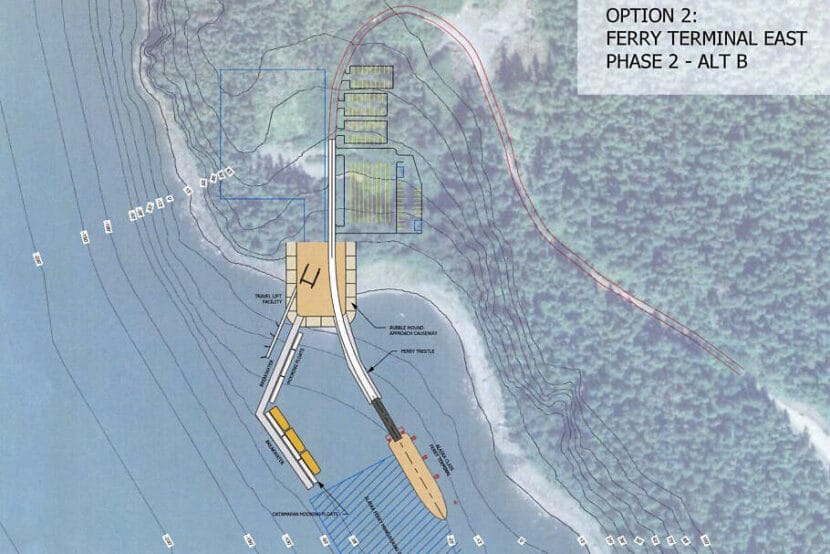
This is a concept design drawing of a new ferry terminal facility in Juneau at Cascade Point. (Alaska Department of Transportation and Public Facilities)

The Juneau Assembly doesn’t plan to take a stance on whether it’s in favor of the state’s proposed Cascade Point Ferry Terminal north of Juneau. That’s despite Haines and Skagway openly opposing the project.

The new ferry terminal would be located beyond where the road ends in Juneau on land owned by Goldbelt Incorporated, a local Alaska Native Corporation. The project is slated to cost tens of millions of dollars. 

Juneau already has a ferry terminal in Auke Bay. The new terminal would be about 30 miles north of the Auke Bay terminal. The state has been pushing for the new terminal for several years, saying it would benefit travelers by reducing operating costs and travel time between Juneau, Haines and Skagway. 

But in an interview, Juneau Mayor Beth Weldon said that the Assembly has other priorities to focus on right now. 

“I don’t think we ever took a stance on it because we just had other, more pressing issues, like the flood,” she said. “We’ve been dealing with that for three years now, and now we’re dealing with budget cuts and everything else, so I don’t see it coming back on our plate for quite some time.”

Multiple Assembly members declined to share where they stood on the topic. Member Paul Kelly said he is “not yet convinced that this is the best solution to help Juneau and other communities in Southeast Alaska improve our interconnectivity.”

The state department of transportation has already signed a $28 million contract for the project’s first phase in July and construction could begin next summer. 

An economic analysis released earlier this month by the department weighed the financial merits. Overall, it portrayed it as having more pros than cons. That’s despite its high price tag and criticism from regional officials and members of the Alaska Marine Highway Oversight Board.

The analysis concluded the project would allow for flexible travel in the region and would play a key role in bringing a proposed new gold mine in Juneau to fruition. Canadian mining company Grande Portage wants to develop an off-site ore terminal at the new ferry dock in partnership with Goldbelt. 

The state began soliciting public comment on the first phase of the project last week. The comment period runs through Nov. 28.

The government shutdown is delaying heating assistance funds for low-income Alaska families

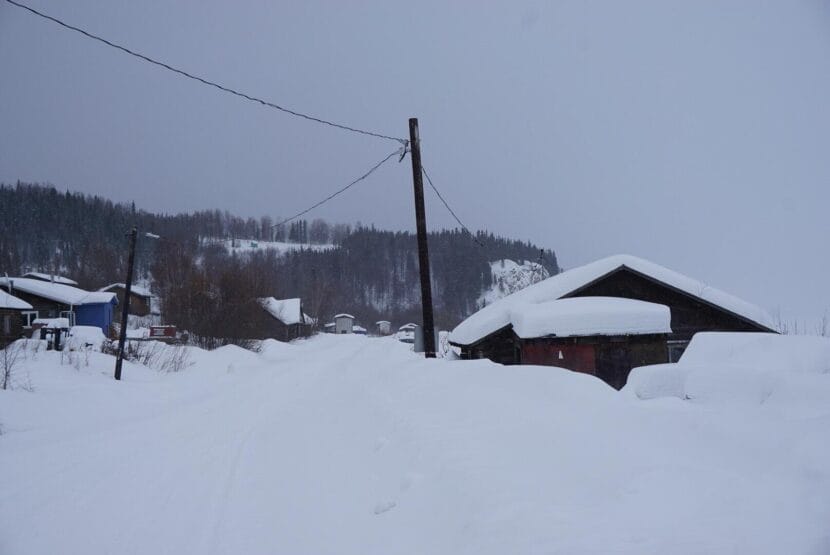
The village of Ruby in Interior Alaska in March 2021.
The village of Ruby in Interior Alaska in March 2021. (Alena Naiden/KNBA)

The government shutdown is delaying funding for a federal heating assistance program that helps thousands of low-income Alaska families to offset their heating costs and weatherize homes for winter, state health officials said Thursday.

The Alaska Department of Health said in a statement that the government shutdown has delayed the release of money for the federal Low-Income Home Energy Assistance Program for the year of 2026. The program subsidizes energy bills for about 50,000 Alaskans, many of whom live in rural and tribal communities.

“It definitely benefits a lot of rural and tribal communities,” said Jennifer Hyde, a federal infrastructure coordinator at the Alaska Center, a nonprofit that advocates for the continuation of the program. “Disproportionately, those communities are often low income or have different economic struggles.”

The shutdown began on Oct. 1. Funding for the heating assistance program usually comes in on Nov. 1.

State health officials said they expect that money to run out by mid-November. For now, they are operating the program using the remaining money from the previous year.

The department said it usually takes four-to-six weeks for the heating assistance funds to be released to states. So if Congress acts in late November, Alaska would receive funding after mid-December, according to the state health department.

Alaska tribal organizations are looking closely at the issue.

The Tanana Chiefs Conference administers heating assistance for over 1,200 households. Amber Vaska, the executive director of tribal government and client services at the organization, said by email that the federal program is “a lifeline across the Interior.”

“In our remote Interior villages, this support means the difference between families keeping their homes heated and pipes from freezing—or being forced to go without heat entirely, ” Vaska said.

Vaska added that Tanana Chiefs Conference can use carryover funds from prior years, which allows the organization to continue serving residents even during funding interruptions or government shutdowns.

The government shutdown is also affecting other programs crucial for Alaska Native communities, like food assistance and tribal Head Start.

Hyde, with the Alaska Center, said families who rely on heating assistance are the same vulnerable residents who will be affected by the loss of food benefits.

“It’s going to just be a really tough winter, unless something can give,” she said.

In the meantime, the state Department of Health said its staff is prioritizing applications by focusing on households in a heating emergency or at immediate risk of losing heat. It’s also processing regular applications in the order they were received.

If the federal money runs out, the department said it plans to continue processing new applications, though payments will be delayed until the new funds arrive.

NOAA cancels funding for data collection crucial to tsunami warning systems

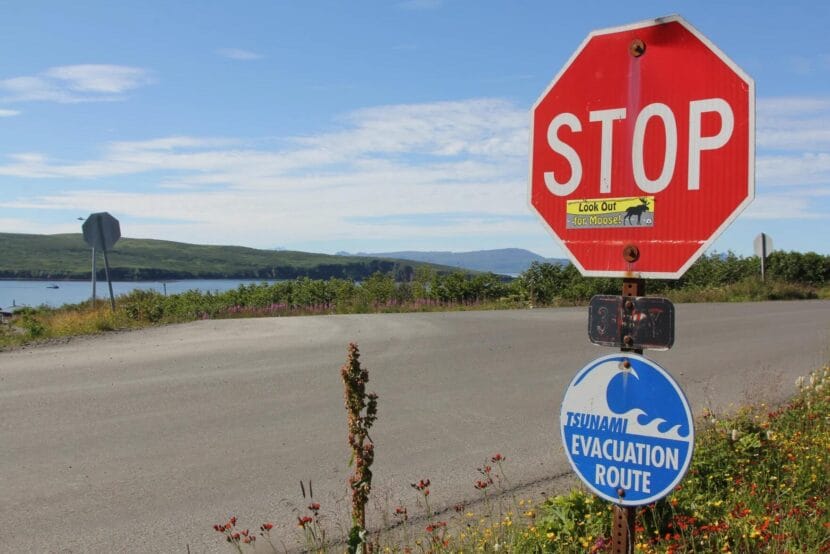
A sign marking a tsunami evacuation route in Sand Point, Alaska on July 29, 2025.
A sign marking a tsunami evacuation route in Sand Point, Alaska on July 29, 2025.  (Theo Greenly/KDSP)

The National Oceanic and Atmospheric Administration is halting a contract that makes it possible for the federal agency to accurately monitor for potential tsunamis in Alaska – and quickly warn at-risk communities.

The Alaska Earthquake Center for decades has collected data from seismology stations across the state and directly fed the information to NOAA’s National Tsunami Center, in Palmer. If the data indicates an earthquake that could lead to a tsunami, the Tsunami Center sends out a warning message within minutes.

Or at least that’s how it worked historically, including on Thursday morning, when an earthquake struck between Seward and Homer.

But that’s about to change. In late September, the federal agency advised the Alaska Earthquake Center that it does not have funding available for that work.

“We are anticipating direct data feeds to stop in mid-November,” said Mike West, the Alaska State Seismologist and director of the Alaska Earthquake Center, which is part of the University of Alaska Fairbanks’ Geophysical Institute.

The news comes amid the Trump administration’s effort to dramatically slash federal spending – including by proposed cuts to key weather and climate programs within NOAA.

West said the change is a big deal. NOAA’s National Weather Service holds the federal responsibility for tsunami warnings, and has historically been a primary supporter of seismic data collection in Alaska. But the agency doesn’t actually collect much of that data itself.

“Without this contract,” West said, “they lose data from dozens and dozens of sites all around the state, and specifically – or maybe more urgently – a handful of sites out in the Aleutians and the Bering that have been there for decades specifically for this purpose.”

The potential fallout isn’t isolated to Alaska. West provided an example: the 1946 tsunami that originated near the Aleutians, and killed more than 150 people in Hawaii.

“The tsunami threats from Alaska are not just an Alaska problem,” West said.

The contract was supposed to re-start October 1. But after funding did not arrive as expected, West reached out to the agency on Sept. 23. A NOAA official advised him via email a week later that the agency did not have the budget to support the long-standing contract.

West said the Earthquake Center is grappling with the situation but that its NOAA data feeds and tsunami-specific work will wind down in November.

“We are not going to continue operating those stations in the Aleutians that are entirely NOAA supported,” he said. “We’re not going to just keep doing it.”

NOAA did not respond to a request for comment. NOAA Tsunami Warning Coordinator David Snider declined to comment for this story.

New poll shows Peltola neck-and-neck with Sullivan, if she were to run for U.S. Senate

Mary Peltola
Rep. Mary Peltola at a campaign event in Bethel, March 15, 2024. (Sage Smiley/KYUK)

The last Democrat elected to statewide office, former Alaska Congresswoman Mary Peltola, is about even in a head-to-head match with Republican U.S. Sen. Dan Sullivan, a new poll shows.

Peltola hasn’t declared her intention to run in any race for 2026 but is considered a potential candidate for Senate or governor.

The progressive firm Data for Progress conducted the poll, at its own expense. Jason Katz-Brown, an Anchorage-based advisor at the firm, said the results in the Senate race are largely holding steady from its last poll.

“Earlier this summer we had her down by one (percentage point). Now we have her up by one, but that’s well within the margin of error,” he said. “I think we can’t conclude anything about that race. It’s just super, super close, if Peltola were to run for Senate.”

The poll also had Peltola leading in a field of nine candidates for governor – the others being Republicans who actually are running for the office.

It shows Anchorage businesswoman Bernadette Wilson in second place. But once lower-ranking Republicans are removed, former Anchorage Mayor Dave Bronson comes in second.

A large factor is name recognition, Katz-Brown said.

Pollster Ivan Moore of Alaska Survey Research said the Data for Progress results mostly track his own findings – that Peltola leads the field in the governor’s race. But, Moore points out, the other candidates have not had a chance to campaign yet.

“So the idea that this is going to be a cake walk and she can just stroll into the governor’s office is misguided,” Moore said. “She’s just streaks ahead of everyone else because she’s built this following, but it’s not going to be the same in a year.”

The latest poll found Alaskans evenly split on whether they have a favorable opinion of President Donald Trump. The poll had 823 respondents and the pollsters used weighted averages to better reflect Alaska voters.

Site notifications
Update notification options
Subscribe to notifications