Government

Alaska’s furloughed feds take on ‘lemonade’ projects amid stress and uncertainty

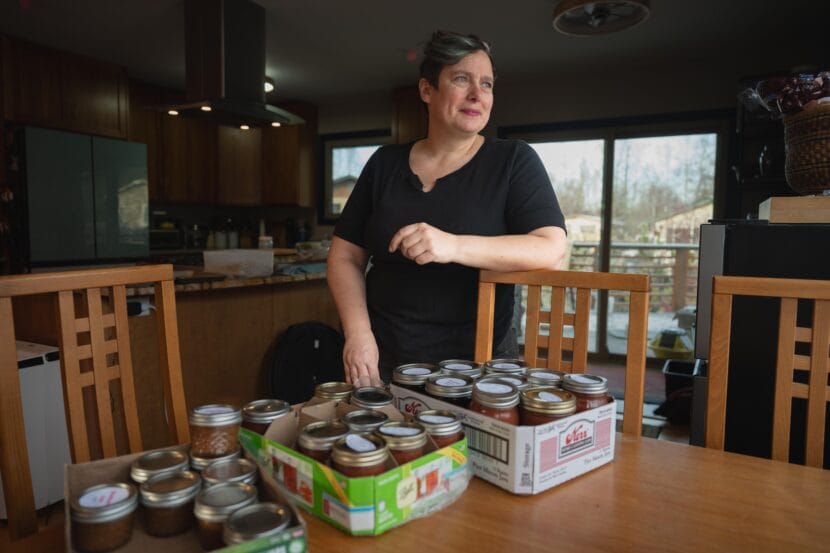
A woman in a black shirt poses with home made jam in her kitchen.
Liza Sanden spent the first weeks of the government shutdown jarring jam and freezing homegrown kale at her Anchorage home. Then anxiety set in. She’s taken up substitute teaching while she waits. (Matt Faubion/Alaska Public Media)

Liza Sanden put the first weeks of the government shutdown to good use with end-of-summer chores at her East Anchorage home. She pickled beets. She made jam.

“These last two weeks, though, have definitely been – the anxiety has been tripping up,” she said. “When are we going to go back to work? When am I going to get a paycheck again?”

As the government funding lapse became the longest in U.S. history, Sanden is one of thousands of federal workers in Alaska who are on furlough and not getting paid. Thousands of other Alaskan civil servants are working without pay.

Alaska, more than most states, is highly dependent on the federal government, for the services the employees provide and the money that fuels the economy. The state is home to some 15,000 federal workers and the shutdown affects each differently. Many we contacted for this story said they didn’t want to give their names. A few mentioned a silver lining: On furlough they don’t feel as much stress from layoff threats and working in an administration that has low regard for civil service.

One furloughed employee in Anchorage said he has traded the feeling of besiegement for new financial stress as he runs up his credit cards.

Sanden, an employee of the National Oceanic and Atmospheric Administration, considers her family luckier than some. She’s taken a furlough gig as a substitute teacher. Her husband collects a pension. They aren’t in danger of losing their house. But without her regular paycheck, the family is economizing. Sanden said her kids are old enough to understand the situation and have pared their Christmas lists.

“When your teenagers ask for $20 LEGO sets, as opposed to Xboxes and new cell phones, I appreciate them, you know, trying to be reasonable,” Sanden said.

She did not want to discuss the politics of the shutdown. Others didn’t mind.

“Even before the shutdown, national parks were facing the biggest staff and budget cuts in history,” said Jason Rogers, a National Park Service archaeologist.

Jason Rogers, shown here on a work trip to the Seward Peninsula, is an archeologist for the National Park Service. He’s on furlough. (Courtesy of Jason Rogers)

He blames the Trump administration and the Republican leadership in Congress, for the funding lapse and more.

“The administration has imposed new rules censoring what park employees can say about things like gender, like sexual orientation, like basic facts about American history,” he said. “So yes, I’m scared of retribution. But at this point, it’s too important, and I feel like I need to speak out.”

Rogers said the loss of federal pay has cascading effects, beyond the federal workforce.

“My landlord, who doesn’t necessarily pay much attention to politics at all, is suddenly concerned because, of course, he’s worried if I’m going to be able to pay my rent,” Rogers said. “And I’m worried if I’m going to be able to pay my rent.”

The government, he said, has a legal obligation to send backpay when the shutdown ends, but he noticed that the Trump administration is also suggesting that it might not.

“I think at this point, nobody has any guarantees,” he said.

Stephanie Rice, who works for the Bureau of Land Management, has a lot to say. But first her caveat: “I am giving this interview in my personal capacity,” she said, enunciating carefully, “expressing my personal views on a matter of public concern.”

Rice, president of her local union, said that shows she’s exercising her right to free speech and, in theory, shouldn’t face retribution. She doesn’t think her job is safe. Still, she’s calling for action against those in the administration who aren’t spending money as Congress directed.

“They have to impeach these officials,” she said. “If these officials will not follow the law, that is the answer. That is the solution. And Congress has that power.”

Rice and her colleagues are keeping their spirits up by sharing photos of themselves hiking and engaged in hobbies — making, as she put it, lemonade of the furlough.

“They’re really leaning into their volunteer activities,” she said of her co-workers. “They’re getting house projects done. They’re able to spend a little more time with their kids. But it’s still very stressful.”

An extra stress on Interior Department employees is that the administration has already said it intends to fire a lot of them. A judge stopped the government from laying off workers during the shutdown. But once the money starts flowing again, Rice said her particular office within the BLM, which is part of Interior, is slated for a 50% reduction.

“If all we do is hide under our desks — they’re gonna lay me off anyways, so I might as well go down swinging,” she said.

At the U.S. Capitol this week, senators are discussing how to end the shutdown. Senate Majority Leader John Thune told reporters key details are nearing completion.

Senators, like their House counterparts, are slated to be off next week.
Federal agency designates Alaska’s Donlin gold mine for fast-track permitting

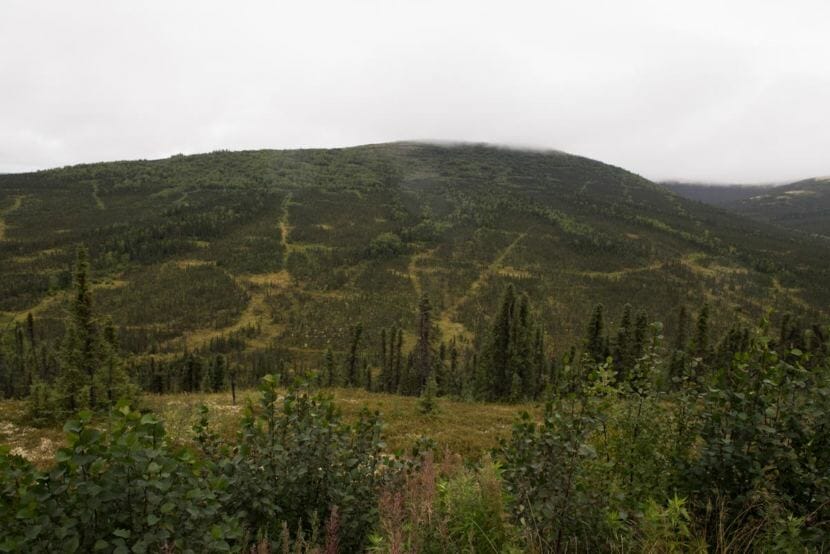
The proposed Donlin mine could be one of the biggest in the world — if completed.
The proposed Donlin mine could be one of the biggest in the world — if completed. (Katie Basile/KYUK)

The long-planned Donlin Gold mine in Southwest Alaska is the latest Alaska project to gain the support of a federal agency seeking to streamline permitting.

The Federal Permitting Improvement Steering Council announced in late October that it had added the massive proposed open-pit mine to a list of projects covered by an obscure Obama-era law meant to speed development, the Fixing America’s Surface Transportation Act. It’s part of a larger push by the Trump administration to expand resource development in Alaska and around the country.

In an interview, Donlin Gold’s environmental and permitting manager, Enric Fernandez, said the designation will likely not accelerate the mine’s timeline. But the so-called FAST-41 designation gives the company more confidence that it’ll be able to move toward a final investment decision in 2027, he said.

“What the program is going to provide is more certainty on the permitting schedule, you know, and also, you know, accountability for the agencies and transparency on the process,” Fernandez said.

The designation does not allow the mine to skip any steps in the lengthy process to make the mine a reality, he said. Work will begin soon on an updated environmental analysis ordered by a federal court to evaluate the possible impacts of a large spill of mine waste, or tailings, he said.

The project has been in the works for years — the company submitted its first federal permit back in 2012, Fernandez said. The head of the Federal Permitting Council, Emily Domenech, said in an interview that the designation was in line with the Trump administration’s resource development and national security goals.

“Up until this administration, the average time to complete a mine to get through the full federal permitting process was just shy of 30 years, which is just completely unacceptable and makes it impossible for us to really effectively compete with China and other adversaries looking to develop critical minerals around the world,” she said.

The project is controversial. Mine tailings would be stored approximately 10 miles from the Kuskokwim River near the village of Crooked Creek, upstream from communities that depend on the river’s salmon for their food supply. More than a dozen tribal governments and a regional tribal consortium, the Association of Village Council Presidents, have opposed the mine, and some have challenged it in court citing the potential for contamination.

“This insensitive federal action is particularly inappropriate while our region’s Tribes are waiting on the mine’s federal permitting agencies to address flaws identified by a federal court and, more importantly, responding to the humanitarian crisis following the hit our region took from Typhoon Halong,” the Mother Kuskokwim Tribal Coalition said in a statement. “A rushed permitting process threatens to override critical environmental protections and silence Yukon-Kuskokwim communities who depend on healthy rivers for survival.”

Some other tribal groups have backed it — notably, the Calista Corp. which owns the resources the mine would target. The company says it would generate royalties for the Native corporation and its shareholders across the region and Alaska Native corporation shareholders across the state, and improve the region’s economy.

Environmental groups have also opposed the mine. Lindsey Bloom with the group SalmonState said in an interview the fast-track designation was inappropriate for a gold mine.

“Gold is not a critical mineral,” she said. “There’s plenty of it already, and … whether or not we develop Donlin will have no effect on our national security.”

Bloom said she saw the designation as an effort to make the project more attractive to investors.

Haines and Skagway collect donations for people displaced by Typhoon Halong

The tops of several canning jars, labeled with stickers showing a formline illustration of a fish and the words "Saak Eix̲í"
The Chilkoot Indian Association will ship donations to Anchorage, including these jars of saak eix̲í, or hooligan oil. (Avery Ellfeldt/KHNS)

Haines and Skagway have joined communities across Alaska that are doing what they can to support the more than one thousand people displaced by ex-Typhoon Halong last month.

Skagway’s donation drive is focused on clothing and gear, as opposed to food. Residents have until the end of the day on Wednesday to drop items from a long list at the Dahl Memorial Clinic, the local health care facility. Donations will be handled by nonprofits in Anchorage.

“The items that they’re looking for are clothes of any sort, preferably new, sleeping bags and pillows and hygiene items like toothbrushes and things of that nature,” said Albert Wall, the clinic’s executive director.

Wall emphasized that people should bring items that are either new or gently used – and clean. Other acceptable donations include air mattresses, duffle bags, cell phone chargers and crafting supplies.

“We’ve had a pretty good response so far,” Wall said.

In Haines, meanwhile, the Chilkoot Indian Association initially asked the community to drop off traditional, harvested foods. But council President James Hart says they will accept any food donations, as long as they’re shelf stable and not expired.

“The preference would be something that you harvested,” he said. “But we shouldn’t be pushing anything away.”

On Monday, at the tribe’s downtown office, there were several boxes of canned goods, including sockeye salmon, homemade applesauce, highbush cranberry juice and hooligan oil.

Soon, there will also be three cases of canned seal meat. Hart, along with locals Zack James and Nels Lynch, harvested the seal in late October to contribute to the effort.

Hart said he knows first-hand how important it is to help when communities are struck by disaster, referring to the 2020 atmospheric river event in Haines that triggered widespread destruction and a fatal landslide.

“I know how much we pulled together as a community, and how much outside help we received, so having the opportunity to give back in that way is special,” he said.

“My heart goes out to all those folks and the challenges they’re going to be going through,” Hart added. “They just went through a whole harvest season, and I’d assume all of that has been lost. That’s so hard to hear and think about and even fathom.”

Alaska aims to regulate its own hazardous waste

Dead batteries are common household hazardous waste items that are accepted at Juneau’s hazardous waste facility. (Photo by Rosemarie Alexander/KTOO)

Alaska might soon regulate its own hazardous waste if the U.S. Environmental Protection Agency authorizes the Alaska Department of Environmental Conservation’s new hazardous waste program.

Alaska is one of only two U.S. states without an authorized program, the other being Iowa. That means the EPA regulates the generation, storage and disposal of the state’s hazardous waste. 

Lori Aldrich, the manager of the state’s new hazardous waste program, said the team consists of six DEC employees, including her, who have been training to take on the responsibility for the past three years. If the program gets federal approval, she said the team will take the lead on permitting, inspections and clean-ups instead of the EPA. 

“Honestly, for Alaska, it doesn’t mean that much change, except that you’re going to have somebody at ADEC here to call,” Aldrich said.

The state Legislature adopted new hazardous waste regulations in 2023 that went into effect this summer. For the most part, the state’s rules now mirror the federal rules under the Resource Conservation and Recovery Act.

According to the most recent EPA data, 2,729 tons of hazardous waste were generated in Alaska in 2023. The three largest producers were the Petro Star Valdez Refinery, Eielson Air Force Base — a Superfund site in Fairbanks — and a company that handles hazardous waste and spills. Together, they were responsible for 57% of the hazardous waste generated in Alaska that year.

Aldrich said Alaska’s generation rate is quite low compared to most other states, and one reason is that petroleum, on its own, is not categorized as hazardous waste. 

She said businesses commonly toss things like cleaning solvents, paint and oil contaminated with other chemicals, which are hazardous wastes. Some things are hazardous due to their toxicity, while others are hazardous because of how they react. 

For instance, “cylinder gas is a hazardous waste if you’re throwing it away, because it could blow up,” Aldrich said.

She said that if the program gets approved, her team will start with a lot of outreach to educate Alaskans about what counts as hazardous waste. 

“Getting people to manage it properly and to make sure that it’s not impacting health or environment here in Alaska is what’s the most important part of our job,” she said.

Aldrich said that almost all of the hazardous waste in Alaska is shipped to disposal facilities in the Lower 48, and that her team would only be in charge of the waste when it’s within state boundaries. 

The public comment period on the state’s application to the EPA is open until December 8.

University of Alaska unions ask Board of Regents not to sign federal higher education compact

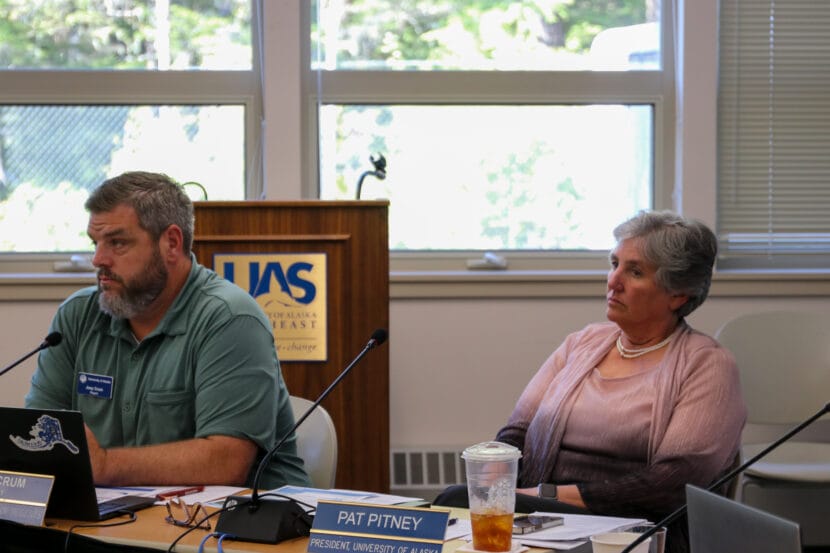
University of Alaska Regent Joey Krum and UA President Pat Pitney listen during a meeting at the University of Alaska Southeast in Juneau on Sept. 4, 2025. (Photo by Jamie Diep/KTOO)

Listen here:

A controversial higher education compact from the Trump administration has sparked a petition from several University of Alaska unions, who say they’re worried about political overreach stifling academic freedom. 

Several University of Alaska staff and community members testified against the Compact for Academic Excellence in Higher Education on Monday, ahead of the UA Board of Regents meeting later this week. A petition from unions representing faculty, graduate workers and university staff opposing the compact also received 659 signatures.

Jill Dumesnil is a mathematics professor for University of Alaska Southeast and the president of the faculty union United Academics AAUP/AFT. She said in an interview that the compact ties federal funding to a political agenda.

“It restricts the freedom to teach, research and learn,” she said. “It undermines institutional autonomy and self governance, and it ties benefits, research benefits, to factors other than scientific merit.”

The compact lays out requirements for universities to receive federal funding. Part of the compact instructs universities “to seek such a broad spectrum of viewpoints not just in the university as a whole, but within every field, department, school, and teaching unit.” It also includes a 5-year tuition freeze and limits how many international students a university can admit.

The U.S Department of Education initially sent the compact to nine universities, and most of them rejected it. In a Truth Social post last month, Trump said any higher education institution in the country could sign on to it.

Even though the UA Board of Regents has not made any move to accept the compact so far, Dumesnil said they want to make their voices heard on the issue. In February, the board suddenly approved a motion to scrub mentions of diversity, equity and inclusion in a process that didn’t give the public an opportunity to comment

“We didn’t want that to happen again. So that’s why we, we went ahead and told them what we, what we thought,” she said. “And you know, that’s all we can do.”

Kate Quick works for United Academics at the university, but testified on Monday as an individual. She says the February motion had a “chilling effect” on people in the university and community.

“When the compact came out, people started to say, ‘Oh, just wait. The board will be the first to sign,’” Quick said. “And so that’s why this petition went around, and that’s why people are calling tonight to ask you not to sign.”

But Jonathon Taylor, the director of public affairs for the university, says the motion from February is different from the compact because it was based on a direct communication from the federal Department of Education.

“If there’s a question as to whether or not the university needs to take action on particular direction or guidance changes or policy changes that have been made, we need to see those official communications to the university, because that’s what the standard practice is,” Taylor said.

Taylor said the agenda for this week’s meeting doesn’t include discussion or action items on the compact. The board is scheduled to meet on Thursday and Friday in Anchorage.

Telephone Hill tenants file lawsuit as city plans next steps for redevelopment project

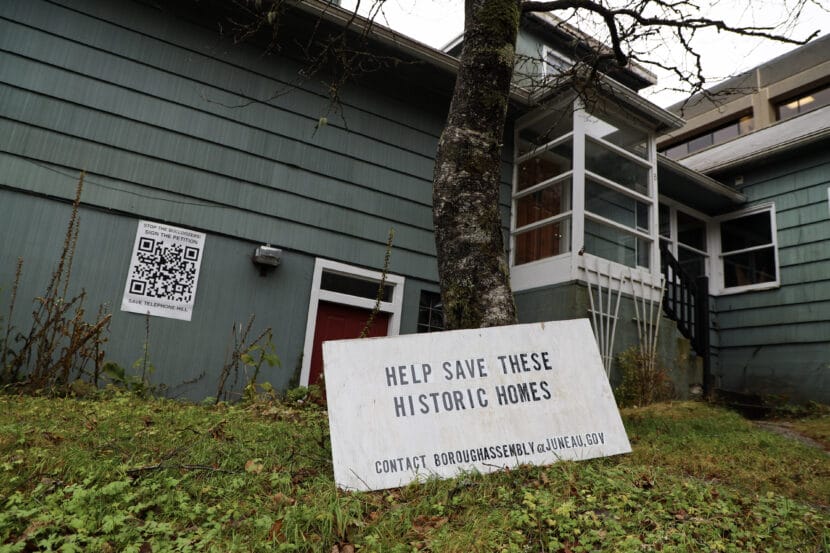
A sign leans against a tree in the Telephone Hill neighborhood on Tuesday, Nov. 4, 2025. (Photo by Clarise Larson/KTOO)

Tenants living in Juneau’s historic Telephone Hill neighborhood had until last weekend to move out.

But some didn’t, and three of them are now suing the city to reverse the evictions. At the same time, city officials are discussing the next steps for the downtown neighborhood’s redevelopment into new, denser housing.

The city’s Nov. 1 eviction date for Telephone Hill tenants has come and gone, and now, the city is laying out the plan for what lies ahead for the neighborhood.

“It is really the only piece of property that is large enough to be able to support maximum density housing and really move the needle on housing in Juneau,” City Manager Katie Koester said at a Juneau Assembly committee meeting Monday night.

She and Assembly members discussed what’s next for the controversial redevelopment project.

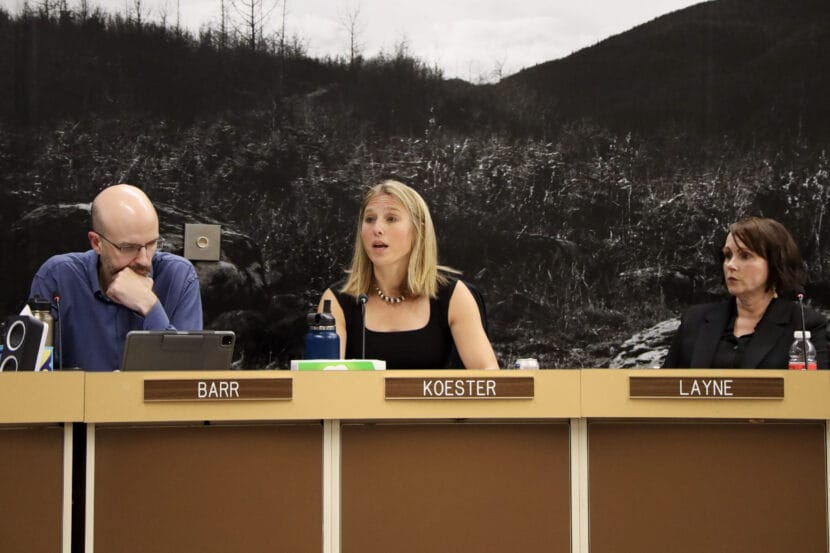
City Manager Katie Koester speaks during a Juneau Assembly committee of the whole meeting on Monday, Nov. 4, 2025. (Photo by Clarise Larson/KTOO)

The discussion came just days after three tenants living on Telephone Hill filed a joint civil lawsuit against the city on Halloween, seeking to reverse the evictions. City leaders did not mention the lawsuit at the meeting.

The plaintiffs claim the city improperly evicted people on the hill, illegally phased the redevelopment and that the project fails to comply with federal and state historic preservation acts.

Joe Karson is one of the plaintiffs. He’s 80 years old and, as of Tuesday, hadn’t moved out of his apartment on the hill.

“They came and told me today that I have to be out by eight o’clock tomorrow morning, and I won’t be,” Karson said.

He says he plans to fight the evictions and demolition as long as possible. He pointed out that the city doesn’t have a developer lined up yet.

“The idea is that at some point, someone will build something — that’s their idea of a project? What on earth is that?” he said.

City Attorney Emily Wright says the city’s law department is reviewing the lawsuit and plans to file a response shortly. She says the city believes it has no merit.

All of the residents of Telephone Hill were renters and had been since the state took ownership of the neighborhood in the 1980s. The state transferred ownership to the city in 2023. Last year, the Assembly voted to redevelop the neighborhood to build denser housing on prime downtown real estate to ease Juneau’s housing crunch.

The city wants to find a developer willing to build four mid-rise apartments, which could create an estimated 155 new housing units. But, right now, there’s no developer signed onto the project.

“This is a unique gem that a community doesn’t get an opportunity very often to have property so centrally located with utilities with infrastructure in their community,” Koester said.

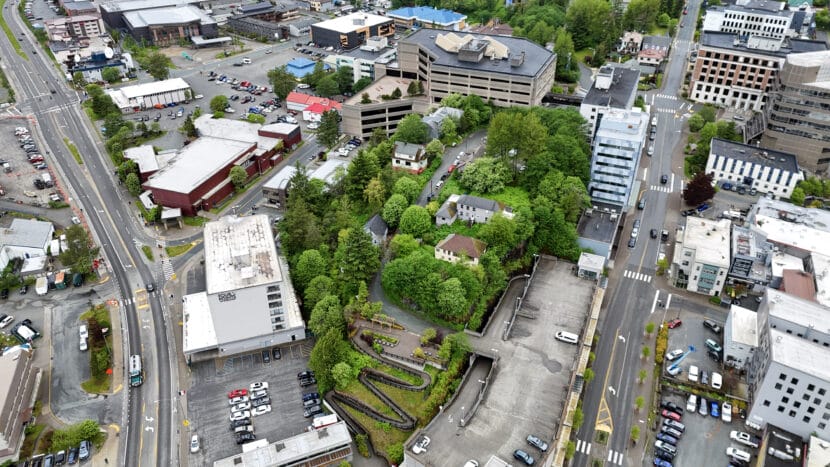
Trees outline the Telephone Hill neighborhood in downtown Juneau on Monday, June 9, 2025. (Photo by Clarise Larson/KTOO)

According to a 2024 assessment, Juneau is in immediate need of at least 400 new housing units.

The project has come with a lot of pushback from local advocates. That’s in part due to the history of the hill — it was home to Alaska’s first commercial telephone service, and many of its houses were a part of the original Juneau townsite in the late 1800s. All seven structures are slated for demolition this winter.

This past spring, the Assembly approved spending $5.5 million to tear them down and prepare the land for new buildings. The Assembly chose to front that cost in order to attract developers and tack on some affordable housing requirements.

Koester said the city plans to select a developer early next year so that construction can begin in 2027.

At Monday’s meeting, she spoke to an audience filled with advocates against the plan. She said that the decision to redevelop the neighborhood is not an easy one, but added it has the potential to dramatically move the needle on the city’s lack of housing availability and affordability.

“Telephone Hill really does represent some of the most developable property, well-located in our community, and it’s been really hard to struggle with those decisions,” Koester said.

According to Wright, as of Tuesday tenants are still occupying three residences on Telephone Hill. The city plans to take legal action against those tenants on Wednesday.

Site notifications
Update notification options
Subscribe to notifications