Sen. Tim Kaine, D-Va., speaks during a press conference following a vote on Capitol Hill on Sunday. The Senate convened for a rare Sunday session in an attempt to end the government shutdown. (Anna Rose Layden/Getty Images)
A bipartisan group of Senate Democrats and Republicans reached a deal to reopen the government after the longest shutdown in U.S. history, voting on the first procedural step on the measure.
The agreement would fund the government through Jan. 30 and include full-year funding for a trio of appropriations bills, including full funding for the Supplemental Nutrition Assistance Program, or SNAP, through Sept. 30, 2026, or the end of the fiscal year.
The vote late on Sunday was 60 to 40, with seven Democrats and one independent joining with most Republicans to advance the measure.
It marked the first, but crucial, step towards passing the measure in the Senate. Once the bill cleared the 60 votes needed to overcome a filibuster, any remaining Senate votes need just a simple majority. However, the legislation still needs to pass the House before the shutdown would end, enabling air traffic controllers and other federal workers to get paid and federal food benefits to resume, among other things.
Senate Democrats had earlier voted against more than a dozen short-term spending measures in their fight to preserve health care subsidies. But as the pain of the shutdown continued to bite, some agreed to more modest changes in the latest framework.
The continuing resolution to fund the government until the end of January would also include language to reverse any reductions in force of federal employees that happened during the shutdown, as well as protections against further such layoffs through the end of the fiscal year, and backpay for all federal employees during the shutdown.
“I have long said that to earn my vote, we need to be on a path toward fixing Republicans’ health care mess and to protect the federal workforce,” Sen. Tim Kaine (D-Va.) said in a statement. “This deal guarantees a vote to extend Affordable Care Act premium tax credits, which Republicans weren’t willing to do.”
The agreement to reopen the government is also expected to include a Senate vote on health care by the second week of December, on a bill of Democrats’ choosing. That informal deal is not part of the legislative text.
Democrats are deeply divided about the compromise measure, which was opposed by Senate Minority Leader Chuck Schumer.
“I think it’s a terrible mistake,” Sen. Elizabeth Warren (D-Mass.) said of the deal. “The American people want us to stand and fight for healthcare.”
Democratic divisions over legislation
Several top Democrats in the House also vowed to vote against the bill.
House Minority Leader Hakeem Jeffries, D-N.Y., panned the agreement in a statement before the Senate vote.
“We will not support spending legislation advanced by Senate Republicans that fails to extend the Affordable Care Act tax credits,” Jeffries said in a statement. “We will fight the GOP bill in the House of Representatives, where Mike Johnson will be compelled to end the seven week Republican taxpayer-funded vacation.”
And Democrat Rep. Greg Casar of Texas called the deal a “betrayal” and a “capitulation” because it doesn’t reduce health care costs.
The House has not held a vote since Sept. 19, and previously passed a government funding measure without Democratic support.
The Senate deal on government funding comes after Democrats cruised to a series of electoral victories in the last week, giving some in the party newfound political confidence to continue to fight for health care extensions.
Many Democrats believed that keeping the government shut down gave them their only legislative leverage, with Republicans still in control of Congress and the White House.
Moderate Democrats defended their votes, with some telling reporters that it’s the best deal they could do.
Kaine, one of the Democrats who voted for the measure on Sunday, defended his support, saying Democrats would be able to put important health care legislation up for a vote.
“Lawmakers know their constituents expect them to vote for it, and if they don’t, they could very well be replaced at the ballot box by someone who will,” he said in his statement.
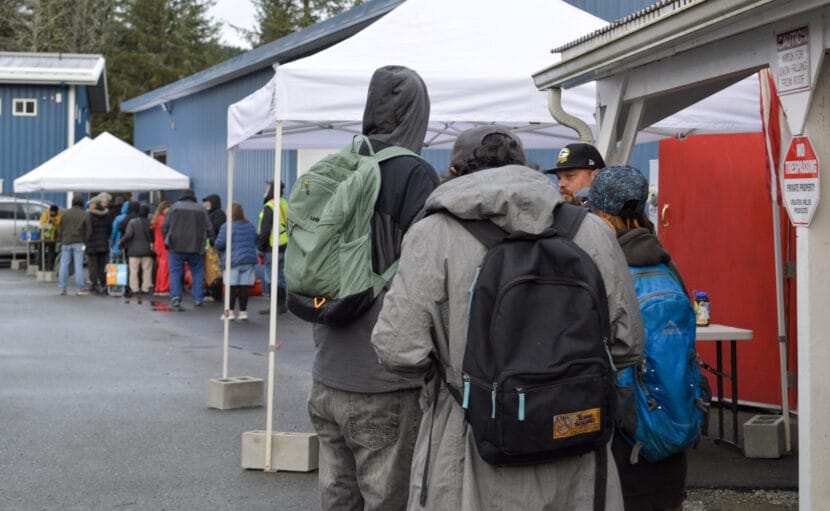
People line up at the Southeast Alaska Food Bank on Nov. 6, 2025. (Photo by Yvonne Krumrey/KTOO)
Outside the Southeast Alaska Food Bank on Thursday afternoon, dozens of people lined up to receive food.
Inside, volunteers took the slips of paper saying how many adults, kids and pets were associated with each household. They filled bags with yogurt, bread and asparagus and sent them down to the other end of the food bank, where people picked them up.
Shannon James was in line to get food for her family.
“I stress a lot about my grandkids,” she said. “I’m not so worried about myself. I can eat Top Ramen, but the kids need nutrients and vitamins.”
After a delay caused by the federal government shutdown, some Alaskans enrolled in the Supplemental Nutrition Assistance Program — also called SNAP or food stamps — have begun to receive half their monthly benefits this week.
Despite that, the delay has driven Juneau residents to worry that their next meal isn’t guaranteed, and local organizations are stepping up their efforts to fill the gap.
James received half of her SNAP benefits on Thursday, but it was a stressful week for her family, and she said she’s not sure when the rest will come.
“The stuff I get from SNAP, then I go to the store and get what I didn’t get from the food bank,” James said. “Because the food bank, you kind of get the regular things, and not necessarily the basics like milk and eggs and stuff.”
This week, those basic groceries were harder to get without food stamps.
In an email, the Alaska Department of Health’s Shirley Sakaye said she expects the rest of the payments to go out next week. But she said the state hasn’t received guidance from the federal government for December if the shutdown continues.
In the meantime, the Southeast Alaska Food Bank has prepared for more need. Dan Parks is its executive director.
“Demand is up,” he said. “We’ve been busy. This is maybe the busiest week I’ve had since I’ve been here.”
He said double the usual number of volunteers were there for Thursday’s distribution. And people are finding other ways to help.
“The thing that we have seen increase the most in the last week is donations,” Parks said. “Which is amazing, and that’s really heartening to see such a huge outpouring of support.”
It’s needed. Organizers say the food pantry at Resurrection Lutheran Church downtown ran out of food a few hours into opening on Tuesday.
Speaking on KTOO’s Juneau Afternoon on Thursday, Karen Lawfer said the church is stepping up its weekly efforts by adding a second night to give out hot food to anyone who needs it.
“If food insecurity is an issue, just come on in and meet your neighbors and meet the community,” she said.
There are food pantry hours throughout the week across Juneau. Resurrection Lutheran Church is hosting a telethon to raise money for food security Saturday from 6 to 10 p.m.
Fifty votes were needed in the Senate to take up the resolution, but only 49 senators — all the Senate’s Democrats, plus Republican Sens. Lisa Murkowski of Alaska and Rand Paul of Kentucky — voted in favor of the procedural action needed to force a vote.
Sen. Dan Sullivan joined a majority of Senate Republicans and voted against taking up the resolution, which was sponsored by Sen. Tim Kaine, D-Virginia.
Thursday’s vote, and the split decision by Alaska’s senators, was similar to a vote that took place last month, when the Senate declined to consider a resolution intended to curtail America’s killing of suspected drug dealers without trial.
Since September, the United States has killed 67 people aboard boats in both the Caribbean Sea and the Pacific Ocean, according to tallies kept by the New York Times and CNN. There have been 16 known military strikes since Sept. 2, each targeting a boat that the U.S. government claims was carrying drugs.
It is illegal for the U.S. military to intentionally kill civilians who are not actively taking part in hostilities against the United States.
In October, Murkowski joined Paul and all but one of the Senate’s Democrats in voting to take up a resolution intended to curtail the strikes. Sullivan joined the rest of the Senate’s Republicans, and Pennsylvania Sen. John Fetterman, D-Pennsylvania, in voting to support the strikes.
The U.S. military has positioned large numbers of soldiers and aircraft near Venezuela’s coastline, possibly in preparation for attack.
In a statement after Thursday’s vote, Murkowski said she has “been briefed multiple times and reviewed classified documents that provide insight into the administration’s factual justification” for attacking Venezuela.
“Even with this additional context, I do not believe their case has met the standard of clarity and rigor that Congress needs to fully evaluate the legality and scope of these operations,” she said.
Devyn Shea, a spokesperson for Dan Sullivan, said by email after the vote, “In both Democrat and Republican administrations, Senator Sullivan has consistently voted against limiting the authority of the President as Commander-in-Chief to protect the national security interests of the country.”
Sullivan “believes that under Article II of the Constitution, President Trump as Commander-in-Chief has the authority to defend our homeland from Venezuelan narcoterrorists, just as President George H.W. Bush did when he ordered the full military invasion of Panama in 1989 to remove the drug-trafficking dictator Manuel Noriega,” Shea said.
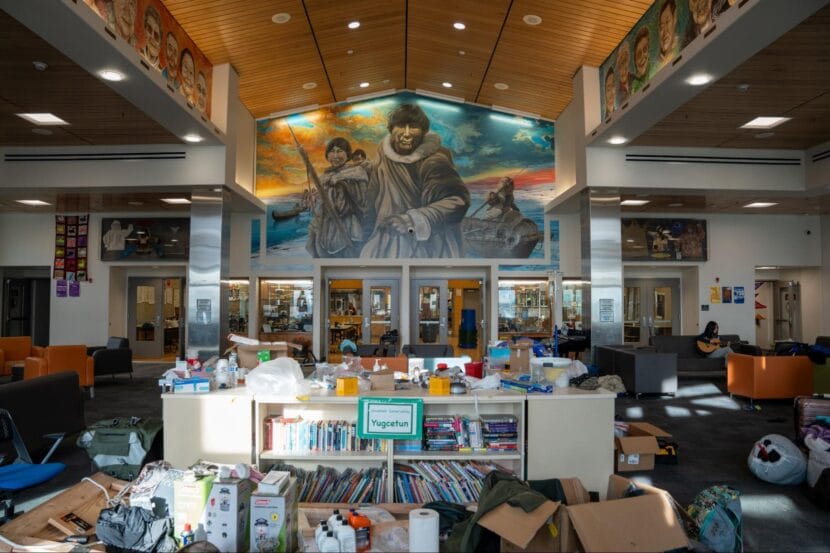
Emergency supplies fill the lobby of the Chief Paul Memorial School in Kipnuk, Alaska. Nearly 700 people sheltered there for two days after ex-typhoon Halong. (Eric Stone/Alaska Public Media)
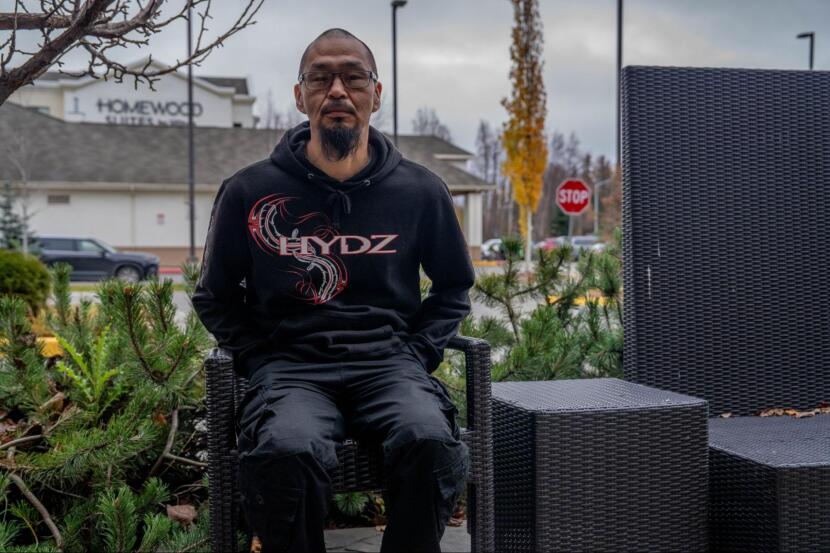
On a Sunday morning last month, James Taq’ac Amik was huddled on a small bridge with his girlfriend. At 4 a.m., they had scrambled into an 18-foot aluminum motor boat, fleeing floodwaters from a massive storm surge that inundated Kipnuk, a village of 700 in the heart of western Alaska’s sprawling Kuskokwim River delta.
“I couldn’t make it up. I tried, but the wind was too strong to try and go by boat, so we ended up staying on the bridge for five hours,” Amik said. Things only grew more dramatic. “The houses started drifting away around 5:30 a.m.,” Amik said. “There was still lights in them; there was people in them.”
When they set out, the couple were heading to Kipnuk’s public school, the largest building in the Alaska Native Yup’ik village. At least that building, they hoped at the time, would be secure.
The storm that hit Alaska’s west coast in mid-October was the remnants of Typhoon Halong, which picked up momentum in a warmer-than-normal Pacific Ocean. After the wind died down and the floodwaters receded, the village lay in ruins. But while the school still stood relatively unscathed on its steel pilings more than 20 feet above the muck and wreckage, there were other problems inside. District staff had been working on much-needed upgrades to its main generator. Then the school’s backup generator sputtered. Everyone in the community, including Amik and his girlfriend, stayed for two days until local leaders decided the storm had done too much damage and organized a mass evacuation.
James Taq’ac Amik, his girlfriend, and his daughter fled to the school in Kipnuk before evacuating to an Anchorage hotel more than 480 miles away two days later. (Gabby Hiestand Salgado/KYUK)
When disaster strikes, public school buildings are integral as safe havens in hundreds of predominantly Indigenous villages scattered across Alaska’s vast landscape. In many remote communities, schools are some of the only buildings with flush toilets and their own generators. Schools are often the only buildings that stand on pilings — important amid the rising waters of climate change — and also the only buildings large enough to house dozens, if not hundreds, of people for days at a time.
“It is a known fact that if you need to evacuate, you evacuate to the elementary school,” said Alaska state Sen. Löki Tobin, a Democrat and chair of the Senate Education Committee, who grew up in Nome but now represents Anchorage.
“Those are lifeboats,” said Alaska’s emergency management director, Bryan Fisher. “They’re the last place of refuge.”
Gov. Mike Dunleavy, a Republican and former educator, has declared more than a dozen disasters since August 2024, and in at least half of those cases, public schools were used as emergency shelters. The state reported damage in 52 communities in October, and the impacts forced hundreds of residents to sleep in gymnasiums and on classroom floors in rural public schools. Since 1998, Alaska has seen more than 140 state-declared disasters, and dozens of those required schools to function as shelters.
But Alaska’s rural schools have been neglected for decades. Earlier this year, ProPublica, KYUK Public Media, and NPR documented a health and safety crisis inside many rural school buildings across Alaska. In some cases, the buildings that function as safe havens in times of emergency are becoming emergencies themselves.
The state is required by law to fund construction and maintenance projects in rural school districts because they serve unincorporated communities where there is no tax revenue to help fund education. In the last 28 years, Alaska’s rural school districts have made close to 1,800 requests to the state for money to maintain and repair deteriorating schools, but only 14% of those requests have been approved. And as the backlog of major maintenance projects continues to grow, the state budget has been shrinking.
“Just the maintenance that goes in every day to keep up a building, that’s really where the flaw is,” said Alaska Education Commissioner Deena Bishop. For years, her department has struggled to meet the growing need for dollars to maintain school facilities, including more than 60 owned by the state. “The crux of the situation,” she said during an interview in Juneau last year, is that “we get to an emergency because we didn’t take care of it.”
The main generator that provides power to the school in Kipnuk was not working before hundreds of residents fled there during ex-typhoon Halong. Lower Kuskokwim School District Superintendent Andrew “Hannibal” Anderson said the generator “was working well enough to provide what it needed for the school.” But it was quickly overwhelmed by the sudden increase in demand for power once the school became Kipnuk’s primary emergency shelter. A smaller backup generator also couldn’t meet that demand to charge cellphones and keep the building heated after the community’s residents piled in.
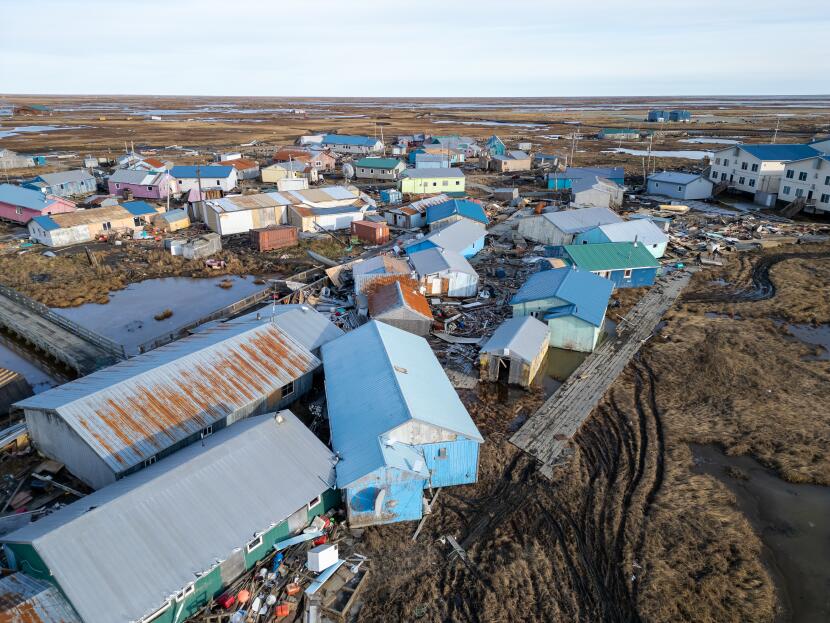
Houses and other buildings sit jumbled and surrounded by debris in Kipnuk on Sunday, Oct. 19, a week after the remnants of Typhoon Halong brought record flooding and high winds. (Eric Stone/Alaska Public Media)
The school district waited 14 years for the state to approve funding to do a major renovation in 2015, but it has not asked for funding since then. Every year, the applications school districts submit for construction and maintenance funds are ranked. Data analysis and interviews with superintendents across the state indicate that submitting an application that ranks high enough to win funding is cumbersome, and they feel pressure to include professional inspections and surveys, which can be expensive. Anderson explained that although the generator required maintenance, he believed Kipnuk’s needs wouldn’t be considered urgent enough to receive funding. “Kipnuk is a relatively new school,” he said.
In Kotlik, a village of just over 650 residents almost 220 miles north of Kipnuk, 70 people spent two nights at the school. “We have a church and a community building, but those are seldom used in evacuations,” explained Principal Cassius Brown. “That’s because the school is situated higher and it’s not as close to the river.”
Since 2018, the Lower Yukon School District has made annual requests ranging from $2 million to more than $5 million to the state’s education department to make extensive repairs to the school in Kotlik and another in a nearby village. That work remains unfunded.
In Chevak, where about 950 Alaska Native Cup’ik people live less than a dozen miles from the Bering Sea coast, school Principal Lillian Olson said 65 people spent a few nights on the gymnasium floor. “Our community is kind of dependent on the school for shelter,” Olson said. “One time, two years ago, we had an electric outage in one part of town that lasted for like a week, and because the houses didn’t have electricity and no heat, we housed them.”
Olson said a test of the building’s fire sprinklers failed in September. In a phone call last spring, Kashunamiut School District Superintendent Jeanne Campbell described a host of problems related to the Chevak school’s boiler and broken water pipes that impacted the fire sprinkler system. “And that’s just inside the building,” Campbell said.
In 2024, the Kashunamiut School District made its first request to the state’s education department since 2001, asking for $32 million to update and renovate the school. The proposal was one among 114 for fiscal year 2025. The state allocated enough money for only 17 of those projects. Work at the Chevak school was not one of them.
Just over a dozen miles west, in Hooper Bay, Mayor Charlene Nukusuk said between 50 and 60 people sheltered for two nights in that community’s public school. The village’s location makes it extremely vulnerable. Over the last few decades, fall coastal storms have devoured several rows of sand dunes that used to protect the community of 1,375 people. Now, the black and frigid Bering Sea laps at the beach only a few hundred feet from the far corner of the local airport runway. Nukusuk said that the school is one of the safest buildings.
Hooper Bay’s school was rebuilt after it was destroyed by fire in 2006. Since then, the district has made 29 funding requests totaling more than $8.4 million in needed repairs to the state for a range of projects on the school including roofing, emergency lighting, and siding. In 2024, the district received money for one of those — just under $2.3 million for “exterior repairs,” according to state data. The superintendent did not respond to questions about specific needs in Hooper Bay.
Alaska’s emergency management division does not have formal agreements with the state’s education department designating schools as emergency shelters, and neither agency has funding to help maintain schools specifically as emergency shelters. However, a division spokesperson said there are some state grants that schools could access for emergency preparedness.
“Schools are built for educational purposes — other uses are incidental or secondary to design,” education department spokesperson Bryan Zadalis wrote in an email. He said no one from the education department visits schools “to ascertain whether a facility is in condition to serve as an emergency shelter.”
“I don’t know if people necessarily correlated together that if you’re going to use schools as multipurpose facilities, that you also have to maintain them for those purposes,” said Tobin, the state senator. “They’re not just institutions of learning. They’re also institutions of after-school activities, of community gatherings, and of evacuation facilities and disaster preparedness support infrastructure,” she said.
In February 2024, Tobin, who also sits on the state senate’s Military and Veterans Affairs finance subcommittee, put the question of funding schools for emergencies to Craig Christenson, deputy commissioner of the Alaska Department of Military and Veterans Affairs, during a budget meeting.
Alaska’s emergency management division falls under Christenson’s department. “From my understanding,” Tobin said to him, “if the school wasn’t available in some of these very small, rural, remote areas, we would be paying to evacuate people, versus using an asset that we have already put resources into but have already failed to maintain. Is that accurate?”
“I can’t comment on failing to maintain them,” Christenson responded. “Our department does not maintain schools.” (The deputy commissioner declined to comment further on last year’s meeting.)
“But you do utilize them?” Tobin asked.
“We do,” Christenson said.
This article was produced for ProPublica’s Local Reporting Network.
Emily Schwing reported this story while participating in the University of Southern California Annenberg Center for Health Journalism’s National Fellowship. She also received support from the Center’s Fund for Reporting on Child Well-being and its Dennis A. Hunt Fund for Health Journalism.
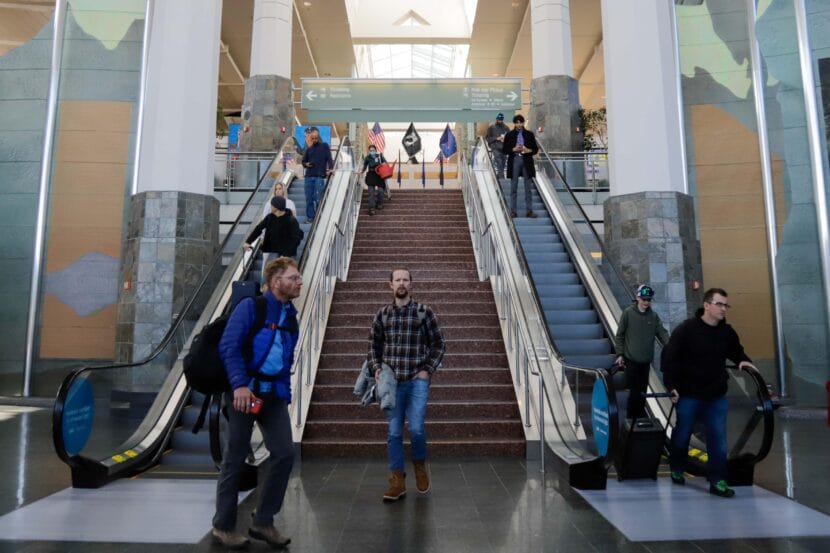
Passengers arrive at the Ted Stevens Anchorage International Airport on April 20, 2022. (Jeff Chen/Alaska Public Media)
Ted Stevens Anchorage International Airport is among 40 airports across the country forced to slash air traffic by 10% starting Friday as the government shutdown becomes the longest in U.S. history.
U.S. Transportation Secretary Sean Duffy said Wednesday that traffic would be cut from the country’s busiest airports to maintain travel safety. Some air traffic controllers, who haven’t received a full paycheck in over a month, are calling out of work, he said, exacerbating staffing shortages and causing flight delays.
Airport officials confirmed by email Thursday that Anchorage International is included among the 40 airports where flights will be reduced. The Anchorage airport is one of the busiest cargo airports in the world. It’s unclear if passenger or cargo flights will be impacted, or both. Airport officials could not immediately be reached Thursday for comment.
In a statement, the state entity that manages the airport, the Alaska International Airport System, said its working to minimize impacts.
“ANC remains fully operational, and all safety and security functions continue without interruption. We are working closely with our federal partners and airline representatives to minimize any impacts to passengers and cargo operations,” said Teri Lindseth, development manager for the Alaska International Airport System.
Travel expert Scott McMurren, who writes the Alaska Travelgram newsletter, said he hasn’t seen this much uncertainty for airline passengers since the disruptions that followed the 9/11 terrorist attacks.
“When the Secretary of Transportation says he predicts ‘mass chaos,’ well, I have to plan for mass chaos,” he said. “That means a lot of flights may get through unscathed, but just because the flight gets through doesn’t mean the travelers themselves aren’t affected.”
Seattle-Tacoma International Airport, where many flights to and from the state connect through, is also on the list of airports forced to cut flights.
Alaska Airlines said that it canceled a limited number of flights in response to the Federal Aviation Administration directive, but international flights are not expected to be impacted. The airline said guests whose flights are canceled will be rebooked or get a refund.
Delta said it expects to operate the majority of flights as scheduled. The company is providing extra flexibility for impacted travelers to cancel their flights without penalty. In a statement, United said long-haul international and hub-to-hub flights wouldn’t be impacted by the reduction, but that reductions would impact regional and domestic flights.
Passengers with questions about specific flights should contact their airline.
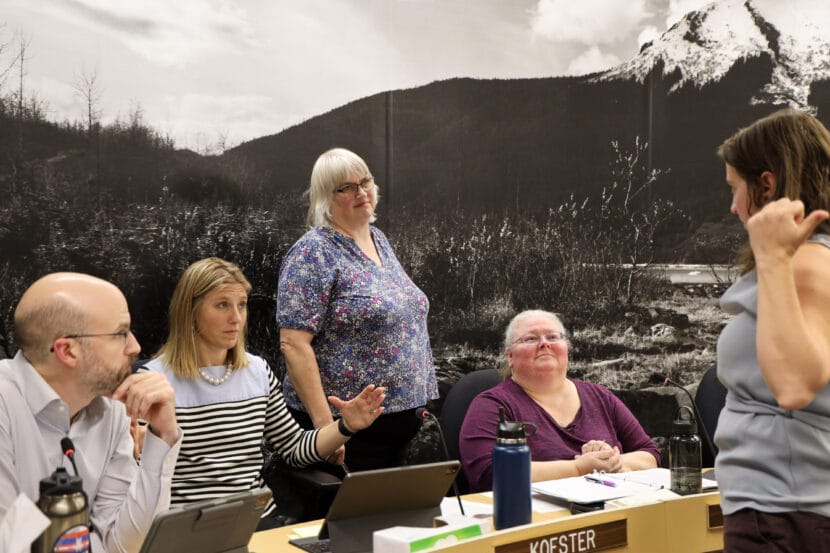
City staff and Juneau Assembly members discuss during an Assembly finance committee meeting on Wednesday, Nov. 5, 2025. (Photo by Clarise Larson/KTOO)
The municipal tax cuts approved by Juneau voters in this fall’s election are expected to create a $6.4 million hole in the city’s budget this fiscal year. But that’s only scraping the surface.
This year, the funding gap is smaller because the city is already partially through this fiscal year. The new food and utility tax exemptions take effect starting Nov. 20 and the property tax rate cap will begin next year.
During a finance committee meeting on Wednesday night, Assembly members began to discuss how to move forward. Assembly member Alicia Hughes-Skandijs said the decisions ahead won’t be easy.
“I think that when people understand the magnitude of the decisions made in the last election, there is going to be a little bit of whiplash,” she said.
For the immediate $6.4 million hole this fiscal year, Assembly members agreed on Wednesday to absorb the revenue shortfall using interest earnings from last fiscal year that came in higher than expected. They opted against implementing any broad service reductions — for now.
Angie Flick, the city’s finance director, said it gives the Assembly more time to figure out how to address the recurring shortfall beginning next fiscal year.
“We have the opportunity to take some time to make thoughtful decisions about reductions,” she said.
Flick and city staff floated a few directions the Assembly could take to fill the recurring gap — though no major decisions were made. She offered options like implementing a blanket reduction in funding across all city departments, hiring freezes, cutting services and major line-item expenses, or increasing revenue.
The Assembly also agreed to distribute the remainder of the grant funding that the city withheld from local organizations before the election. The city originally withheld the funds out of concerns about the revenue loss if the ballot propositions passed.
Assembly member and finance committee chair Christine Woll advocated for providing the full funding promised.
“I think it plays into this idea that our community grants are philanthropy, that we’re doing this to be nice,” she said. “We’re doing this because these are needed services in our communities that others can do more efficiently and better than we can.”
City staff and the Assembly plan to evaluate the city’s finances in the coming months and develop a plan to engage the public as it moves forward with any potential reductions to services.
Disclosure: KTOO is one of the organizations that will receive previously withheld grant funding from the City and Borough of Juneau.
Close
Update notification options
Subscribe to notifications
Subscribe
Get notifications about news related to the topics you care about. You can unsubscribe anytime.