Government

Tribes and environmental groups sue to stop road planned for Alaska wildlife refuge

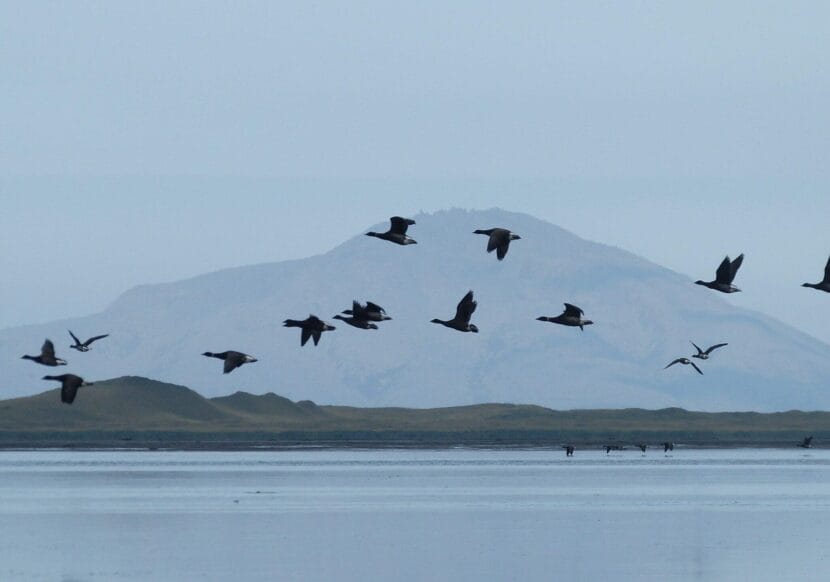
Brant fly over the water on Sept. 28, 2016, at Izembek Lagoon in Izembek National Wildlife Refuge. The refuge supports the entire Pacific population of black brant, a species of goose.
(Kristine Sowl/U.S. Fish and Wildlife Service)

Three tribal governments and several environmental groups sued the Trump administration on Wednesday to try to block a land trade that would allow a road to be built through a national wildlife refuge in southwestern Alaska.

The land swap, approved by the U.S. Department of the Interior last month, would open up a section of the Izembek National Wildlife Refuge.

Supporters argue that the road is needed to connect the community of King Cove, home to about 750 people, with a legacy military airstrip that can accommodate jets. That would give King Cove’s residents access to safer medical evacuations if needed. Opponents say the proposed road — to run 18.9 miles in total, most of that within what is currently refuge land — would damage world-class bird habitat that is in the heart of the refuge.

Wednesday’s challenges came in three lawsuits filed in U.S. District Court in Anchorage. All assert that the land trade and road development pose dire threats to migratory bird populations that use Izembek’s wetlands, including species with Endangered Species Act listings, and to the wider ecosystem. All say the trade and planned road violate the Alaska National Interest Lands Conservation Act and other federal laws.

The three lawsuits have their individual characteristics as well.

One of them, filed by tribal governments in the Yukon-Kuskokwim Delta villages, focuses on threats to traditional subsistence hunters who depend on the birds that use Izembek’s wetlands. The tribal plaintiffs are the Native Village of Paimiut, Native Village of Hooper Bay and Chevak Native Village.

“Izembek’s eelgrass wetlands are a lifeline for emperor geese, black brant and other birds that feed our families and connect us to Indigenous relatives across the Pacific,” Angutekaraq Estelle Thomson, traditional council president of the Native Village of Paimiut, said in a statement. “Trading away this globally important refuge for a commercial corridor devalues our lives and our children’s future. We are joining this lawsuit because defending Izembek is inseparable from defending our subsistence rights, our food security and our ability to remain Yup’ik on our own lands.”

The Center for Biological Diversity, an environmental organization, is also a plaintiff in the case.

A second lawsuit, filed by Friends of Alaska National Wildlife Refuges, Wilderness Watch, the Alaska Wilderness League and the Sierra Club, puts a special focus on the process used to achieve the land swap and what it may mean for all wildlife refuges.

“Trading the ownership of refuge lands that Congress designated for conservation is a terrible precedent for the privatization of public lands. Building a road will have tremendous impacts on fish and wildlife habitat and could also greatly increase both disturbance and sport hunting pressure on vulnerable species,” Marilyn Sigman, president of Friends of Alaska National Wildlife Refuges, said in a statement.

The third complaint, filed by Defenders of Wildlife, puts a focus on the wider environmental impacts.
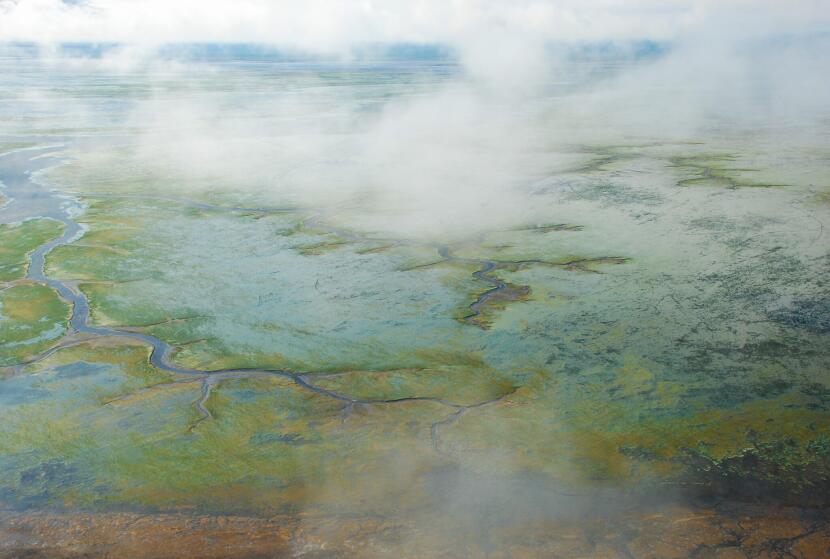
Green eelgrass appears at low tide in the vast wetlands of Izembek Lagoon, at the edge of Izembek Refuge. (Kristine Sowl/USFWS)

The planned road enabled by the land trade would “result in incalculable and irreversible damage” to myriad wildlife species, including marine and land mammals as well as migratory birds, that lawsuit says. The lawsuit alleges that the land deal violates both the National Wildlife Refuge System Improvement Act and the federal Wilderness Act.

“Under the Trump administration, the Interior Secretary entered into an illegal deal done in the darkness of a government shutdown: a sellout of one of our country’s largest and most pristine wildlife refuges and wilderness areas,” Jane Davenport, a senior attorney in Defenders of Wildlife’s Biodiversity Law Center, said in a statement. “Our treasured public conservation lands belong to all Americans. Defenders of Wildlife will stand up in court to hold this administration to account for recklessly and unlawfully trading them away.”

The Izembek Lagoon area, where the road is planned, holds the largest single stand of eelgrass in the world and the largest bed of seagrass along the North American Pacific Coast, according to the U.S. Fish and Wildlife Service. The entire Pacific population of black brant, a type of goose, uses the refuge’s lagoon area, feeding on the eelgrass. The refuge and its eelgrass support several other bird and mammal species; about half the world’s emperor geese use the refuge as a migratory stopover, according to biologists.

A Department of the Interior spokesperson declined to comment Wednesday on the lawsuits.

Last month, however, Interior Secretary Doug Burgum touted the land exchange and planned road as long overdue.

He spoke about the project during an event called “Alaska Day,” a gathering in Washington with Gov. Mike Dunleavy and the state’s three-member congressional delegation. The Izembek land exchange was one of the pro-development Alaska actions announced at the event.

“It just seems preposterous to me that somehow, it’s taken 40 years for us to put people first,” Burgum said at the event. “Because I know one thing as a governor of a state: You can actually do things like build 18 miles of gravel road and still take great care of wildlife.” Burgum was North Dakota’s governor before being appointed as Interior secretary.

The land trade he approved would convey a little less than 500 acres of refuge land, most of it designated wilderness, to the Native-owned King Cove Corp. The corporation would give 1,739 acres of its land to the U.S. Fish and Wildlife Service to be added to the refuge, and the federal government would also pay the corporation for the land.

The idea of a road linking King Cove to the World War II-era military runway at Cold Bay dates back decades. The legal and political battle over the proposal has also been long. Some of the plaintiffs in the new cases were plaintiffs in previous lawsuits over proposed land trades. The dispute was being considered by the 9th Circuit Court of Appeals, but that court in 2023 determined that the case was moot and dismissed it because the Biden administration was not pursuing the plan endorsed by the first Trump administration.
Green eelgrass appears at low tide in the vast wetlands of Izembek Lagoon, at the edge of Izembek Refuge. (Kristine Sowl/USFWS)

New lawsuit seeks to block revived bear-culling program in Western Alaska

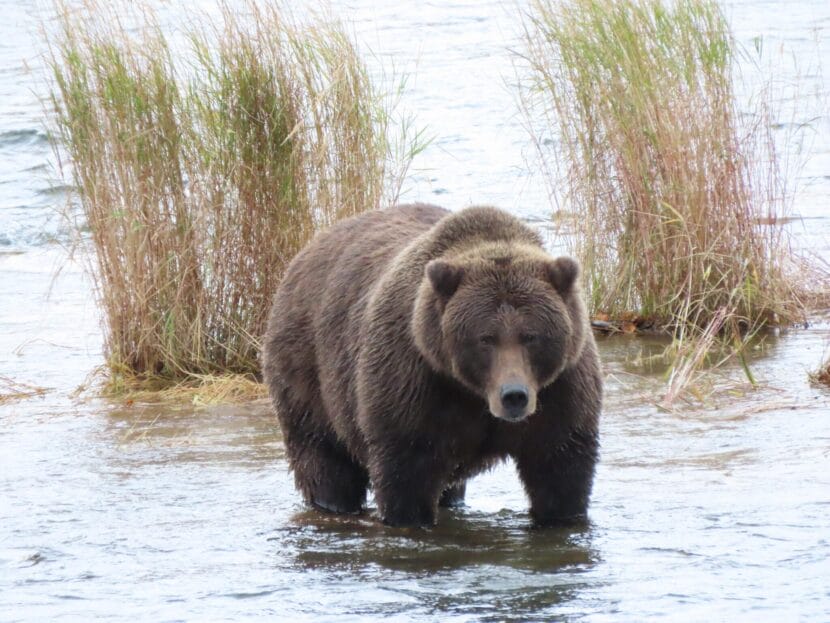
A brown bear stands in in shallow water in front of two bunches of tall grasses.
A brown bear stands in water in Katmai National Park on Sept. 27, 2022. A new lawsuit has targeted a revived predator control program that aims to boost Mulchatna caribou herd numbers by killing bears in a portion of the herd’s range. (T. Carmack/National Park Service)

The state’s latest plan to kill bears in part of Western Alaska to try to boost a flagging caribou population has drawn a new legal challenge.

Environmental groups on Monday filed a lawsuit in state Superior Court that seeks to strike down the Alaska Board of Game’s July approval of a controversial predator control program in the part of the state used by the Mulchatna caribou herd.

The lawsuit, filed by the Alaska Wildlife Alliance and the Center for Biological Diversity, is the latest step in a legal and political battle over state efforts to increase the herd size. It names the board, the Alaska Department of Fish and Game and the department’s commissioner as defendants.

The lawsuit argues that the revived program approved by the Board of Game suffers from many of the same flaws that were in the previous program. That program had been approved by the board in 2022 but was overturned by court rulings earlier in the year that resulted from a previous lawsuit filed by the Alaska Wildlife Alliance.

Two state judges found that the program, under which 186 brown bears, five black bears and 20 wolves have been killed since 2023, violated the elements of the Alaska constitution.

Monday’s lawsuit says the new predator control program is largely the same as the old one and it continues to violate the Alaska constitution’s requirement for sustained yield of natural resources. For Alaska, the principle of sustained yield holds that renewable resources should be managed so that they can exist indefinitely.

There are two ways that the sustained yield requirement is violated, according to the lawsuit.

The board, when it approved the predator control plan presented by the Alaska Department of Fish and Game, “failed to take a hard look at brown and black bear population data” for the targeted area, thus failing to properly consider impacts to those populations, the lawsuit said.

And the plan has no end point, meaning there is no trigger for suspension of predator control if bear populations drop below a minimum threshold deemed necessary for their sustainability, the lawsuit said.

“The Board of Game gave the Alaska Department of Fish and Game the authority to aerially shoot any bears of any age across 40,000 square miles until 2028, with no population data or cap on the number of bears killed,” Nicole Schmitt, executive director with the Alaska Wildlife Alliance.

She noted that the southeast border of the targeted area is only 3 miles from Lake Clark National Preserve, 30 miles from Katmai National Park and 50 miles from McNeil and Brooks Falls, sites that are world-famous for the large numbers of brown bears that gather there to fish for salmon. Meanwhile, the western border reaches two national wildlife refuges, “which means this program threatens bears who move across vast stretches of public lands,” she said.

Cooper Freeman, Alaska director at the Center for Biological Diversity, called the program “a disgraceful misuse of public resources and a betrayal of the trust Alaskans place in their wildlife managers.”

“There’s no excuse for the state of Alaska to be gunning down bears from helicopters,” Freeman said in the statement.

The commissioner of the Alaska Department of Fish and Game defended the program, though he did not specifically address the claims in the new lawsuit.

“ADF&G is committed to all users of the herd in rebuilding this population, which has been identified as important for providing high levels of human consumption under state statute and regulation,” Commissioner Doug Vincent-Lang said in a statement.

Vincent-Lang said “intensive management,” or IM, has shown to be helping the caribou herd. Intensive management is the term Alaska wildlife managers use for predator-control programs.

“There is strong evidence that neither disease nor nutrition are preventing this herd from recovering. Department predator removal efforts in the Mulchatna caribou herd IM program are administered to reduce wolf and bear populations in small, defined areas for short periods of time, to enhance caribou calf survival and to increase herd abundance,” Vincent-Lang said in his statement. “Predation has been isolated as the limiting factor preventing the herd from growing, and predator removal is increasing calf survival—we know that now—and we have seen increased calf survival as a result of our past IM efforts.”

The Mulchatna caribou herd crashed in recent decades, and there is heated debate about the cause.

The herd peaked at about 200,000 animals in 1997, when it provided up to 4,770 caribou for subsistence hunting in the region’s communities, according to the Department of Fish and Game. But the population crashed after then and is now estimated at about 16,000 animals, according to the department. Hunting has been closed in recent years.

State wildlife officials argue that predation by bears and wolves on caribou calves is the reason for the decline. The department has stated a goal of boosting the herd to a size ranging from 30,000 to 80,000 animals, enough to support resumption of hunting.

Backers of the Mulchatna predator control program have included the Alaska Federation of Natives, which passed a resolution in 2023 that supported the program because the organization says it is necessary to ensure food security in that part of the state.

But critics of the program, including some veteran Alaska wildlife biologists, argue that other factors caused the herd’s population crash. Among the cited factors is a change in habitat, driven by long-term warming, that makes the region less supportive of lichen-eating caribou and more favorable to moose and other animals dependent on woody plants. Migratory tundra caribou herds around the Arctic have suffered similar problems, with overall population declines of 65% in the past two to three decades, according to the 2024 Arctic Report Card released by the National Oceanic and Atmospheric Administration.

The Board of Game and Department of Fish and Game have lost past court fights over Mulchatna predator control.

Aside from having judges rule that the earlier program was unconstitutional, one of the judges found in May that the department acted in bad faith by continuing to conduct aerial shooting this spring even after the program was declared legally void.

Juneau plans to clear its largest homeless encampment ahead of first snow

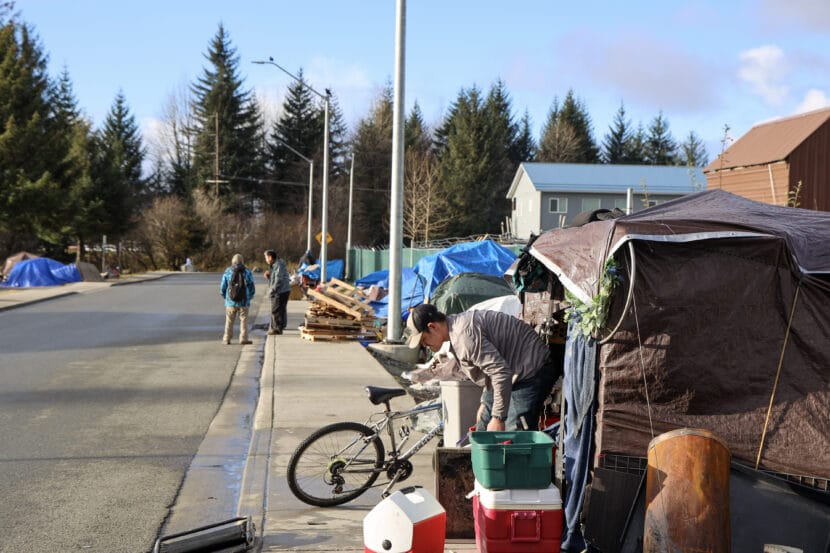
Campers pack up their belongings on Teal Street in the Mendenhall Valley on Wednesday, Nov. 12, 2025. (Photo by Clarise Larson/KTOO)

More than a dozen people without permanent housing living in Juneau’s largest unhoused encampment will be forced to leave on Friday morning, ahead of the season’s first expected snowfall. 

The City and Borough of Juneau gave notice to the people camping on Teal Street in the Mendenhall Valley earlier this week. The notices says the city is prohibiting camping in the area due to winter maintenance and safety concerns. 

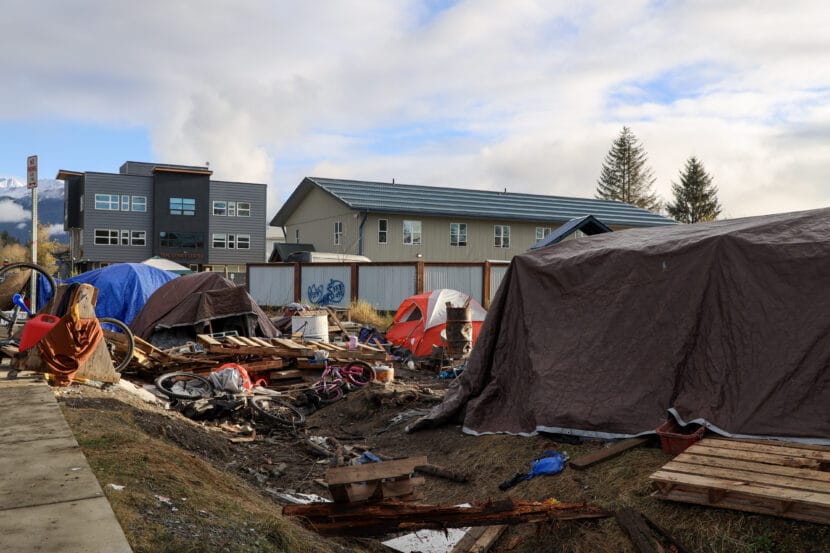
Right now, the street is lined with more than a dozen campsites. Some campers don’t want to leave.

“I assumed that they would let us stay through the winter. I didn’t anticipate them doing this now — it just seemed like the worst timing,” said Darian Bliss, who’s been living in the Teal Street area in a makeshift shelter since about May. 

People without housing in Juneau set up camp here because it’s close to social services and other resources provided by the Glory Hall and St. Vincent de Paul. 

“I think it’s the safest, best place out of everywhere in town, because you’re right across from the homeless shelter anyway, and so I don’t know where a better place could possibly be,” he said. 

Tents line the sidewalks along Teal Street in the Mendenhall Valley on Wednesday, Nov. 12, 2025, (Photo by Clarise Larson/KTOO)

Bliss said he’s frustrated with the timing of the city’s eviction. He doesn’t want to have to uproot his life again, even as winter comes. He’s spent the last week or so insulating his campsite, and recently installed a wooden door with a lock. 

Campers like Bliss have few options for where they can stay. One option is the city’s cold weather emergency shelter, which opened for the season in mid-October. It’s located in a warehouse in Thane, about a mile from downtown and about nine miles across town from the services on Teal Street. 

The shelter accepts anyone who comes in search of a place to sleep at night, as long as they aren’t disruptive to other patrons. City officials say it’s a stopgap and meant to be a last resort for unhoused people when the weather gets cold. 

Bliss said he doesn’t plan on going there. He doesn’t like how crowded it is and the distance from resources. 

“I don’t like going out there at all. I just stay perfectly fine here,” he said. 

Logan Henkins works at the Glory Hall shelter. He was playing music and handing out hot chocolate and coffee to people who passed by on Wednesday afternoon.  

“I’m just out here this morning trying to touch base with as many people as I can touch on base with about the extended services that St. Vincent de Paul is offering on Friday to catch the people who are being displaced,” he said. 

St. Vincent de Paul operates the city’s emergency shelter. In light of the clearing, the shelter will open earlier on Friday and offer a meal.

He’s not the only one trying to help out. Claire Richardson stood outside her car next to a campsite on Teal Street, waiting to help a woman she met the day before move her belongings from an encampment and into a family member’s apartment. 

“You start to realize that people (are) living on the margins, and the snow is coming, and really, I don’t know what they’re going to do, and there’s a lot of stuff here,” she said. 

Richardson is with ReSisters, a local group of women who work for social justice and equality. She said when she heard about the encampments being cleared, she felt drawn to help the people who were about to be displaced. 

“It’s going to start snowing here in a few days, and the thought of me being safe in my home, sipping my hot coffee and knowing that people are living like this. Well, it’s just hard to sleep at night,” she said. 

Other groups in town are helping out too, like the Haa Tóoch Lichéesh Coalition, which is asking the community to offer storage space or funds to those being displaced. 

Deputy Police Chief Krag Campbell said the police department plans to have officers arrive at 8 a.m. on Friday to ask people to leave the area. Then at 9 a.m., they’ll start throwing people’s belongings away. He encouraged campers to pack up their belongings beforehand.

“Hopefully, we’ve given them ample time, ample notice, and they can start making those arrangements to go somewhere else,” he said. 

Deputy City Manager Robert Barr said the city will continue to monitor the area after Friday in the event that people set up camp again. 

Fairbanks mother speaks on her 2-month detainment by ICE

Atcharee Buntow with Dmonhi, her two-year-old son, after her release from ICE custody on Oct. 2, 2025.
Atcharee Buntow with Dmonhi, her two-year-old son, after her release from ICE custody on Oct. 2, 2025. (Atcharee Buntow)

On a sunny afternoon in early August, Atcharee Buntow was running an errand for her mom’s Thai restaurant, topping off their supply of oyster sauce. But when an unmarked vehicle pulled her over on her way home, it became one of the worst days of her life.

A U.S. Immigrations and Customs Enforcement agent approached her car, and Buntow started taking a video of the encounter on her phone while frantically trying to text her family.

Buntow says she didn’t know what was happening until after the agent put her in handcuffs.

“They did not identify themselves until they had me in custody,” she said in an interview after her release.

Buntow said she was told that she was being detained for overstaying her visa and then taken to a holding facility in Tacoma, Washington. She said she was locked in a dorm with about 60 other women, where it was hard to sleep and meals didn’t come on time.

“Some nights, we didn’t get our dinner till 10:30 p.m., or 11,” she said. “The latest night I ever got dinner was at 2:30 a.m., so I just starved that night.”

She was released on bail about two months later, on Oct. 2.

Buntow, who turns 43 this week, was born in Thailand but has lived in the United States since she was 11. She said she wasn’t aware that there had been any issue with her immigration status, especially after she got married to her first husband, an American citizen.

She’s now married to a different American citizen and is the mother of six American children — four adults and two younger kids. She said the separation was hardest for them.

“My 12-year-old, he was in and out of the hospital for asthma attacks,” Buntow said. “Now that I’m back, he is fine.”

She also has a two-year-old son who relatives say would cry every night she was gone. 

Buntow stayed in touch with family with a tablet she shared with dozens of other women in the detention center. She said those brief calls were one of her only sources of comfort behind bars.

“I was depressed,” Buntow said. “You know, what are they going to do for Thanksgiving? I cook every year. Mac and cheese, sweet potato pie and the green bean casserole. The kids love that.”

Buntow said she feels like her arrest was pretty random. But she’s been convicted of a few nonviolent misdemeanors in Fairbanks over the last couple decades, as well as a felony for fraudulently applying for the Alaska Permanent Fund dividend, according to court records.

She pleaded guilty to falsely claiming U.S. citizenship on her PFD application in 2014. Buntow said that was a mistake she made while she was filling out the PFD paperwork for her children. Now, she’s trying to get the conviction vacated so she can stay in Alaska with her family.

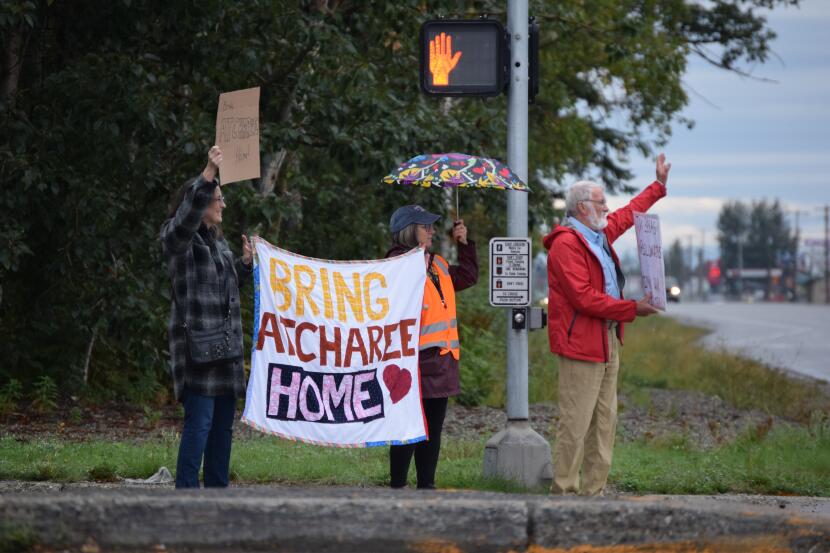
Over the last couple months, Buntow’s friends and neighbors, Fairbanks officials, and state legislators advocated for her release. Fairbanksans held a protest in her honor, and her family was able to crowdfund over $20,000 for her bail.

Buntow said the fundraiser remains active to help cover her legal fees while she tries to secure a green card.

Fairbanksans protested federal Immigration and Customs Enforcement activity throughout the city and rallied to support detained Thai resident Atcharee Buntow on Aug. 23, 2025. (Shelby Herbert/KUAC)

Margaret Stock, an Anchorage-based attorney who is recognized for her expertise in immigration law, said she’s seen many people in Alaska face similar situations this year. And that while the Trump administration insists ICE agents are only picking up the worst of the worst, she sees a lot of collateral damage.

“What I’m seeing are a lot of people being picked up who don’t have a criminal record,” Stock said. “Or it’s something really minor, like they had an encounter with the police, but no charges were filed. In some cases, they’re picking up U.S. citizens.”

Stock said she’s even working with an Alaska military veteran to fight deportation proceedings. She said the majority of people she sees ICE detaining are eligible for a green card, and that she believes ICE is putting pressure on them to leave the country by putting them in detention centers.

But those proceedings can take years. And Stock said legal resources are stretched thin, especially in Alaska.

“It’s pretty hard to find help,” she said. “I mean, there are a few private lawyers, but we’re strapped thin. Right now, the immigration judges have more than 4,000 cases per judge. Getting a hearing with the judge can take a really long time, and you have to comply with a lot of technical rules, so it’s really difficult if you don’t have an attorney.”

That’s the route Buntow is trying to take. Buntow said she’s cautiously hopeful she won’t be deported to Thailand, which doesn’t feel like home anymore.

“I don’t know anything over there,” she said. “I’ve been living here all my life. Where would I live? Where would I go? What will I do without my kids, my husband? I’m happy that I’m back, I’m just scared of what’s going to happen next.”

Her husband, an American citizen who has never left the country before, is preparing to start his life over with her abroad if their worst fears come to pass.

Buntow remains grateful for the time she has with her family and the chance to celebrate her birthday and the holidays together. But her thoughts remain with the other mothers she befriended in the Tacoma detention center.

Buntow is still in touch with a fellow detainee named Paula, an immigrant from the Philippines who was born in Cambodia.

“I just heard Paula got sent to Louisiana, which is worse than Tacoma,” Buntow said. “She has eight children. She’s been in there for 18 months, and her immigration case is over. She was trying to appeal it, and they denied her appeal. I really feel very bad for her. Like, I cried when she told me her story.”

ICE did not respond to interview requests before press time.

Anchorage state Sen. Matt Claman is second Democrat in Alaska governor’s race

Anchorage Democratic state Sen. Matt Claman speaks on the floor of the Alaska Senate on April 28, 2025.
Anchorage Democratic state Sen. Matt Claman speaks on the floor of the Alaska Senate on April 28, 2025. (Eric Stone/Alaska Public Media)

The number of Democrats running for governor of Alaska grew to two on Monday as Anchorage state Sen. Matt Claman entered the race. Claman, an attorney, has represented West Anchorage in the Legislature for more than a decade and said in an interview his experience working across the aisle prepares him well for the top job in state government.

“I think that Alaska needs a person with my background and experience and balanced approach to doing what’s best for Alaska,” he said.

Claman is a member of the 14-person Senate majority caucus that includes nine Democrats and five Republicans. He’s chair of the Senate Judiciary Committee and in 2024 led the effort to pass a wide-ranging crime bill that, among other things, allows drug dealers to be charged with second-degree murder and allows prosecutors to avoid forcing sexual assault survivors to testify to a grand jury.

The bill included proposals backed by Republican Gov. Mike Dunleavy, who publicly praised it and signed it into law later that year.

Claman said he’d been “actively involved” in 21 pieces of legislation related to public safety. That’ll be one area of emphasis in his campaign, he said.

“I think we’ll be very focused on improving public safety, quality education, strengthening the economy and being fiscally responsible in how we manage state government,” he said.

Claman said he supports an “affordable” Permanent Fund dividend. He said the state’s recent budget turmoil — which pushed dividends down to their lowest inflation-adjusted amount in history — will require the next governor to carefully prioritize his or her budget.

“I think we should pay an affordable dividend, but I also think we need to invest in our public schools and invest in public safety to protect our neighborhoods,” Claman said.

He’s the second Democrat to officially enter the race, following former Anchorage state Sen. Tom Begich. Begich has said he plans to step aside if former Congresswoman Mary Peltola, the last Democrat to win a statewide election, enters the race. It’s unclear if she will.

Claman declined to say what differentiates him from Begich — and also declined to make a similar commitment to exit the race if Peltola enters.

“Mary Peltola is not in the race today, and I’m entering because I believe I’m the best candidate for governor,” he said. “I’m looking forward to a very positive and engaged campaign.”

Claman said he does not plan to resign his Senate seat to run for governor.

Claman is the 14th candidate to formally enter the race. The top four vote-getters in the August 2026 primary, regardless of party, will advance to the ranked choice general election.

Candidates have until June 1 to enter the race. For now, the rest of the field includes, in alphabetical order:

Alaska Division of Elections begins reviewing petition to repeal election reform law

“I voted” stickers are seen on display in the headquarters offices of the Alaska Division of Elections in Juneau on Tuesday, Nov. 12, 2024. (Photo by James Brooks/Alaska Beacon)

State elections officials have begun reviewing signatures gathered by people opposed to Alaska’s system of open primary elections and ranked-choice general elections to determine whether a repeal ballot measure will appear before voters in 2026.

Alaskans enacted the state’s existing elections system via a ballot measure in 2020, and a repeal measure last year failed by only 737 votes out of 320,985 cast.

Proponents of the repeal vowed at that time to renew their effort and began gathering signatures in February to force another vote.

Based on state law and the number of people who voted in the 2024 statewide election, repeal supporters needed to collect signatures from at least 34,099 registered voters, including a certain minimum number in at least 30 of the 40 state House districts.

This week, supporters of the repeal measure said they were submitting more than 48,000 signatures to the Alaska Division of Elections for review.

If the repeal petition is deemed to have enough signatures, it would go before voters in either the 2026 primary or the 2026 general election, depending upon the length of next year’s state legislative session.

If voters approve the measure in 2026, all three components of the 2020 ballot measure would be repealed.

That would have three main results. Financial donors to political campaigns would be able to conceal their identity by contributing to a political nonprofit, which could donate money to causes on their behalf.

The 2020 law, currently in effect, requires campaigns to disclose the “true source” of their money.

The second effect would be the repeal of the state’s open primary system, in which all candidates, regardless of political party, run in the same race. Under the current law, the top four vote-getters in a given race advance to the general election.

If that is repealed, political parties would be able to determine the rules for deciding which of their candidates advance to the November general election.

The third change is to general election. Instead of voters being allowed to rank all candidates in order of preference, voters would be able to choose only one candidate, and the candidate with the most votes would win.

One other ballot measure, which would reimpose a limit on financial donations to political candidates, has already been certified and is slated for the 2026 ballot.

Two other ballot measures remain in the signature-gathering process. One would decriminalize several psychedelic substances, and the other would reinforce the state’s existing prohibition on noncitizen voting.

Backers of those measures must gather sufficient signatures before the start of the January legislative session in order to force a vote in 2026.

Site notifications
Update notification options
Subscribe to notifications