Government

One month after Halong, here’s what rebuilding looks like in six Y-K Delta communities

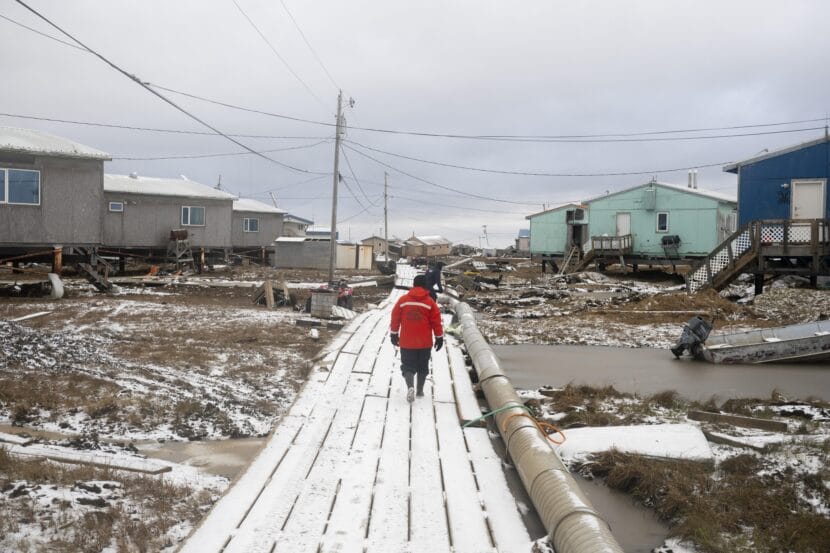
Pollution response teams from U.S. Coast Guard Sector Western Alaska and U.S. Arctic conduct post-storm assessments in Kipnuk, Alaska, Oct. 22, 2025, after the community was impacted by severe flooding from Typhoon Halong. Personnel deployed to affected areas to identify pollution concerns and work with state, federal, and industry partners to conduct clean-up operations.
Pollution response teams from U.S. Coast Guard Sector Western Alaska and U.S. Arctic conduct post-storm assessments in Kipnuk, Alaska, Oct. 22, 2025, after the community was impacted by severe flooding from Typhoon Halong. (Petty Officer 1st Class Shannon Kearney/U.S. Coast Guard Arctic)

Last week marked one month since the remnants of Typhoon Halong devastated communities in Western Alaska with high winds and flooding.

The scale of the destruction in the remote, isolated region is still only starting to emerge.

As of Thursday, the state Department of Homeland Security and Emergency Management reported that 471 homes sustained major damage. Another 208 were destroyed. Among the 3,472 homes surveyed across the affected area, only about a quarter made it through the storm undamaged.

The storm killed one person and left two more missing.

The Association of Village Council Presidents, a regional tribal government consortium, reported that more than 50 communities saw impacts from the storm, with more than a dozen reporting serious damage.

The damage, especially in the villages of Kipnuk and Kwigillingok, led residents to evacuate in what the Alaska National Guard called the largest airlift in the state’s history. After rescuing 51 people in the storm’s immediate aftermath, first responders evacuated nearly the entire population of Kipnuk and Kwigillingok. More than 500 people are sheltering in hotels, and their long-term future remains in question.

Kipnuk

In Kipnuk, only the school and a handful of houses made it through the record flood in good shape. The vast majority of structures were damaged or destroyed — some 90%, according to the state Department of Transportation and Public Facilities.

James Paul is one of a small group of locals remaining in Kipnuk and working on the immense task of rebuilding. There have been some small wins, he said — for one thing, the local school, still serving as a hub for the relief effort, is also now connected to village electricity. Some street lights are even on.

“They have been making good progress every day,” he said in a phone interview earlier this month.

But there’s a lot left to do. The community’s water system is still offline, and most homes don’t have power.
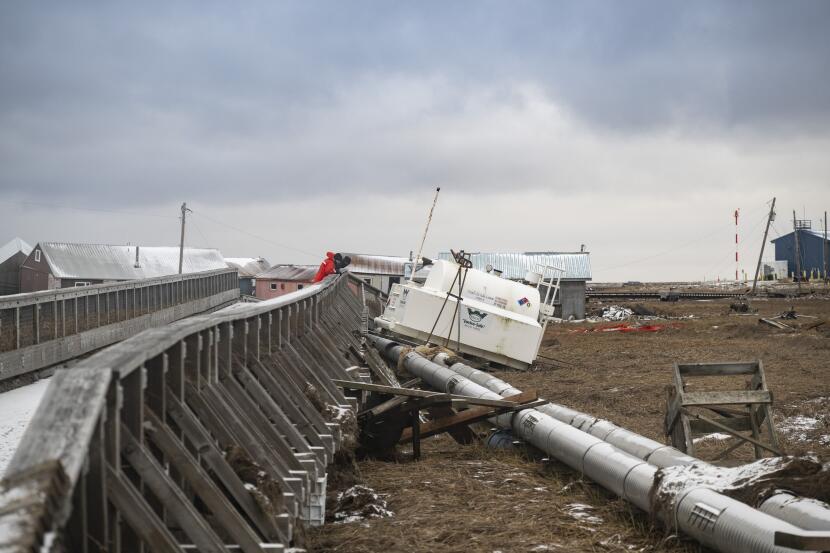
Arctic conduct post-storm assessments in Kipnuk, Alaska, Oct. 22, 2025, after the community
was impacted by severe flooding from Typhoon Halong. Personnel deployed to affected areas
to identify pollution concerns and work with state, federal, and industry partners to conduct
clean-up operations. (U.S. Coast Guard photo by Petty Officer 1st Class Shannon Kearney)

Meanwhile, Paul said, aid is surging in. Cargo planes drop off heavy equipment and building supplies.

“Every agency and everybody that comes out here, I think has been really helpful,” he said. “They want to help, and I can’t say enough (about) all the help we’re getting.”

A staggering amount of aid has been flowing to the region from governments, nonprofits and the private sector.

But it likely won’t be enough for large numbers of residents to return this winter. Paul said his future is uncertain.

“I’m not sure about that,” he said. “I want to keep working as long as I can stay here.”

But another resident, Benjamin Kugtsun, said he had no plans to leave — at least, as long as they keep making progress.

“As long as we’ve got power from our power plant and some lights that can power up how we’ve been living, we’re not going to leave,” he said. “We’re going to stay here and work on Kipnuk — rebuilding Kipnuk.”

Kwigillingok

In another village devastated by the storm, Kwigillingok Tribal Resilience Coordinator Dustin Evon said there’s just too much damage.

“We feel like it’s not going to be habitable through the winter,” he said.

Locals and aid workers are keeping busy working to restore the homes that can be saved, Evon said, lifting homes back onto their foundations, replacing insulation soaked by the flood, restoring water and power and so on.
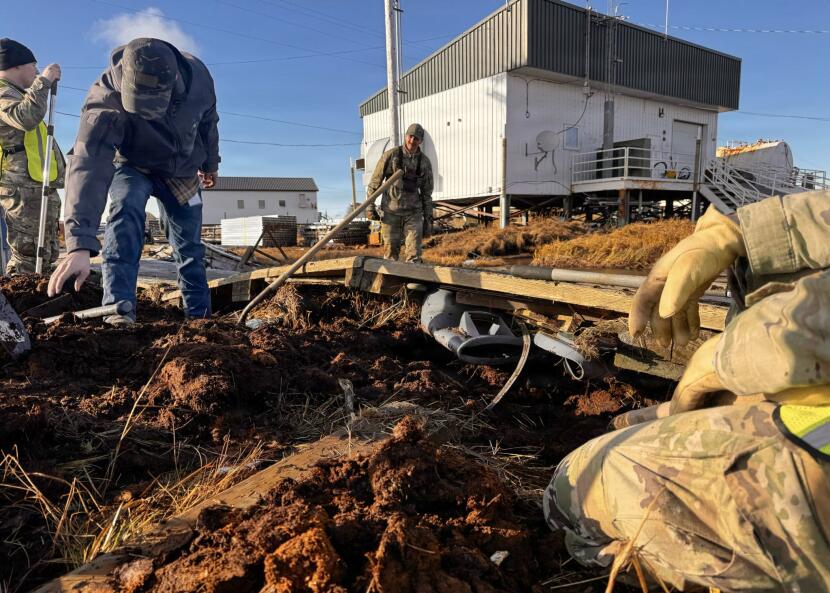
Alaska Organized Militia members, assigned to Task Force Bethel, clean up debris at Kwigillingok, Alaska, during post-storm recovery efforts for Operation Halong Response, Oct. 20, 2025. (Alaska National Guard/Digital)

But once the sun goes down, he said, Kwig feels like a ghost town.

“It feels empty, and it’s not as lively as it used to be before the storm,” he said.

For now, the focus is on restoring homes in place, but the long-term future for the village is miles away. The tribe’s members voted in the weeks after the storm to officially relocate about 20 to 25 miles northeast to higher ground, Evon said.

“A lot have said that if a complete rebuild happens in Kwig, many don’t feel safe coming back,” Evon said.

But financing that relocation, which could cost tens or hundreds of millions of dollars, will be a challenge.

Bryan Fisher, director of the Alaska Division of Homeland Security & Emergency Management, said finding funding for relocation will take time. At a town hall meeting in Anchorage this week, he said that the emergency funding the communities have access to now can be used for rebuilding homes and infrastructure and making them more resilient. The relocation work will have to be addressed with different types of funding later on, he said.

“The programs that we have to respond and recover from Typhoon Halong in this disaster will not relocate the communities. They’re intended to repair and replace damaged infrastructure, homes, personal property, subsistence, gear and equipment from the storm,” he said. ” However, we will be working with all of the agencies and the councils to talk about what we can do to support your desire — if you have it — to relocate in the longer term.”

Fisher said he hoped the currently available aid funding would at least buy communities time.

Napakiak

The village of Napakiak was already working on relocation to a nearby bluff when Halong hit — what the local tribe calls a “managed retreat” from the eroding banks of the Kuskokwim River. And Walter Nelson, who coordinates that effort, said the vast majority of homes in Napakiak were flooded during Halong. Approximately a dozen residents have yet to return to their homes, he said.

“I’m 65 years old. I’ve never seen anything like this,” he said. “I’ve talked to our eldest elder. He’s never seen anything like this, the aftermath of Halong.”

Still, Nelson said he’s grateful the damage in Napakiak was not as severe as it was in Kipnuk and Kwigillingok. For now, crews are working to dry out flooded homes, replace insulation and restore heat, he said.

Nelson said the flood underscores just how urgent relocation is — and not just for his village.

“We can’t predict Mother Nature, and we can’t challenge her,” he said.

Tuntutuliak

Around 30 miles southwest, in Tuntutuliak, the most severe damage came in the low-lying part of town along the banks of Qinaq River. Twenty-six people evacuated, at least a dozen homes were knocked from their foundations, and large sections of boardwalk in the roadless community were ripped away by the storm surge. Elder Henry Lupie said that nearly all of the community’s traditional steam baths were flooded or displaced.

“We need steam house(s). We don’t have bath and showers readily available in homes,” Lupie said.
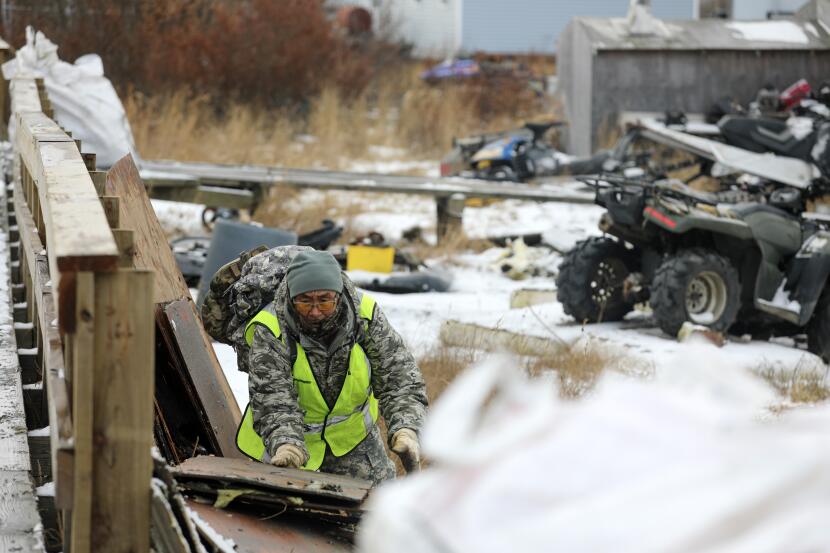
An Alaska Organized Militia member, assigned to Task Force Bethel, cleans up debris at Tuntutuliak, Alaska, during post-storm recovery efforts for Operation Halong Response, Oct. 25, 2025. (Capt. Balinda O’Neal/Alaska National Guard)

Lupie said most of the oil-fired heaters in the community have been repaired or replaced. He said the volunteer and agency-led efforts to tear out and replace wet insulation have made multiple homes livable through the winter.

Floodwaters destroyed numerous freezers full of subsistence foods, forcing residents to shift to winter harvests — ice fishing for lush and setting black fish traps, Lupie said. He said his son was among the first residents to harvest a moose under an emergency hunt opened by the state in early November, and that others are waiting for thicker ice to do the same.

“We’re just now cutting it up and passing it to the ones down in the lower village … and the ones from Kwigillingok, evacuees,” Lupie said.
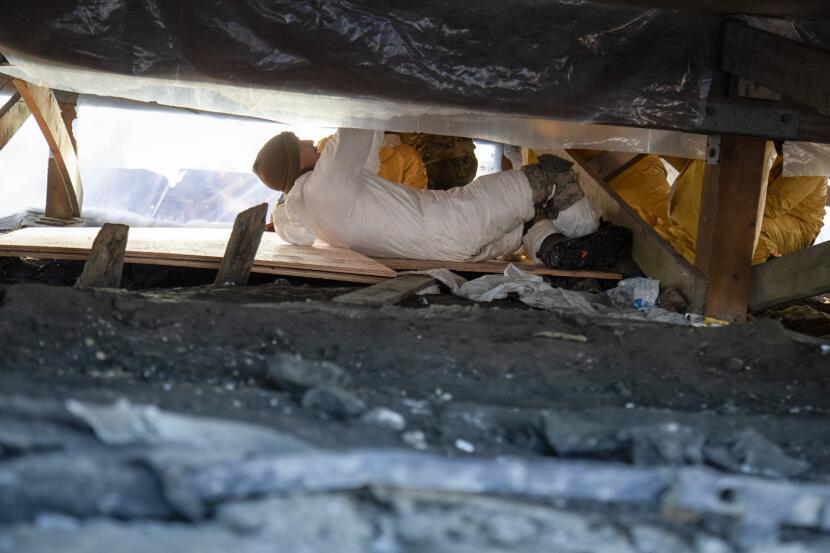
Alaska Organized Militia members, assigned to Task Force Bethel, conduct home restoration work during post-storm recovery efforts for Operation Halong Response at Tuntutuliak, Alaska, Nov. 11, 2025. (1st Lt. Keara Hendry/Alaska National Guard)

Quinhagak

Further south, the Kuskokwim Bay community of Quinhagak dodged the worst effects of the storm.

“We are fortunate that our community was not devastated and acknowledge that the communities across the bay have a lot more needs than we do,” Mayor Jerilyn Kelly wrote by email.

Nevertheless, Quinhagak saw erosion of as much as 60 feet along miles of beach. The storm surge brought the shoreline closer to the community’s already threatened sewage lagoon. It also destroyed unexcavated portions of a nearby archaeological site, the largest known precontact Yup’ik site in Alaska.

Kelly said that 10 homes were damaged by the storm, and that multiple fish camps, drying racks, smokehouses, and boats were washed away by floodwaters. She said the community’s water intake line is still damaged and will need to be replaced after break-up.

Nightmute

Far to the northwest, at least 19 people evacuated after floodwaters inundated homes in the Nelson Island community of Nightmute, roughly 10 miles up the Toksook River, according to the National Guard. The flooding made the riverside community appear as if it were in the middle of the ocean, said Tribal Administrator Clement George.

A month later, rebuilding work is still underway, he said.

“We’re rebuilding houses, boardwalks are mostly rebuilt, repaired … I think there’s three homes to be demolished,” George said.

George said a contractor has finished constructing a temporary landfill on higher ground after the storm pushed water into the community’s landfill and sewage lagoon.

George said it’s the worst disaster he’s ever experienced. The nearby community of Toksook Bay saw the highest wind gust ever measured on Nelson Island, at 100 miles per hour. George said the level of erosion around Nightmute stands out.

“Some of the tundra is folded and the small creeks, they’re bigger than before,” George said.

At the nearby coastal subsistence camp of Umkumiut, dozens of structures were all but wiped out. The site holds deep cultural importance for many on Nelson Island, and according to George, provides as much as 75% of Nightmute’s subsistence needs.
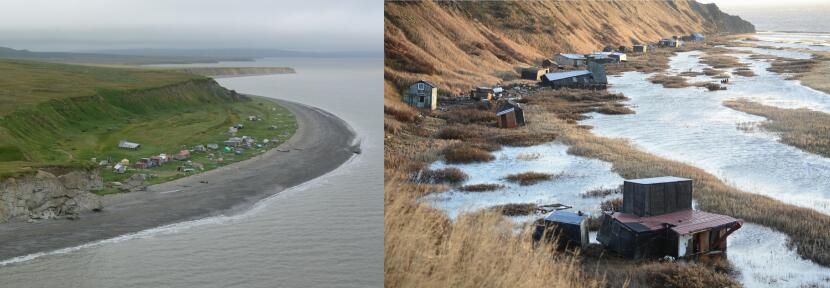
The Umkumiut seasonal subsistence site and village on Nelson Island is seen in 2014 (left) and after the remanants of Typhoon Halong struck the site on Oct. 12, 2025. (NOAA ShoreZone/Jimmie Lincoln)

Alaska owns dozens of crumbling schools. It wants underfunded districts to take them on

The first week of school in Aniak, Alaska. Alaska’s education department has transferred ownership of 54 buildings to rural public school districts since 2003, including Aniak’s elementary school. (Gabby Hiestand Salgado/KYUK)

For more than a decade, the Kuspuk School District asked Alaska’s education department for the money to fix a rotting elementary school. The school, in the small and predominantly Indigenous community of Aniak in western Alaska, was in deep need of repairs. The nearby Kuskokwim River had flooded the 88-year-old building several times. The walls were moldy. Sewage was leaking into a space below the school’s kitchen.

In 2018, the department finally approved the school district’s $18.6 million funding request to build a new elementary school wing onto Aniak’s middle and high school building, which was owned by the state.

But on Page 4 of the funding contract for the project, Alaska’s education department included a catch.

“The State would only build the new school if the local school board agreed to own it when completed,” former superintendent James Anderson said in an email to KYUK Public Media, NPR and ProPublica.

In the end, Anderson agreed. He worried that if he didn’t, it would jeopardize kids’ health and safety. But he said he also worried about the financial and legal implications of the agreement for the school district, where nearly 30% of families live in poverty. If the state owned the building, it would be responsible for repairs and liability. Anderson worried that if the district took ownership of the school, it might be on the hook.

According to a review of deeds and project funding agreements, Alaska’s education department has transferred ownership of 54 buildings to rural public school districts since 2003. That’s nearly four times as many compared with the two decades prior. That same year, a new clause appeared in the funding agreements that districts sign with the state: In return for the money to make repairs to run-down schools or to build new ones, school districts would have to agree to own the buildings.

Alaska education department spokesperson Bryan Zadalis said in an email that the department didn’t have documentation about why the contract language changed. He wrote that “the main clauses of the project agreement are boilerplate language” and were last reviewed by Alaska’s Department of Law in 2019.

Seven current or former superintendents representing rural school districts with student populations that are predominantly Alaska Native said it’s unclear whether a change of ownership also changes a school district’s responsibility to maintain its facilities. The districts can’t use tax revenue to pay for education because the communities they serve are unincorporated. As a result, the state is required by law to pay for construction and maintenance in many rural school districts, but it often takes years to secure that money. Because the funds are hard to come by, superintendents have also said they feel pressure to sign the contracts.

“We’re all sort of trying to find the best, most optimal use of very lean resources,” said Hannibal Anderson, superintendent of the Lower Kuskokwim School District, Alaska’s largest rural district, covering an area nearly the size of West Virginia. “There’s very little room for negotiation.”

Last summer, after nearly two decades, two more Kuspuk district schools, upriver from Aniak, received funding from the state to remedy severe structural problems and serious health and safety risks that the district has reported to the state’s education department for years. In both cases, the money wasn’t enough to fix everything, but superintendent Madeline Aguillard said it was better than nothing, so she signed contracts that also required the district to own those schools.

“What choice did I have?” she asked.

Madeline Aguillard, superintendent of the Kuspuk School District, is negotiating with the state over ownership of school buildings. (Gabby Hiestand Salgado/KYUK)

Over the last year, KYUK, NPR and ProPublica have documented a health and safety crisis inside many rural school buildings across Alaska. Water lines and sewer systems are backing up. Roofs are leaking and foundations are crumbling. Until this summer, at least one school was in danger of collapse. The state has largely ignored hundreds of requests from rural school districts to fix deteriorating buildings. Some of the worst conditions exist at state-owned schools.

Losing Sleep Over Liability

Unlike most other U.S. states, where schools are owned locally, Alaska’s education department owns nearly half of the 128 rural schools open in the state today. In most cases, school districts own the remainder.

In an interview, education department staff said shifting ownership from the state to districts cuts red tape and gives districts more local control over how the building is maintained and used.

“We’re very much a hands-off landlord, as it were,” said Lori Weed, the education department’s school finance manager. “So the hope was that districts would take title to sites so that they could have the control, because we’ve been so hands off.”

A damaged ceiling in Aniak’s high school in August. (Gabby Hiestand Salgado/KYUK)

There are several overlapping Alaska laws governing school ownership. Collectively, they allow school districts to take over supervision of school construction or maintenance projects and to initiate a transfer of ownership. None of those laws require schools to accept ownership; one says a school board “may” take that action.

However, in some cases, the education department’s contracts say that school boards “shall” take over ownership in order to receive funding.

Howard Trickey, an attorney who has spent most of his career representing public schools in Alaska, said the state could be misinterpreting the law. “‘May’ means you don’t have to do something,” he said. “So to interpret that statute to say it’s mandatory is overreaching.”

The contract for Aniak’s elementary school project says the district “agrees to comply” with several conditions and “shall request title interest of the new facility.” According to the education department, districts are permitted to request the removal of this provision, and it doesn’t require the transfer in order for a district to receive project funding.

Aguillard said she’s still trying to negotiate with the state. Records show Alaska’s education department still owns the facilities used for education in Aniak.

Trickey also believes that such ownership changes could create huge risks for rural school districts in Alaska.

“Suppose a facility was in such disrepair and had such life safety issues as inadequate electrical system, and the school catches on fire and burns down and children are injured,” Trickey said. “If the state owned it, the state would be liable for those injuries.”

A staff member with the education department said there hasn’t been a recent case where someone got hurt. “I would argue that if something happens, it’s going to become a legal battle,” said Heather Heineken, the department’s director of finance and support services, who previously was finance director for a district in Alaska’s Interior.

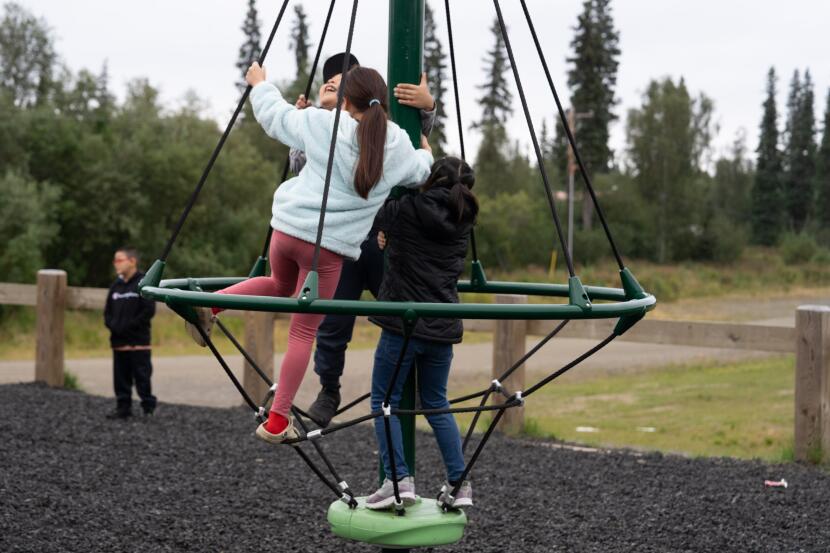
Aniak students play outside on the playground. (Gabby Hiestand Salgado/KYUK)

Rod Morrison, superintendent of the Southeast Island School District, said he loses sleep over liability in his schools, which suffer from leaking roofs, black mold and, at one school, a nonfunctional fire suppression system. The state transferred ownership of that school, in Thorne Bay, to the district in 1998.

In August, Morrison asked the state to allow him to use $300,000 left over from a state-funded project at another school in his district to address the fire suppression system. In September, Michael Butikofer, facilities manager for Alaska’s education department, denied the request, saying it may not be legal. He encouraged Morrison to submit a new application for the funds to fix the suppression system instead.

“When they denied the transfer of the funds or refused to fix my fire suppression system, then I requested the state to take liability of that facility,” Morrison said. “Then of course they said no, they’re not going to take liability for that.”

In a response letter, Butikofer told Morrison that the “ultimate responsibility for day-to-day safety and facility operations lies with the district.”

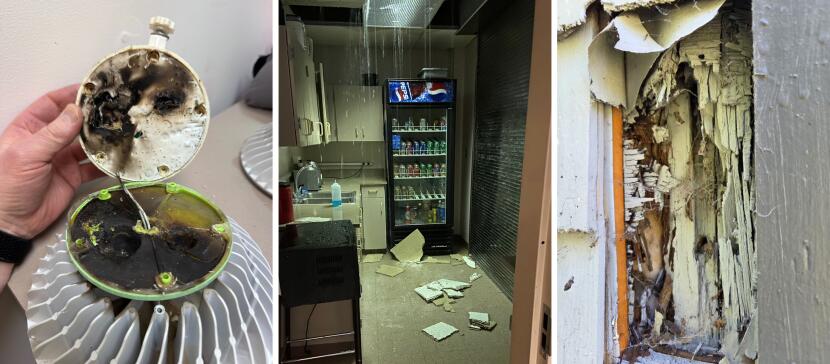
The district has made 17 funding requests to the state since 2009 for the money to replace the system. During a Senate Finance Committee hearing in Juneau this spring, Morrison presented lawmakers with a giant light bulb, blackened by a short in the electrical wiring in the school’s gymnasium ceiling. Morrison said it’s not a matter of if, but when, a fire might consume the building.

Rod Morrison, superintendent of the Southeast Island School District, said he loses sleep over liability in his schools, including fire hazards (left), leaking roofs (center) and structural damage (right). (Rod Morrison)

Decades of Contamination

Alaska inherited dozens of schools from the U.S. Bureau of Indian Affairs (BIA) in the three decades after it gained statehood in 1959. During those decades, state officials complained about being burdened with schools that were already in bad shape.

Those schools also came with other liability risks. Some buildings stand on land previously used by the military, where highly toxic and volatile chemicals have been found. And leaking fuel tanks have contaminated the property at dozens of rural schools, according to the Alaska Department of Environmental Conservation.

That was the case with a BIA school in the Bering Sea community of Toksook Bay, which the state acquired in 1990. There, a corroded pipe leaked 5,000 gallons of fuel into the crawl space of a maintenance building associated with the elementary school. The city of Toksook Bay sued both the school district and the state, arguing that the leak contaminated the city’s water system, damaged land and caused illness. The state Legislature approved over a million dollars in settlement funds for the city.

In response, the Legislature passed a law in 1997 that limited the state and rural school districts’ liability for chemical spills on their land. However, the law does not absolve the state or districts from paying for cleanups, which can cost millions.

Bill O’Connell, who manages contaminated site cleanup for the state Department of Environmental Conservation, said paying for cleanups is harder in rural districts. In municipal school districts, local taxes can help cover the cost. But rural districts rely on the state for nearly all of their funding.

“The money that the school districts get is just to educate the students,” O’Connell said. “There’s no consideration of contaminated site cleanup. It’s really just kind of an unmet need.”

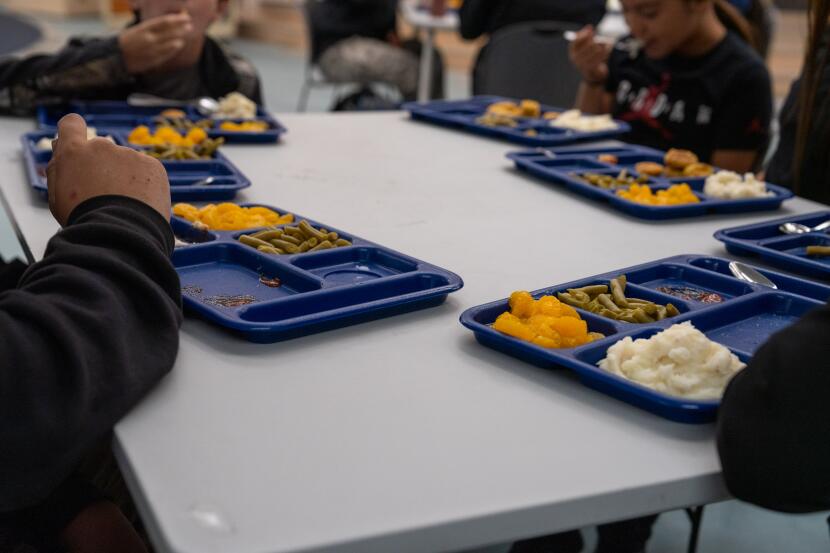
Students eat lunch during the first week of school at Aniak. (Gabby Hiestand Salgado/KYUK)
Students in math class during their first week of school in Aniak. The superintendent says the state required the school district to take ownership of the new elementary school. (Gabby Hiestand Salgado/KYUK)

He pointed to an old building in Aniak that served the U.S. Air Force during the Cold War as particularly concerning. He said the legacy of highly toxic contaminants started before the building was used for education. The state-owned building, once used by the school district for vocational training, has been demolished, but its foundation stands about 200 yards from the school where kids still take classes everyday. O’Connell said cleanup at the site was officially completed this year, but there are still contaminants below the surface and it is unlikely any new construction will ever be allowed there.

In 1997, the same year the liability law passed in Alaska, a group of parents sued the state over conditions inside rural public schools where their kids spent their days. When the case was settled in 2011, the judge’s consent decree called on the state to pay for five new schools. At the time, the state owned four of those buildings. The state paid to build the schools but required each of the districts to accept a transfer of ownership.

Ken Truitt, an attorney who represented the education department in 2003, when the ownership requirement appeared in construction and maintenance funding agreements, said he does not recall being consulted on the contracts or the addition of that language.

Tim Mearig, a former facilities maintenance director for the education department, said that in the early 2000s, leadership believed “it was of no benefit to the state to hold title, and it was a significant benefit to districts to manage their own property.”

Mearig said a change of ownership was eventually “baked in” to project agreements.

Some ownership and liability questions come down to what the state’s constitution requires. Alaska’s education commissioner, Deena Bishop, said the constitution is intended to give local communities maximum control and that the department is following the law. But Trickey, the longtime attorney for Alaska school districts, said the transfers “don’t relieve the state of that ongoing, continuing constitutional duty.”

“The constitution says the state has a duty to establish and maintain a system of public schools open to the children of the state,” he said. “And that just fundamentally and basically starts with adequate schools.”

Students run toward the finish line in a cross-country race in Aniak this August. (Gabby Hiestand Salgado/KYUK)

This story is a collaboration from NPR’s Station Investigations Team, which supports local investigative journalism, member station KYUK, and ProPublica’s Local Reporting Network.

Emily Schwing reported this story while participating in the University of Southern California Annenberg Center for Health Journalism’s National Fellowship. She also received support from the Center’s Fund for Reporting on Child Well-being and its Dennis A. Hunt Fund for Health Journalism.

Alaska station that covered devastating storm cuts jobs

The village of Kwigillingok, Alaska is seen in October. The area was hit by the remnants of Typhoon Halong earlier in the month, which caused major damage to homes and displaced most of the residents. (Claire Harbage/NPR)

KWIGILLINGOK, Alaska – When the remnants of Typhoon Halong hit this Alaska Native village last month, Ryan David was at home with his four children. They felt the house shake in the wind, then as floodwaters came, the building floated away.

“I yelled at my kids to get up and group up here, on the stairs, just in case we tip over,” David said when he talked with public broadcaster KYUK. He and his children were still trapped inside. David says the home stopped floating when it hit a bridge. He talked with a KYUK reporter as he waited for rescuers to arrive.

A month later, as villages across the Yukon-Kuskokwim Delta clean up from the storm and make repairs, hundreds of residents remain evacuated to cities such as Anchorage and Bethel. Now they face another loss. One of the few sources of local news and native language programming — public radio and television station KYUK — has lost federal funding that was up to 70% of its budget and plans to make cuts in January.

Mathew Hunter, 26, works at KYUK in Bethel. Due to the funding cuts his position will drop from full-time to 10-15 hours on call. (Claire Harbage/NPR)

The station plans to severely cut staff and some programming as it tries to raise money to fill the budget gap.

The broader public media landscape is also experiencing a loss of federal funding, including at least some money for improving emergency alert systems, as human-caused climate change from burning fossil fuels is heating the planet and increasing risks from extreme weather.

In remote villages KYUK is “crucial”

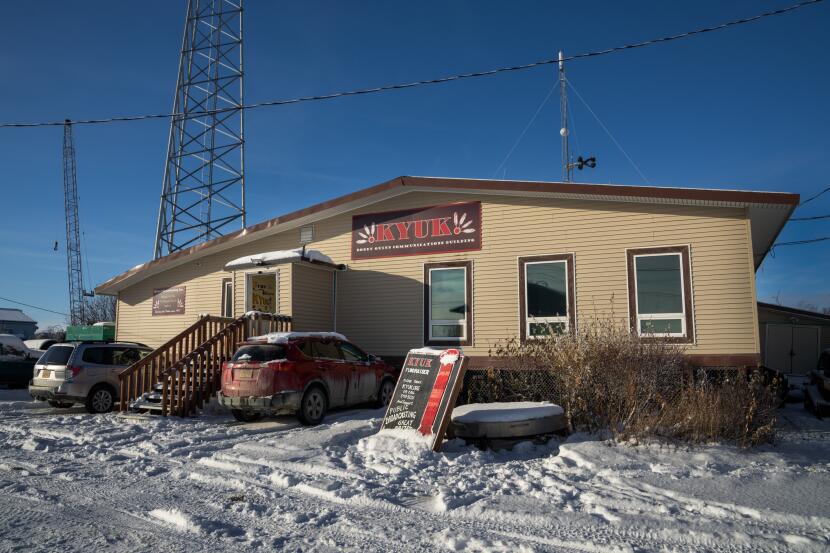
KYUK broadcasts out of a small tan building at the base of a tall tower in Bethel, Alaska — about 400 miles west of Anchorage. Bethel is a hub community for 56 tribes spread across 48 communities. The station says its coverage area is about the size of Louisiana.

Darrel John is a lifelong resident of Kwigillingok and he says the news in Yugtun is especially valuable. (Claire Harbage/NPR)

KYUK has been on the air since 1971 and “is a Native American initiated public broadcasting joint licensee” — that means it has both a public radio and television stations. It also has a digital news website and serves a predominantly Yup’ik population of less than 30,000 people in the Yukon-Kuskokwim Delta. Many residents, especially elders, primarily speak the Yup’ik language Yugtun.

“It’s very crucial to have that KYUK network,” says Darrel John, a lifelong resident of Kwigillingok. He says the news in Yugtun is especially valuable. “A lot of great advice we listen to from the elders… Any updates from any other communities — you know what to look out for — and the upcoming events.”

Each weekday, as Morning Edition ends, there’s local news and the weather forecast in Yugtun.

“Weather is definitely one of the things that KYUK focuses on because it’s life or death,” says Sage Smiley, KYUK news director. In a place where there are few roads, residents sometimes drive on frozen rivers and need to know where it’s safe to do that. “Getting from community to community in a boat, on a snow machine, in a bush plane, the weather matters almost more than anything else,” Smiley says.

When it became clear the remnants of Typhoon Halong were headed toward the Yukon-Kuskokwim Delta. Smiley says reporters started including that in their reports to warn residents. She says fall storms and even flooding are common in the region, but Halong was different from most.

“This storm took a track that was unexpected, hit south of where it was expected to and in an area that was less prepared for the storm to hit,” Smiley says. “I think all of those factors went into what made it so devastating.”

Sage Smiley, KYUK news director, stands in the office in Bethel. (Claire Harbage/NPR)

Three people in Kwigillingok died because of the storm. Nearly every building in the village was damaged. Overall more than 1,600 people were displaced, many of them evacuated in helicopters.

Smiley also coaches the high school swim team and was at a meet in another city when the storm arrived.

“I was working remotely from a minivan with the swim team while the rest of the [news] team was working on the ground here,” Smiley says in the news department studio in Bethel. “And we had collaborators in Anchorage who were helping draft scripts and call communities to figure out what was happening.”

That’s part of being a news director at a small station, but soon KYUK will try to report the news with a third less staff, because in January Smiley’s position will be among those cut.

KYUK loses funding and makes cuts

KYUK was already navigating a loss in funding from the state of Alaska when President Trump targeted public media and Congress eliminated funding this summer. It was a big hit to the station’s finances because federal funding has been up the bulk of its budget.

Loading…

The federal money essentially paid for employee salaries and benefits.

“It’s a little over $1 million that we’re receiving each year from the Corporation for Public Broadcasting. Our salaries and benefits in FY 25 [fiscal year 2025] was also a little over $1 million,” says Kristin Hall, KYUK’s general manager.

The station had 10 full- time employees and 13 part-time or on-call workers, says Hall. “Beginning in January, KYUK will transition to four full-time employees and ten part-time and on-call employees.”

In deciding where to make programming cuts, Hall says preserving Yup’ik language programs was a priority. A daily interview program, Coffee at KYUK, will lose three episodes a week in English, but keep its weekly Yugtun episode.

KYUK broadcasts out of a small tan building at the base of a tall tower in Bethel, Alaska — about 400 miles west of Anchorage. (Claire Harbage/NPR)

The station’s technical director’s hours will be cut from 40 to 10 hours a week, something Hall says she’s particularly concerned about because that person trouble shoots engineering problems and helps the station manage power outages.

To bring in more revenue, Hall says the station is applying for grants, trying to sell more underwriting announcements and will hold two pledge drives each year instead of just one. The station also expects to receive one-time funding through a Trump administration promise to provide $9.4 million for tribal broadcasting.

Hall says the station will re-evaluate in March 2026 whether the workload is sustainable for the smaller staff. So, more cuts could still come.

Kristin Hall is KYUK’s general manager says in January the station will have a decrease of full-time and part-time employees. (Claire Harbage/NPR)

“My employment here was hanging on by a hair,” says Sam Berlin, a long-time host of the Yugtun language talk show Yuk to Yuk. “But the people, God bless them, they got together and we raised over $100,000 with our fundraiser.”

Just before Typhoon Halong hit the region, KYUK raised the money during its fall fundraiser. “It was our most successful we have ever seen in the history of KYUK,” Hall says. That helps, but doesn’t fill the funding gap.

Raising money in a region with fewer than 30,000 people and with a poverty rate that’s twice the national average is difficult. Hall says many people live a subsistence lifestyle, which means they may not have money to give.

Sam Berlin is the long-time host of the Yugtun language talk show Yuk to Yuk. (Claire Harbage/NPR)

“The encouragement that we get from local folks aren’t always in dollars,” Hall says. She says one person baked blueberry muffins to support the fundraiser and someone else dropped off salmon strips. Hall says an elder came to the station, and in an act of generosity, poured out her purse on the break room table. “And everything that fell out was less than $3. And she said, ‘I want you to have it.’ And it was literally everything in her purse.”

Hall says the station hopes its funding strategy will be enough to support the smaller team after January. If KYUK doesn’t exist, there’s no one else doing the station’s level of journalism in the Yukon-Kuskokwim Delta. “In terms of local news and information, and especially local news and information in Yup’ik, No, there is no one else,” Hall says.

Disclosure: This story was written and reported by NPR Climate Correspondent Jeff Brady. It was edited by Managing Editors Vickie Walton-James and Gerald Holmes. Under NPR’s protocol for reporting on itself, no corporate official or news executive reviewed this story before it was posted publicly.

‘It’s just been a frustrating time’: Juneau’s federal workers return to their posts after shutdown ends

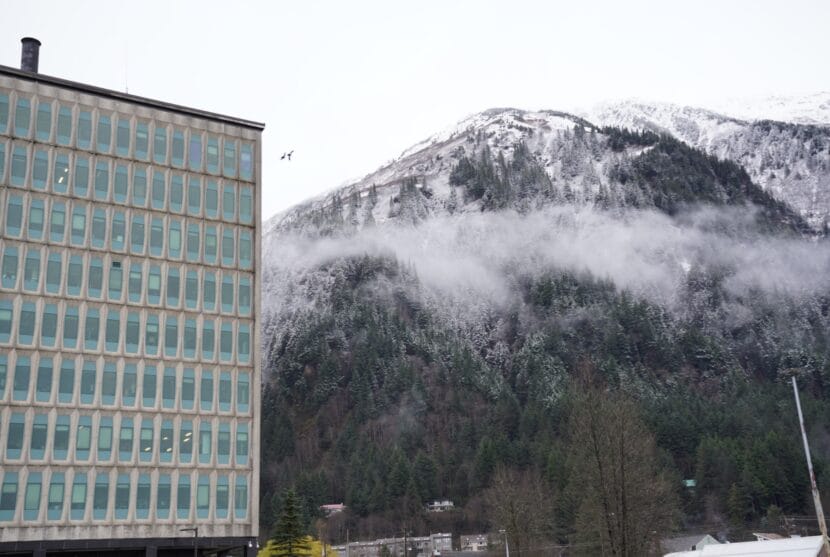
Juneau's federal building on November 14, 2025. (Photo by Alix Soliman/KTOO)
Juneau’s federal building on November 14, 2025. (Photo by Alix Soliman/KTOO)

Listen to this story:

The longest government shutdown in U.S. history ended last week, paving the way for federal employees to return to their posts, including many in Alaska’s capital city. But reopening is not necessarily a smooth process and some agency workers say they are frustrated.

After 43 days without work or pay, Don MacDougall got a text from his boss Wednesday evening telling him to come back to the office the next morning. Walking out of the federal building downtown on Friday afternoon, he said it felt strange to go without work for that long, knowing that eventually he’ll be paid for the lost time. 

“It seems kind of senseless,” MacDougall said. “Then when you come back, you’re overloaded with all the work that you didn’t get to do before you left and stuff that’s built up.”

He’s a program coordinator at the U.S. Forest Service. He works on projects involving workforce development, volunteers and recreation across Alaska. He said he has hundreds of emails to sift through.

“It’s just been a frustrating time,” MacDougall said.

Eric Antrim said reopening has been disorganized. He manages bridge inspections in Alaska’s national forests and he’s the recording secretary for his union, the National Federation of Federal Employees Local 251. 

He said some furloughed employees, not knowing how long the shutdown would last, left town and weren’t available to return on such short notice. But Antrim said leadership in his office is being flexible as workers come back. 

“People are everywhere,” he said. “One of my colleagues is in Antarctica right now.”

Antrim spent part of his unpaid furlough organizing free lunches for federal workers. Now, he said he’s expecting a paycheck within the next week. 

“Whenever that comes through, I should get one giant lump sum payment for, you know, three pay periods at the same time,” he said.

In 2019, Congress passed a law that guarantees back pay for federal workers as soon as possible after a government shutdown ends. The bill Congress passed Wednesday affirms that guarantee, despite comments that President Donald Trump made last month. 

Back at the federal building, as workers returned from lunch, Jaimie Rountree said she was mandated to work without pay during the shutdown. But she said that wasn’t the case for everyone in her department at U.S. Customs and Border Protection. 

“So there are a handful of us that weren’t getting paid while we were sitting in an office watching others get paid,” Rountree said. “Humiliating, disrespectful, unfair.”

She’s an agriculture specialist officer and said she had to stay at her post because it’s considered essential for national security. Rountree processes people coming in on mining barges, cruise ships and aircraft who intend to stay in the U.S. 

She said she feels unsure about the future. 

“You just don’t know,” Rountree said. “I mean, there’s things happening nowadays that you never thought would happen.”

Unhoused campers kicked off Teal Street say they have few options

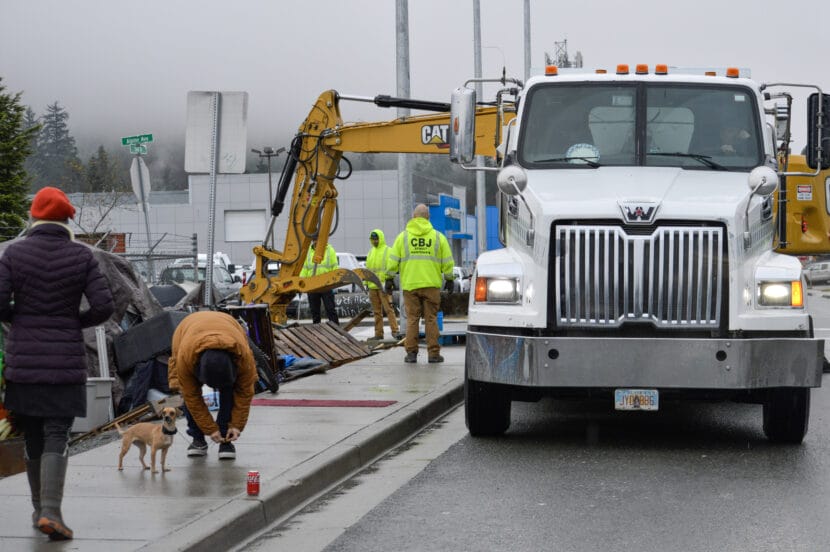
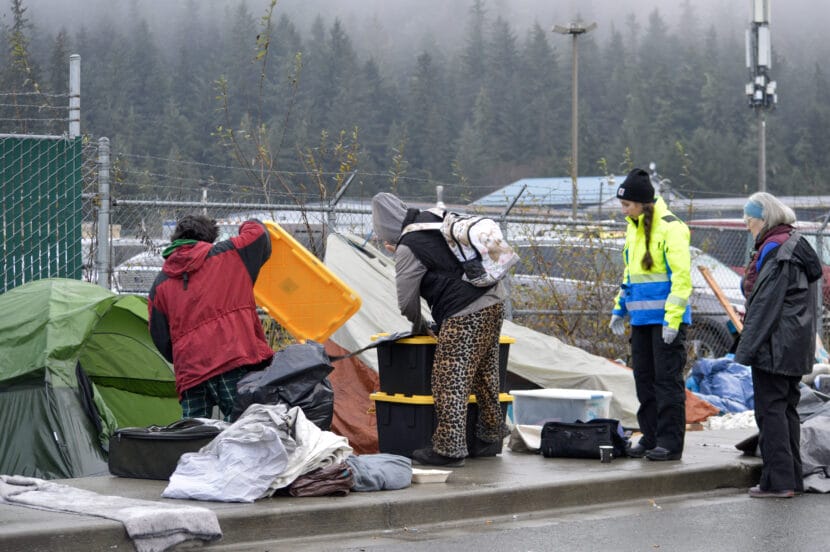
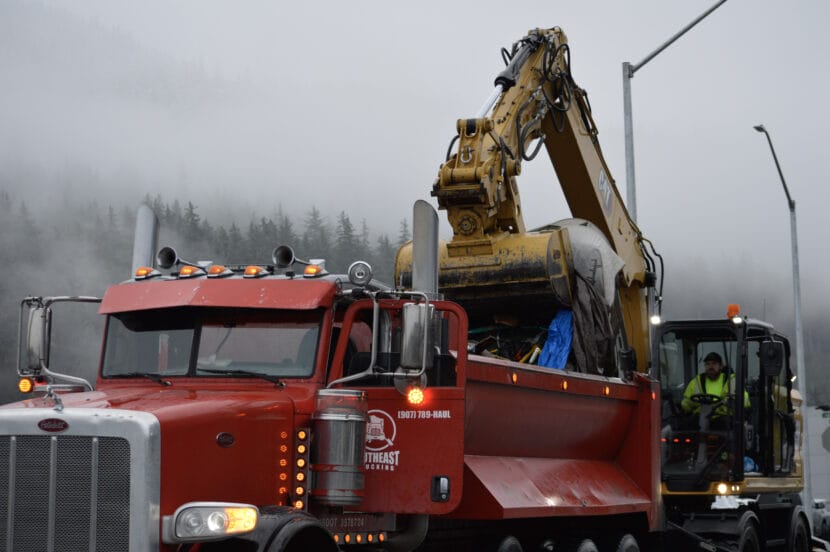
An excavator scoops tents and platforms into a dump truck as part of the City and Borough of Juneau’s demolition of an encampment on Teal Street on Nov. 14, 2025. (Photo by Yvonne Krumrey/KTOO)

On Friday morning, about a dozen people pulled items out of their makeshift homes along Teal Street, and packed them into black trash bags or tote boxes.

A dusting of snow had already started settling on the tents and shelters. Police stood on the sidewalk, and volunteers and nonprofit workers passed out eggs and potatoes from a tent nearby. 

Willow Williams sat in a wheelchair across the street from his tent. He has severe health problems: he has a colostomy bag and a hernia, alongside a slew of injuries. A lot of people at the encampment were worried about him, and they came by to bring him food and ask what else he needed, as others helped him pack up his shelter.

“My friend built that place, and he let me move in there, because, you know, it was hard for me with everything,” he said, pointing to his colostomy bag. “And I got a bed in there, and it kept me out of the wind. It kept me away from the rain.” 

Williams said he’s been comfortable there. It’s close to the Glory Hall shelter where he receives help with his health conditions. He said he hopes he’ll get a bed in the shelter soon.

Last year, the city closed a summer campground that unhoused people in Juneau frequently used, and instructed people to camp in small groups on other public land.

This past spring, large groups of tents cropped up in the Teal Street area. And they have been the subject of public debate and safety concerns. The city already cleared the encampment at this spot at least once this year. 

Then in August, because of safety threats to Glory Hall staff and residents, the nearby shelter stopped offering day services. 

Friday morning, the city forced people out of the encampment after giving notice earlier in the week

Juneau Police Commander Jeremy Weske was on site, along with several other officers. He said that this encampment isn’t safe in the winter months. 

“We don’t want people being on streets or in ditches and snow plows coming through and having a tragedy,” he said. “So that’s why this is happening now.” 

Smaller groups of people are allowed to camp on what the city calls “unimproved public land,” but officials haven’t offered more concrete guidance. Friday, city officials advised people to go to the city-funded emergency warming shelter in Thane, which only operates overnight.

Williams needs to make it through the next few days, or however long it takes before he can go to the Glory Hall. He said he hasn’t been able to sleep at the emergency warming shelter in the past due to discomfort from his medical issues, but he’s hopeful accommodations have improved.

Director Kaia Quinto said the Glory Hall has been at capacity every night so far this year. 

“Usually when we have somebody move out, there’s like that hour of space where we’re helping them clean and pack up their belongings,” she said. “And then someone else is right in their bed afterwards.”

But she said staff is trying hard to get Williams into the shelter.

“We don’t have any beds,” Quinto said. “But Willow is a high priority for us, to get him in before the weather gets too bad.”

Doug Worthington and Nathaniel Hensley-Williams pack up their belongings as the City and Borough of Juneau demolishes an encampment on Teal Street on Nov. 14, 2025. (Photo by Yvonne Krumrey/KTOO)

Back on Teal Street, Doug Worthington and his partner Nathaniel Hensley-Williams were strategizing where they could store their stuff, and where to go next. Worthington said they can stay at the Thane warming shelter at night. 

“The other half of the problem is, where are we gonna go during the day?” he said.

“Well, that’s when we just set up our tent during the day and collapse it during the evening,”  Hensley-Williams said. “Because I have thought about that.”

Worthington is from Juneau and said he has been living outside without stable housing for about a year now. 

Initially, people camped here on Teal Street to access the Glory Hall’s day services, but since those stopped, Hensley-Williams said people stay because it feels safer here than other parts of town. 

“Staying here is where we’re not getting f—– with,” he said. “That’s the only reason we have stayed here.”

An excavator drops a tent into a dump truck as part of the City and Borough of Juneau’s demolition of an encampment on Teal Street on Nov. 14, 2025. (Photo by Yvonne Krumrey/KTOO)

As an excavator picked up tents and platforms and dropped them in a dump truck, Worthington stood with his and his partner’s stuff, packed into a tower of totes. He said the city isn’t giving his community the help they need. 

“And they say they hate it because they don’t want to be doing this. But yet, here they are,” he said. “They say they want to help us, and yet they’re kicking us out. We’ve all built our homes right here. 

Worthington said he’s been moved around to different parts of the city, but people always complain about people camping, no matter where they go.

Alaska Republican Senator Shelley Hughes resigns to pursue gubernatorial campaign

Sen. Shelley Hughes, R-Palmer, walks out of the Senate chambers on Saturday, Aug. 2, 2025. (Photo by James Brooks/Alaska Beacon)

Sen. Shelley Hughes, R-Palmer, resigned from the Alaska Senate on Friday to pursue her gubernatorial candidacy, according to a news release from her campaign.

Her resignation follows that of fellow Senate minority caucus member Mike Shower, who represented Wasilla and resigned at the end of last month to focus on his run for lieutenant governor.

Senate President Gary Stevens, R-Kodiak, confirmed he received Hughes’ resignation letter Friday.

Hughes’ resignation was expected. She told the Alaska Beacon in October she planned to resign in time for her replacement to be in place before the legislative session begins in January.

“My constituents, they’ve been my peeps all these years. I want to make sure that they have representation from the get-go,” she said on Friday afternoon.

Gov. Mike Dunleavy will select her replacement from among a number of nominees to be selected by Republican party officials in her district. Republican Senators must confirm his choice before that person is seated.

Hughes’ replacement must be a Republican and meet the state Constitution’s requirements to hold office.

Hughes said she expects that Rep. Cathy Tilton, R-Wasilla, will be among the nominees for her seat because Tilton has already filed to run for senator in the district. If Tilton were appointed, the governor would then have to select someone to fill the empty House seat.

Hughes was initially appointed to her seat in 2012 by then-Gov. Sean Parnell, which she credits, in part, to the fact that she was already running.

“I think that when a candidate does that, that shows real interest,” she said.

She said she does not expect her departure to cause significant changes because her district reliably produces “reasonable conservative” lawmakers.

Hughes is one of 12 Republicans and 14 total candidates that seek to be elected governor in 2026. Gov. Mike Dunleavy is termed out and cannot seek reelection.

Hughes said she has fond memories of her time in the Capitol.

“It’s a big change, stepping into the gubernatorial race,” she said. “You know, there are unknowns with that, but I have tremendous peace about this. I really did feel that my chapter was closing in the Senate.”

She represented her district for 12 years.

Site notifications
Update notification options
Subscribe to notifications